How to Make a Thesis Defense Presentation: Step by Step
A thesis defense presentation is the short talk you give before your committee asks questions about your thesis. The slot is often 20 to 30 minutes. In that time, it shows what you studied, how you did it, what you found, and why it matters. The challenge is compression: a thesis of a hundred pages or more has to fit into a set of clear slides.
This guide covers the rules to check first, a slide-by-slide structure, how many slides to plan, and how to condense each chapter. It also walks through an AI method in three steps, a worked example, and how to prepare for committee questions.
What a thesis defense presentation is
The defense is the final oral step of a graduate degree. York University's graduate studies office says it may be "referred to as the 'Defence', the 'Oral Exam' or the 'Viva'." It describes the aim as engaging graduate students "in scholarly discourse with experts who have read and reviewed your work closely."
The presentation opens that discussion. Your committee has already read the thesis. The talk reminds them of its argument and shows that you can explain it clearly. Then the questions begin.
Committees assess both parts. A library guide from Universidad Carlos III de Madrid lists what committees usually value. One point is that "The presentation follows a logical structure." It names three parts: an introduction, a development section with methods and results, and an outcome with discussion and a conclusion.
Before you start: rules, time, and audience
Three questions shape the thesis defense presentation before you open a slide.
- What are your program's rules? Rules differ by school and by degree. The UC3M guide tells students to "consult your doctoral program for specific instructions in your area." It also tells them to find out "the time assigned for the presentation and defense."
- How long do you have? York says students are usually given 20 to 30 minutes "to provide an oral presentation (at a moderate pace) of your work." A dissertation defense guide from Valdosta State University sets a firm cap: "The presentation should be no longer than 30 minutes."
- Who is in the room? The committee knows your thesis well. A public audience may not. Decide how much background the room needs.
Ask your supervisor how defenses run in your department. York recommends asking your supervisor or graduate program director "to demystify the defence for you." It also suggests "attending defences leading up to their own" to see how the event unfolds.
Thesis defense presentation structure
The Valdosta State guide gives a slide-by-slide outline for a dissertation defense. You can adapt it for a thesis defense in your field. The slide numbers below are a guide, not a rule.
| Slide | What it covers | Source in your thesis |
|---|---|---|
| 1. Title | Thesis title, your name, program, date, committee | Title page |
| 2. Your background | Brief note on what qualifies you to do the research | — |
| 3. Topic background | Why this topic, its history, and the gap your study fills | Introduction |
| 4. Problem statement | The reason for the study in one clear sentence | Introduction |
| 5. Importance | How the research could affect the field and practice | Introduction |
| 6. Theoretical foundation | The orientation your study draws on | Literature review |
| 7. Conceptual framework | The major categories of literature, as an overview | Literature review |
| 8. Research questions | Each question, numbered | Introduction or methods |
| 9–10. Methodology | Design, participants, data collection, analysis, limitations | Methods chapter |
| 11–15. Findings | Results in the order of your results chapter | Results chapter |
| 16. Conclusions | What you learned and how it ties to the framework | Discussion |
| 17. Implications and recommendations | For research, for practice, for policy | Discussion |
| 18. References | Only the sources cited in the talk | Reference list |
| 19. Thank you | Thanks to the committee | — |
A few lines from the guide deserve attention. On your background, it says "BE VERY BRIEF!" On research questions, it says to "Number questions for easy reference during discussions with the committee members." On references, it says to "List only those cited in the presentation."
How many slides and how long
Plan slides from time, not the other way around. York suggests "1-2 minutes of speaking time per slide." At that pace, a 20-minute talk fits about 10 to 20 slides. A 30-minute talk fits about 15 to 30.
Most of the time should go to findings. The Valdosta State guide tells presenters to summarize chapters 1 to 3 and to focus on chapters 4 and 5. In a five-chapter thesis, those last two chapters hold your results and discussion.
A simple time budget for a 25-minute talk might look like this:
- Introduction, problem, and importance: 3 minutes
- Literature and framework: 3 minutes
- Methods: 4 minutes
- Findings: 9 minutes
- Conclusions and implications: 4 minutes
- Thanks and transition to questions: 2 minutes
Rehearse with a timer and adjust. If a section runs long, cut slides rather than speed up.
How to condense each chapter into slides
This is the hard part. You know every detail of the thesis, and you want to show all of it. Two of the guides say plainly that you should not.
York says to "Strive to hit the highpoints in your presentation and avoid attempting to include everything from every chapter." A defense guide from Texas A&M International University (TAMIU) puts it as "Don't Explain Everything." It advises you to "Focus on major argument and most relevant information."
Use a different rule for each chapter:
- Introduction. Keep the problem statement and research questions word for word. Cut the rest to one line each.
- Literature review. Show themes and the gap, not individual studies. Our guide to a literature review presentation covers how to group sources by theme.
- Methods. Show the design, the sample, and the analysis in one diagram or table if you can. Valdosta State lists "Participants—number, how selected, IRB considerations, demographics" among the details.
- Results. Follow your results chapter. Valdosta State says to "Use the organizational structure from your Chapter 4." It also warns to present "enough detail to be convincing, but not so much that you get 'lost in the weeds!'"
- Discussion. Tie each finding back to a research question. Then state limitations plainly before the committee raises them.
Keep a list of everything you cut. Those points become backup slides for the question period. Our guide to backup slides shows how to organize them.
How to make a thesis defense presentation with AI
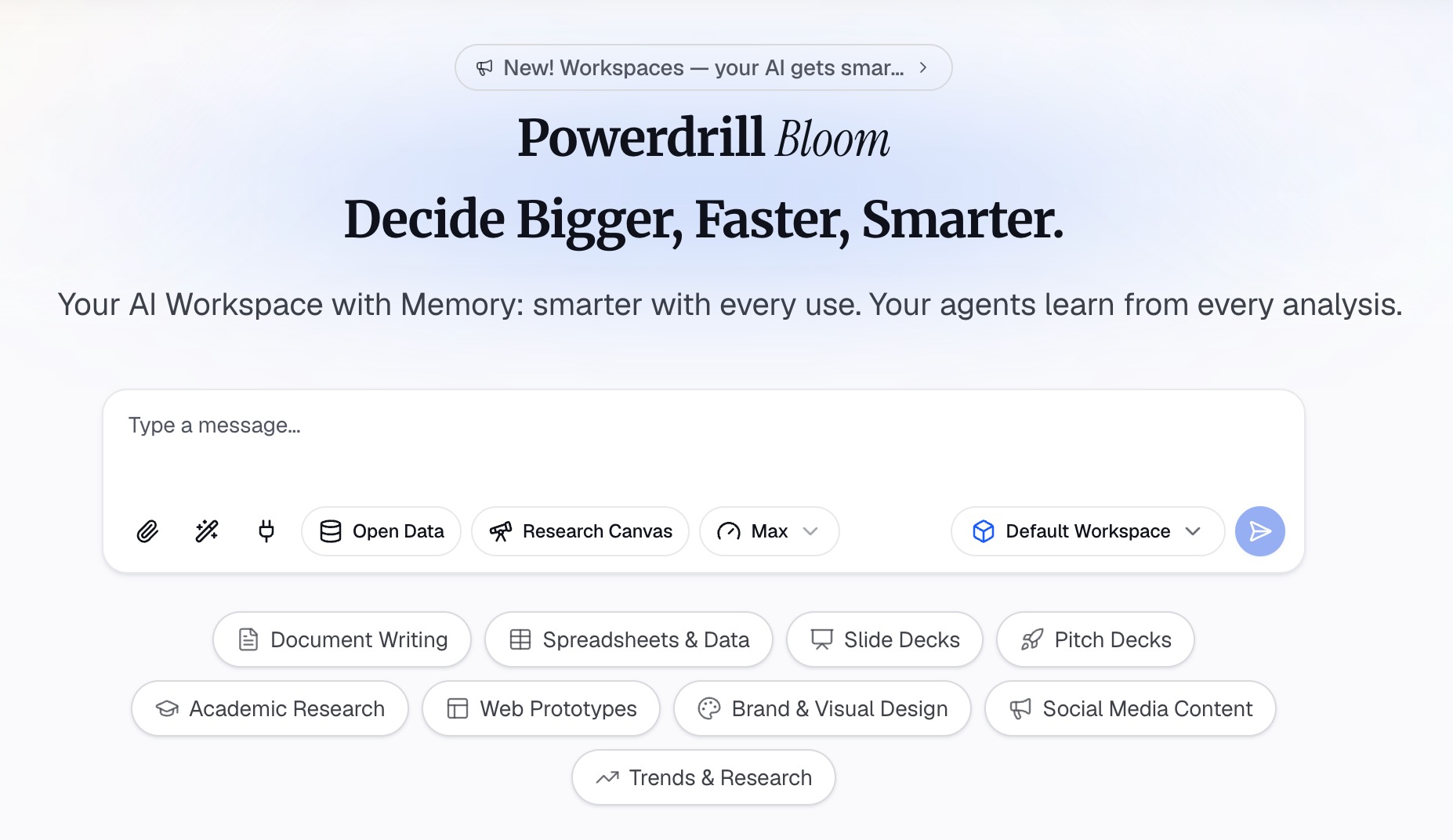
AI can do the slow parts: reading the full thesis, pulling the key points from each chapter, and laying out a first draft. Your job is to choose what matters and check every claim against the thesis. Here is the method in three steps, using Powerdrill Bloom.
Step 1: Upload your thesis, data, and rules
Start with the final thesis, as a Word file or a PDF. Add the spreadsheets behind your main tables and figures. Add your program's defense rules, if they are written down. Powerdrill Bloom's Free plan lists "Upload Excel, CSV, PDF, and docs."
For a long document, the Word to PowerPoint page describes how the tool reads it. It says the tool "identifies sections, key points, and themes automatically." The page lists research papers among its uses. For a PDF version, the PDF to PowerPoint page covers the same step.
State the time limit and the audience in your first prompt. For example: "This is a 25-minute master's thesis defense for a committee of three. Use the attached thesis as the only source."
Step 2: Draft the outline and the findings slides
Ask for an outline that matches your program's structure. A useful prompt is: "Draft a thesis defense presentation outline of 16 slides. Summarize chapters 1 to 3 in six slides. Give the findings at least six slides. Number the research questions. Cite the chapter and page for each point."
Then build the findings slides from the data, not only from the text. Ask for one chart per key result, labeled with the research question it answers. If your results already have tables, ask for a simplified version of each one for the slide.
Check every slide against the thesis. The Powerdrill Bloom homepage says "Every number comes back with the page, the row and the figure behind it." That makes the check faster, but it is still your job. The committee knows the thesis, and a mismatch will show.
Step 3: Build the deck, the notes, and the question list
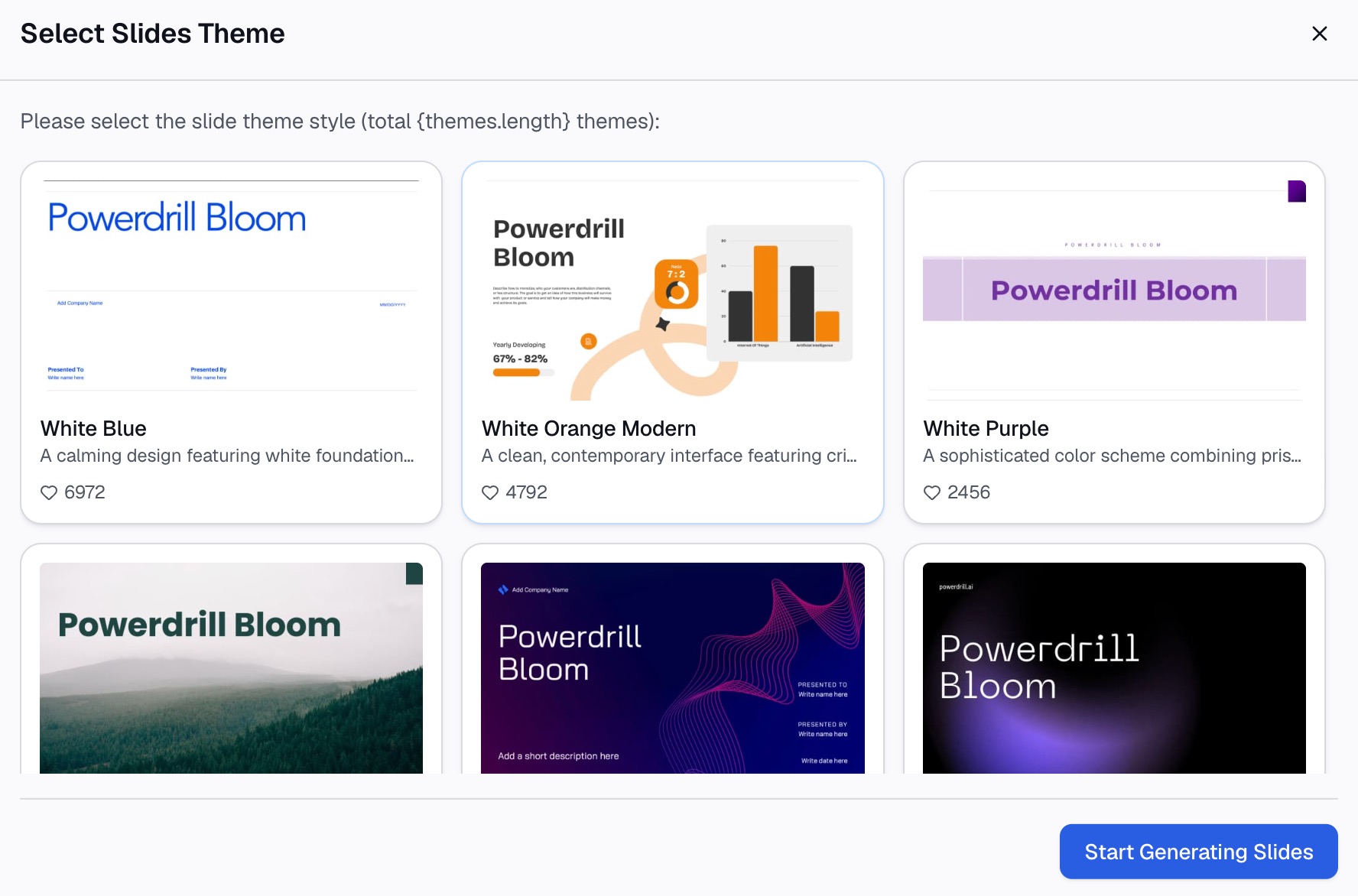
Once the outline is right, ask for the thesis defense presentation itself. The Free plan lists "Create basic slides, docs, sheets, and images," so you can export a first draft to PowerPoint.
Give each findings slide a title that states the result. "Mentoring raised first-year retention in all three cohorts" works better than "Results 2." Our guide to takeaway slide titles explains the method.
Next, ask for speaker notes for each slide. Valdosta State advises you to "Create notes in your presentation of the points you want to cover in your oral presentation of each slide." Our guide to speaker notes covers how to keep them short.
Finally, ask for a list of likely committee questions, with the chapter and page that answers each one. Use the list in your mock defense. Then add backup slides for the hardest questions.
A worked example
Here is an outline for a 25-minute master's thesis defense in education. The thesis, the numbers, and the findings are illustrative, not results from a real study.
| Slide | Title | Content |
|---|---|---|
| 1 | Peer mentoring and first-year retention | Title, name, program, committee, date |
| 2 | Why first-year students leave | Two-line background and the gap in prior studies |
| 3 | The question this study answers | Problem statement in one sentence |
| 4 | Three research questions | RQ1 to RQ3, numbered |
| 5 | What earlier studies found | Three themes from the literature review |
| 6 | Design and sample | Mixed methods; 412 students across three cohorts |
| 7 | How the data was analyzed | Retention model and interview coding, in one diagram |
| 8–9 | RQ1: Retention rose with mentoring | Chart by cohort, with the effect size |
| 10–11 | RQ2: Meeting frequency mattered | Chart of retention by meetings per month |
| 12 | RQ3: What students said | Three themes from interviews, one quote each |
| 13 | What this adds | Two conclusions tied to the framework |
| 14 | Limits of the study | One campus, three years, self-selected mentors |
| 15 | Implications and next steps | For advisors, for policy, for future research |
| 16 | Thank you | Thanks to the committee; questions |
Backup slides hold the full regression table, the interview protocol, and a cohort-by-cohort breakdown. Each one answers a question the committee is likely to ask.
How to start and end your defense presentation
The opening. Thank the committee first. TAMIU's guide lists "Thank the committee for being there first before starting." It also lists "Introduce yourself and the title of your work." Then state the problem in one sentence. Our guide to a presentation introduction has more openings.
The body. Move in one direction. TAMIU says "Stick to a specific order! Try not to backtrack!" The UC3M guide says a continuous line, "without jumping around or backtracking," keeps the audience's attention.
The close. End on your conclusions, not on a slide that says "Questions?" Restate the answer to each research question, name the main limitation, and say what comes next. Then thank the committee. Our guide to a conclusion slide shows how to write the last content slide.
How to prepare for committee questions
Preparation for questions deserves its own time. York says "preparing responses to potential questions you'll be asked at the defence is important." It lists common topics: the topic's importance, the literature, the research questions, the methods, and the key findings.
York also lists a set of general questions to prepare for. Five of them are a good start:
- "What is your study about and why did you choose to research this in particular?"
- "How did you design your study and why did you take this approach?"
- "What were the main shortcomings and limitations created by your research design?"
- "How did your findings relate to the existing literature?"
- "If you could redo your research, how would you alter your approach?"
Practice in a mock defense. York recommends "a mock exam with their supervisor/supervisory committee, dry runs with trusted peers." It also suggests holding one mock defense "in the actual room."
During the real questions, listen to the end. TAMIU's guide says "Don't Interrupt the Committee's Questions!!!" It adds a reminder: "it is the committee's job to ensure that you know the material thoroughly." For data-heavy questions, our guide on answering data questions in a presentation covers how to respond.
Design rules for defense slides
A defense is a formal setting, so keep the design plain. The Valdosta State guide says to "Select a conservative slide layout that appears professional." It also says "Use figures and tables" and "Do not crowd slides with excessive text."
Microsoft's presentation tips add practical rules. "Try to avoid using font sizes smaller than 18 pt." Keep each bullet "to one line; that is, without text wrapping." On delivery, Microsoft says "Don't read the presentation."
A short checklist for every slide:
- One message per slide, stated in the title.
- Charts with clear labels and a source line.
- No transitions, animations, or sounds; Valdosta State lists these as distracting.
- Slide numbers, so committee members can refer back.
- The same template on every slide, including backup slides.
Common mistakes
Watch for these mistakes:
- Retelling the whole thesis. The committee has read it. Show the argument and the findings.
- Too much time on the literature. Background should take a few minutes, not half the talk.
- Findings without research questions. Label each result with the question it answers.
- Reading the slides. Valdosta State says "do not just read the slides."
- Hiding the limitations. Name them before the committee does.
- No timed rehearsal. Run the full talk aloud at least twice with a timer.
- Skipping the room check. TAMIU says to "Triple check the day, time, and place."
The slides are the visible part of a defense, and the preparation behind them matters just as much in the question period. Want a first draft built from your own thesis? Try Powerdrill Bloom with your final chapter files and check every slide against them.
Frequently asked questions
What should a thesis defense presentation include?
A thesis defense presentation should include a title slide, the background and problem statement, and the research questions. Then come the literature and framework in brief, the methods, the findings, conclusions, implications, and a thank-you slide. Most of the time should go to findings, organized the way your results chapter is.
How long is a thesis defense presentation?
Most programs allow 20 to 30 minutes for the presentation, followed by committee questions. York University's guidance says students are usually given 20 to 30 minutes, and Valdosta State's guide caps the talk at 30 minutes. Check your own program's rules first.
How many slides should a thesis defense presentation have?
Plan about one to two minutes per slide. That gives roughly 10 to 20 slides for a 20-minute talk and 15 to 30 for a 30-minute talk. Keep extra detail in backup slides after the thank-you slide, ready for questions.
How do I start a thesis defense presentation?
Start by thanking the committee, then introduce yourself and the title of your thesis. Next, state the problem your study addresses in one sentence and show your numbered research questions. Keep the opening to two or three minutes.
Can AI help make a thesis defense presentation?
Yes. AI can read the full thesis, pull key points from each chapter, draft an outline, build charts from your data, and suggest likely committee questions. You still need to check every slide against the thesis and follow your program's rules.
Sources: York University, Gearing up for Your Defence · Valdosta State University, Preparing a Presentation for Your Dissertation Defense · Texas A&M International University, Defending the Thesis · Universidad Carlos III de Madrid Library, Defending your Thesis · Microsoft Support, Tips for creating and delivering an effective presentation.