How to Build DCF Models Faster with AI Agents and Automated Financial Workflows (2026 Guide)
Introduction
Discounted Cash Flow (DCF) modeling has long been the gold standard for intrinsic valuation. But for decades, the process of building one has remained painfully manual: pulling historical data from SEC filings, scrubbing financial statements, calculating the weighted average cost of capital (WACC), and projecting free cash flows step by step.
In 2026, the landscape of equity research and investment analysis has fundamentally shifted. Analysts are no longer spending hours on rote data entry. Instead, they are turning to AI agents and automated financial workflows to generate baseline models in minutes, freeing up time to focus on what actually matters: refining assumptions and generating investment insights.
But there is a catch. Using generic, blank-prompt AI chatbots often leads to formatting errors, hallucinated numbers, and frustrating rework. To truly accelerate valuation, financial professionals need reusable, skill-based AI workflows.
In this guide, we will explore how AI agents are transforming DCF valuation, why skill-based execution beats ad hoc prompting, and how to use platforms like Powerdrill Bloom to automate your financial analysis step by step.
Quick Answer: How AI Agents Help Build DCF Models Faster
If you are looking for the fastest way to build a DCF model today, integrating an AI agent into your financial modeling workflow is the answer. Here is how AI accelerates the process:
Automated Data Extraction: AI agents can instantly pull and standardize historical financials from 10-Ks and 10-Qs.
Instant WACC & Terminal Value Setup: Agents can calculate baseline discount rates and terminal multiples based on real-time market data.
Standardized Projections: By applying historical averages and consensus estimates, AI generates reliable baseline projections for Revenue, EBITDA, and CapEx.
Workflow Automation: Instead of manually typing Excel formulas, you can trigger a complete valuation workflow using natural language commands.
Why Traditional DCF Modeling is Still So Slow
Even with advanced Excel templates, traditional DCF valuation is bottlenecked by manual workflows. If you are an investment banker, equity researcher, or corporate finance analyst, you likely lose hours to the following:
Data Scrubbing: Downloading raw financial data is easy; formatting it into a clean, 3-statement model template is not.
Assumption Hunting: Finding the right risk-free rate, beta, and equity risk premium to calculate WACC requires jumping between multiple data providers.
Formula Errors: A single broken link or circular reference in a manual Excel grid can derail an entire valuation, requiring tedious auditing.
Starting from Scratch: Too often, analysts rebuild similar models from scratch or struggle to adapt an old template to a new company's specific capital structure.
The Shift: From Blank Prompts to Skill-Based AI Workflows
When AI first entered the finance space, the standard approach was conversational: opening a chat window and typing a long, complex prompt hoping the AI would output a usable valuation.
This "blank-page setup" approach is fundamentally flawed for financial workflows. It is unpredictable, hard to repeat, and prone to breaking. If you forget to specify a terminal growth rate constraint in your prompt, the AI might generate wildly inaccurate intrinsic values.
To launch finance workflows faster, the industry has shifted from ad hoc prompting to skill-based execution.
Rather than starting from a blank prompt, modern platforms allow you to start from reusable best-practice Skills. A "Skill" is a pre-configured AI agent workflow designed for a specific task—meaning the underlying financial logic, data sourcing constraints, and output formatting are already standardized. This makes running financial analysis with AI a highly repeatable, enterprise-grade process.
Step-by-Step: How to Use Powerdrill Bloom’s "Start from Skills" for DCF Modeling
To move from abstract concepts to a concrete automated valuation workflow, let's look at how to execute this using Powerdrill Bloom.
Powerdrill Bloom is an AI workflow platform that connects data analysis, insight extraction, and visual outputs. With its newly launched Start from Skills feature, Bloom acts as a powerful skill-based agent workspace. It reduces the friction of setting up prompts and allows analysts to execute repetitive financial tasks instantly.
Here is how you can build a DCF model faster using the dedicated dcf-model Skill in Powerdrill Bloom.
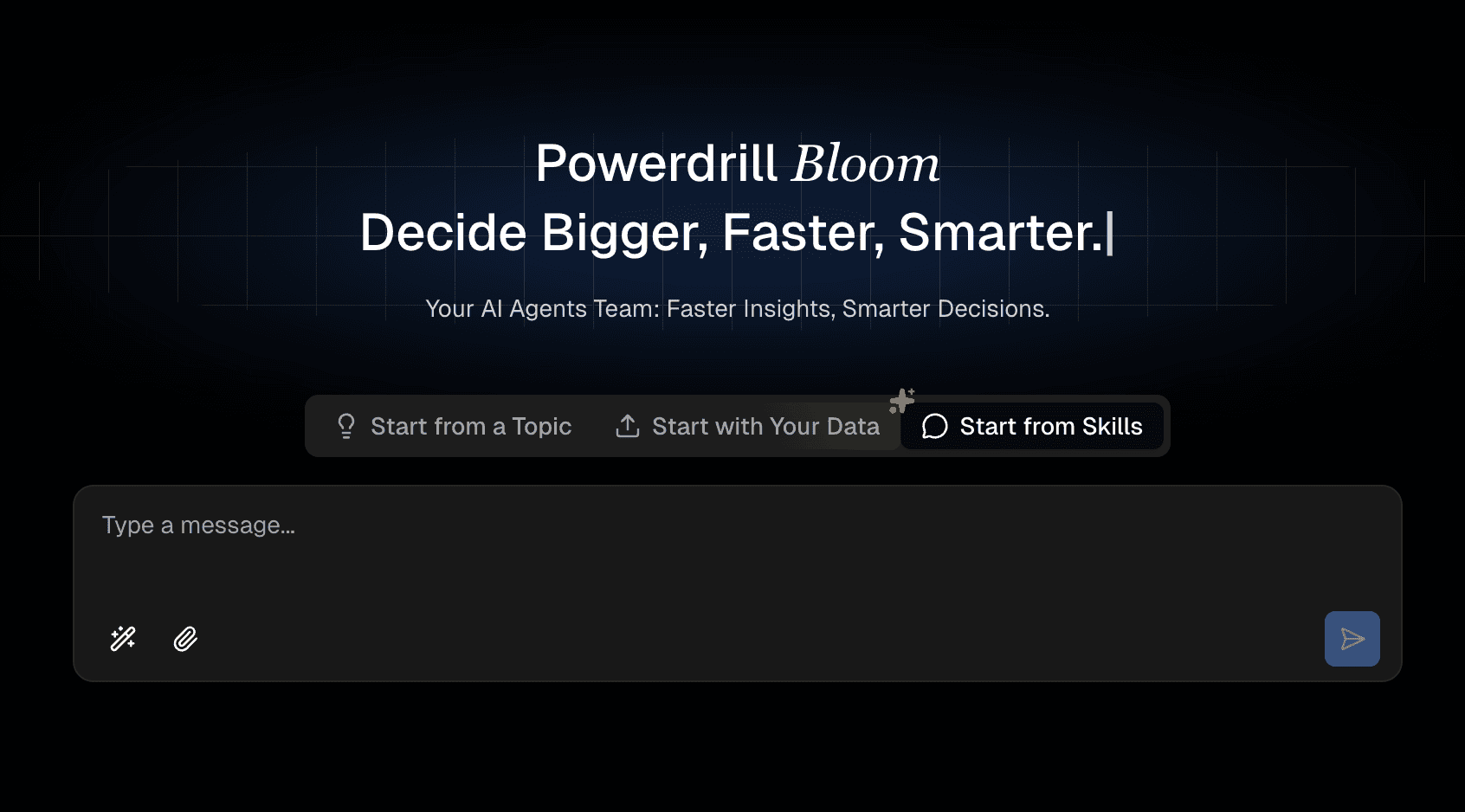
Step 1: Go to the homepage and switch to "Start from Skills"
Instead of facing an empty chat box that requires heavy prompt engineering, open the Powerdrill Bloom interface and toggle to the Start from Skills tab. This immediately shifts your workspace from a generic chat environment to a structured, task-oriented workflow engine. It eliminates the blank-page syndrome and prepares the agent for specialized execution.
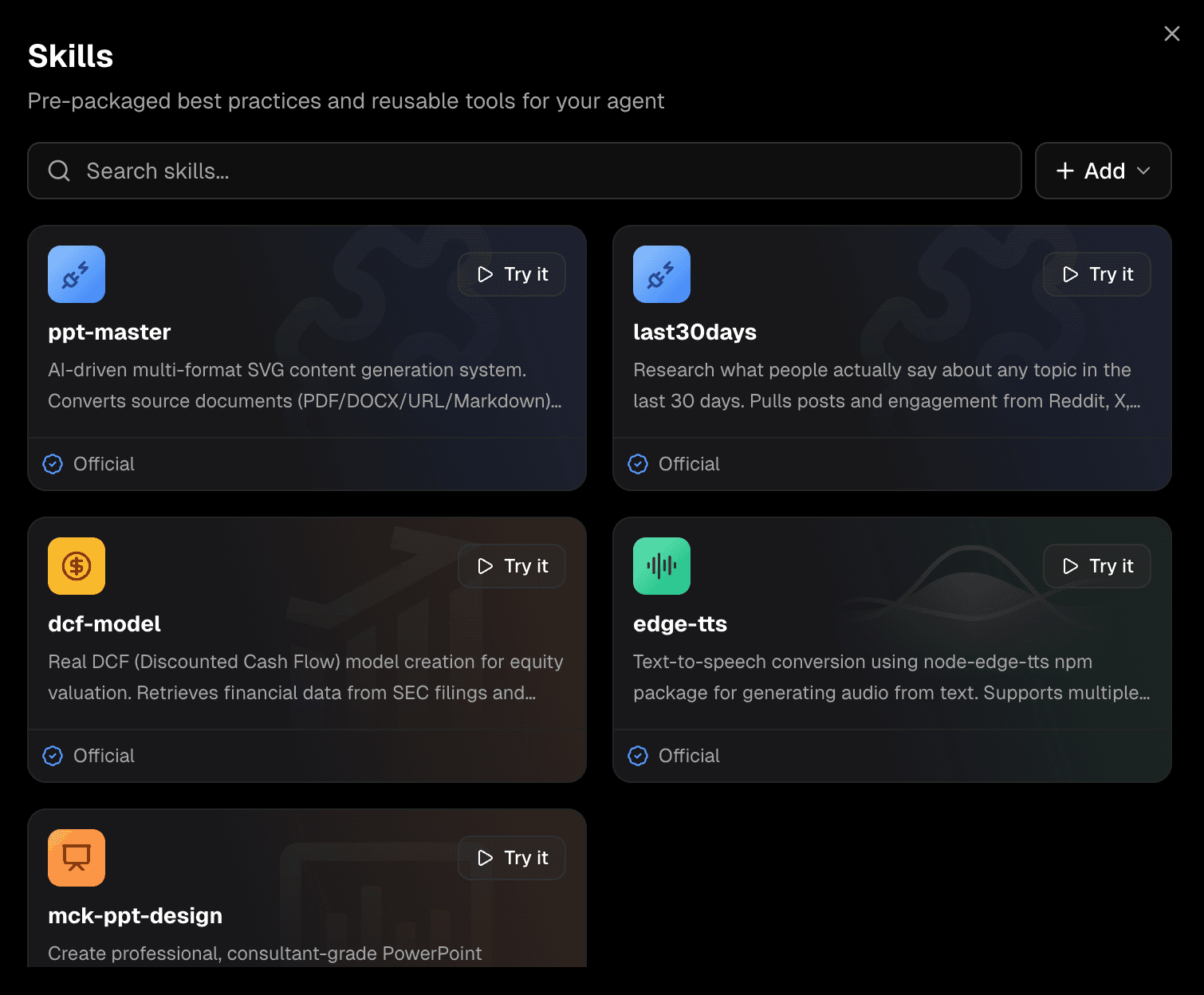
Step 2: Choose "dcf-model" from Recommended Skills or Manage Skills
Browse through the Recommended Skills or search your Manage Skills library to locate the dcf-model Skill. Selecting this loads a pre-configured, reusable agent workflow specifically optimized for DCF valuation. Because the underlying financial logic is already embedded in the Skill, the agent knows exactly what data it needs to fetch and how a standard DCF is structured.
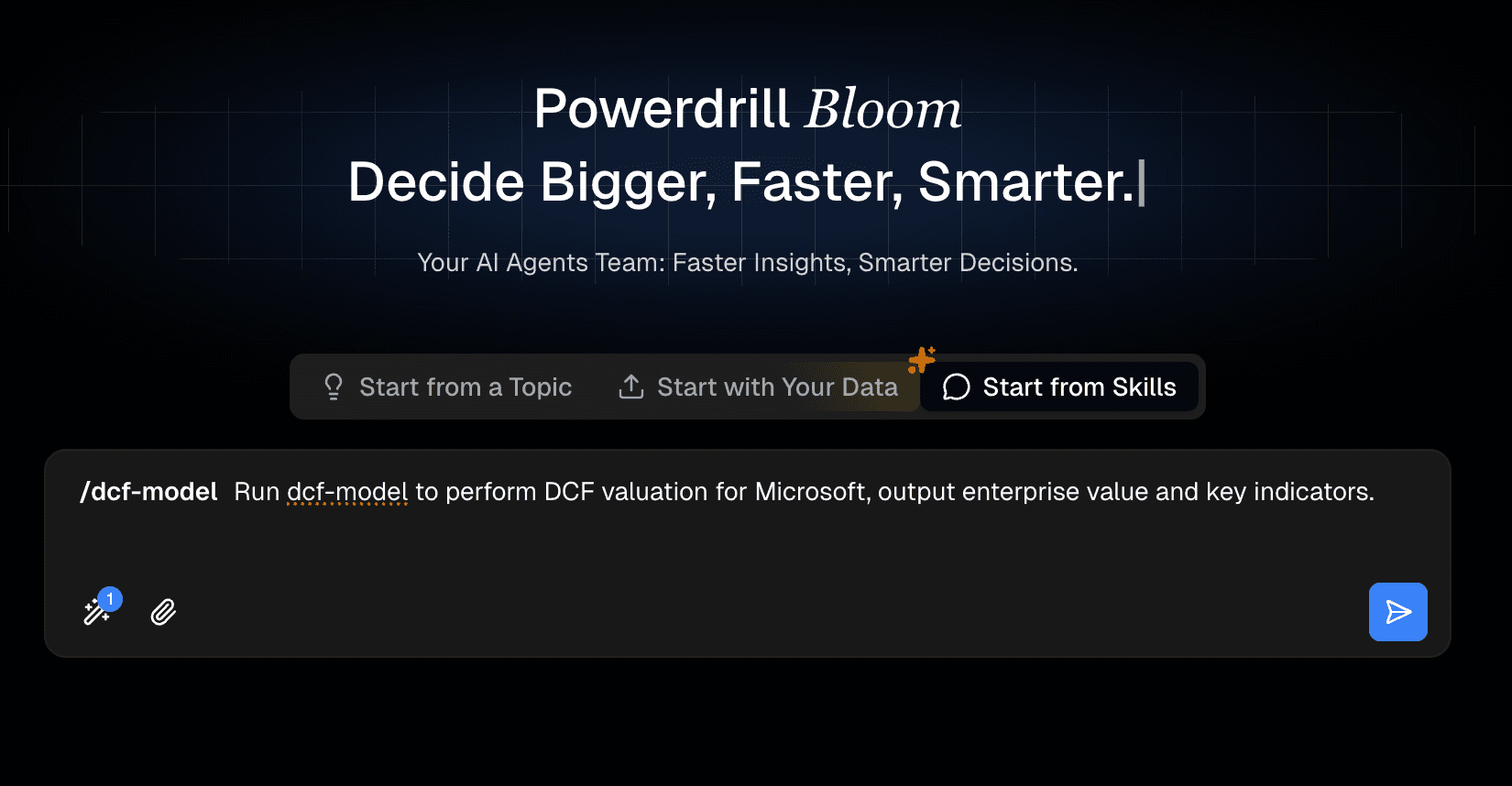
Step 3: Enter your natural-language instruction
Now, simply provide the agent with your target company and desired output using natural language. For example, you can type:
Run dcf-model to perform DCF valuation for Microsoft, output enterprise value and key indicators.
Because you are using a standardized Skill, you don’t need to write a 500-word prompt explaining how to calculate Free Cash Flow. The agent immediately goes to work, leveraging the skill to fetch Microsoft’s financials, run the projections, and calculate the discount rate.
Step 4: Review, preview, and download the results
Within moments, the agent will generate the valuation. Review the generated output directly within the Bloom interface to check the enterprise value, implied share price, and key indicators like WACC and terminal growth rates. Finally, you can preview and download the results, transitioning seamlessly from AI generation to a tangible asset you can drop into a pitch deck or further refine in a spreadsheet.
What Kind of Outputs Can You Expect from a Skill-Based DCF Workflow?
When utilizing an automated financial modeling workflow like the dcf-model Skill, you should expect structured, professional-grade outputs, including:
Implied Share Price & Enterprise Value: The core intrinsic valuation metrics based on the DCF methodology.
Key Assumptions Summary: A clear breakdown of the WACC (cost of equity, cost of debt, beta) and Terminal Value assumptions (perpetuity growth rate or exit multiple).
Unlevered Free Cash Flow (UFCF) Projections: Year-by-year baseline forecasts for the next 5 to 10 years, detailing operating income, taxes, D&A, CapEx, and changes in net working capital.
Exportable Formats: Structured data that can be downloaded and plugged directly into your existing reporting workflows.
Best Practices for Using AI in DCF Valuation
While AI significantly accelerates the heavy lifting of financial modeling, it does not replace the judgment of a professional analyst. To get the most out of AI valuation tools, follow these best practices:
Treat AI as the Baseline, Not the Final Word: Use the AI-generated model as your starting point. You must still overlay your specific thesis, such as anticipated management changes, M&A synergies, or unique macro headwinds.
Always Audit the WACC: Small changes in the discount rate drastically swing a DCF valuation. Always review the AI's inputs for the risk-free rate and beta to ensure they align with your firm's internal standards.
Run Sensitivity Analysis: Once the AI has built the baseline model, manually tweak the terminal growth rates and WACC to create bull, base, and bear scenarios.
Common Mistakes to Avoid
Relying on Generic Chatbots: Trying to build a DCF in standard ChatGPT without a structured workflow often leads to math errors and "hallucinated" financials. Always use dedicated, skill-based platforms.
Ignoring Macro Context: An AI agent will base projections on historical trends and consensus data. If an industry is facing a sudden, unprecedented disruption (like a new regulatory ban), the AI's baseline projection will not account for it unless prompted.
Over-complicating Prompts: If you are using a robust tool like Powerdrill Bloom’s Start from Skills, you don’t need to over-engineer your prompt. Trust the underlying Skill logic and keep your natural language instructions clear and direct.
Conclusion
The days of manually copying and pasting numbers from 10-Ks into endless Excel grids are coming to an end. By adopting AI agents and automated financial workflows, analysts can cut the time it takes to build a DCF model from hours down to minutes.
The key to unlocking this speed is moving away from the unreliable "blank prompt" approach and embracing reusable, skill-based workflows. Standardized AI skills ensure that your models are structured consistently, calculated accurately, and ready for your strategic overlay.
If you are ready to launch finance workflows faster, reduce manual setup, and standardize your valuation process, try exploring Powerdrill Bloom. By leveraging its new Start from Skills feature and running tools like the dcf-model Skill, you can transform how you approach investment analysis—spending less time building models, and more time uncovering value.
Frequently Asked Questions
Can AI build a DCF model?
Yes. AI agents can automate the data gathering, standard formatting, and baseline calculations required to build a DCF model. While AI handles the quantitative heavy lifting, analysts are still required to adjust qualitative assumptions and finalize the valuation.
What is the fastest way to build a DCF model?
The fastest method is using a skill-based AI workflow. By selecting a pre-configured DCF skill, an analyst can generate a baseline valuation for any public company in minutes by simply entering a natural language command, bypassing hours of manual spreadsheet setup.
What is the difference between prompting an AI model and using a reusable Skill?
Prompting is an ad-hoc, trial-and-error process where you must instruct the AI from scratch every time (a blank-page setup). A reusable Skill is a standardized, pre-programmed workflow designed for a specific task. Skills offer enterprise-grade consistency, ensuring the AI strictly follows financial best practices without needing complex prompts.
Can you automate DCF valuation workflows entirely?
You can automate the foundational aspects—data ingestion, historical formatting, WACC calculation, and baseline projections. However, human-in-the-loop review remains essential for finalizing sensitive inputs like long-term growth rates.
Is Powerdrill Bloom good for finance workflows?
Yes. Powerdrill Bloom goes beyond basic text generation. Its "Start from Skills" feature allows users to deploy specialized, reusable AI agents (like the dcf-model skill) to process complex financial data, making it an ideal workspace for automated financial analysis and equity research.