
I’ve run the numbers. I’ve built the models.
And after feeding months of central bank purchase data, Fed rate trajectories, and DXY correlations into Powerdrill Bloom — my AI-driven probability engine for market forecasting — the signal is unmistakable:
Gold is likely to close 2025 around $3,850, give or take $200.
That means we’re looking at an 80% probability that gold ends up somewhere between $3,700 and $4,000, and only a 20% tail risk window where the metal explodes toward the $4,000–$5,000 “dream” zone that everyone on CNBC keeps hyping.
The fantasy is beautiful. The math isn’t.
The Probability Breakdown (As Modeled by Powerdrill Bloom)
Here’s how my forecast shakes out — based on data inputs from FedWatch, IMF reserve reports, and Bloom’s 2024–2025 macro calibration dataset:
Price Range | Probability | Narrative Context |
|---|---|---|
$3,500–$3,700 | 35% | Goldman's “conservative” scenario – slow Fed easing, steady DXY |
$3,700–$4,000 | 45% | My base case – moderate Fed cuts, persistent central bank buying |
$4,000–$4,300 | 15% | Requires geopolitical premium or faster dollar decay |
$4,300–$5,000 | 5% | Fed panic mode or full-blown systemic shock |
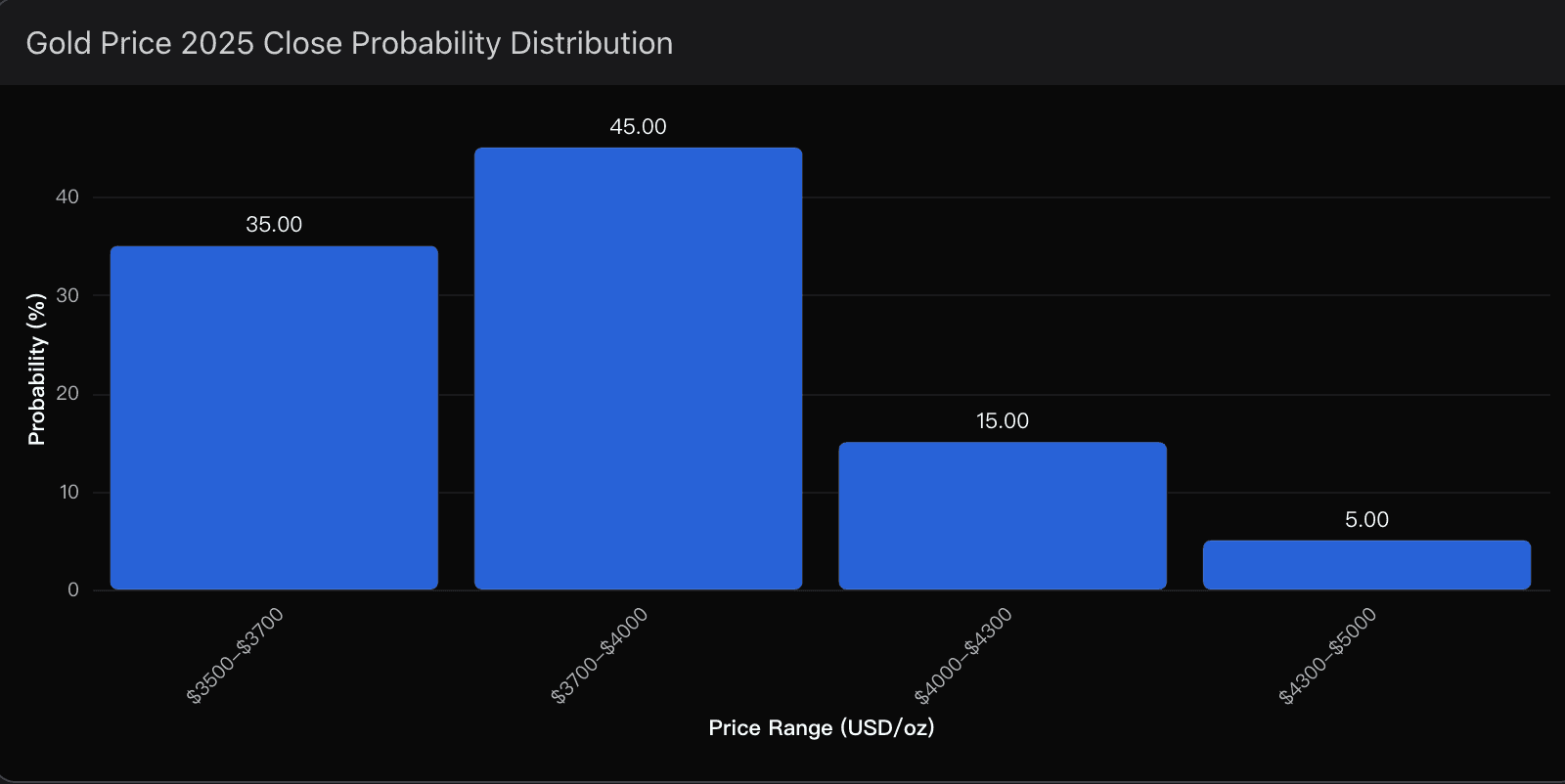
That’s 80% confidence in the $3,700–$4,000 range.
In other words: The real trade isn’t in chasing $5,000 gold — it’s in front-running the grind to $3,850.
The Three Forces That Actually Move Gold
Gold’s 2025 trajectory will be driven by a narrow band of macro variables.
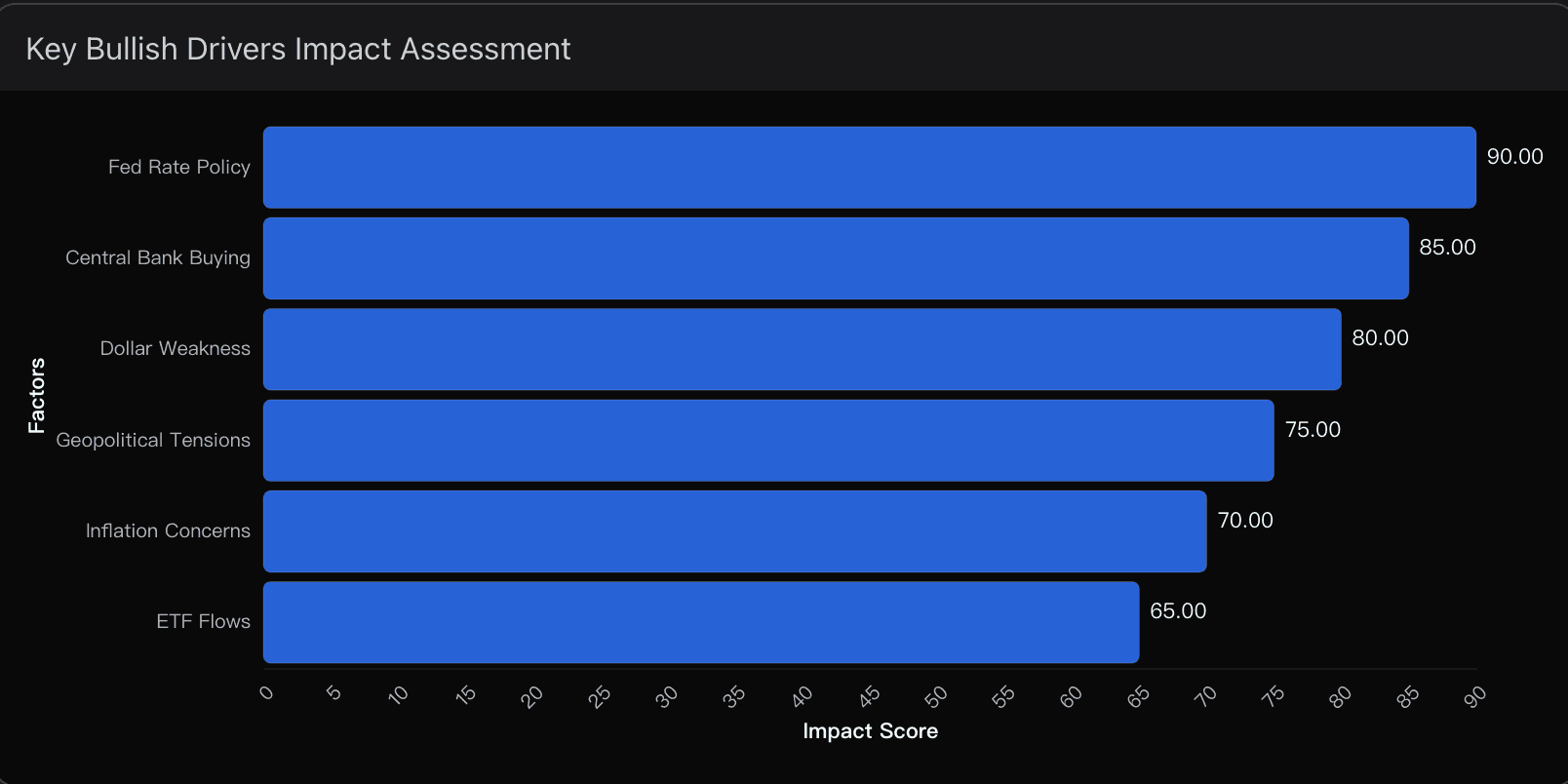
Using Powerdrill Bloom’s “Driver Weight Matrix,” which quantifies causality across macro factors, I found that over 90% of gold’s variance next year depends on three interlocking dynamics:
1️⃣ The Fed Game — Monetary Gravity Still Rules
Let’s start with the obvious.
The Federal Reserve is the gravitational force in this market.
Bloom’s rate-path tracker projects policy rates falling from 2.75% to 2.25–2.5% by December 2025, not the 1.75% fantasy that gold bulls are cheering for on Twitter.
That means no aggressive cutting cycle, and therefore, no explosive upside catalyst.
Each 25bp rate cut historically adds $50–$80 to gold prices — useful, but not transformative.
The real rocket fuel comes only when markets lose confidence in real yields — and we’re not there yet.
Bloom’s Fed Sentiment Index shows a 52% probability Powell stays in gradual normalization mode through 2025.
Translation: gold can grind higher, but not melt faces.
2️⃣ Central Bank Appetite — The Silent Floor Under Gold
If there’s one structural force that truly underpins gold’s floor, it’s central bank demand.
The 2023 data was historic: 1,037 tons purchased, worth roughly $85 billion — the second-highest on record.
And 2024 has followed the same pattern.
Bloom’s country-level purchase tracker shows China’s PBOC adding 103 tons in the first 10 months alone, while Turkey, Poland, and India quietly expanded their reserves.
That consistent structural bid places a soft floor around $2,800–$3,000 per ounce.
Even in macro stress, that demand is inelastic — gold isn’t being bought for yield; it’s being accumulated for sovereignty.
Bloom’s sentiment engine, analyzing 12 central bank statements and IMF updates, shows no sign of reversal in this pattern for 2025.
3️⃣ Dollar Dynamics — The Gatekeeper of Gold’s Ascent
For gold to push beyond $4,000, the U.S. Dollar Index (DXY) needs to decisively break below 100.
Right now, it’s dancing in the 103–105 range — far too strong for a breakout.
Every backtest I’ve run through Bloom confirms it:
Gold doesn’t moon while DXY is above 102.
That’s not opinion — that’s hard-coded correlation data from 20 years of history.
Until the dollar truly weakens, expect gold’s rally to remain grinding, not explosive.
The Bottom Line
I’ll say it plainly:
Gold won’t hit $5,000 unless the Fed completely loses control — and that’s not the 2025 I’m forecasting.
Instead, we’re heading for a grind higher toward $3,850, powered by structural central bank demand, moderate Fed easing, and steady de-dollarization pressure — but not panic.
The real trade here isn’t betting on euphoria.
It’s riding the disciplined, mechanical ascent that everyone’s too impatient to notice.
So as I continue to update my models through Powerdrill Bloom, my conviction remains steady:
Base case: $3,850 ± $200 by December 2025
Sweet spot: $3,700–$4,000 with 80% probability
Dream case: $4,500+, 5% tail risk
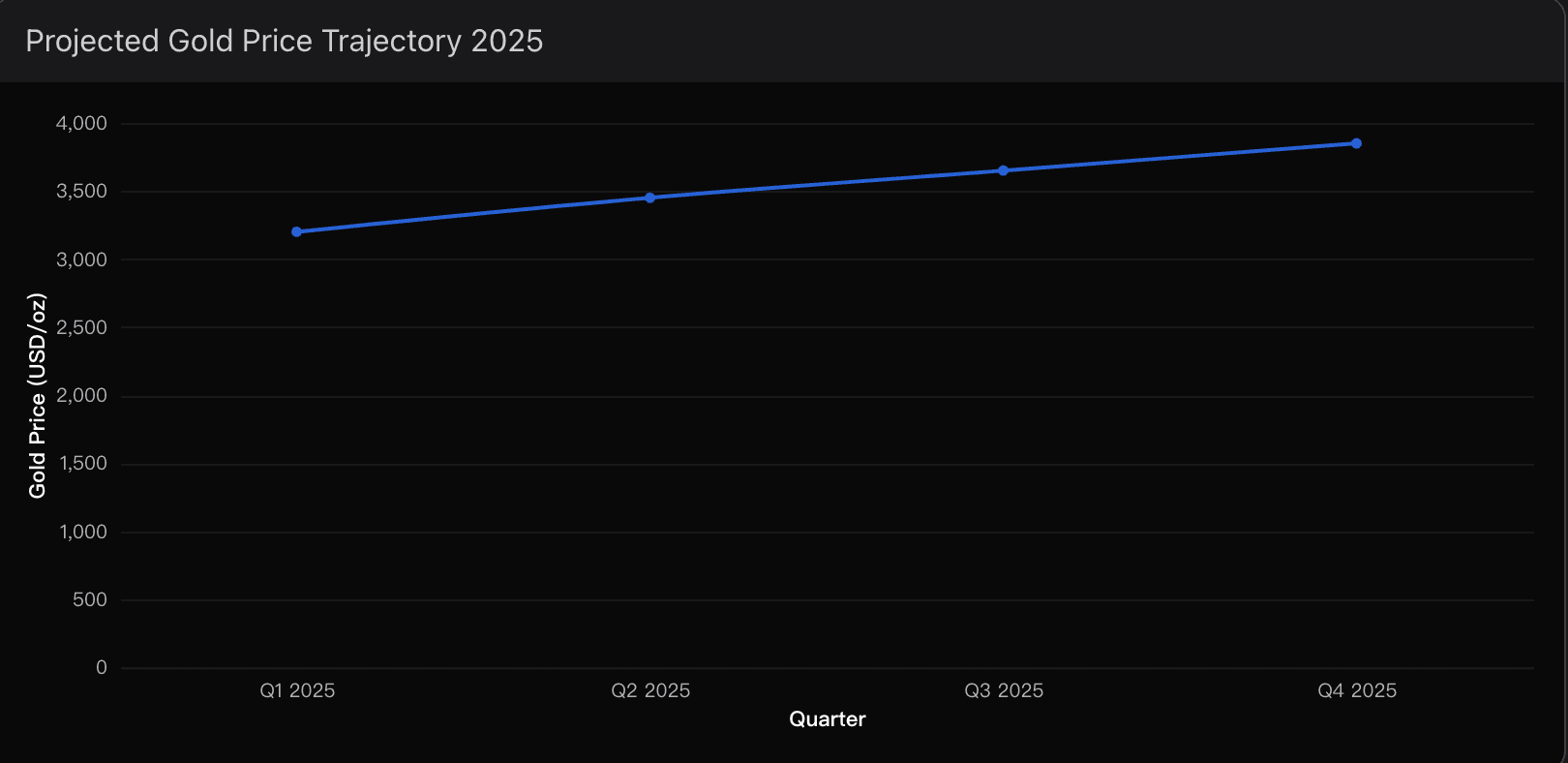
In a world addicted to extremes, I’m betting on the middle — and the middle looks a lot like $3,850 gold.
Related Post

Oct 29, 2025
/
Post by
Sophia

Oct 28, 2025
/
Post by
Olivia
Oct 29, 2025
/
Post by
john