
Over the past year, I’ve closely tracked the release cadence of OpenAI—from GPT-4o to GPT-5—not just through headlines, but through ecosystem signals, rollout patterns, and probability markets.
Using structured scenario modeling inside Powerdrill Bloom, I built a forward-looking timeline for what comes next: GPT-5.3 (general-purpose) and GPT-5.4 (next major capability step). This is not speculation for entertainment. It’s a disciplined forecast grounded in shipping velocity, market pricing, and competitive dynamics.
Here is my base case.
1. Core Prediction: Estimated Release Windows
After synthesizing distribution signals and rollout maturity, my highest-confidence windows are:
GPT-5.3 (General-Purpose Core Model)
March 8 – March 31, 2026
This is the highest-density probability window.
Importantly, I am modeling a general-purpose core release, not a specialized coding variant. Historically, OpenAI distinguishes between vertical releases (e.g., developer-focused) and broad flagship steps.
GPT-5.4 (Next Core Capability Step)
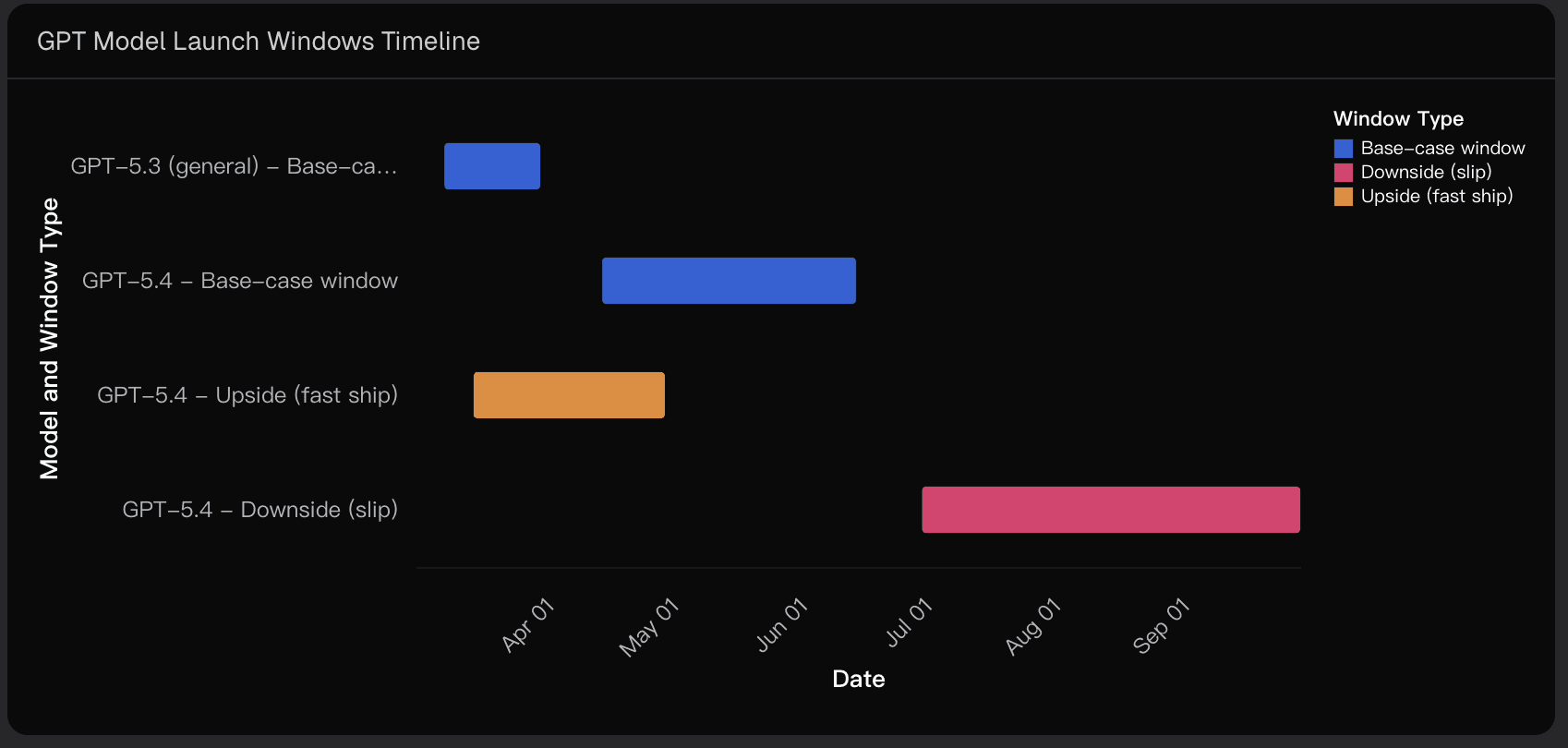
Base Case: April 15 – June 15, 2026
Upside (Fast Ship): March 15 – April 30, 2026
Downside (Slip): July 1 – September 30, 2026
My central thesis:
OpenAI ships GPT-5.3 in March, then follows with GPT-5.4 roughly 4–10 weeks later—unless safety gating extends the cycle.
The timeline visualization I modeled shows a tight clustering around late March for 5.3, and a broader probability band stretching into mid-Q2 for 5.4.
2. Scenario Probabilities
Rather than a single date, I structured the forecast into four discrete scenarios that sum to 100%. This makes the outlook usable for product planning and competitive positioning.
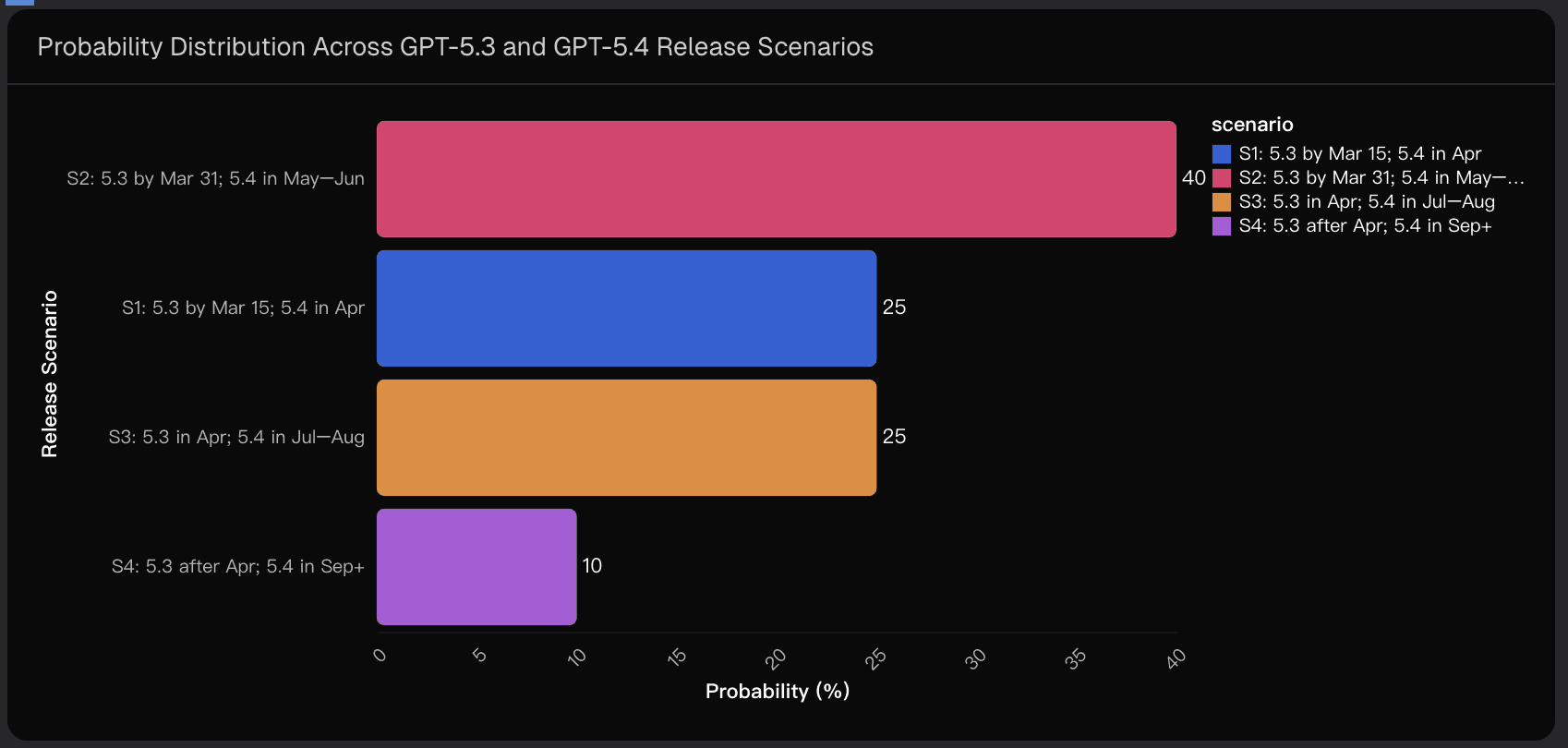
S1: GPT-5.3 by March 15; GPT-5.4 in April — 25%
S2: GPT-5.3 by March 31; GPT-5.4 in May–June — 40%
S3: GPT-5.3 in April; GPT-5.4 in July–August — 25%
S4: GPT-5.3 after April; GPT-5.4 in September+ — 10%
Interpretation
The most likely path (S2) implies:
A late-March 5.3 core launch.
A measured but steady progression toward 5.4 in mid-Q2.
The probability distribution is skewed toward Q2 2026 for GPT-5.4, with a meaningful downside tail into Q3. That tail is not trivial—10%+ probability mass beyond September reflects real gating risk.
3. What the Market Signals Are Telling Us
A) Prediction Markets Price a Near-Term Core Step
On Polymarket, contracts referencing GPT-5.3 release timing have implied strong odds of a March 2026 outcome.
Crucially, market rules exclude specialized variants, making the pricing a cleaner proxy for a true general 5.3 core launch.
Markets aren’t perfect—but they aggregate informed expectations. And right now, they heavily weight March.
B) Ship Velocity as a Leading Indicator
Recent shipping behavior suggests high operational readiness. Specialized releases have moved quickly into ecosystem surfaces (developer tooling, partner integrations, product layers).
When distribution pipelines mature, the bottleneck shifts from infrastructure to governance and safety review. That shift typically precedes a broader flagship release.
Velocity matters. And velocity right now is high.
C) Internal Signals Around GPT-5.4
Multiple third-party reports have referenced GPT-5.4 in artifacts such as:
Model selector sightings
Pull request references
Endpoint naming conventions
These signals are directional—not definitive. Internal staging often appears weeks or months before public availability.
What this tells me: GPT-5.4 likely exists in late-stage integration. What it does not tell me: That it is guaranteed to launch in April.
Hence: upside scenario, but not base case.
D) Competitive Dynamics Favor a Visible Core Step
The AI landscape is accelerating. When competitors release new coding or reasoning models, the strategic response is often not just incremental—it's headline-worthy.
From a positioning standpoint, OpenAI benefits from:
A visible GPT-5.3 core step.
A subsequent capability jump labeled GPT-5.4.
This two-step cadence preserves narrative momentum while spacing out safety reviews.
4. Major Risks That Could Shift the Timeline
No forecast is complete without modeling friction.
1) Safety & Red-Teaming Duration
Core models undergo heavier evaluation than specialized variants. A longer review cycle meaningfully increases slip probability.
2) Branding Ambiguity
OpenAI could release substantial upgrades under alternative labels rather than explicitly calling it “GPT-5.4.” Markets might interpret that as equivalent—even if branding differs.
3) Staged Rollout Dynamics
“Released” may mean:
ChatGPT first
API later
Limited tiers initially
Public availability definitions often lag internal enablement.
4) Infrastructure & Compute Constraints
Higher context windows or throughput demands could stress serving costs, delaying general rollout.
5) Leak Noise
Commit references and UI sightings can be placeholders or experimental branches. They confirm existence more reliably than timing.
6) External Shocks
Regulatory events, security incidents, or major competitive launches could either accelerate or delay deployment.
Conclusion: My 2026 GPT Timeline
After weighting cadence, probability markets, ecosystem maturity, and integration signals, my structured forecast is:
GPT-5.3 (general): March 2026 (highest confidence: March 8–31)
GPT-5.4: Mid-Q2 2026 (April–June base case)
Meaningful downside risk extending into Q3
The most probable scenario remains:
Late March 5.3 → May/June 5.4.
I built this forecast using structured scenario modeling in Powerdrill Bloom, forcing probability discipline instead of narrative bias. That approach doesn’t eliminate uncertainty—but it clarifies it.
In fast-moving AI cycles, clarity beats certainty.
Disclaimer: This analysis is a forward-looking forecast based on publicly observable signals and probabilistic modeling; actual release timelines may differ.
Related Post

Mar 2, 2026
/
Post by
Liam
Feb 28, 2026
/
Post by
Franklin

Feb 27, 2026
/
Post by
Olivia