

Every cycle, the same debate returns: when macro conditions shift, should capital favor digital scarcity or physical scarcity? As we are currently in 2026, I’ve been modeling the probability of Bitcoin outperforming Gold under different macro regimes, rather than relying on a single-point forecast.
Using scenario-weighted analysis and regime-based return modeling inside Powerdrill Bloom, my base case suggests that Bitcoin is more likely than not to outperform Gold this year.
The conclusion is not based on hype, nor on a simplistic “Bitcoin replaces Gold” narrative. Instead, it rests on liquidity sensitivity, institutional flow dynamics, and asymmetric payoff structures under easing conditions.
My probability-weighted forecast: Bitcoin has a 70% chance of outperforming Gold in 2026.
1. Macro Regime Framework: Why 2026 Is a Regime Question, Not a Price Guess
Rather than predicting exact prices, I structured 2026 into three internally consistent macro scenarios. This avoids false precision and allows us to assess how each asset behaves under different economic conditions.
Scenario A: Soft Landing + Monetary Easing + ETF Inflows
Financial conditions gradually ease
Real yields decline
Liquidity improves
Institutional allocation expands
In this regime, Bitcoin’s high beta to liquidity becomes a tailwind. Its convex return profile means upside moves tend to be amplified relative to Gold. Gold still performs, but its return path is typically more linear and defensive.
Scenario B: Inflation Resurgence + Geopolitical Tension
Sticky inflation
Policy uncertainty
Heightened geopolitical risk
Gold benefits from inflation hedging demand and geopolitical flows. Bitcoin can still perform, especially if capital seeks alternative stores of value, but volatility increases and dispersion widens.
Scenario C: Hard Landing + Liquidity Shock
Recession shock
Credit event
Forced deleveraging
This is the primary bearish regime for Bitcoin. In severe liquidity stress, Bitcoin can trade more like a risk asset than a defensive hedge. Gold, by contrast, typically attracts safe-haven flows.
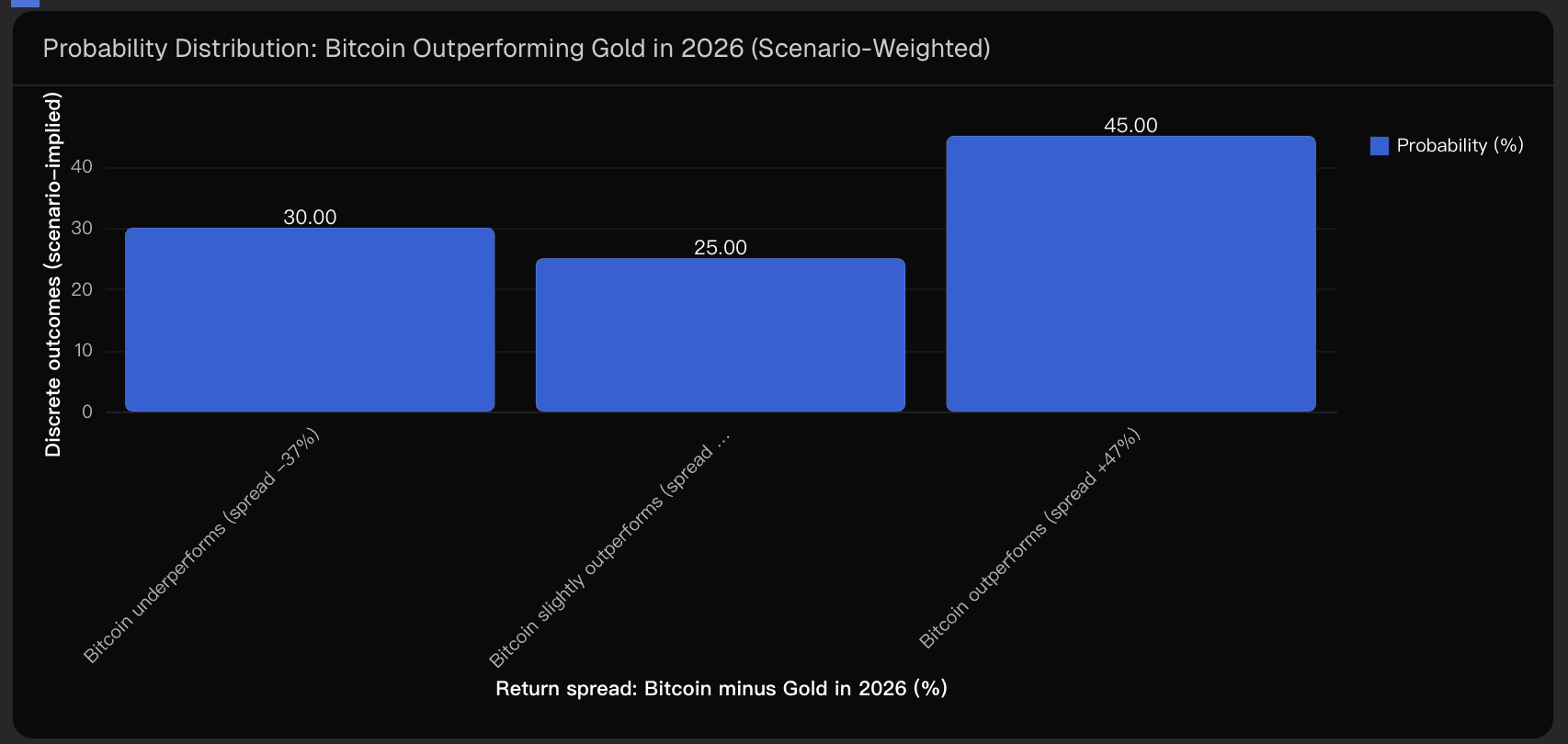
When weighting these scenarios probabilistically, Bitcoin outperformance dominates in two of the three regimes. That is how the 70% probability emerges—not from optimism, but from structural payoff asymmetry.
2. Scenario-Weighted Return Outlook for 2026
Instead of giving a single forecast number, I modeled conditional expectations for both assets in each macro regime:
Soft landing + easing: Bitcoin significantly outperforms Gold due to liquidity sensitivity and ETF-driven demand.
Inflation/geopolitics regime: Moderate Bitcoin outperformance, though dispersion increases.
Hard landing: Bitcoin underperforms, potentially materially.
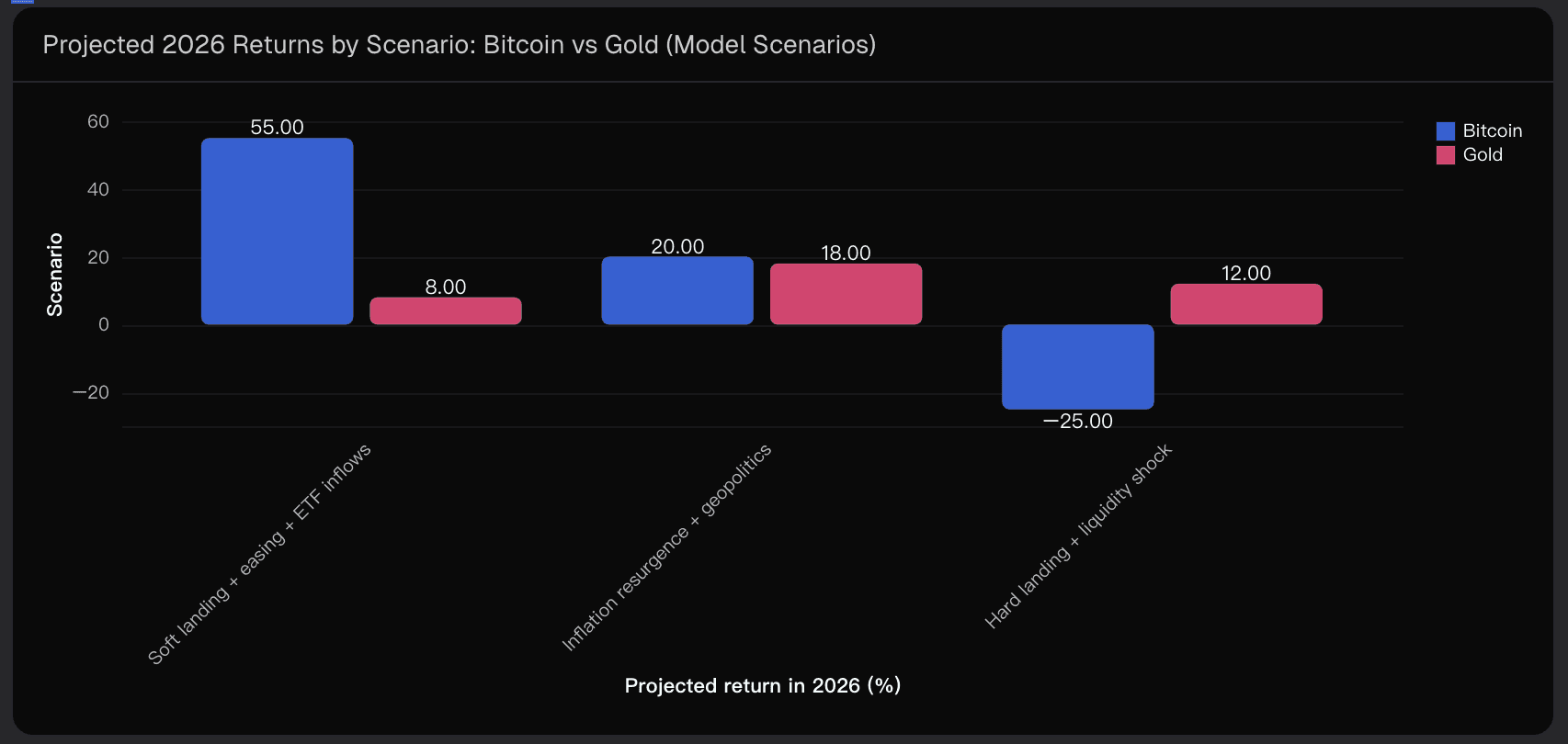
The distribution of outcomes is intentionally fat-tailed for Bitcoin. There is a meaningful probability of substantial outperformance, but also a non-trivial left tail in a liquidity shock. Gold’s distribution, in contrast, is tighter and more defensive.
This asymmetry matters for portfolio construction. Bitcoin’s convexity increases expected spread outcomes when easing dominates, while Gold provides steadier hedging characteristics across adverse shocks.
3. Structural Drivers: Liquidity, Flows, and Convexity
3.1 Liquidity Sensitivity and Real Yields
Bitcoin behaves like a high-duration liquidity asset. When real yields fall and financial conditions ease, its marginal buyer expands rapidly. Gold benefits from negative real rates as well, but historically its upside convexity in risk-on recoveries has been lower.
If 2026 brings a gradual normalization cycle with declining real yields, Bitcoin’s beta to easing likely dominates Gold’s defensive premium.
3.2 Institutional Access and ETF Flows
The normalization of Bitcoin via ETFs and institutional rails has changed its demand structure. Incremental capital from asset allocators can create persistent marginal bid pressure during constructive macro environments.
Gold’s ownership base is already deeply institutional and sovereign. While this provides stability, it also means explosive incremental demand is less common. The “new buyer effect” structurally favors Bitcoin in expansionary regimes.
3.3 Supply Narratives and Reflexivity
Bitcoin’s transparent supply schedule and halving-driven narrative amplify reflexive rallies when demand accelerates. This reflexivity contributes to convex upside in favorable liquidity environments.
Gold’s supply growth is comparatively steady and less narrative-driven. Its price is more tightly linked to macro hedging demand and real-rate dynamics rather than supply shocks.
3.4 Correlation Dynamics and Portfolio Competition
Bitcoin and Gold compete as alternative stores of value, but their short-term correlations shift dramatically by regime. During liquidity crises, Bitcoin may correlate more with equities. During easing cycles, it may detach and outperform.
The key insight is not that Bitcoin replaces Gold. It is that in most plausible 2026 regimes, Bitcoin’s liquidity beta outweighs Gold’s defensive stability.
4. What Could Invalidate the Bitcoin Outperformance Thesis?
Liquidity Shock or Severe Recession
A sharp credit contraction or systemic deleveraging event would likely trigger volatility-driven drawdowns in Bitcoin. In such a regime, Gold’s safe-haven demand could dominate performance spreads.
Policy Path Uncertainty
If inflation re-accelerates while growth remains resilient, real yields could stay elevated. That environment may simultaneously cap Bitcoin upside and support Gold’s inflation hedge appeal.
Regulatory and Market Structure Risk
Regulatory tightening, adverse taxation, or structural constraints on crypto market infrastructure could raise Bitcoin’s risk premium. Conversely, further clarity could expand institutional participation and increase outperformance odds.
Geopolitical Escalation
Severe geopolitical stress typically benefits Gold. Bitcoin’s response is more ambiguous—it can attract capital flight narratives, but liquidity tightening can offset that effect.
5. Conclusion: A 70% Probability That Bitcoin Outperforms Gold in 2026
After modeling macro regimes, liquidity sensitivity, institutional flows, and payoff convexity, my base call is clear: Bitcoin is more likely than not to outperform Gold in 2026, with an estimated 70% probability.
The thesis rests on three pillars:
Bitcoin’s higher beta to easing regimes
Expanding institutional access and flow dynamics
Convex upside relative to Gold’s linear defensive profile
The main risk remains a hard landing or liquidity shock that shifts the regime decisively toward defensive assets. If that occurs, Gold could outperform even if both assets rise.
From a scenario-weighted perspective, however, easing and soft-landing conditions appear more probable than systemic stress. Under that distribution, Bitcoin’s expected return spread versus Gold tilts positive.
These scenario-weighted forecasts and probability distributions were modeled and visualized using Powerdrill Bloom, which made it possible to compare macro regimes and quantify the likelihood of Bitcoin outperforming Gold in a structured and data-driven way.
Disclaimer: This analysis reflects probabilistic macro modeling and is for informational purposes only, not investment advice.
Related Post
Feb 26, 2026
/
Post by
Sophia

Feb 25, 2026
/
Post by
Michael

Feb 10, 2026
/
Post by
Jasper