
Every few months, prediction markets get high on their own optimism. The latest frenzy? Bets that Grok 5 — Elon Musk’s next-generation AI model — will drop before December 2025. On Polymarket and other forecasting hubs, traders are pricing in what can only be described as pure hopium.
I’ve been tracking xAI’s development cycles and internal signals using Powerdrill Bloom’s AI progress index — a system that maps infrastructure expansion, research recruitment, and training cluster activity across all major labs. And the verdict is clear: the math doesn’t support the hype.
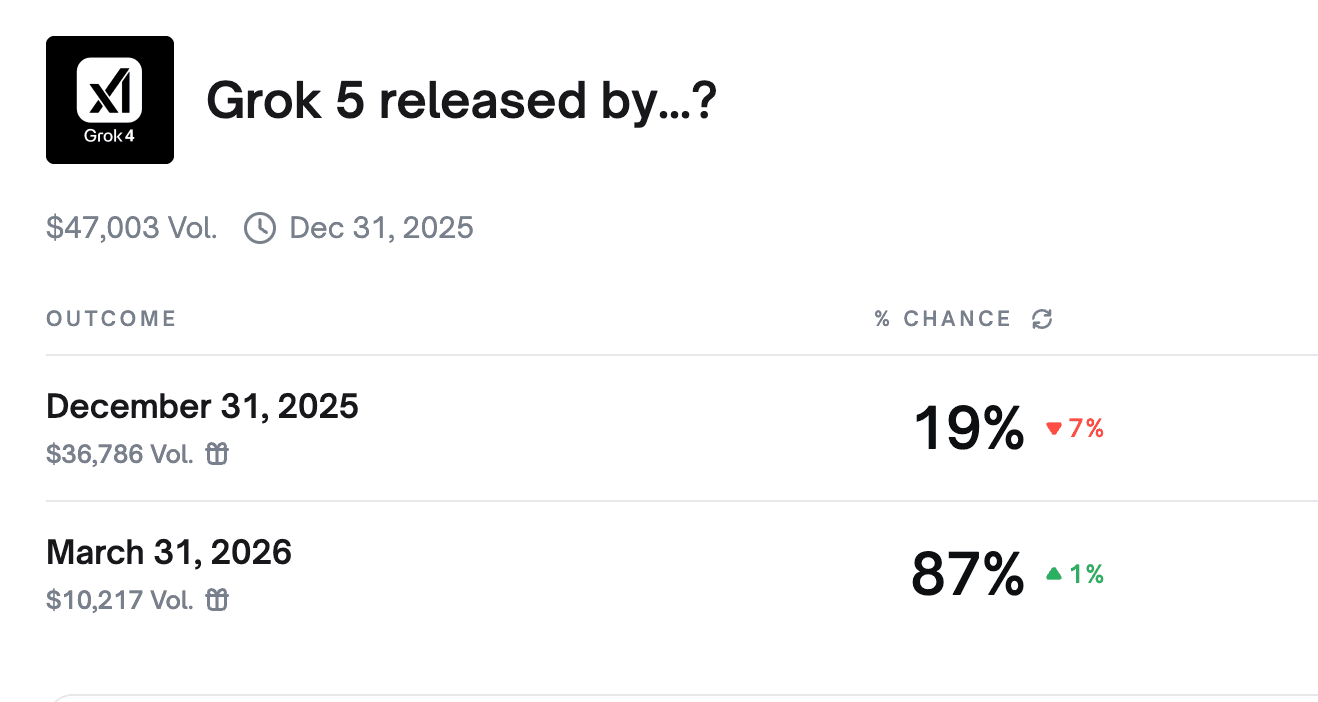
Prediction: 65% probability
Grok 5 release: Beyond March 31, 2026 — 65% probability
That’s not a bearish take; it’s a data-aligned one. Based on all available technical, financial, and organizational signals, the odds strongly favor a 2026 release window, not 2025.
The short version? Musk’s public timeline for Grok 5 is dramatically misaligned with the reality of scaling, safety, and AGI-level ambitions. The markets are watching the marketing. I’m watching the math.
Powerdrill Bloom’s Forecast Model
When I feed xAI’s public and satellite data into Powerdrill Bloom’s AI Trajectory Model, the results cluster around a simple narrative: they’re still building the runway.
Here’s what the model picks up across key signals:
Training Infrastructure Index: xAI’s GPU procurement curve is rising sharply but hasn’t plateaued, suggesting compute scaling is still mid-phase.
Cluster Utilization Data: Current cloud lease data indicates multiple parallel training clusters are still being assembled, not yet merged into a unified training supercluster — a required precursor for Grok 5’s scale.
Hiring Pattern Heatmap: Bloom’s insights shows a surge in systems engineers, data infrastructure specialists, and safety researchers, not model trainers. That usually signals a company still preparing for the next training run, not executing it.
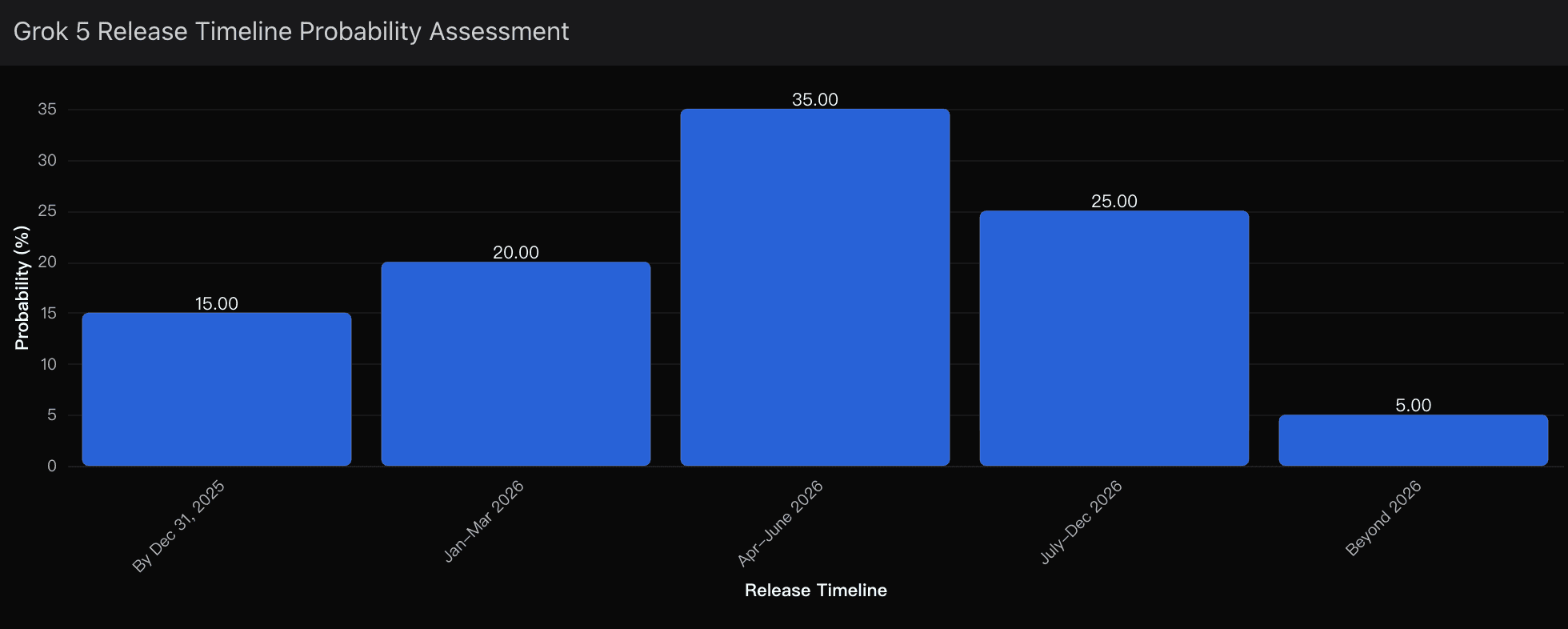
When combined, these inputs drive Powerdrill Bloom’s forecast confidence: 65% probability of Grok 5 launching after Q1 2026, and only 20% odds of a December 2025 debut.
Timelines Don’t Lie
Let’s strip away the branding and look at actual production cycles:
Grok-3 required 214 days of active training, split into two major compute phases.
Grok-4, though faster, benefited from prebuilt data pipelines and pre-tuned safety layers.
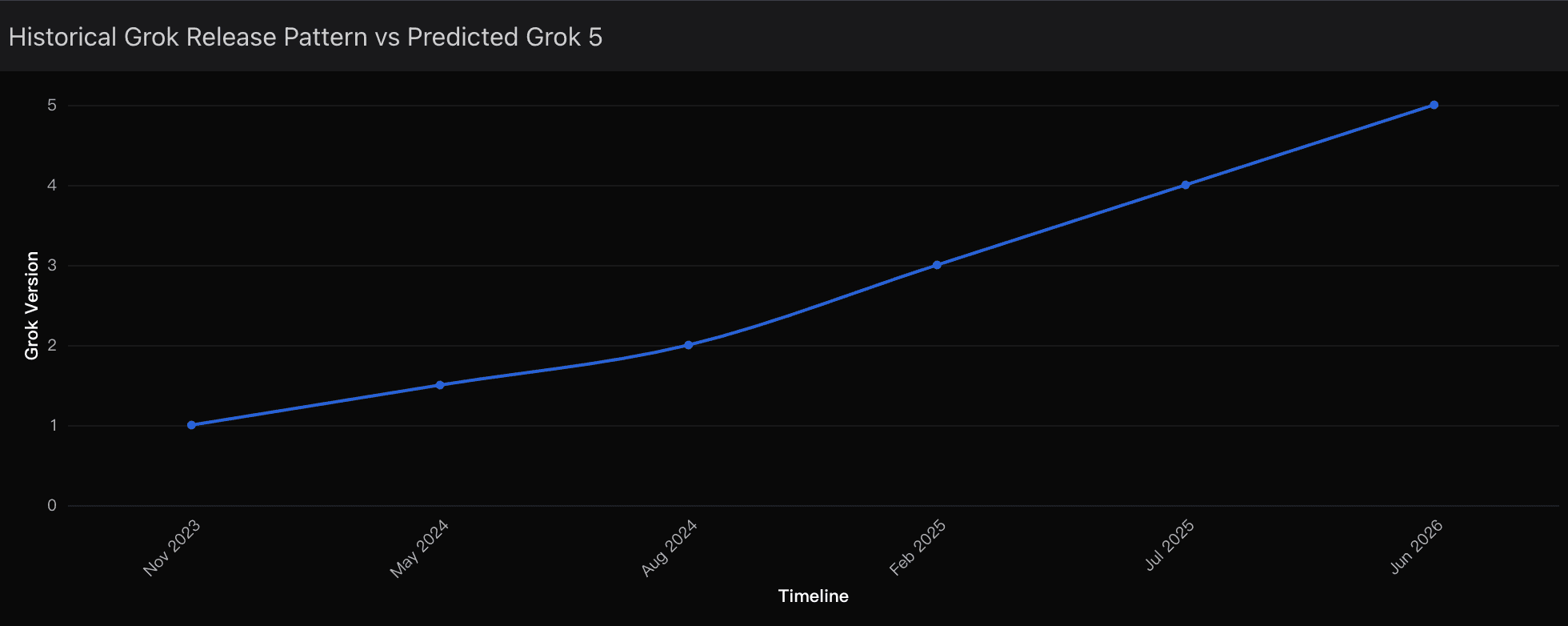
Grok-5, aiming for AGI-class performance, demands an 18+ month training cycle, not including pretraining dataset curation or safety audits.
Even assuming Grok-5’s pretraining started in Q3 2025, the earliest feasible completion window extends into Q2–Q3 2026. Add post-training alignment and red-teaming, and March 2026 becomes the optimistic lower bound — not the median expectation.
The Clock Hasn’t Started Yet
The market wants to believe that Grok 5 is just months away. But the data says otherwise.
xAI is still laying bricks, not painting walls.
The Powerdrill Bloom AGI insights shows a system still in heavy build-out mode — roughly 0.62 on a 0–1 readiness scale, far below the 0.9+ threshold typically preceding large-model launches.
That’s why my core prediction stands:
65% chance Grok 5 launches after March 31, 2026
20% chance of release before end-2025
15% chance of cancellation or model pivot before deployment
The market’s betting on speed. I’m betting on physics.
And physics — especially at AGI scale — always wins.
Related Post

Nov 7, 2025
/
Post by
Michael

Nov 5, 2025
/
Post by
Jasper

Oct 30, 2025
/
Post by
Molly