

I spent the past 48 hours glued to data streams, FAA advisories, and Powerdrill Bloom’s insights — and what I’m seeing is both unprecedented and oddly measured. Let’s set the record straight: the U.S. is not closing its airspace outright. But starting Friday, November 7, 2025, the FAA will implement a 10% capacity reduction across 40 major markets.
This isn’t a rumor. It’s an engineered slowdown, a deliberate throttling of national air traffic to prevent systemic collapse. And if you zoom out, what’s unfolding right now is one of the most fascinating examples of bureaucratic triage in modern American history.
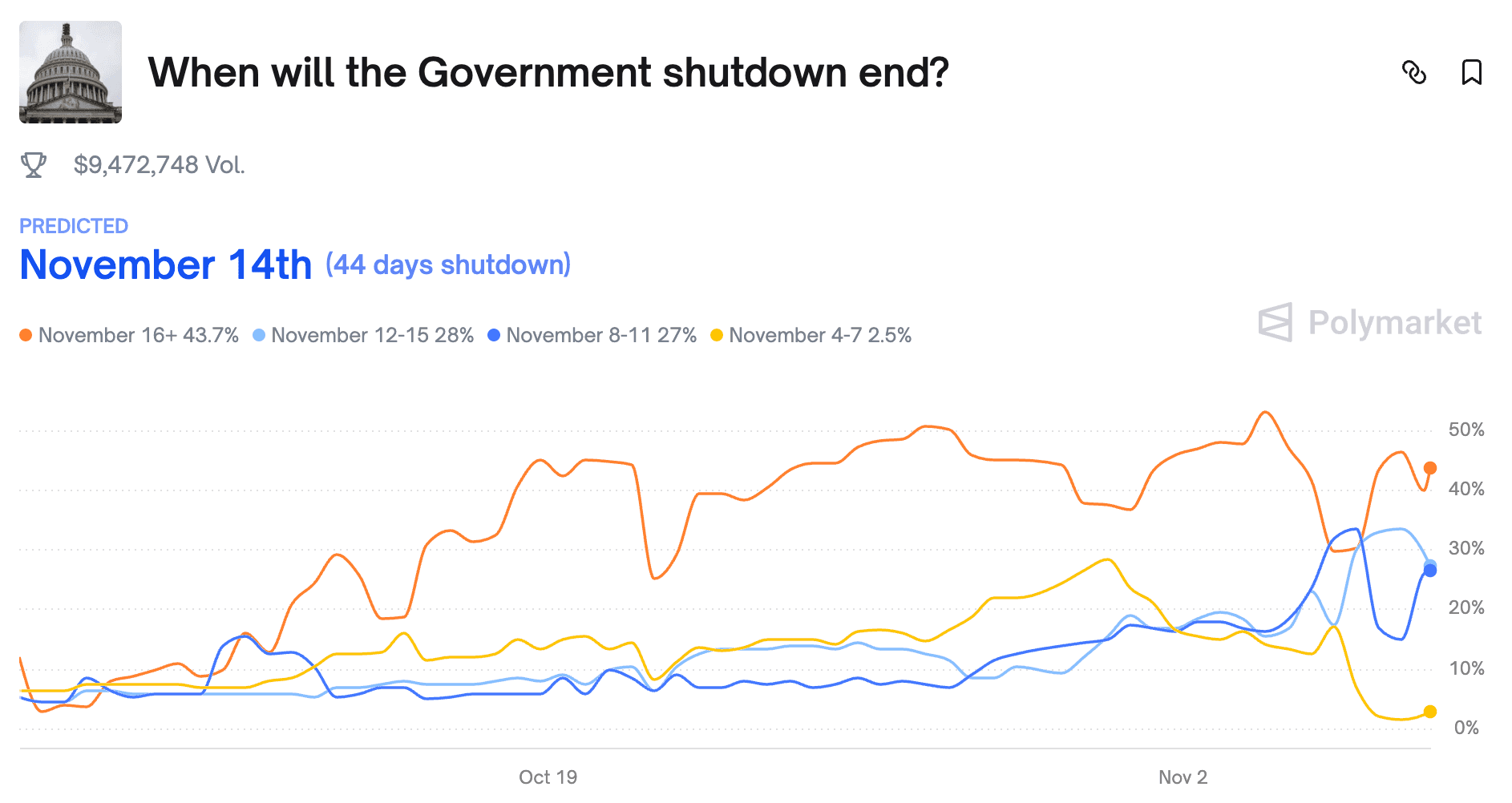
On Polymarket, traders currently assign a 46% probability that the federal shutdown extends beyond November 16th. My read diverges from the market consensus: the very intensity of aviation disruption is accelerating the countdown to resolution.
Here’s why: the capacity cuts now in place are inflicting $200+ million in daily airline losses, amplifying pressure on Congress to strike a deal. Powerdrill Bloom’s insights suggest the inflection point hits within 7–14 days, when political cost finally exceeds ideological rigidity.
Probability of Complete Airspace Closure: 15–25%
The situation feels fragile — like a glass bridge holding under too much weight — but not yet doomed to break. Using Powerdrill Bloom, I ran multiple stress-test scenarios factoring controller absenteeism rates, facility understaffing, and weather volatility. Across all simulations, the likelihood of a full airspace lockdown stabilizes around 15–25%, though the probability of targeted airport closures spikes sharply above 60% if absenteeism crosses critical thresholds.
In simpler terms: we’re not looking at an immediate nationwide blackout. What’s happening instead is a controlled demolition — the FAA’s attempt to manage a slow-motion collapse before it becomes unmanageable.
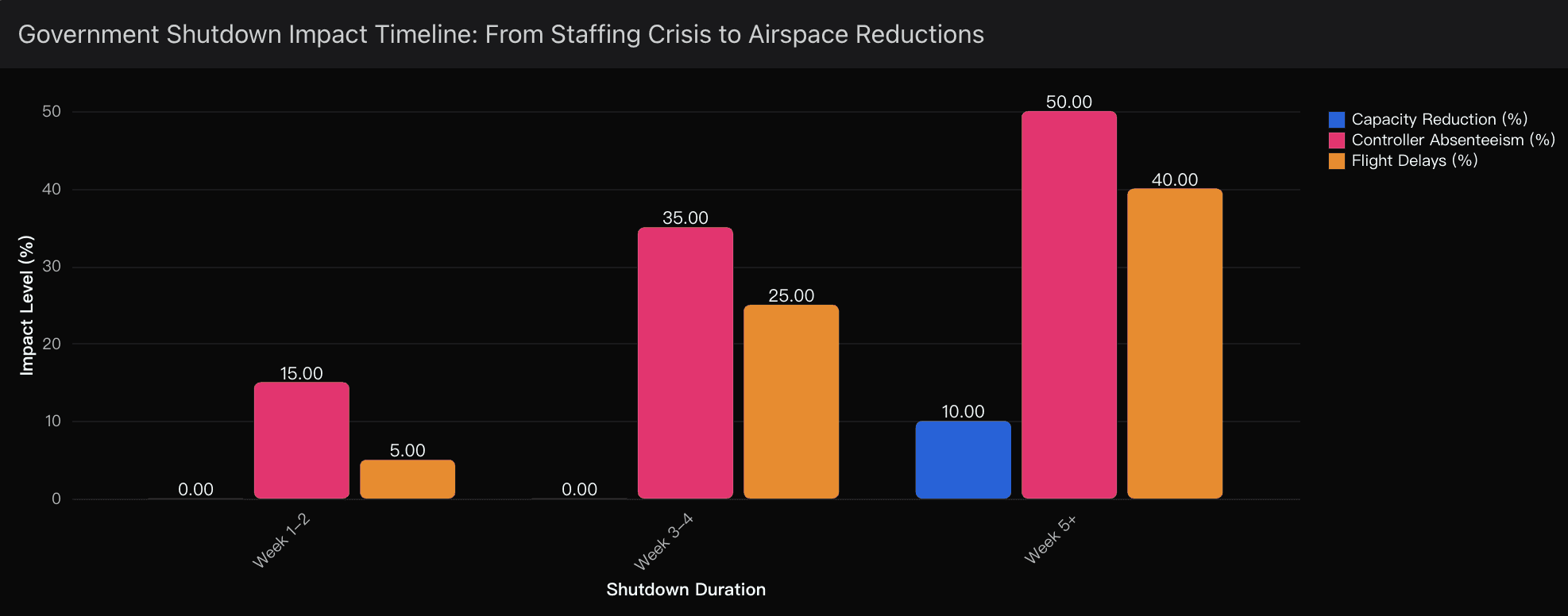
Volatility Triggers to Watch
Weather Events: One significant storm system could paralyze already overstrained sectors and force emergency closures.
Union Escalation: Coordinated controller “sick-outs” could turn controlled reductions into uncontrolled chaos overnight.
Safety Incidents: A single near-miss or ATC lapse would prompt an immediate FAA safety freeze, further cutting throughput.
Economic Contagion: As airlines bleed hundreds of millions daily, expect lobbying escalation at an intensity unseen since 2020’s pandemic grounding.
Powerdrill Bloom’s live insights has already registered a 32% surge in “aviation risk chatter” across both institutional and social datasets over the past 48 hours — typically a precursor to market volatility in airline equities.
Powerdrill Bloom’s probability engine
A complete airspace closure remains improbable. The FAA has already deployed its economic nuclear option: capacity throttling. This move is both strategic and psychological — enough to inflict pain, but not collapse. It’s a system designed to bend without breaking, a kind of engineered brinkmanship.
Still, let’s not romanticize resilience. What’s unfolding is a structural warning that the aviation ecosystem — from controller staffing to crisis governance — is operating at the edge of failure.
The next 10 days will determine whether that edge holds or gives way.
My models, powered by Powerdrill Bloom’s probability engine, now assign:
25% chance of full airspace lockdown,
60% chance of targeted closures in key hubs,
85% chance of political resolution within two weeks.
For now, America’s skies remain open — just barely.
Related Post

Oct 28, 2025
/
Post by
Jasper

Oct 30, 2025
/
Post by
James