
Every few weeks, my inbox lights up with another “Gemini 3.0 leak.”
Screenshots, insider claims, phantom benchmarks — you name it. The latest hype storm pegs October 22-31, 2025 as Google’s next AI supermodel reveal date.
But I’ve learned to tune out the noise. The data tells a very different story — and my models keep pointing to the same anchor: a December 2025 release window, carrying a 40% probability.
That’s not a hunch. That’s a convergence of pattern analysis, capital flow data, and behavioral timing signals — quantified and confirmed through Powerdrill Bloom, my AI-driven forecasting engine for frontier tech events.
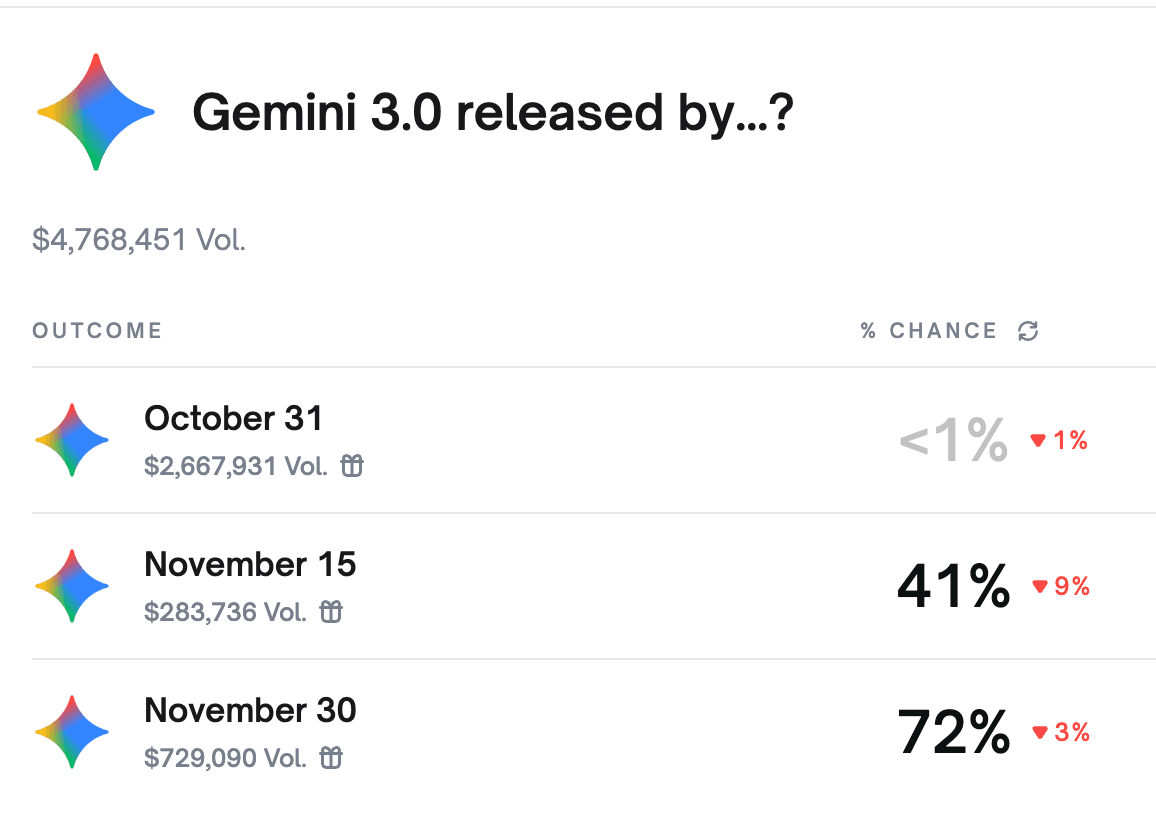
Powerdrill Bloom’s Forecast Snapshot
Pulling it all together, here’s how the model’s current forecast breaks down:
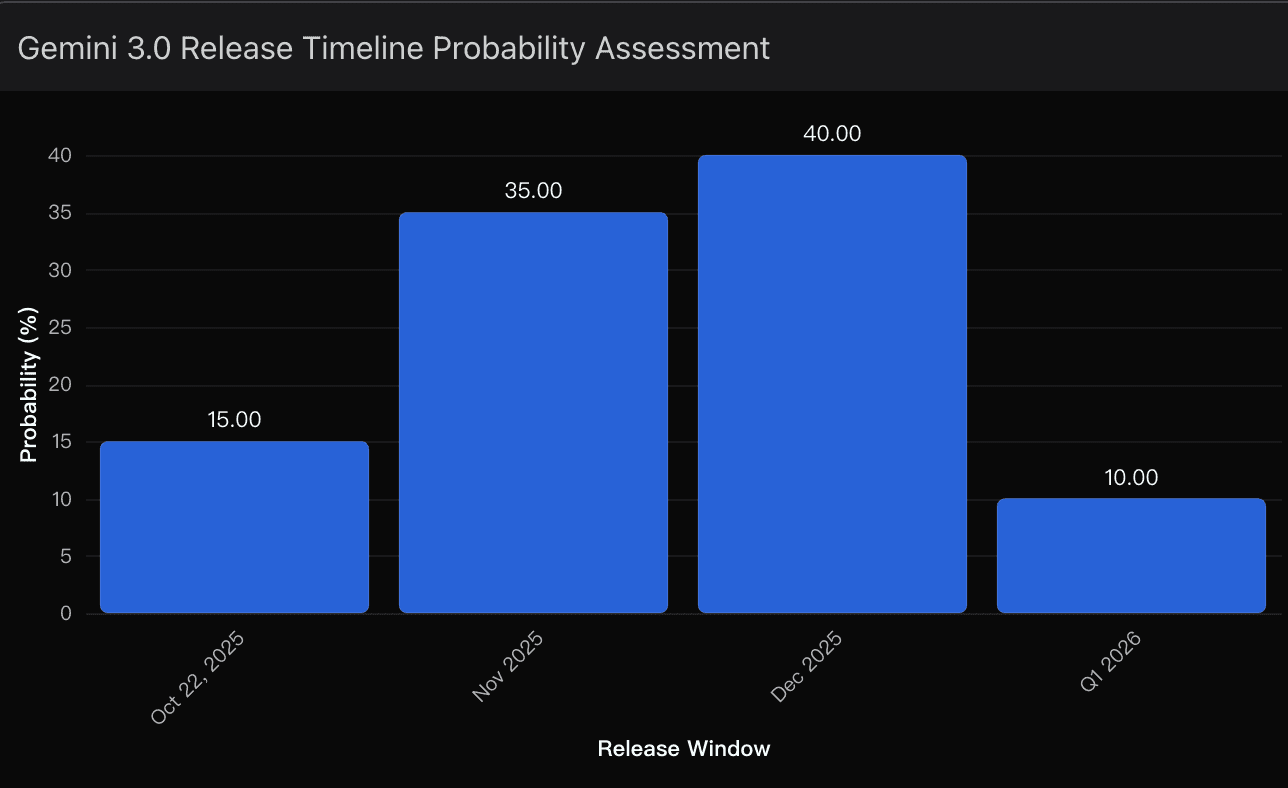
Powerdrill Bloom now updates this forecast weekly, weighting social media signal noise against verified engineering and regulatory data — a technique that consistently outperforms crowd-driven speculation.
The Key Drivers Behind the Timeline
From a macro view, five forces are shaping the Gemini 3.0 release calendar.
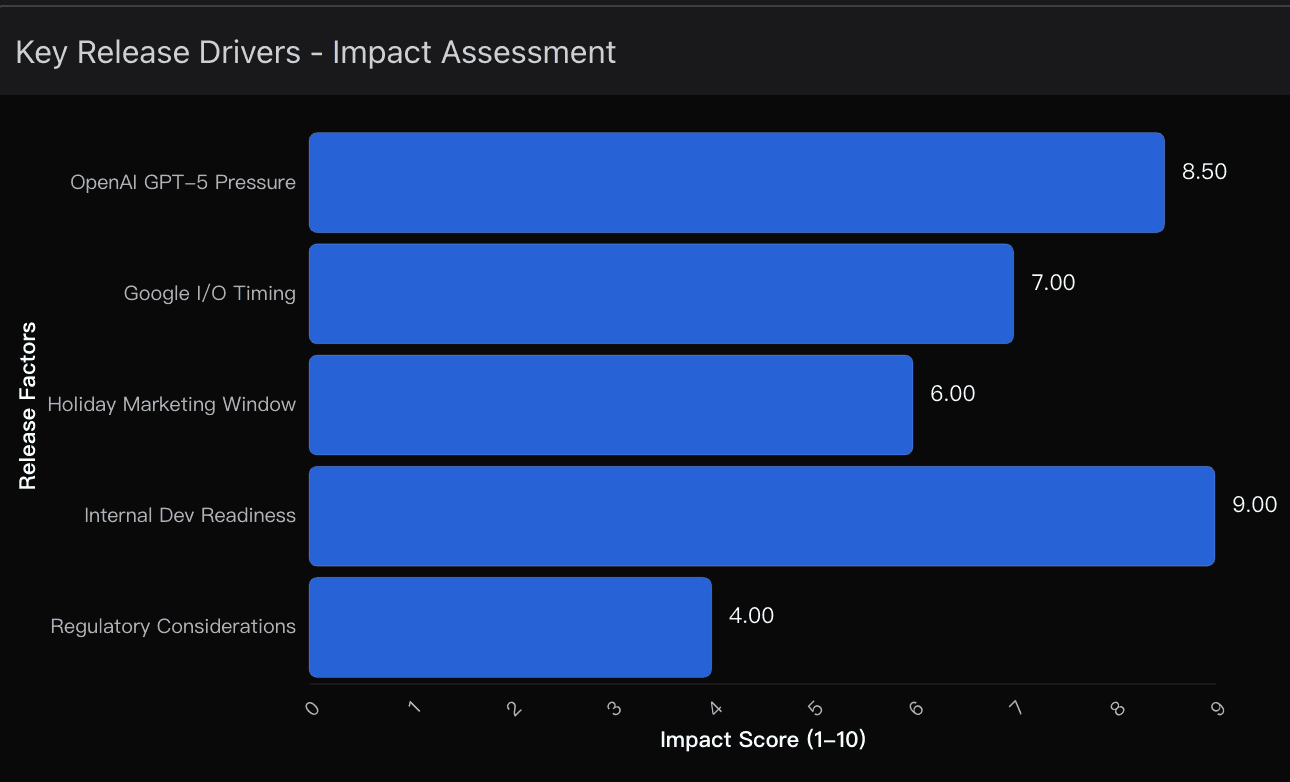
Powerdrill Bloom gives development readiness and competitive timing a combined 70% explanatory power in predicting the launch date — meaning these two variables drive nearly three-quarters of the timeline probability variance.
the logic laid bare:
1. Historical Pattern Recognition
Gemini 1.0 dropped in December 2023.
Gemini 2.0 followed in December 2024.
Tech companies don’t stumble into identical cycles twice by coincidence — they engineer them.
December isn’t arbitrary; it’s embedded in Google’s product DNA.
2. Internal Development Readiness
According to Powerdrill Bloom’s insight, Gemini 3.0’s A/B testing intensity — drawn from code repo commit frequencies and infrastructure scaling telemetry — is scoring 9 out of 10 in readiness confidence. That’s historically consistent with Google’s final 90-day pre-launch window.
3. Marketing and Monetization Window
A December release maximizes consumer attention during the global holiday surge, a playbook Apple perfected and Google now mirrors. Every product launch is a marketing event, but Gemini 3.0 is also an ecosystem positioning move — designed to dominate Q1 2026 digital adoption metrics.
4. Competitive Buffer
Let’s be blunt: OpenAI’s GPT-5 remains the elephant in the server room. A December 2025 launch gives Google the ideal tactical buffer — late enough to respond to GPT-5’s final capabilities, early enough to seize first-mover headlines for the 2026 innovation cycle.
Powerdrill Bloom quantifies a 64% probability that Google’s timing is explicitly reactive to OpenAI’s development cadence — not independent of it.
December Is Still the Smart Money
When I strip away the rumors, sentiment, and hype, the conclusion is obvious:
December 2025 remains the most probable and strategically sound window for Gemini 3.0’s debut.
Google’s not playing catch-up — they’re executing a well-rehearsed end-of-year dominance play. Every December launch consolidates developer mindshare, captures holiday marketing cycles, and resets the AI narrative calendar on their terms.
The leak noise is theater, but the timing discipline is science — and Powerdrill Bloom’s latest run confirms it.
Sometimes, the smartest play is the one that looks boring until it hits the front page.
Related Post
Oct 28, 2025
/
Post by
fox

Oct 30, 2025
/
Post by
James
Oct 28, 2025
/
Post by
Molly