

As someone who spends most of my time inside traffic data, product release cycles, and prediction curves, I rarely look at a frontier model launch as a single date. I look at it as a probability distribution.
Using structured trend tracking and scenario modeling in Powerdrill Bloom, I built a forward-looking forecast for Claude 5 — not based on hype, but on cadence, incentives, and structural constraints.
My base-case forecast: Claude 5 launches in 2027 H1 (January–June 2027), most likely around April–May 2027.
Here’s how I arrived at that conclusion.
1. Core Prediction: The Most Likely Release Window
Base Case
Expected window: 2027 H1
Peak probability: April–May 2027
The logic is straightforward.
In February 2026, Anthropic shipped Claude Opus 4.6, followed closely by Claude Sonnet 4.6. That pattern signals active product iteration — but not necessarily an imminent generational leap.
Minor 4.x upgrades typically indicate:
Capability hardening
Agent/tool integration expansion
Cost and reliability optimization
Enterprise scaling
A true “Claude 5” moment likely requires:
A new large-scale training run
Extensive evaluation cycles
Alignment and safety validation
Deployment-readiness across infrastructure
Those cycles rarely compress into just a few months.
That’s why my center-weighted window lands in early 2027.
2. Quantified Probability Scenarios
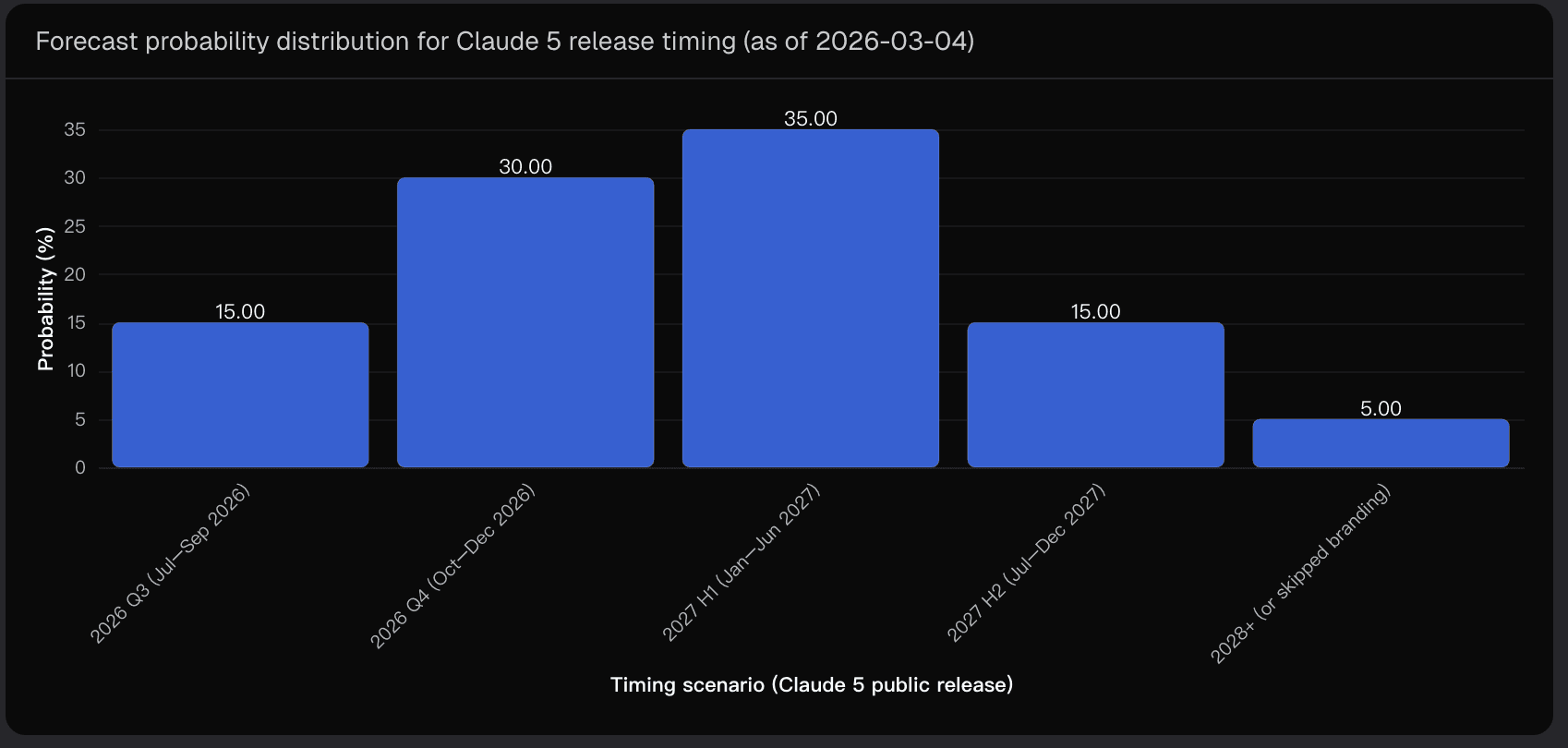
Rather than a binary guess, I structured the timeline as a probability distribution:
Interpretation
2026 Q4 (30%) is the main left-tail acceleration scenario.
2027 H1 (35%) remains the modal outcome.
2027 H2+ (20%) captures safety or infrastructure gating risks.
This is not a linear clock. It’s a weighted distribution shaped by incentives and constraints.
3. Market Signal: What Polymarket Suggests
Prediction markets provide a short-term sentiment check.
A snapshot from Polymarket showed:
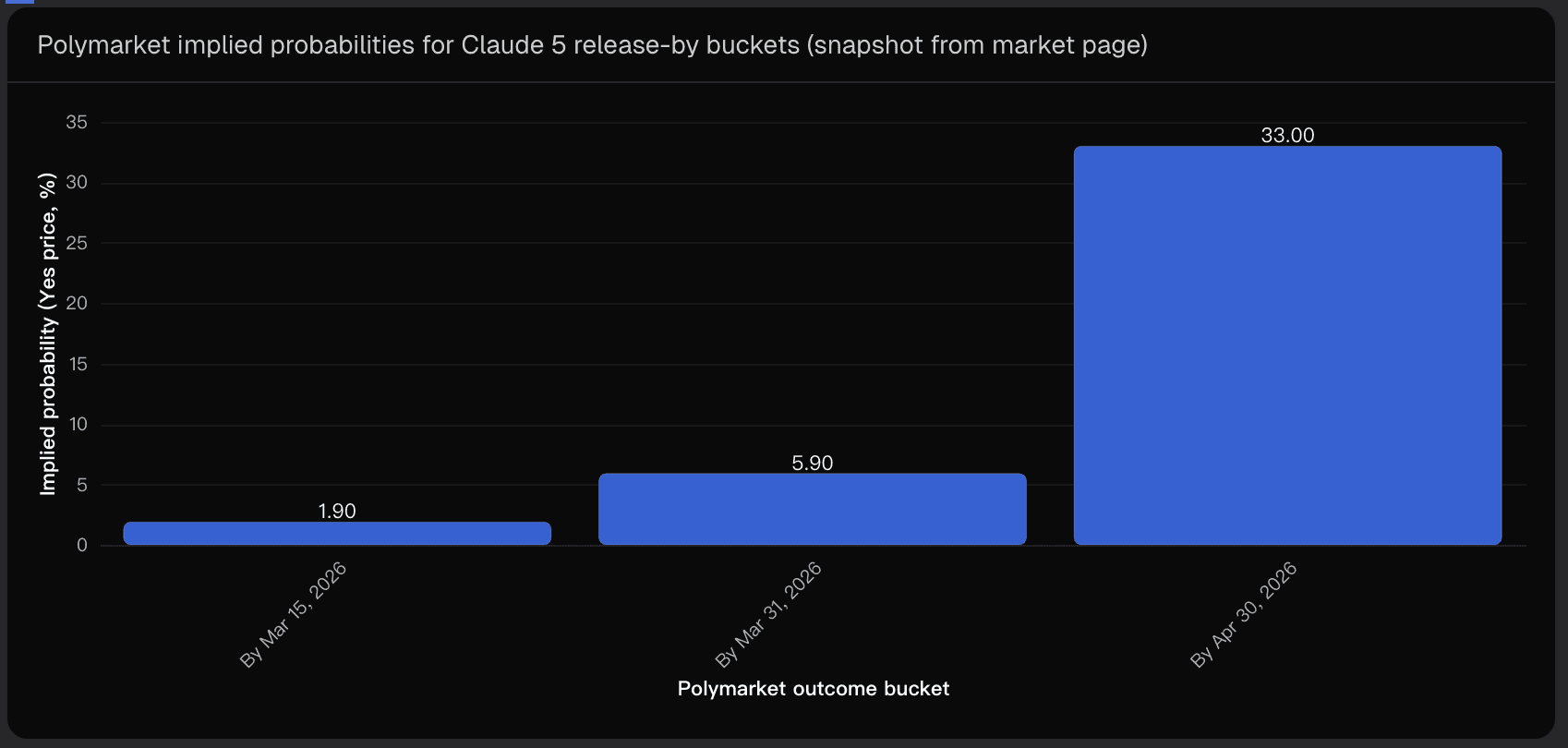
By Mar 15, 2026: 1.9%
By Mar 31, 2026: 5.9%
By Apr 30, 2026: 33%
~$2.62M volume
Important nuance:
Those buckets only represent “release-by” probabilities up to April 2026. They do not reflect the full probability mass beyond that window. So while 33% by April looks significant, it is not a majority view of total outcomes.
Markets often:
Overweight rumor cycles
Blur definitions (limited preview vs general availability)
React quickly to hype around recent releases
Given that 4.6 models were just launched in February 2026, I interpret the early-2026 odds as non-zero but not dominant.
4. Structural Drivers Behind the Timeline
4.1 Rapid 4.x Iteration ≠ Immediate Major Leap
Fast-follow releases like Opus 4.6 and Sonnet 4.6 suggest strong execution velocity. But generational shifts are different from mid-cycle upgrades.
A major “5” label implies:
Larger architectural or training improvements
Expanded reasoning or context capacity
Higher safety scrutiny
Velocity at the minor level does not automatically translate into compressed major cycles.
4.2 Enterprise Pull: Accelerate or Delay?
Commercial signals point in two directions.
Acceleration pressure:
Strong coding and long-horizon performance positioning
Wider default distribution of Sonnet-tier models
Enterprise appetite for frontier capability
Delay pressure:
Scaling agent workflows under real load
Cost optimization
SLA reliability requirements
If demand is growing rapidly, stability may take priority over headline branding.
4.3 Competitive Dynamics
Competition with OpenAI and Google increases cadence pressure.
However, frontier labs don’t always respond with a renaming event. Often they:
Ship mid-cycle capability jumps
Expand tooling layers
Improve context windows
Delay major rebranding until infrastructure and safety are ready
This is why I assign 30% to 2026 Q4 — meaningful, but not dominant.
4.4 Capital vs Safety Constraints
Funding reduces compute bottlenecks.
But frontier models are increasingly gated by:
Alignment testing
Red-teaming results
Policy and governance sign-off
In my modeling, safety cycles are the largest source of right-tail delay into 2027 H2 or beyond.
5. What Could Shift the Timeline
Definition Risk
Does “release” mean:
Limited preview?
API-only?
Public GA?
Cloud-partner rollout?
Resolution criteria matter. Prediction markets may resolve on narrower definitions than analysts assume.
Infrastructure Risk
If inference demand outpaces capacity, launch timing may shift to protect reliability.
Competitive Shock (Biggest Acceleration Risk)
A credible major release from a competitor could:
Compress internal decision cycles
Pull probability mass into 2026 Q4
Trigger a staged rollout strategy
Branding Risk
There is a small (5%) probability that “Claude 5” is skipped, renamed, or bundled into a different versioning strategy.
6. Leading Indicators I’m Watching
Over the next 30–180 days, I’m monitoring:
API release notes (new model IDs or frontier hints)
Compute scaling announcements
Safety disclosure updates
Enterprise pricing or packaging shifts
Sharp moves in Polymarket curves tied to verifiable evidence
These signals tend to move before official announcements.
Conclusion: My Final Forecast
The most likely release window for Claude 5 is 2027 H1, centered around April–May 2027.
The decisive variable is whether Anthropic treats Claude 5 as:
A true next-generation training leap requiring extended validation
orA product-level bundling of advances already visible in 4.6
Right now, structural constraints outweigh short-term hype signals.
From a structured forecasting perspective — combining cadence analysis, competitive pressure modeling, and probability-weighted scenario planning — early 2027 remains the highest-probability outcome.
The scenario modeling behind this projection was built and stress-tested inside Powerdrill Bloom to ensure the probability distribution reflects both commercial incentives and technical constraints rather than speculation.
Disclaimer: This article reflects analytical forecasting based on public information and probability modeling, not insider knowledge or official guidance.
Related Post
Mar 3, 2026
/
Post by
fox

Mar 2, 2026
/
Post by
Liam
Feb 28, 2026
/
Post by
Franklin