10 Best AI Memory Tools for Financial Analysts Dealing with Large PDFs, Excel Files & Memory Limits (2026 Guide)
Introduction
Financial analysts spend countless hours reading 10-Ks, analyzing complex Excel spreadsheets, and synthesizing equity research reports. While AI has revolutionized data extraction, analysts still face a frustrating bottleneck: AI forgets. Every new chat requires re-uploading massive PDFs, stuffing prompts with historical context, and battling restrictive context window limits.
If you are tired of your AI losing the thread of your long-term research, you need an AI memory tool.
What is an AI memory tool and why do financial analysts need it?
AI memory tools are systems that persistently store, manage, and recall context across multiple chat sessions. For financial analysts, they eliminate repetitive prompt stuffing, bypass context window limits, and turn scattered PDFs and Excel files into a durable, reusable knowledge base. While basic tools offer simple chat history, advanced solutions like MemoryLake provide governed, cross-session memory infrastructure ideal for complex, long-term financial research.
Here is your comprehensive 2026 buyer’s guide to the best AI memory tools and context systems designed to handle heavy financial workflows.
Quick Comparison of the 10 Best AI Memory Tools
Tool | Category | Best For | Pricing |
Persistent AI Memory Infrastructure | Complex financial research, cross-session continuity, and governed workflows | ||
Contextual Workspaces | Fast, isolated project research with large context models | ||
Native Chat Memory | Quick, everyday individual analyst queries | ||
Enterprise Knowledge Search | Firm-wide AI search and intranet integration | Custom enterprise pricing | |
Developer Memory Layer | Quants and dev teams building custom analyst agents | ||
OS-level Memory Management | Autonomous agents requiring infinite memory | ||
Temporal Agent Memory | Tracking evolving financial timelines and knowledge graphs | ||
Personal AI Bookmarking | Analysts saving and querying web-based financial news | ||
Framework-based Memory | LangChain developers building financial tools | Open-source | |
Document-centric RAG | Extracting tables from extremely messy PDF reports | Open-source |
MemoryLake
MemoryLake positions itself as a persistent AI memory infrastructure and portable memory layer across AI systems. Often described as a "second brain" or "memory passport" for agents, it is highly suited for financial analysts who require durable, user-governed memory. Rather than just saving chat logs, MemoryLake structures research trails, facts, and document insights into a continuous memory foundation that can be securely queried across different sessions and models.
Key Features
Cross-Session & Cross-Model Portability: Your research memory is not locked to a single chatbot; it travels with you across different AI models and agentic workflows.
Provenance and Traceability: Every stored fact maintains a strict link to its original source (e.g., a specific cell in an Excel model or a paragraph in a 10-K), ensuring full auditability.
Advanced Conflict Handling: Automatically recognizes and updates outdated financial figures when new quarterly reports are ingested.
Deep PDF & Excel Parsing: Engineered to handle the complex, multimodal nature of enterprise knowledge files without losing structural integrity.
Pros
Eliminates repetitive prompt stuffing by maintaining a persistent baseline of your investment thesis and historical data.
Highly transparent provenance ensures compliance and trust in AI-generated financial outputs.
Excellent governance features make it suitable for institutional adoption and cross-team research continuity.
Cons
May be over-engineered for casual users who only need simple, stateless PDF summaries.
Requires a slight paradigm shift to treat memory as an infrastructure layer rather than a simple chat interface.
Setup can take longer than out-of-the-box consumer chat apps.
Pricing
MemoryLake has three pricing tiers: a free plan for testing, a Pro plan at $19/month ($16 annually), and a Premium plan at $199/month ($166 annually), with higher tiers offering more tokens.
Claude Projects
Claude Projects is Anthropic’s native workspace solution for organizing long-context workflows. While technically a stateful workspace rather than an agnostic memory infrastructure, it is a favorite among investment analysts. It allows users to upload custom instructions, large PDFs, and complex Excel files into a dedicated "Project," ensuring that every chat within that space draws from the same curated knowledge base.

Key Features
Massive Context Window: Leverages Claude’s massive token context (up to 200k+) for deep multi-document synthesis.
Artifacts UI: Generates and iterates on financial models, code, and charts in a dedicated side-panel.
Project-Specific Custom Instructions: Analysts can define strict formatting and analytical frameworks for each specific equity or sector.
High-Fidelity Document Understanding: Exceptional native capability at reading dense tables in financial PDFs.
Pros
Extremely easy to set up for immediate, deep dives into specific companies or sectors.
World-class reasoning capabilities directly tied to your uploaded documents.
Artifacts feature is highly useful for generating financial summaries and dashboards.
Cons
Memory is siloed within individual Projects; cross-project continuity is limited.
Lacks a true, evolving long-term memory layer that learns your preferences across all activities.
Restricted exclusively to Anthropic’s ecosystem.
Pricing
Claude offers three plans for individuals: Free ($0/month) for basic use, Pro ($20/month) with higher limits and advanced tools, and Max (from $100/month) for top-tier access and priority support.
ChatGPT Memory
ChatGPT Memory is OpenAI’s native, cross-chat recall feature built into its standard interface. It automatically picks up on facts, preferences, and workflow habits during conversations and applies them to future chats. It serves as a lightweight, frictionless memory tool for everyday retail investors and individual financial analysts.
Key Features
Implicit & Explicit Memory: Learns automatically from conversation, or you can explicitly command it to "remember this financial model formatting."
Memory Management UI: Users can view, edit, or delete specific memories in their settings.
Temporary Chat Option: Allows analysts to discuss sensitive topics without saving them to the memory graph.
Integration with Custom GPTs: Memories can inform custom financial GPTs built within the OpenAI ecosystem.
Pros
Zero setup required; it runs passively in the background.
Great for remembering personal formatting preferences (e.g., "Always output financial summaries in a specific bulleted format").
Included natively in an interface most analysts already use daily.
Cons
Struggles to act as a robust document database for massive PDF and Excel workflows.
Prone to "forgetting" or misapplying nuanced facts in complex financial models.
Lacks the strict provenance and source-citing governance required by institutional compliance.
Pricing
ChatGPT offers tiered personal plans: Free ($0/month), Go ($8/month), Plus ($20/month, free trial available), and Pro (from $100/month), plus a Business plan ($20/month per seat) for teams with enterprise-grade security and unlimited core chat.
Mem0
Mem0 (formerly Embedchain) is a developer-focused memory layer designed to give LLM applications a personalized, persistent memory. While not a ready-to-use analyst UI, it is a top choice for fintech developers and quantitative engineering teams building custom AI tools for financial analysts. It focuses on storing user profiles, historical interactions, and preferences in an easily queryable format.
Key Features
Multi-Level Memory: Manages memory at the user, session, and AI agent levels.
Developer API: Easy integration into existing internal financial dashboards via robust APIs.
Continuous Learning: Updates user profiles and contextual preferences autonomously over time.
Vector and Graph Integration: Combines vector search with graph relationships for deeper contextual retrieval.
Pros
Highly customizable for financial institutions building bespoke AI research platforms.
Significantly reduces token costs by only injecting relevant memory into the prompt.
Scales exceptionally well across hundreds of users and agents.
Cons
Not an end-user application; requires engineering resources to implement.
UI/dashboard is meant for developers managing the system, not analysts reading reports.
Heavy reliance on developer configuration for optimal document parsing.
Pricing
Mem0 has four pricing tiers: a free Hobby plan, a $19/month Starter plan, a $249/month Pro plan with higher limits, and a custom Enterprise plan offering unlimited usage and premium support.
Zep
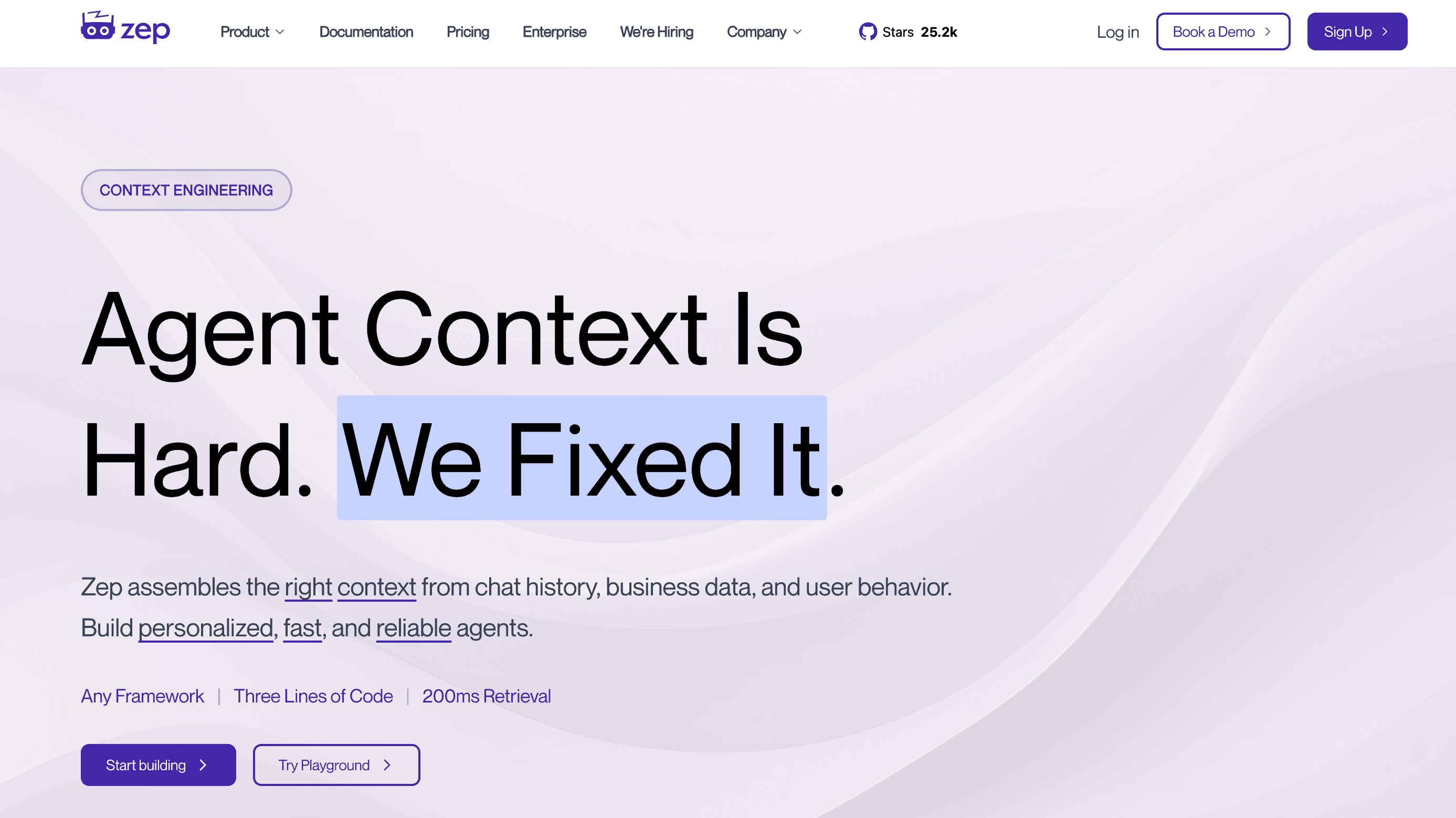
Zep is a long-term memory service specifically built for AI assistants and agents. It focuses on extracting a temporal knowledge graph from conversations and documents. For financial analysis, where timelines such as the sequence of macroeconomic events, M&A developments, or earnings revisions are critical, Zep helps AI applications understand when things happened and how facts have evolved.
Key Features
Temporal Knowledge Graphs: Maps out relationships and timelines of extracted entities.
Extremely Low Latency: Designed for high-speed retrieval to keep agent interactions fluid.
Automatic Fact Extraction: Distills dense financial chats and document queries into core factual nodes.
Seamless Vector Store Integration: Works alongside traditional RAG setups to provide stateful context.
Pros
Outstanding at handling the temporal aspect of financial data (e.g., tracking a company's shifting guidance over four quarters).
Greatly reduces the context window burden by summarizing older chat history intelligently.
Strong privacy and data segregation capabilities.
Cons
Strictly a developer infrastructure tool, lacking an analyst-facing UI.
Requires advanced prompting and orchestration to leverage the temporal graph fully.
Document parsing requires additional external modules to handle complex Excel models.
Pricing
This platform offers three credit-based pricing plans: Flex at $125/month with 50,000 credits, Flex Plus at $375/month with 200,000 credits, and a custom Enterprise plan for mission-critical use cases with tailored credits, compliance support, and dedicated services.
Letta
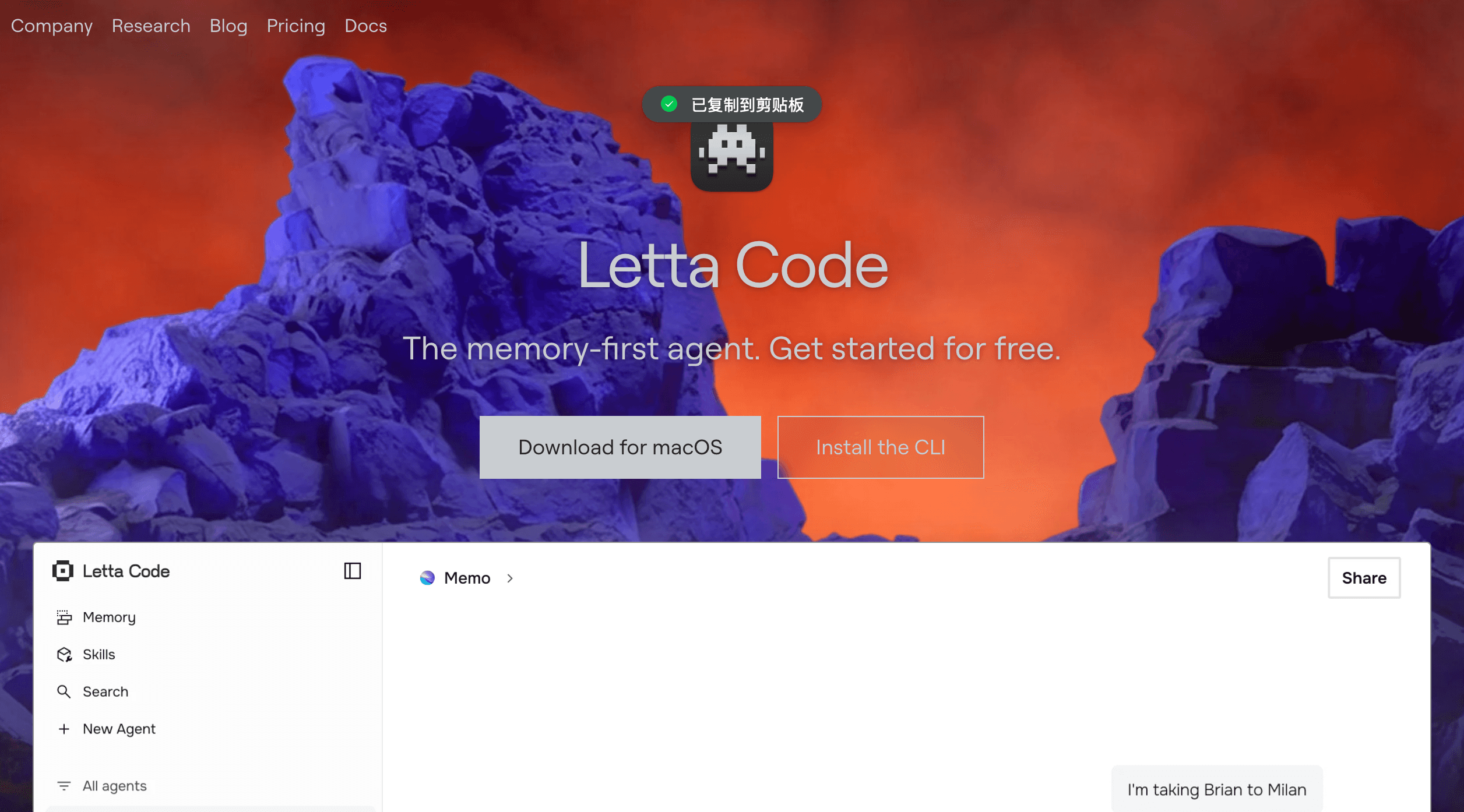
Letta (built by the creators of MemGPT) provides an operating-system-level approach to LLM memory management. It treats the LLM's context window like RAM and its persistent storage like a hard drive, autonomously moving data between the two. This makes it ideal for autonomous financial research agents that need to continuously crawl SEC filings, news, and spreadsheets without ever hitting a hard memory limit.
Key Features
Tiered Memory Architecture: Autonomous paging between main context (RAM) and external databases (Disk).
Self-Editing Memory: The AI agent actively updates, edits, and manages its own memory state.
Infinite Context Illusion: Allows agents to run indefinitely on long-term research tasks.
Agentic Framework: Built to support autonomous workflows rather than just Q&A.
Pros
Brilliant solution for continuous, running financial monitoring agents.
Bypasses token limits intelligently by allowing the AI to fetch what it needs.
Open-source foundation provides flexibility for fintech developers.
Cons
Steep learning curve for integration.
Relies heavily on the LLM's reasoning to manage its own memory, which can sometimes lead to lost context if the model makes an error.
Not a plug-and-play UI for non-technical financial analysts.
Pricing
Letta offers multiple pricing tiers including Pro at $20/month, Max Lite at $100/month, Max at $200/month, and an API Plan at $20/month with usage-based add-ons.
Glean
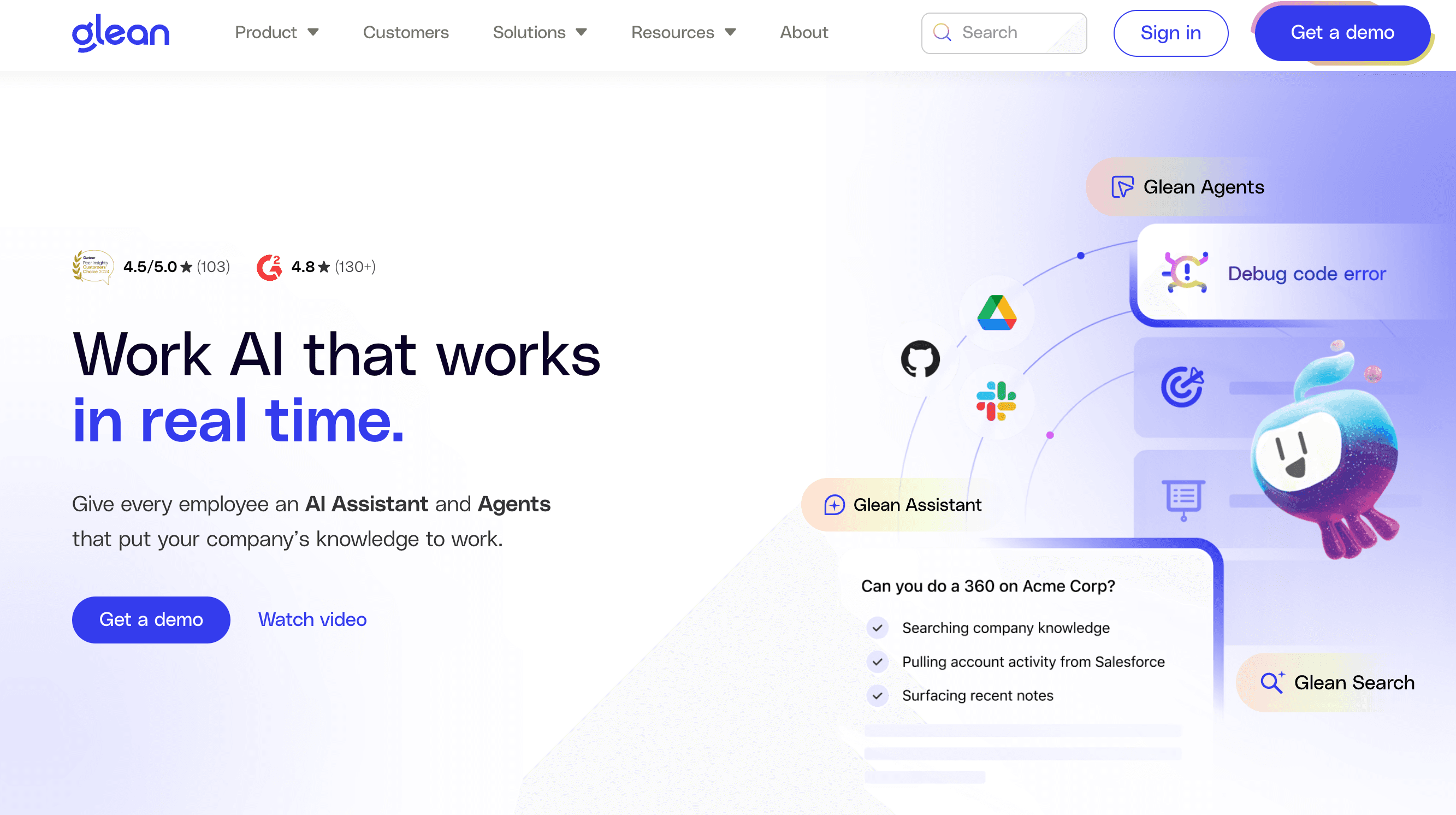
Glean is a sophisticated enterprise AI search and knowledge management platform. While often categorized as internal search, it acts as a massive contextual memory system for corporate finance teams and investment banks. By connecting to a firm’s entire internal ecosystem (SharePoint, Google Drive, Jira, Slack), it gives the AI a complete, governed memory of the institution’s proprietary research.
Key Features
Enterprise Connectors: Native integration with 100+ enterprise data sources.
Strict Permissioning: AI responses respect the firm’s existing document access controls, crucial for compliance in IB/PE.
Knowledge Graph Retrieval: Maps relationships between analysts, documents, and projects.
In-Chat Document Synthesis: Allows users to query the entire firm's repository natively.
Pros
Unmatched in institutional-scale knowledge retrieval and security.
Zero need to manually upload PDFs or Excel files; it indexes them directly from your company drives.
Highly polished, analyst-ready user interface.
Cons
More of an enterprise RAG/search tool than a personalized, cross-session agentic memory layer.
Very high cost barrier for individual analysts or small boutique firms.
Less suited for highly customized, iterative financial modeling workflows.
Pricing
Pricing is available upon request and customized for each enterprise. Interested organizations can request a demo and get a tailored quote based on their specific needs.
Supermemory
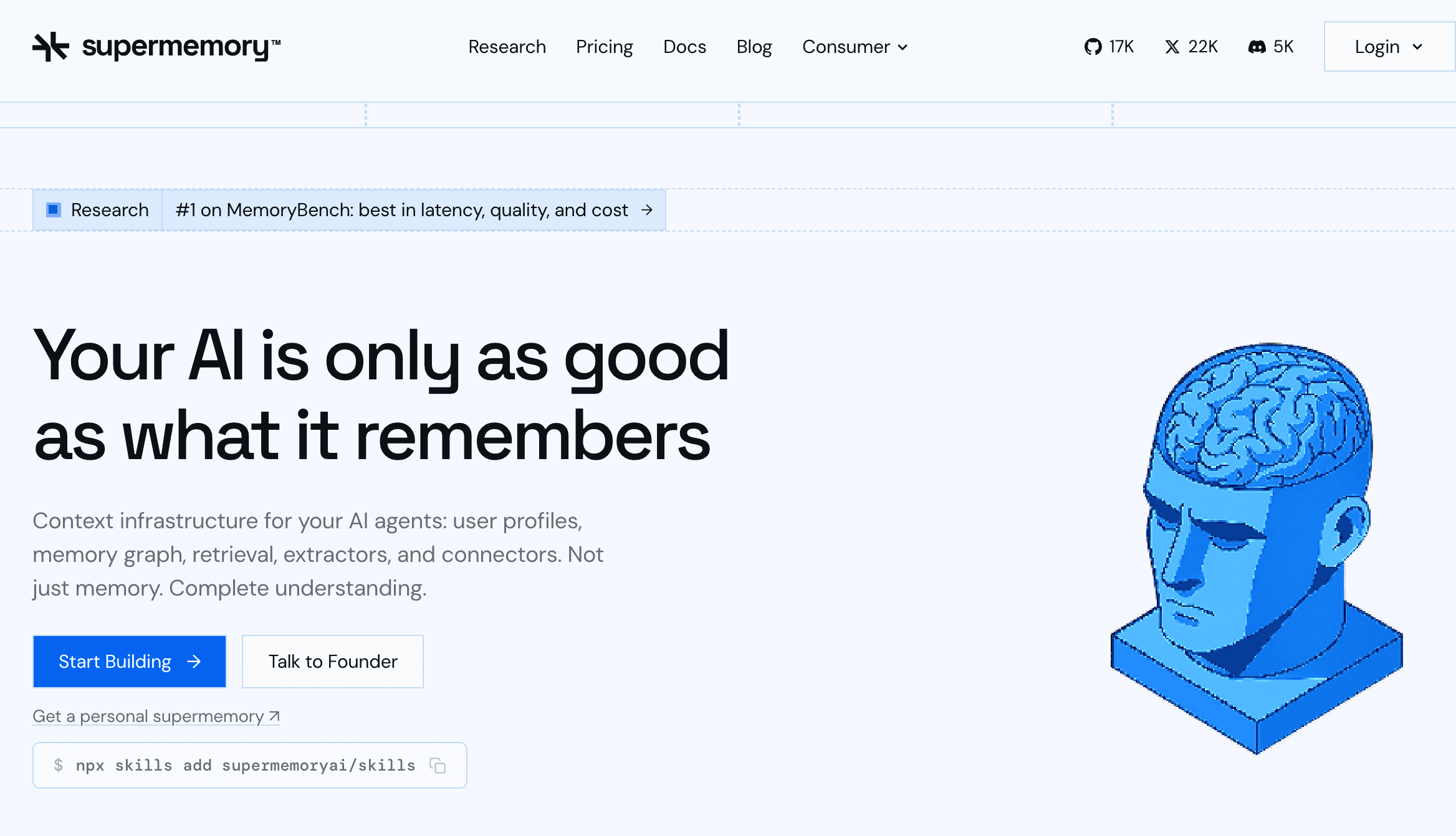
Supermemory is a personal AI bookmarking and memory tool designed for web-heavy research workflows. Financial analysts who spend their days gathering market intelligence, reading financial news, and saving web-based research can use Supermemory to save URLs, PDFs, and snippets into a centralized "brain" and query them later via a chat interface.
Key Features
Web Clipper & Bookmarking: Easily save articles, Twitter threads, and web pages.
Centralized Canvas: Visual organization of saved financial research.
Native AI Chat: Talk to your saved bookmarks and documents instantly.
Privacy-Focused Space: A dedicated vault for personal research.
Pros
Extremely user-friendly for individual analysts doing macro or market sentiment research.
Great extension support for saving data directly from the browser.
Inexpensive and accessible.
Cons
Struggles with massive, complex Excel spreadsheets and large 10-K parsing.
Lacks the robust provenance, governance, and enterprise integrations needed for institutional teams.
Not designed for complex cross-agent portability.
Pricing
Supermemory offers four pricing tiers: Free at $0/month, Pro at $19/month, Scale at $399/month, and custom Enterprise plans, with additional overage fees for tokens and queries.
LangMem
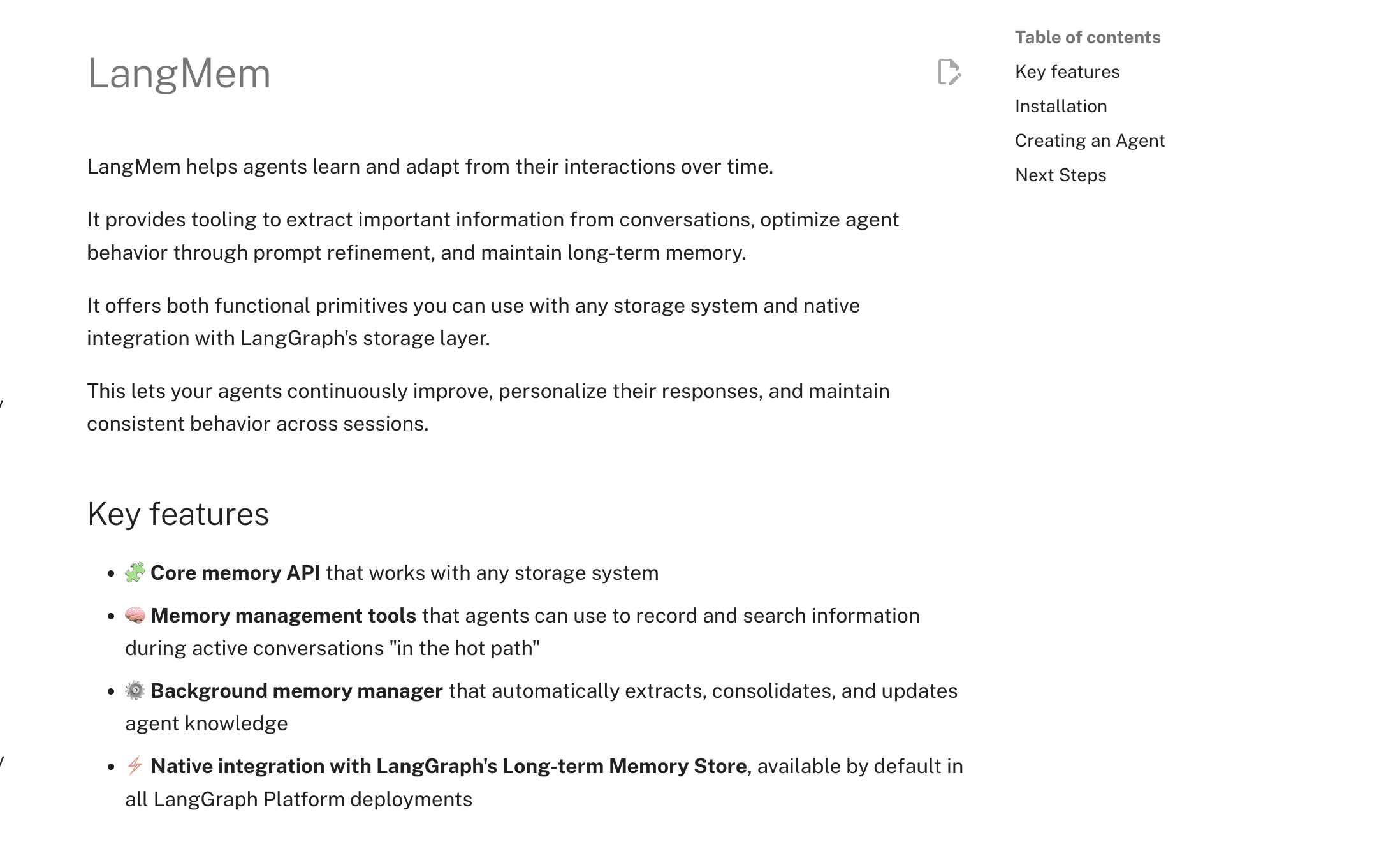
LangMem is the memory module ecosystem built by LangChain. For financial engineering teams already using LangChain to build custom RAG applications, LangMem provides the standardized components to add persistent memory. It allows developers to extract user profiles, track long-running research threads, and build stateful financial assistants.
Key Features
Native LangChain Integration: Works seamlessly with the industry-standard AI orchestration framework.
Profile Extraction: Automatically distills ongoing chats into a permanent user or entity profile.
Thread Management: Manages long-running, multi-turn financial research conversations.
Flexible Storage Backends: Can connect to various vector databases and graph databases.
Pros
The path of least resistance if your internal AI tools are already built on LangChain.
Highly modular; you can plug in your preferred models and storage infrastructure.
Excellent community support and documentation.
Cons
Requires significant Python/development knowledge; not an out-of-the-box tool for end-users.
Performance depends entirely on how the developers configure the extraction prompts.
Can be overkill for simple memory needs.
Pricing
Open-source library is free. LangSmith (for observability and managed features) offers usage-based pricing and custom enterprise plans.
RAGFlow
RAGFlow is an open-source RAG (Retrieval-Augmented Generation) engine tailored for deep document understanding. While RAG is technically stateless, RAGFlow acts as a durable knowledge memory system for financial analysts because of its unparalleled ability to parse, store, and remember the complex layouts of financial PDFs, including nested tables, charts, and OCR-heavy documents.
Key Features
Deep Document Understanding (DDU): Exceptionally accurate parsing of complex financial tables and multi-column PDFs.
Template-Based Chunking: Recognizes document structures natively (headers, tables, paragraphs) to avoid breaking context.
Visual Citations: Traces answers back to the exact visual block in the original PDF.
Workflow Orchestration: Allows the creation of multi-step AI data extraction processes.
Pros
Best-in-class handling of messy, table-heavy financial documents like SEC filings and earnings reports.
Traceability features are excellent for analysts who need to verify numerical data.
Open-source with high data privacy control.
Cons
Primarily a document retrieval system, lacking the personalized user-profile memory of tools like MemoryLake or Mem0.
Does not inherently manage cross-session chat continuity without additional configuration.
UI is functional but more technical than consumer-facing chat apps.
Pricing
Open-source version is free. Cloud/managed versions offer usage-based pricing and contact-sales enterprise tiers.
Why Financial Analysts Need AI Memory Tools
For buy-side, sell-side, and FP&A analysts, standard generative AI often falls short because financial research is continuous, not transactional. A standard AI chatbot treats every new session as a blank slate. AI memory tools solve critical workflow pain points by offering:
Cross-Session Continuity: You shouldn’t have to remind your AI about your macro thesis on semiconductor supply chains every time you log in. Memory tools retain this context indefinitely.
Overcoming Context Window Limits: Even with large context windows in 2026, feeding fifty 100-page SEC filings into a single prompt is slow, expensive, and leads to "needle in a haystack" hallucinations. Memory tools selectively retrieve only what matters.
Large File Management: Dealing with large PDFs and complex Excel spreadsheets requires persistent storage where the AI remembers row-level details and document hierarchies without needing a fresh upload.
Building a Reusable Research Trail: Analysts need their facts, assumptions, and modeling logic saved as a "reusable memory" that compounds over time, creating a durable institutional knowledge base.
Best Picks by Use Case
For Enterprise Governance & Portable AI Infrastructure: MemoryLake is the standout option. According to MemoryLake’s positioning, it excels at taking analysts out of the repetitive "prompt stuffing" loop by acting as a durable, governed, cross-model second brain.
For Isolated, Deep-Dive Project Research: Claude Projects offers immediate value with its 200k context window and Artifacts UI, ideal for building quick financial models.
For Custom Fintech Agent Development: Mem0 and Letta provide the robust backend architecture required by dev teams to build autonomous, stateful financial assistants.
For Firm-Wide Intranet Search: Glean is the premier choice for indexing massive internal repositories on SharePoint and Drive.
AI Memory Tools vs Chat History, RAG, and Vector Search
When exploring tools for long-term financial research, it is crucial to understand the technical distinctions:
Chat History: Basic systems simply reload past transcripts into the prompt. This quickly exhausts the context window limits and raises token costs.
Vector Search / Standard RAG: These systems retrieve relevant text snippets from uploaded documents. However, they are generally stateless. They don't remember you, your ongoing workflow, or evolving analytical preferences.
Persistent AI Memory (e.g., MemoryLake, Mem0): These systems are stateful. They bridge the gap by combining RAG with continuous learning, user profiling, and temporal tracking. They maintain cross-session research continuity, acting as a governed context platform rather than just a search engine.
Conclusion
The era of starting every Monday morning by re-uploading the same core PDFs and Excel files into a blank AI chat window is ending. For financial analysts dealing with large data sets and continuous research cycles, upgrading from simple chatbots to sophisticated AI memory tools is a game-changer for productivity and accuracy.
While developer layers like Mem0 and workspace features like Claude Projects offer significant value depending on your technical capabilities, analysts dealing with complex, recurring research context need a more robust foundation.
For teams that need persistent, governed, cross-workflow memory, MemoryLake stands out as a highly compelling option. By operating as a portable memory passport with deep traceability, it ensures your research trails, facts, and document insights compound over time. If your workflow has outgrown chat history and repeated prompt stuffing, MemoryLake is worth a closer look to future-proof your financial analysis stack.
Frequently Asked Questions
What is an AI memory tool?
An AI memory tool is an infrastructure or application layer that allows AI models to persistently store, manage, and retrieve contextual data (facts, preferences, document insights) across multiple sessions, bypassing standard token limits.
Why do financial analysts need AI memory tools?
Analysts handle continuous research workflows. AI memory tools prevent the need to repeatedly upload the same large PDFs and Excel models, saving time, reducing token costs, and preserving the nuanced context of complex financial models.
Can AI memory tools handle large PDFs and Excel files?
Yes. Advanced memory systems process large files by intelligently chunking and storing the data, recalling specific tables, rows, or paragraphs only when required for analysis, bypassing restrictive context window limits.
Are AI memory tools better than plain RAG or vector search?
For analytical workflows, yes. While plain RAG is great for querying a static document, AI memory platforms retain cross-session continuity, track the evolution of research, and remember the analyst’s custom framing and formatting preferences.
Are there AI memory tools with better governance or traceability?
Yes. Platforms specifically geared toward complex enterprise needs, like MemoryLake, highlight their strong provenance tracking, allowing analysts to trace any AI-generated claim back to the precise cell or document paragraph.
What is the difference between AI chat history and AI memory infrastructure?
Chat history merely feeds past conversational text back into the LLM, quickly hitting token limits. Memory infrastructure actively synthesizes, structures, and updates facts into an intelligent, queryable graph that scales infinitely.