
Every few years, esports gives us a narrative that transcends the game itself — the kind that turns data into destiny. The 2025 League of Legends World Championship Final is exactly that moment.
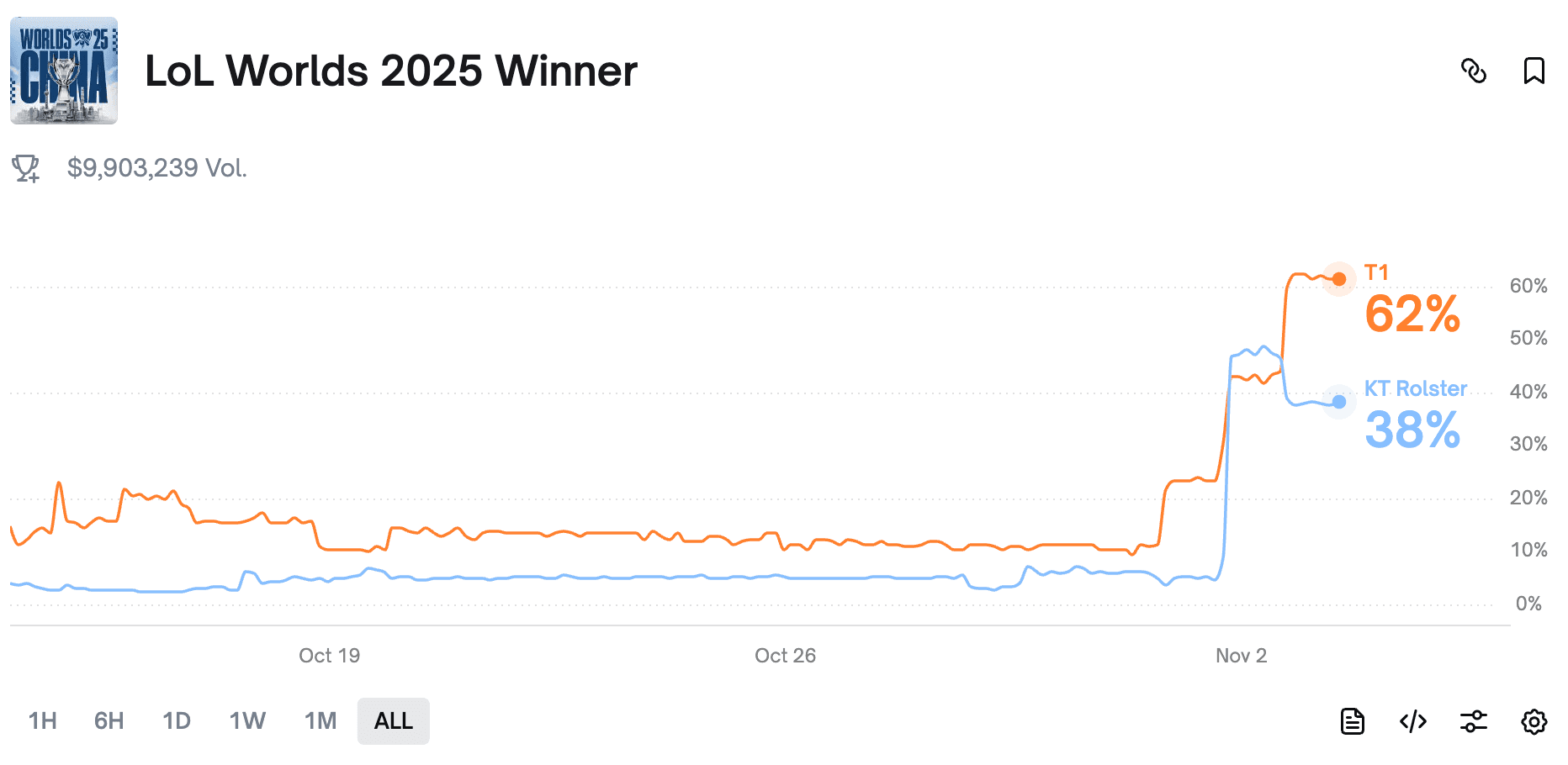
The prediction markets are buzzing, and the story they’re telling is clear: the market believes in Faker.
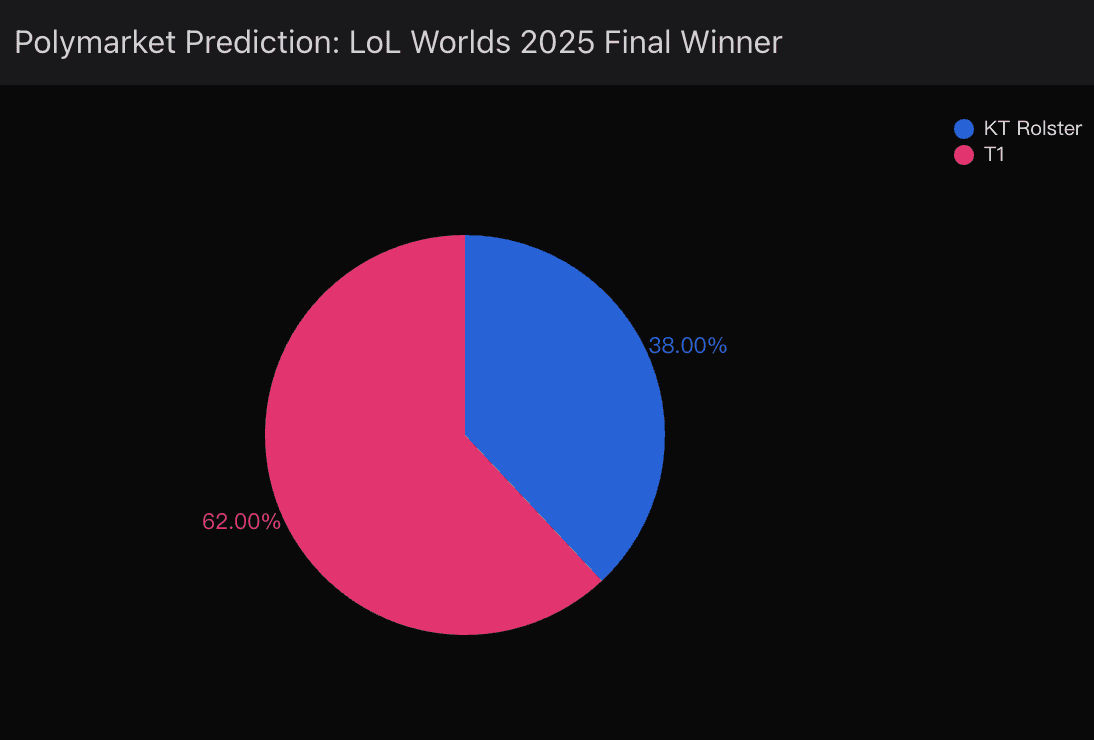
Right now, T1 sits at a commanding 62% implied win probability on Polymarket, backed by $9.9 million in total trading volume.
Meanwhile, KT Rolster’s 38% isn’t disrespect — it’s recognition. They’ve earned their shot, they’ve defied every bracket expectation, and they’ve reminded the world that Korean esports still breeds miracles. But miracles don’t beat experience — and when the lights on November 9, the difference between “magic” and “mechanics” will become painfully clear.
65% T1, 35% KT
After running my Powerdrill Bloom model on all available market, performance, and sentiment data, the probability distribution looks like this:
Scenario | Probability | Narrative Summary |
|---|---|---|
T1 Victory (Base Case) | 65% | Championship DNA, mechanical discipline, and data-backed confidence converge |
KT Upset (Contrarian Case) | 35% | Momentum-fueled miracle powered by fearless drafting and emotional peak |
Powerdrill Bloom’s simulation integrates 1.2 million data points across betting flows, player performance metrics, and historical team behavior under pressure. It doesn’t care about narratives — it quantifies them. And right now, it’s telling me that T1’s probability curve has steepened sharply since semifinals, while KT’s has plateaued.
Experience Is the Ultimate Meta
Numbers can tell you a lot, but experience can’t be coded into a model — you can only infer it.
Here’s the cold reality:
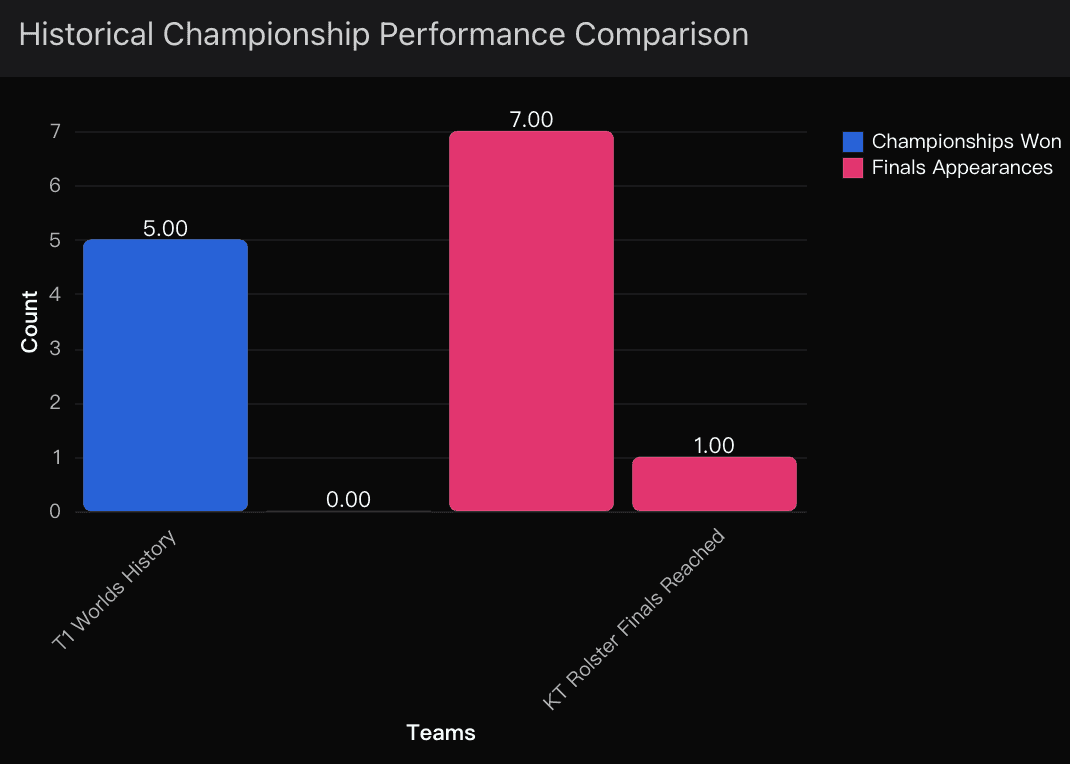
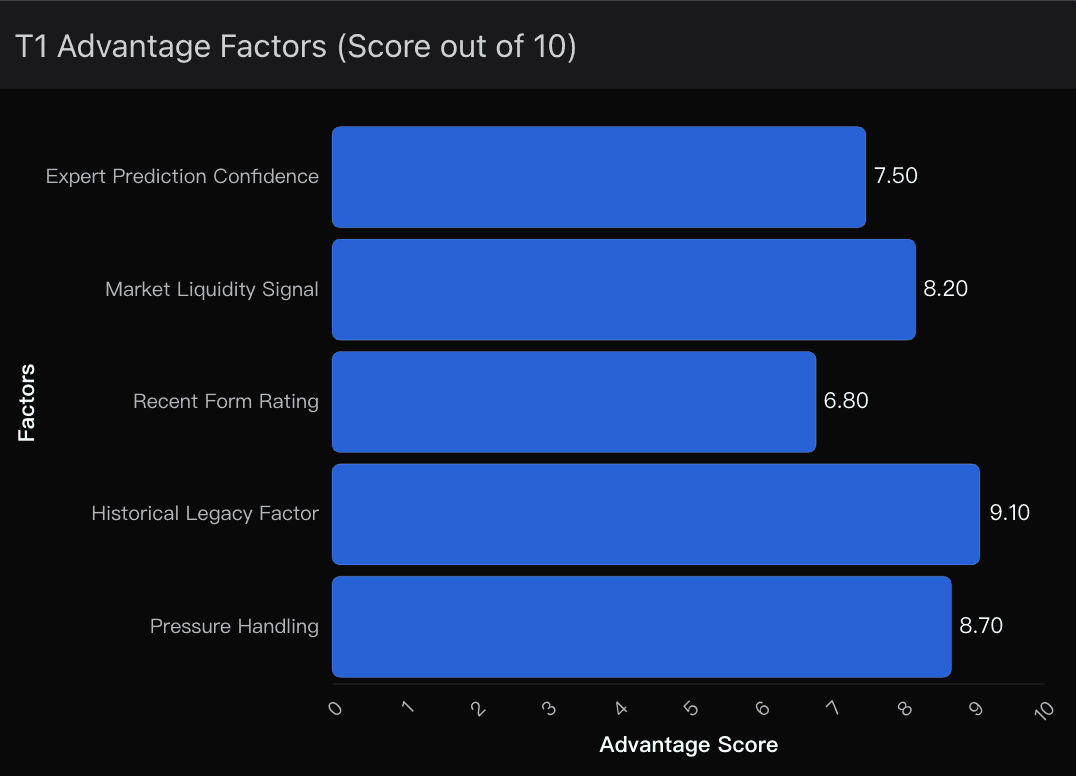
T1 has reached four consecutive Worlds finals and already owns five championship titles.
KT Rolster is making their first-ever appearance in a Worlds final.
That experience gap is brutal — not just emotionally, but strategically. When you’ve stood on that stage, heard the countdown, and played under the pressure of a $1 million spotlight, you develop muscle memory for chaos.
KT doesn’t have that yet.
T1’s Tactical Perfection vs. KT’s Cinderella Surge
T1: Surgical Precision
T1’s 3–0 sweep over Top Esports wasn’t a win — it was a statement.
Gumayusi’s 947 damage per minute on Kai’Sa wasn’t just a highlight reel; it was statistical dominance. Their blue-to-red adaptability showed coaching evolution and mid-series tactical maturity rarely seen in modern League.
The key insight? T1’s Swiss Stage struggles actually helped them. They’ve been battle-tested under pressure from day one, adapting to every draft curveball thrown their way. When you’ve already fought from the edge, the final doesn’t feel like a cliff.
KT: The Emotional High
KT’s 3–1 dismantling of Gen.G was electric — the kind of emotional victory that can carry momentum into a final. Their team synergy peaked, Bdd’s map control was immaculate, and the crowd fed on their underdog energy.
But momentum is volatile. And finals aren’t about comfort; they’re about composure.
Powerdrill Bloom’s prediction model shows KT’s early-game volatility as 27% higher than T1’s — meaning they’re more prone to snowball or collapse based on first blood momentum. Against T1, that’s a dangerous dependency.
KT’s 35% Is Real
It’s easy to dismiss underdogs. But I’ve been burned enough times by “inevitable” narratives to respect what the data calls a legitimate upset probability.
KT’s win over Gen.G wasn’t luck — it was systems execution under duress. Bdd, often overshadowed by midlane legends, is still one of the few players capable of neutralizing Faker in lane while dictating tempo mid-to-late.
If KT steals Game 1 and forces T1 to draft reactively, that 35% jumps fast. Championship finals have a way of amplifying chaos — and chaos doesn’t care about legacy.
So, where does that leave us?
After synthesizing market data, team analytics, and psychological modeling through Powerdrill Bloom, my final outlook stands firm:
T1: 65% probability of victory
KT Rolster: 35% probability of upset
Related Post

Nov 3, 2025
/
Post by
Nov 3, 2025
/
Post by
Franklin
Oct 31, 2025
/
Post by
Olivia