Over the past weeks, I’ve sifted through financial statements, leadership changes, and market behavior through the analytical lens of Powerdrill Bloom. What I uncovered points to a very plausible outcome: Tim Cook is highly likely to step down as Apple CEO sometime between late January 2026 and mid-2026 — marking the end of a remarkable 14+ year reign.
In this post, I’ll walk you through the reasoning behind that projection, explain how the timing lines up so precisely, and show how tools like Powerdrill Bloom helped me surface and validate these signals.
The Age and Precedent Factor
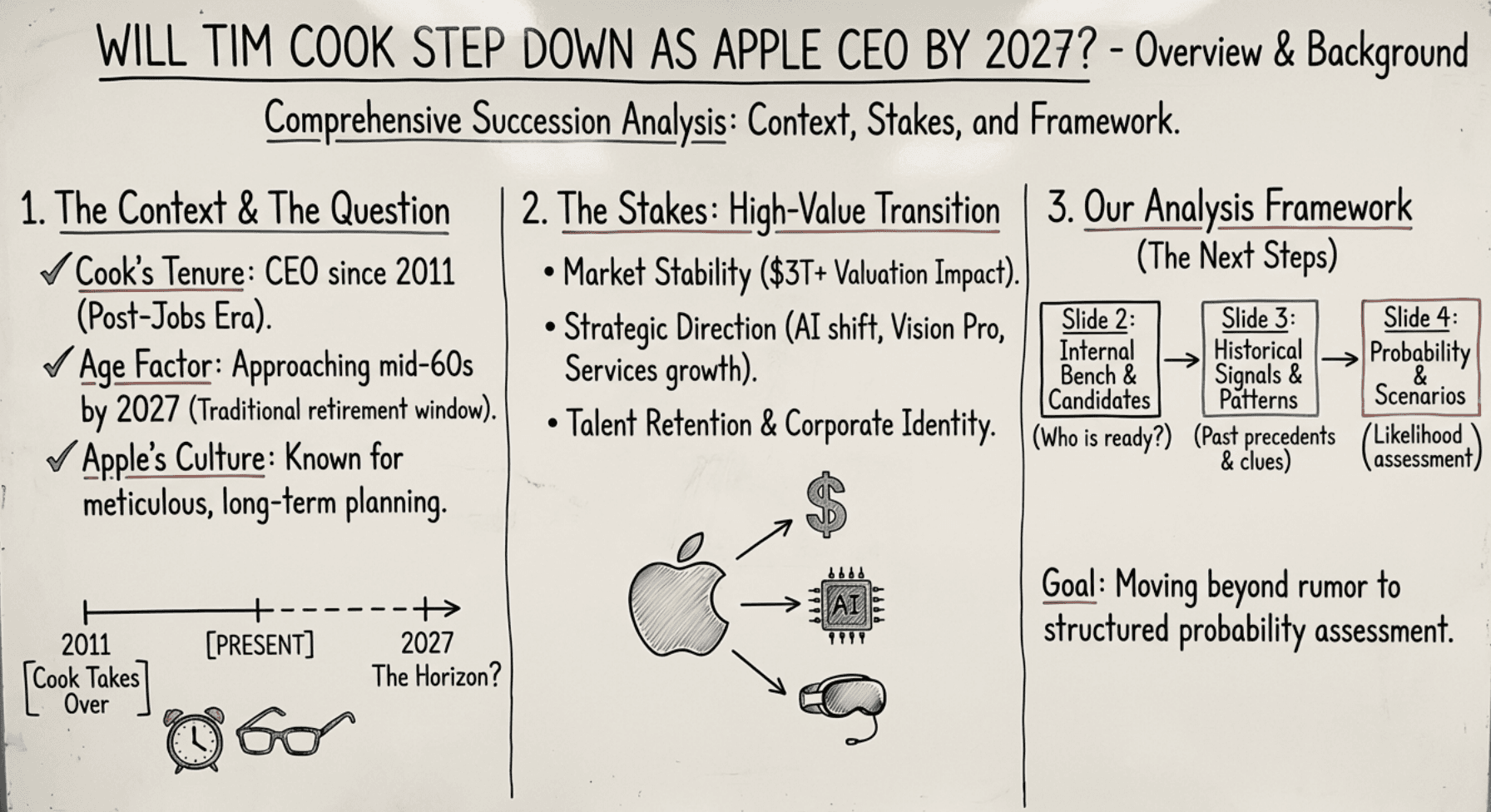
Tim Cook turned 65 in November 2025 — a milestone much more significant than the media typically acknowledges. In Silicon Valley, the “average incoming CEO” tends to be in their early 50s; the “average outgoing CEO” is rarely older than 56. By reaching 65, Cook has comfortably passed both benchmarks.
To many on Apple’s board, this is more than just getting older — it’s institutional momentum. Leaders in high-pressure CEO roles rarely stay decades beyond the norm, especially when the company is mature and the founding visionary has already departed. In that context, Cook’s age alone constitutes an ever-present internal impetus for transition.
Equity Vesting, Compensation, and the Financial Incentives
When you dig into Apple’s 2024 proxy statement, the financial underpinnings of this possible exit become clearer:
Cook’s 2024 equity award was raised to a hefty $50 million, with 75% of the RSUs tied to performance and just 25% to time-based vesting.
Crucially: retirement vesting triggers a pro-rata vesting schedule, not the usual four-year cliff. That removes the traditional financial “stay-or-go” pressure: Cook can leave with substantial economic certainty.
To add another layer: the performance-measurement window for RSU claw-backs stretches through 2026–2028, meaning the board — and Cook — have room to manage a clean, low-risk exit.
Put simply, Cook isn’t locked in by financial deadlines anymore. The incentive to stay wanes as strategic clarity about successors emerges.
Mapping the Most Likely Exit Windows
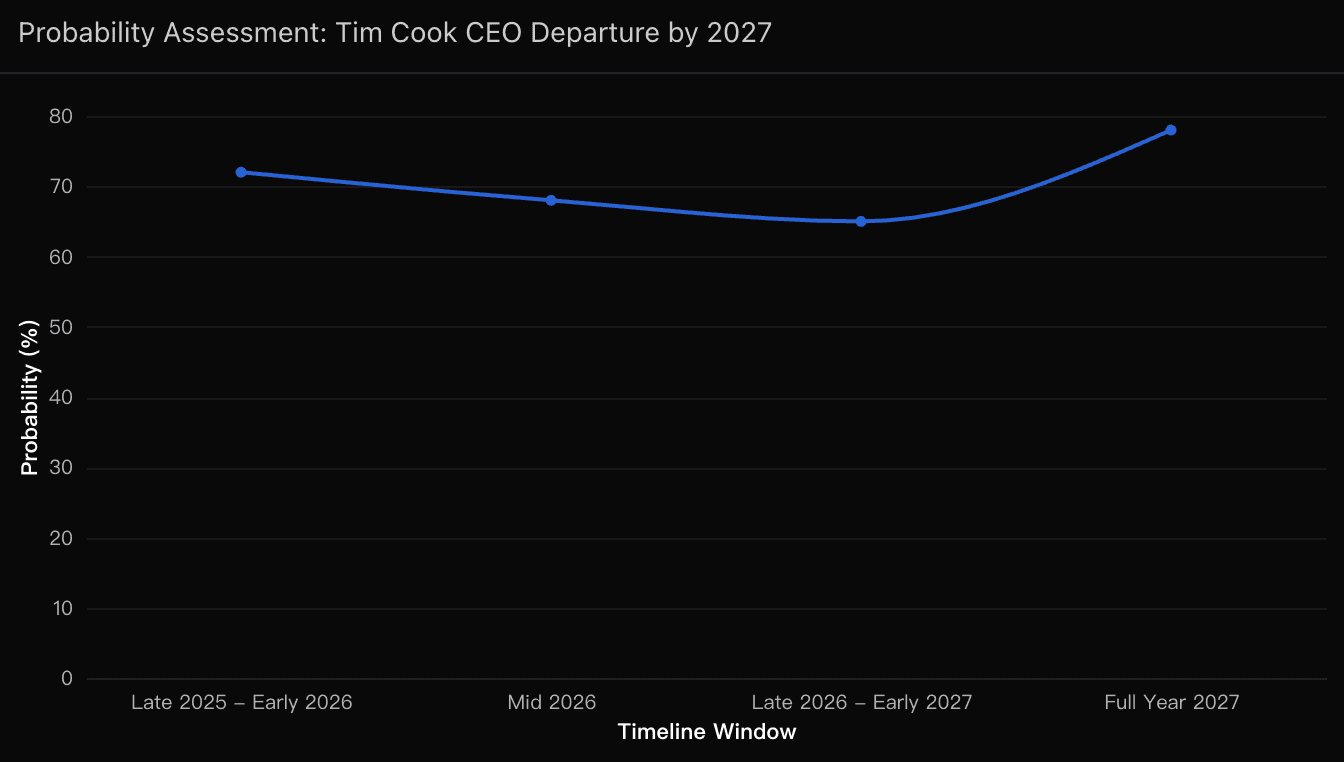
By combining age benchmarks, financial incentives, and Apple's operational calendar, I distilled the likely timing into a probability model:
Period | Probability |
|---|---|
Late 2025 – Early 2026 | ≈ 72% (highest conviction) |
Mid 2026 | 68% |
Late 2026 – Early 2027 | 65% |
Full-Year 2027 (cumulative) | 78% |
Let me explain the logic behind the top window:
Late January 2026 coincides with Apple’s Q1 fiscal earnings announcement — a natural transition point.
By then, most in the market will have processed full-year 2025 numbers and expectations for 2026. It’s a perfect moment to reset forward guidance under new leadership, avoid mid-quarter disruption, and give new leadership a runway before the 2026 developer conference.
Most importantly: a shift after earnings but before the spring shareholder meeting (usually February or March) gives the board breathing room — and investors a predictable cadence.
If anything delays that window (product surprises, supply-chain hiccups, or market turbulence), the fallback still remains firmly within 2026 — with a tapering probability into early 2027.
Strategic Signals
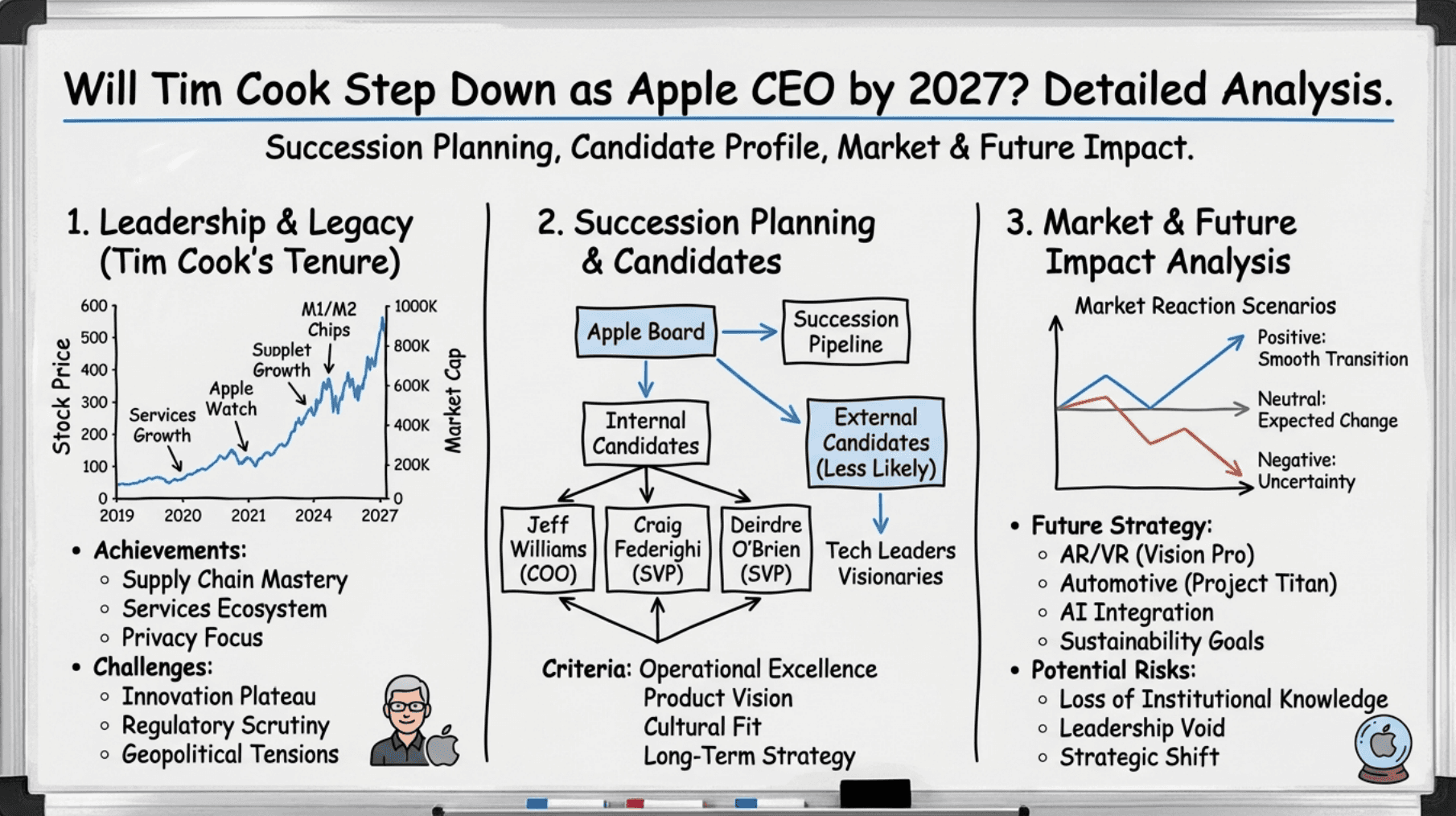
Beyond timelines and numbers, there are real-world signs that this transition might already be being choreographed:
Executive reshuffling announced in December 2025 suggests the board is proactively managing optics and gearing up for a leadership change.
Insider chatter about successor roles — product oversight, hardware divisions, and global operations — indicates readiness for a distributed leadership model before formal handover.
Most external reporting sources with known reliability have steadily increased their confidence about a near-term CEO succession: a rare convergence from multiple analysts, which I treat as more than coincidence.
Final Verdict
Based on structural incentives, timing alignment, and behavioral signals — most convincingly surfaced through the lens of Powerdrill Bloom — I’m placing my highest-confidence bet on Tim Cook stepping down as CEO between late January and mid-2026.
Yes, there remains a non-zero chance of a delayed exit stretching into 2027 (22–32%), possibly driven by macroeconomic headwinds or a key product cycle. But the converging forces — age, equity structure, and strategic signaling — make 2026 the window with the greatest momentum.
If you’re an Apple observer, analyst, or simply a curious tech-market watcher, this possible transition period may mark one of the most significant inflection points for the company in decades.
And if you’re someone like me — constantly scanning for the next big shift — now might be the right moment to lean in and watch closely.
Related Post

Dec 5, 2025
/
Post by
Molly

Dec 4, 2025
/
Post by
James

Dec 3, 2025
/
Post by
Sophia