MemoryLake vs Mem0: Which Is Better for Long-Term Memory in AI Agents?
Introduction
As enterprise AI evolves from stateless chatbots to autonomous AI agents, the underlying infrastructure is experiencing a massive paradigm shift. Models are no longer just expected to answer questions—they are expected to understand continuous business contexts, remember user preferences across sessions, and execute complex workflows over time.
This transition has given rise to the AI memory layer, a dedicated infrastructure component designed to give language models long-term, persistent context. When evaluating the best AI memory tools on the market today, two names frequently surface at the top of the list: MemoryLake and mem0.
While both platforms aim to solve the problem of "forgetful AI," they approach the challenge from entirely different architectural philosophies. This comprehensive comparison will explore MemoryLake vs mem0, analyzing their product positioning, capability boundaries, and ideal use cases to help you choose the right long-term memory system for your AI agents.
Quick Answer: The Core Difference Between MemoryLake and Mem0
If you are currently evaluating an AI memory platform comparison, here is the short version:
MemoryLake is a highly popular, enterprise-grade, multimodal AI memory infrastructure designed to act as a persistent, portable, and private memory lake. According to its public positioning, MemoryLake excels at cross-session and cross-model continuity, prioritizing strict data governance, conflict handling, versioning, and user-owned AI memory.
Mem0 is a developer-centric memory layer that intelligently extracts and stores semantic facts from conversational data. Known for its quick developer integration and open-source availability, mem0 categorizes context into user, session, and agent scopes.
What is AI Memory? (And What It Isn't)
Before diving into mem0 alternatives or MemoryLake features, we must clearly define what a long-term AI memory system actually is. The concept is frequently confused with other technologies.
AI memory is NOT just chat history.
Chat history is merely a raw log of past interactions. If you dump 50 pages of chat history into a prompt, the LLM will hallucinate, lose focus, and burn through expensive tokens. True AI memory systems intelligently extract, consolidate, and update facts from those logs, retrieving only what is contextually relevant.
AI memory is NOT just RAG (Retrieval-Augmented Generation).
This is a critical distinction for anyone comparing ChatGPT memory vs MemoryLake or mem0 vs RAG. Standard RAG takes static, external documents (like a company HR policy), chunks them, puts them in a vector database, and retrieves them. It is static and impersonal. AI memory, by contrast, is dynamic and stateful. It learns about the user and about the ongoing session, updating its knowledge graph as facts change over time.
AI memory is NOT TurboQuant.
In early 2026, Google Research unveiled TurboQuant, a breakthrough compression algorithm that shrinks the Key-Value (KV) cache of an LLM by 6x with zero accuracy loss. While TurboQuant is an incredible advancement for short-term hardware memory (allowing models to process longer inputs faster during inference), it is entirely different from long-term semantic memory. TurboQuant compresses the active context window; platforms like MemoryLake and mem0 manage the persistent knowledge that persists after the context window is closed.
Why do AI agents need persistent memory? Because without cross-session memory, an agent cannot learn from past mistakes, cannot evolve its understanding of a complex workflow, and forces the user to repeat instructions endlessly.
What is MemoryLake?
According to MemoryLake’s public website and documentation, the platform is not merely a generic vector database or a simple RAG layer. It is a persistent, portable, and private AI memory layer that guarantees continuity across models, agents, and sessions.
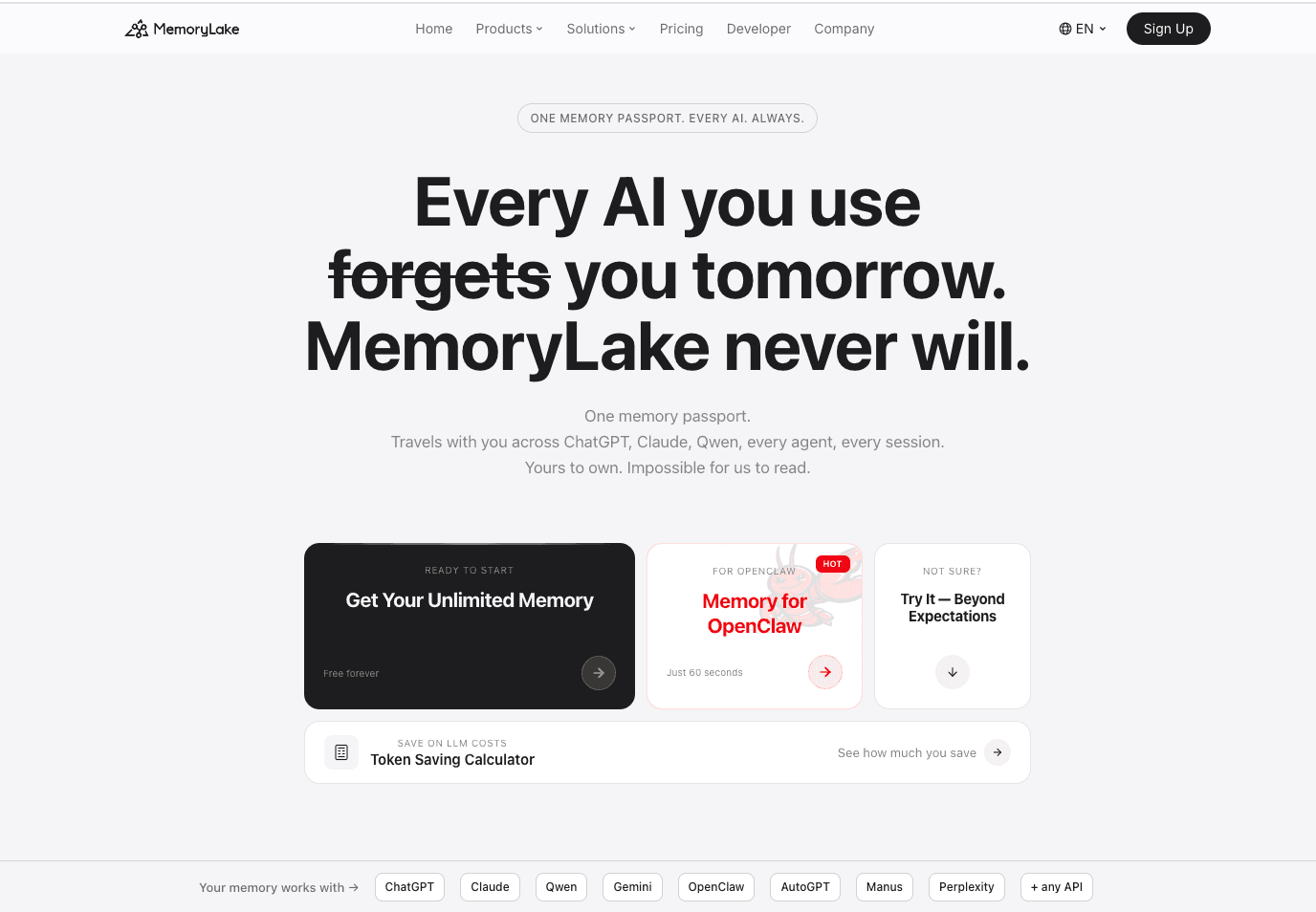
MemoryLake highlights a deep commitment to user-owned AI memory. It treats memory as a highly governed asset, offering advanced capabilities such as:
Intelligent Conflict Handling: When a user's preferences or facts change over time, MemoryLake merges and resolves conflicts dynamically rather than just storing contradictory vectors.
Memory Versioning and Traceability: Enterprises can track exactly when and how a specific memory was formed, ensuring complete auditability.
Multimodal Understanding: Powered by its proprietary extraction models, MemoryLake can process complex Excel tables, PDFs, and audio-visual data into structured "memory units," capturing full decision trajectories rather than just text snippets.
Based on public GitHub repositories detailing the rigorous SNAP Research LoCoMo (Long-term Conversational Memory) benchmark, MemoryLake ranks #1 overall, heavily outperforming baselines in temporal reasoning and open-domain tasks.
What is mem0?
Mem0 is designed to sit between your application and the LLM. It automatically extracts relevant information from conversations, stores it using a combination of vector search and graph relationships (often integrating with tools like AWS Neptune Analytics), and retrieves it when needed.
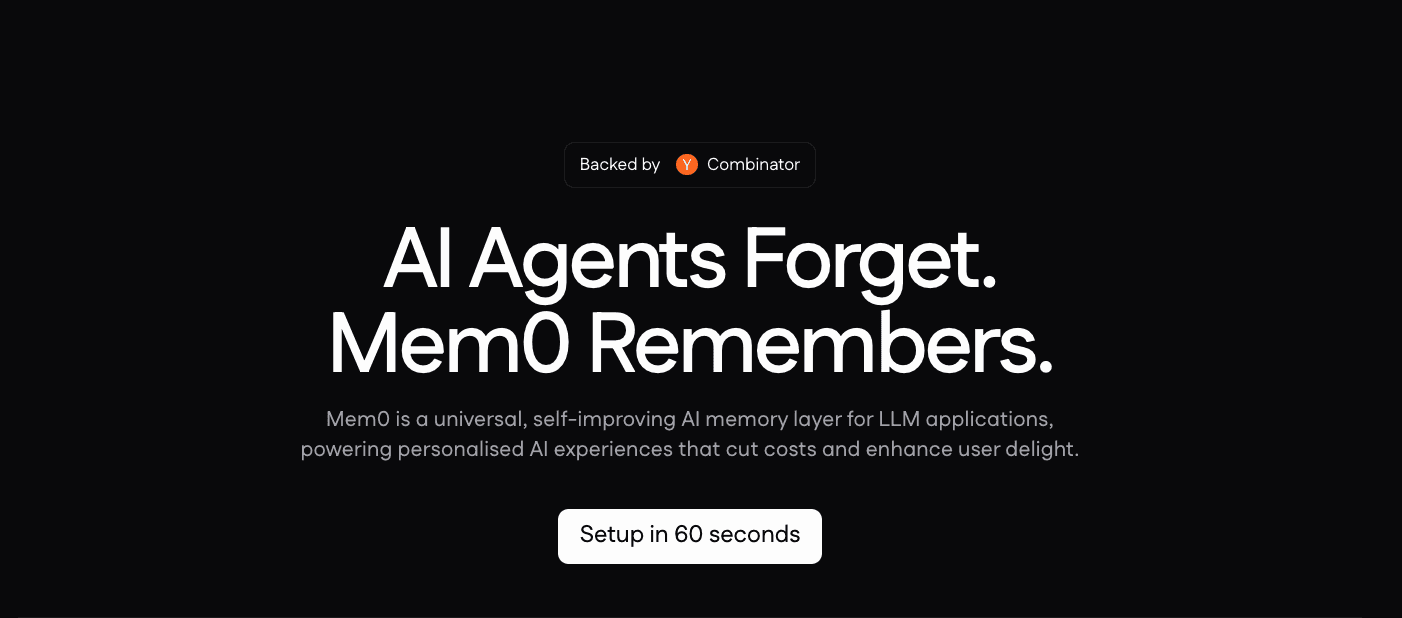
Mem0 organizes memory into three distinct, easy-to-manage scopes:
User Memory: Persists across all conversations with a specific individual.
Session Memory: Tracks context within a single, isolated conversation.
Agent Memory: Allows specific AI agents to retain specialized instructions or learned behaviors.
According to mem0's research papers, it reduces token usage by roughly 90% compared to full-context approaches and outperforms standard built-in memory features (like OpenAI's native memory) by 26% on the LOCOMO benchmark. It is highly favored by developers for its unified APIs, robust open-source community, and quick integration with any LLM provider.
MemoryLake vs mem0: Comparison Table
To help you evaluate these two long-term memory for LLMs solutions, here is a side-by-side comparison of their core attributes:
Feature | MemoryLake | mem0 |
Core Architecture | Multimodal Memory Lake (Infrastructure level) | Universal Memory Layer |
Primary Target | Enterprise AI systems, complex agents, decision intelligence | App developers, consumer SaaS, personalized chatbots |
Data Modalities | Multimodal (Text, tables, audio, visual, workflows) | Primarily text and conversational interactions |
Memory Ownership | Highly emphasized (Persistent, portable, private, user-owned) | Standard data isolation via User/Session/Agent scopes |
Conflict & Versioning | Advanced conflict handling, timeline backtracking, full traceability | Automatic filtering, decay mechanisms, basic update logic |
Benchmark Performance | Ranks #1 overall on LoCoMo benchmark (high temporal reasoning) | Outperforms OpenAI memory by 26% on LOCOMO |
4 Key Decision Factors
When evaluating an agent memory platform, looking at feature lists isn't enough. Here is how MemoryLake and mem0 differ on the most critical architectural and business dimensions.
1. Modality and "Decision Trajectories"
If you are building an AI agent that only interacts via text chat, mem0 is exceptionally efficient. It uses LLMs under the hood to extract semantic facts from text and map them into vector/graph stores.
MemoryLake differentiates itself heavily here by focusing on multimodal memory. According to MemoryLake’s architectural documentation, enterprise decisions aren't made just in chat; they involve spreadsheets, PDFs, and multimedia. MemoryLake is engineered to ingest these various modalities and construct a continuous "decision trajectory," allowing agents to reason over a much richer corpus of real-world information.
2. Governance, Privacy, and User Ownership
For enterprise AI memory governance, the stakes are incredibly high. A persistent memory layer stores the most sensitive context about users and business logic.
Mem0 handles security well, boasting SOC 2 & HIPAA compliance and offering Bring Your Own Key (BYOK) architectures.
However, MemoryLake elevates this by structurally treating memory as a private, user-owned asset. It emphasizes strict traceability—allowing administrators to see the exact provenance of a memory (where it came from, which model extracted it, and when). This ensures that memory is portable and fully governed, making MemoryLake highly attractive for strictly regulated industries.
3. Temporal Reasoning and Conflict Handling
AI agents must deal with changing facts. A user might say "I live in New York" in January, and "I just moved to London" in March.
Mem0 uses memory decay mechanisms and update prompts to replace old information, which is highly effective for standard user profiles.
MemoryLake takes a more rigorous approach to temporal reasoning. It supports complex timeline backtracking and intelligent conflict merging. Instead of just overwriting a fact, it understands the chronological evolution of the data. This is reflected in its performance on the LoCoMo benchmark, where MemoryLake highlights a massive lead in the "temporal reasoning" category, ensuring that facts that evolve across dozens of sessions are reasoned over accurately.
4. Portability and Cross-Model Continuity
Both platforms support multiple LLMs (OpenAI, Anthropic, open-source models). However, MemoryLake strongly emphasizes cross-model and cross-agent continuity as a core philosophy. Because it is a unified data lake, an agent powered by Gemini can seamlessly pick up a task using the exact memory context generated by an agent powered by Claude yesterday, with zero fidelity loss and complete structural compatibility.
Which Use Cases Are Better for MemoryLake vs mem0?
When to Choose MemoryLake:
Enterprise-grade Decision Intelligence: Agents that need to analyze complex, multimodal data (spreadsheets, reports) spanning months of company history.
Multi-Agent Workflows: Environments where different specialized agents must share a single, highly governed memory state.
Regulated Industries: Finance, healthcare, or manufacturing where memory traceability, versioning, and user-ownership are compliance requirements.
Dynamic Gaming & Metaverse: Building continuously evolving "worldview memories" for NPCs that require deep, conflict-free chronological reasoning.
Cost Optimization: Teams looking to drastically cut LLM API costs.
When to Choose mem0:
Consumer SaaS & Chatbots: Adding immediate personalization to a customer-facing app (e.g., a fitness app agent remembering a user's workout history).
Developer-Led Projects: Teams wanting a fast, open-source-friendly SDK to quickly get a stateful agent off the ground.
How to Choose an AI Memory Platform for Your Agents
If you are building AI agents/Openclaw and looking at mem0 alternatives or MemoryLake, your evaluation should center on three questions:
What is the scale of my context? If you are tracking simple user preferences, go with mem0. If you are tracking complex corporate decision histories across files and formats, lean toward MemoryLake.
What are my governance requirements? If you need deep versioning, timeline backtracking, and absolute provenance of every memory node to satisfy enterprise risk teams, MemoryLake's architecture is explicitly designed for this.
What is my engineering timeline? If you need to ship a personalized memory feature by next week, MemoryLake's developer experience is currently one of the best in the industry.
What Else to Evaluate Beyond MemoryLake and Mem0
While MemoryLake and mem0 are leading dedicated memory platforms, the broader AI memory tools comparison includes other approaches:
Standard Vector Databases (Pinecone, Milvus): Great for static RAG, but they require you to build your own extraction, conflict resolution, and update logic if you want true "memory."
Graph Databases (Neo4j): Excellent for mapping relationships, but again, they are bare-metal databases, not out-of-the-box memory layers. (Note: mem0 can use graph stores like AWS Neptune under the hood).
Native Provider Memory (ChatGPT Memory): OpenAI offers built-in memory for its API, but it locks you into their ecosystem. Both MemoryLake and mem0 provide the critical advantage of being model-agnostic, preventing vendor lock-in.
Conclusion
The era of forgetful AI is over. As we expect language models to act as autonomous agents and business partners, a robust long-term AI memory system is no longer optional—it is the foundation of the architecture.
Mem0 has proven itself as a brilliant, highly effective memory layer that brings immediate personalization and cost savings to LLM applications.
However, for organizations looking to build a true enterprise infrastructure—one that handles multimodal data, enforces strict governance, ensures temporal reasoning, and treats memory as a portable, user-owned asset and cost savings to LLM applications—MemoryLake stands out as the superior architectural choice. By treating memory not just as a cache of vectors, but as a deeply structured, version-controlled lake of knowledge, MemoryLake is redefining what stateful AI can achieve.
Frequently Asked Questions
What is mem0 used for?
Mem0 is primarily used by developers to give AI applications and agents persistent memory. It extracts facts from user conversations and stores them across User, Session, and Agent scopes, allowing chatbots to remember user preferences, maintain context over long periods, and significantly reduce token costs during inference.
What is MemoryLake?
MemoryLake is an enterprise-grade AI memory service and data platform that provides persistent, portable, and private memory for AI agents. It processes multimodal data (text, tables, media) into structured memory units, focusing heavily on user-ownership, traceability, and high-performance temporal reasoning across multiple sessions and AI models.
Why do AI agents need long-term memory?
Without long-term memory, AI agents are "stateless." They treat every interaction as if it were the first, requiring users to repeat instructions continuously. Long-term memory allows agents to learn from past mistakes, understand evolving contexts, execute multi-step workflows over days or weeks, and provide highly personalized experiences.
What is the difference between AI memory and RAG?
RAG (Retrieval-Augmented Generation) connects an AI to external, static documents (like a company wiki) to help it answer questions. AI memory is dynamic and stateful; it actively records, updates, and manages facts learned during interactions with the user, evolving its knowledge base as the user's preferences and situations change.
How do you choose an AI memory platform?
You should choose an AI memory platform based on your data complexity and governance needs. Evaluate whether you only need simple text-based personalization (favoring tools like mem0) or if you require multimodal data ingestion, strict auditability, conflict resolution, and cross-agent enterprise continuity (favoring platforms like MemoryLake). Always prioritize platforms that prevent vendor lock-in by supporting multiple LLMs.