How to Do a SWOT Analysis: Examples and Template
A SWOT analysis sorts the factors that affect a goal into four groups: strengths and weaknesses inside your control, and opportunities and threats outside it. To do one, set a clear objective and gather evidence. Fill in the four quadrants with specific statements, then rank the items and turn the top ones into actions.
This guide covers what a SWOT analysis is, when to use it, and how to do one in six stages. It also lists the questions to ask in each quadrant, a template, three examples, an AI method in three steps, and common mistakes.
What a SWOT analysis is
SWOT stands for strengths, weaknesses, opportunities, and threats. The Community Tool Box is a University of Kansas resource. It says the method "guides you to identify your organization's strengths and weaknesses (S-W), as well as broader opportunities and threats (O-T)."
The four groups sit on two lines. One line splits what is internal from what is external. The other splits what helps from what harms. The Minnesota Department of Health describes the setup in one sentence. "Create a chart with columns titled 'Helpful' and 'Harmful,' and rows titled 'Internal' and 'External.'"
| Helpful | Harmful | |
|---|---|---|
| Internal | Strengths | Weaknesses |
| External | Opportunities | Threats |
The method is not only for companies. The Community Tool Box says it was "originally developed for business and industry." It adds that it is "equally useful in the work of community health and development, education, and even for personal growth."
When to use a SWOT analysis
Use one when a decision depends on both your own position and the world around you. Business Queensland, a Queensland Government service, lists uses. It says a SWOT analysis can help you "decide if you should introduce a new product or service" and "understand your market and competitors."
Common moments include:
- Planning. Business Queensland says it can "be part of your regular strategic planning review (quarterly, half-yearly or yearly)."
- A specific decision. Launching a product, entering a market, or changing a supplier.
- A program review. The Minnesota Department of Health says SWOT analyses "can be performed on multiple levels of an organization." Its examples are a program, a division, or a specific process.
- A career choice. Career offices use a personal version to prepare for a job search, an interview, or a career change.
The tool also has limits. Business Queensland says a SWOT analysis "will not prioritise issues" and "will not provide solutions or offer alternative decisions." Plan for those steps from the start.
Before you start: objective, scope, and people
Three choices shape the result.
Set one objective. Write the decision in one sentence, such as "Should we open a second location next year?" Every item in the grid should relate to it. Without an objective, the lists grow long and vague.
Set the scope. Decide whether you are reviewing the whole business, one product, or one team. Business Queensland says you can review your entire business or "conduct an analysis focussing on 1 or 2 specific issues."
Invite more than one view. The Community Tool Box says a small group can develop the analysis. It adds that "it will be more effective if you take advantage of many stakeholders." Business Queensland advises you to "ask for input from your employees, suppliers, customers and partners."
How to do a SWOT analysis in six stages
Here is the manual method, step by step. It works on paper, in a spreadsheet, or in a meeting.
- Write the objective at the top. One decision, one sentence, and a date.
- Gather evidence before you fill the grid. Pull sales figures, customer feedback, cost data, competitor prices, and any market reports. Business Queensland suggests "researching trends, reports and industry data" for the external side.
- List internal factors. Fill strengths and weaknesses first. The Community Tool Box lists areas to check: human resources, physical resources, finances, activities and processes, and past experiences.
- List external factors. Fill opportunities and threats next. The Community Tool Box says "Cast a wide net for the external part of the assessment." Its list covers trends, the economy, funding sources, demographics, legislation, and events.
- Make each item specific. Replace "good staff" with who, what skill, and why it matters. The Minnesota Department of Health says to "verify/quantify statements when possible, rather than making general statements."
- Rank and act. Business Queensland says to select "a maximum of 3–5 issues from each quadrant," prioritize them, and create an action plan for each one.
In a group, give people time to brainstorm before you judge any idea. The Community Tool Box suggests giving small groups "20-30 minutes to brainstorm." It then asks them to report back in S-W-O-T order.
Questions to ask for each quadrant
Good questions keep the lists honest. These come from Business Queensland's SWOT guidance and the Minnesota Department of Health.
Strengths (internal, helpful)
- What does the business do well?
- What is your competitive advantage, and could it reach more customers?
- What skills, knowledge, networks, and reputation do you have?
Weaknesses (internal, harmful)
- What are the weaknesses of your systems and processes?
- Are there weaknesses in your business model?
- What might other organizations do better than yours? The Minnesota guidance lists this among possible weaknesses.
Opportunities (external, helpful)
- What are the current industry trends, and can they work in your favor?
- Are there upcoming changes in customers, regulation, or technology?
- Are there unmet customer needs that no one else serves?
Threats (external, harmful)
- What external factors could put the business at risk?
- What new competitors may enter your market?
- What political, environmental, social, and technological factors might affect you?
One more tip from the Minnesota guidance applies to all four quadrants. "Try to look at your organization from an external perspective, even when assessing internal factors." Ask what customers and partners would say.
SWOT analysis template
Copy this template into a document or a spreadsheet. Keep each quadrant to a short list. The Community Tool Box suggests asking groups to choose "10 or fewer points so that the analysis can be truly helpful."
| Objective: (one decision, one sentence) | Date: | Owner: |
|---|---|---|
| Strengths (internal, helpful) — Item, evidence, source | Weaknesses (internal, harmful) — Item, evidence, source | |
| Opportunities (external, helpful) — Item, evidence, source | Threats (external, harmful) — Item, evidence, source | |
| Top 3 to 5 issues — Ranked, with the quadrant each came from | Actions — Owner, budget, deadline, review date |
The evidence column is what makes the grid checkable. Without it, a SWOT analysis records opinions. With it, anyone can check why an item is on the list.
SWOT analysis examples
The three examples below show different scopes. The first is Business Queensland's own example. The other two are illustrative, not results from a real business or person.
A small business deciding on a new product. Business Queensland's example comes from "a business trying to decide if they should introduce a new product to their range." Its lists include:
- Strengths: excellent sales staff with strong product knowledge, a high traffic location, and a reputation for innovation.
- Weaknesses: trouble meeting deadlines, high rental costs, cash flow problems, and poor record keeping.
- Opportunities: similar products on the market are less reliable or more expensive, and customers have asked for a similar product.
- Threats: a competitor with a similar product, a new competitor shop nearby, and a downturn that may reduce spending.
Notice how specific the threats are. The page says "rather than simply list 'competitors' as a threat, specific details about how competitors are a threat have been included."
A software team planning next year (illustrative). Strengths: 92% of customers renew, and support replies within four hours. Weaknesses: one engineer owns the billing code, and onboarding takes three weeks. Opportunities: two large customers asked for an integration, and a rival raised prices. Threats: a new privacy rule in one market, and a well-funded new entrant.
A personal SWOT for a job search (illustrative). A career worksheet from Virginia Commonwealth University (VCU) asks you to note "your strengths and weaknesses in a situation," then the opportunities and threats. A handout from Cal Poly Humboldt says the exercise takes about "10-20 minutes depending on the nature of the topic." A graduate applying for analyst roles might list SQL skills and an internship as strengths. Weaknesses might be no public portfolio and limited networking. The opportunities could be campus recruiting events and an alumni mentor program. A competitive applicant pool would be a threat.
How to do a SWOT analysis with AI
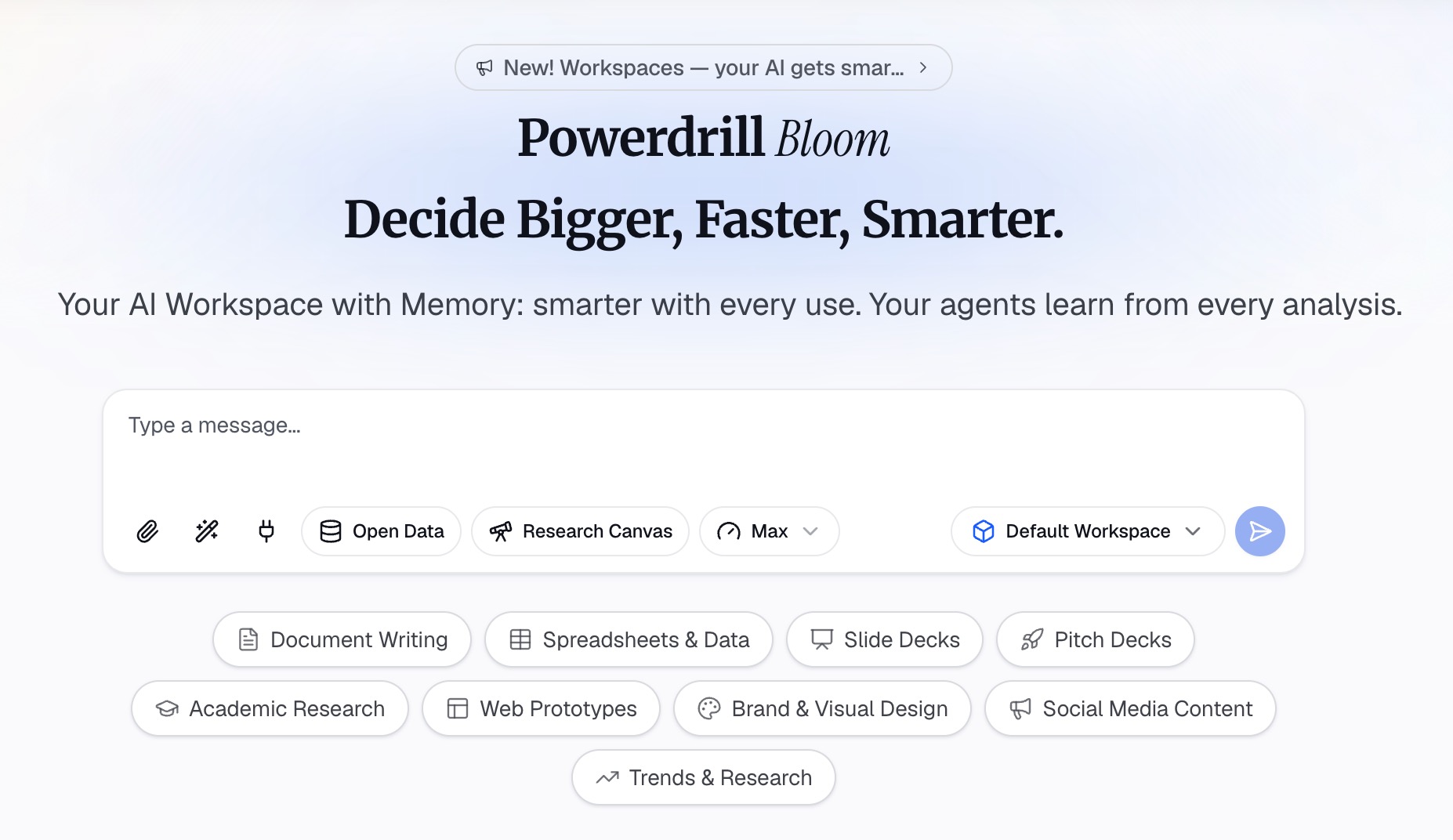
AI is useful for the slow parts: reading many sources, sorting evidence into quadrants, and drafting the report. Your judgment is still needed to decide what matters and to check the evidence. Here is the method in three steps, using Powerdrill Bloom.
Step 1: Gather your evidence in one place
Upload the files that hold the facts: sales exports, customer survey results, cost reports, competitor price lists, and any market research. Powerdrill Bloom's Free plan lists "Upload Excel, CSV, PDF, and docs" and "Search built-in open data sources."
For the external side, the AI competitor analysis tool lists "SWOT per competitor with cited evidence and a comparative summary." The AI market analysis tool covers the market itself.
State the objective in your first prompt. For example: "We are deciding whether to open a second location next year. Use these files as the only sources for internal factors."
Step 2: Draft the four quadrants with sources
Ask for a first draft in the template's shape. A useful prompt is: "Draft a SWOT analysis for this decision. List up to eight items per quadrant. For each item, give the evidence and the file, page, or row it comes from. Mark any item that has no evidence."
Read every item against its source. The Powerdrill Bloom homepage says "Every number comes back with the page, the row and the figure behind it." Delete items with weak evidence, and rewrite vague items until they are specific.
Then add what the files cannot know. Your team's judgment about culture, timing, and risk belongs in the grid too. Mark those items as judgment, so readers can tell them apart from data.
Step 3: Rank the issues and build the report
Ask the tool to rank the items by impact on the objective, and keep three to five per quadrant. Then ask for an action plan with an owner, a budget, and a date for each top issue.
Finally, ask for the output your audience needs. Paid plans list "Deep analysis, visualization, and reporting." The AI report generator page covers turning the result into a written report. If you need to present the result, our guide to a SWOT analysis presentation covers the slides.
How to turn a SWOT analysis into actions
A finished grid is a starting point, not a decision. The Minnesota Department of Health lists four questions to ask next:
- "How can you convert weaknesses into strengths?"
- "Use strengths to overcome threats?"
- "Use strengths to maximize opportunities?"
- "Use strengths to compensate for or minimize weaknesses?"
Those questions pair the quadrants. A strength matched to an opportunity becomes a growth move. A weakness matched to a threat becomes a risk to fix first. The Community Tool Box includes a matrix for this pairing, adapted from Fred David's strategy text, called the TOWS matrix.
Each action needs an owner and a date. Business Queensland lists "the people responsible for solving the issue," "the necessary resources and budget," and "the timeframes for completion and review."
Then link the result to your plan. Business Queensland says to "link the SWOT analysis back to your business plan." If the analysis feeds a funding request, our guide to a business plan presentation shows where it fits. Review the grid on a schedule. A threat from last quarter may now be gone, and a new one may have taken its place.
Common mistakes
Watch for these mistakes:
- No objective. Without one decision, every item seems relevant, and none leads anywhere.
- Mixing internal and external. "A competitor opened nearby" is a threat, not a weakness. Keep the line between what you control and what you do not.
- Vague items. "Strong brand" means little. Say what the evidence is and where it came from.
- Too many items. Business Queensland notes that a SWOT analysis "can generate too many ideas but will not help you choose which one is best."
- One perspective. A grid written by one person can miss what customers and staff see.
- No follow-up. The Business Queensland guidance warns that a SWOT analysis "will not provide solutions," so the action plan is not optional.
- Never updated. Markets change, so review the analysis at your next planning cycle.
A good grid is short, specific, and backed by evidence. Want to draft one from the files you already have? Try Powerdrill Bloom with your latest sales export and customer feedback.
Frequently asked questions
What is a SWOT analysis?
A SWOT analysis is a planning method that lists strengths, weaknesses, opportunities, and threats. Strengths and weaknesses are internal factors you control. Opportunities and threats are external factors you do not. The result is a four-part grid that supports one decision or plan.
What are the steps to do a SWOT analysis?
Set one objective, gather evidence, and list internal strengths and weaknesses. Then list external opportunities and threats, and make each item specific. Finally, rank the top three to five issues in each quadrant and write an action plan with owners and dates.
What is an example of a SWOT analysis?
Business Queensland gives an example of a business deciding on a new product. Its strengths include skilled sales staff and a high traffic location. Its weaknesses include cash flow problems. Customer demand counts as an opportunity, while a competitor opening nearby counts as a threat.
How do I do a SWOT analysis on myself?
Set a goal, such as a job search or a career change. List your skills and experience as strengths, and gaps as weaknesses. Then list outside openings, such as employers hiring or a mentor program, as opportunities, and outside risks as threats. Plan how to use your strengths.
Can AI do a SWOT analysis?
AI can draft a SWOT analysis from your files and public data, sort evidence into quadrants, and write the report. It cannot know your team's judgment or goals unless you give them. Check every item against its source and add the factors only people inside the work can see.
Sources: University of Kansas Community Tool Box, SWOT Analysis · Minnesota Department of Health, SWOT Analysis · Business Queensland, SWOT analysis · VCU Career Services, SWOT Analysis worksheet · Cal Poly Humboldt, Resume SWOT Analysis.