Data Facts: The HBM Boom Behind SK Hynix's Record Profits (2026 Report)

TL;DR — The SK Hynix Turnaround in 5 Numbers
SK Hynix has just pulled off one of the most staggering financial turnarounds in the history of the semiconductor industry. Driven by the insatiable demand for AI compute, here is the company’s dramatic rise in five figures:
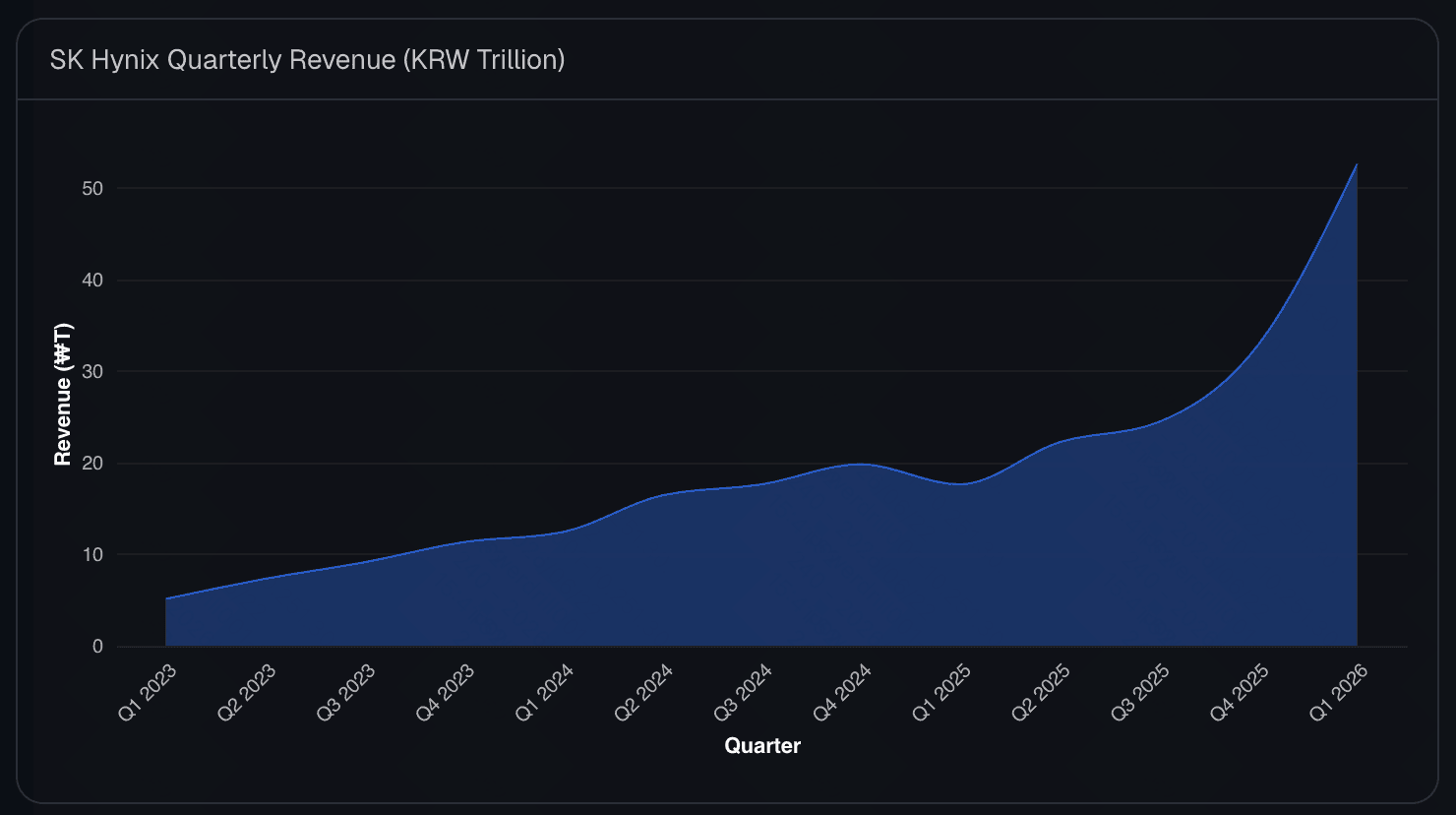
- +931%: The staggering surge in quarterly revenue from Q1 2023 (5.1T KRW) to Q1 2026 (52.6T KRW).
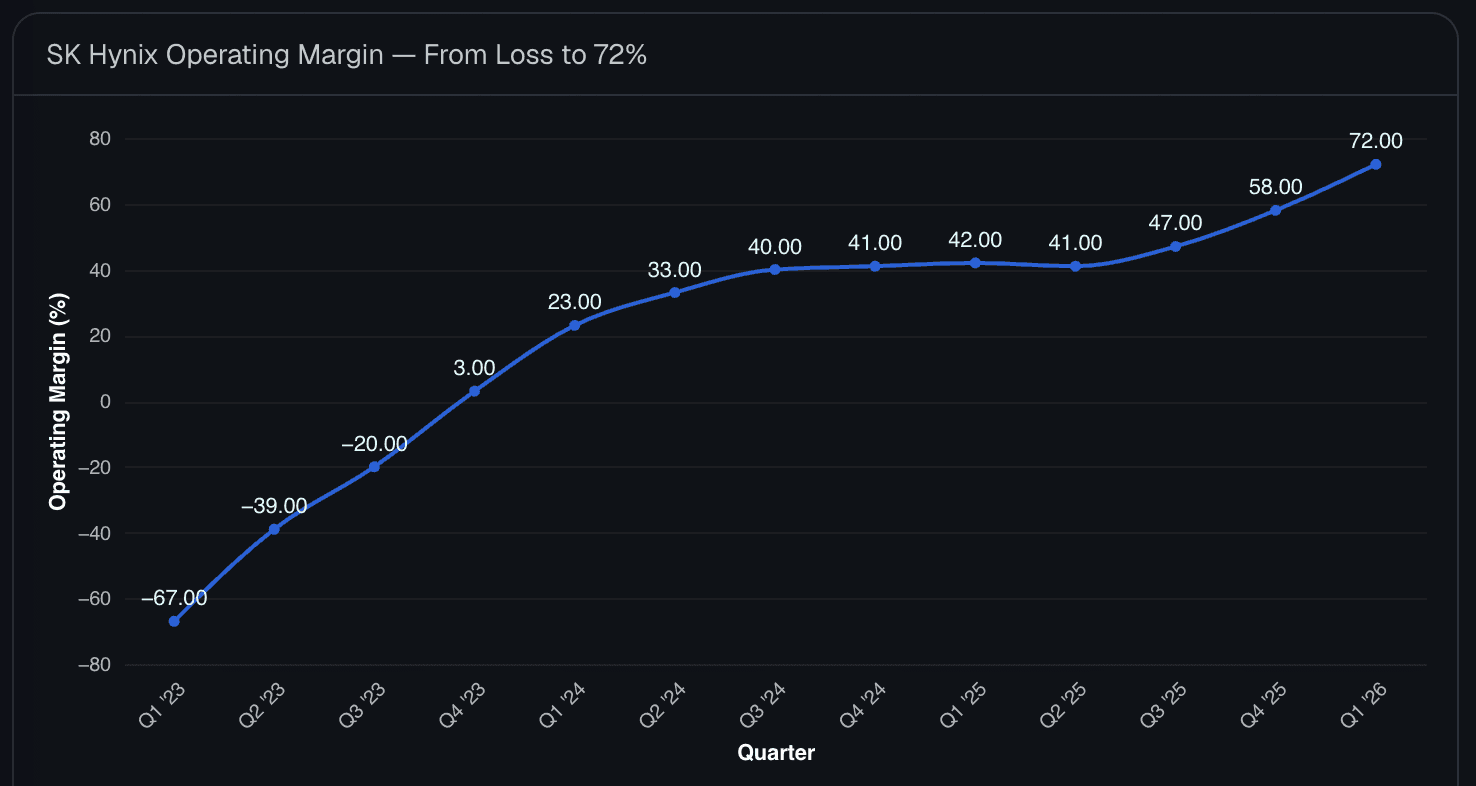
- 72%: SK Hynix’s operating margin in Q1 2026, swinging violently from a deep -67% trough just three years prior.
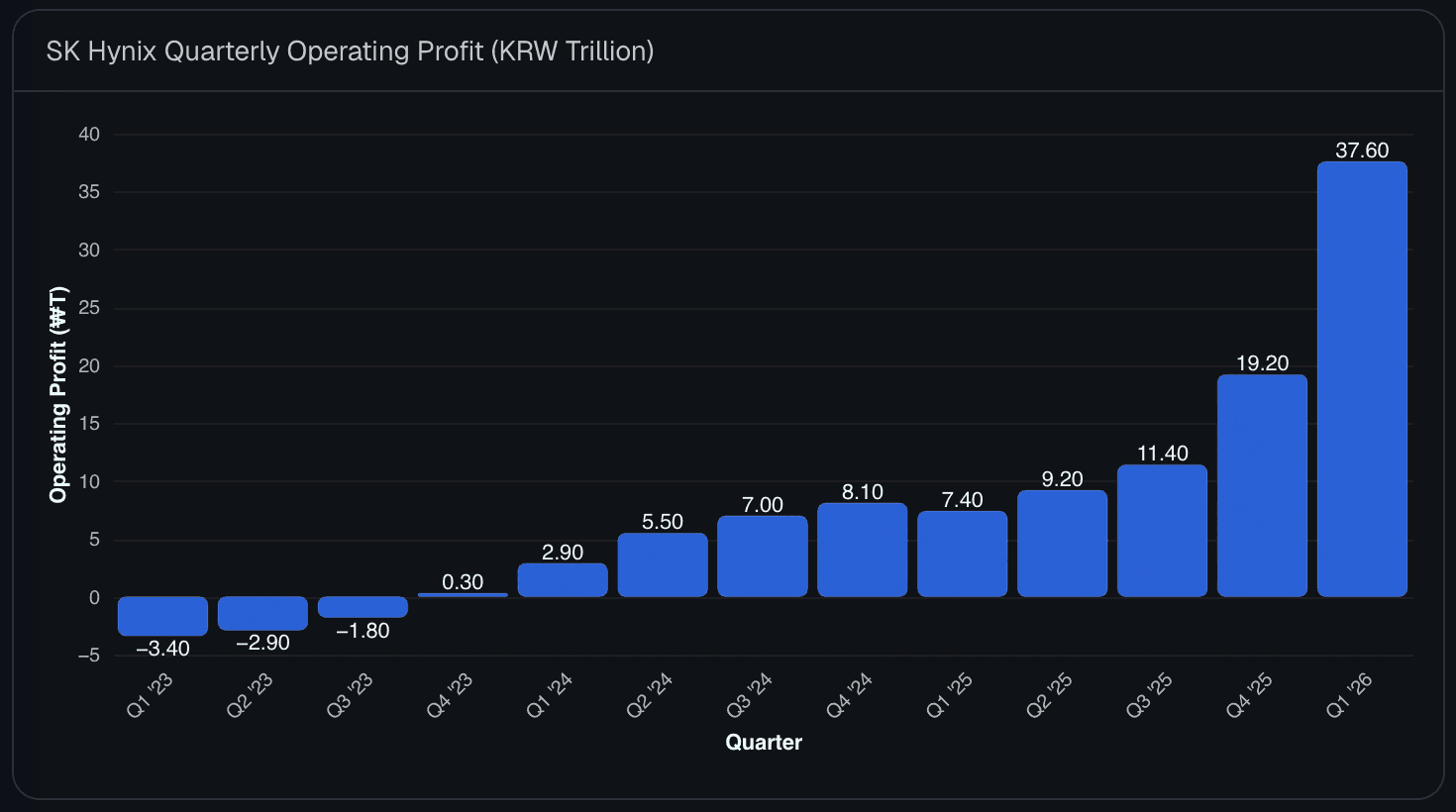
- 37.6 Trillion KRW: The operating profit generated in Q1 2026 alone—exceeding the company’s entire operating profit for the full year of 2024.
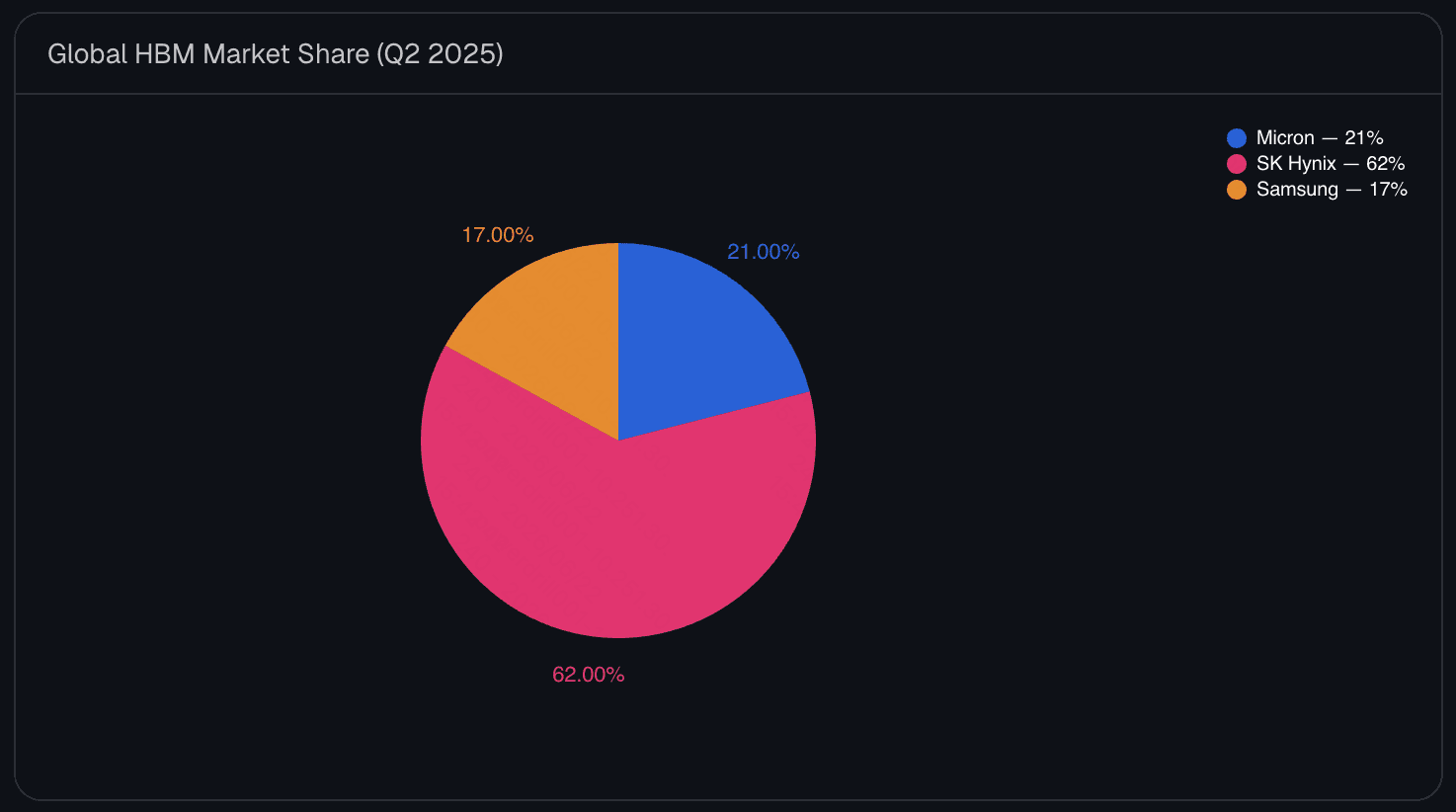
- 62%: SK Hynix’s commanding share of the global High Bandwidth Memory (HBM) market as of Q2 2025.
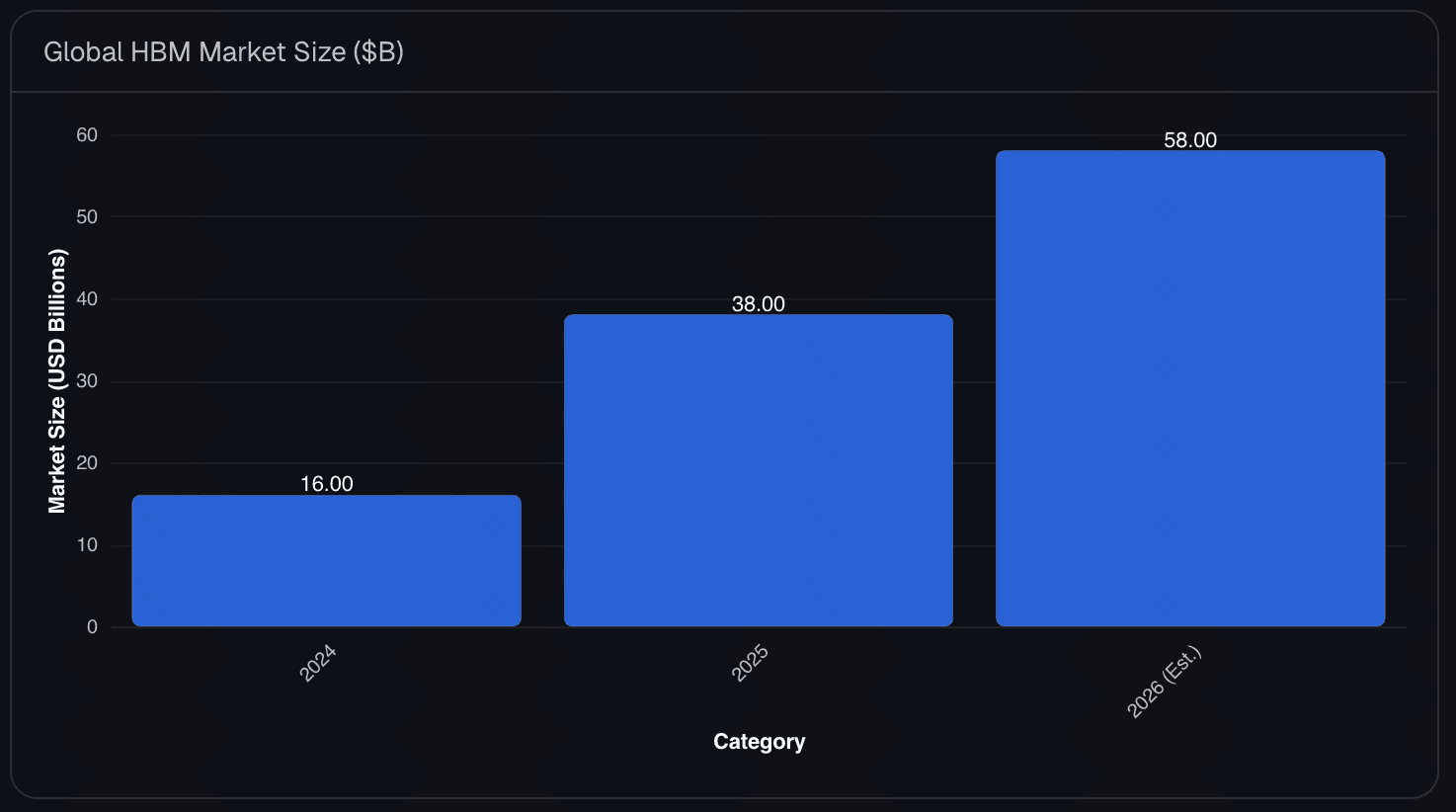
- $58 Billion: The estimated global HBM market size in 2026, on track to hit $100 billion by 2028.
The short version: The AI revolution isn't just about GPUs; it's about the memory that feeds them. SK Hynix placed its bets early, and those bets are paying off at a historical scale.
A Little Background
Just three years ago, SK Hynix was bleeding cash. In Q1 2023, amidst a broader memory market slump, the company posted a massive operating loss of 3.4 trillion KRW. The conversation was about survival, cutting capital expenditures, and weathering the cyclical winter of the semiconductor industry.
Then, generative AI exploded. Large Language Models (LLMs) require massive parallel processing power, primarily supplied by NVIDIA GPUs. However, these accelerators are entirely bottlenecked without extremely fast memory.
Enter High Bandwidth Memory (HBM), a specialized 3D-stacked DRAM technology. SK Hynix was the first to mass-produce advanced HBM3 and HBM3E chips, locking in a dominant supplier relationship with NVIDIA. Falling dominoes of AI data center build-outs turned SK Hynix's deep losses into record-shattering profits in just 36 months.
About the Dataset
This report draws on publicly reported financial data covering SK Hynix's performance from Q1 2023 through Q1 2026. Data points include quarterly and annual revenue, operating profit margins, HBM market share, and global HBM market forecasts. Sources include SK Hynix's official financial results, PR Newswire, BloombergNEF, Astute Group, and CNBC reporting. Figures are approximate and rounded for readability.
About the Tool
We built every chart in this analysis with Powerdrill Bloom, an AI-powered data agent. After dropping in the raw financial spreadsheets, Bloom instantly cleaned the data, pinpointed the most striking turnaround patterns, and rendered the visuals you see below. Absolutely no SQL, Python, or manual formatting was needed. Ready to visualize financial metrics this quickly? Explore our AI data visualization platform.
Key Takeaways
- The fastest turnaround in chip history. From a -7.7T KRW annual operating loss in 2023, SK Hynix soared to a 47.2T KRW annual profit in 2025, and an unbelievable 37.6T KRW single-quarter profit in Q1 2026.
- HBM is the engine. Once a niche product, HBM grew to represent roughly 77% of SK Hynix's total revenue by Q2 2025.
- Supply cannot meet demand. SK Hynix is entirely sold out of HBM capacity through 2026. Customer demand is currently outpacing planned production for the next three years.
- A locked-in oligopoly. Three companies control 100% of global HBM supply, making barriers to entry almost insurmountable for newcomers.
- The supercycle accelerates. We are not at the peak. With HBM4 mass production ramping up, capital expenditures are surging past 30T KRW to build massive new clusters like the M15X fab.
The HBM Boom: The Full Data Breakdown
What does the revenue trajectory look like from 2023 to 2026?
The quarterly revenue chart paints a picture of hyper-growth. Revenue hovered sluggishly between 5T and 11T KRW throughout 2023. As NVIDIA's H100 and H200 chips shipped in volume throughout 2024 and 2025, SK Hynix's revenue inflected sharply.
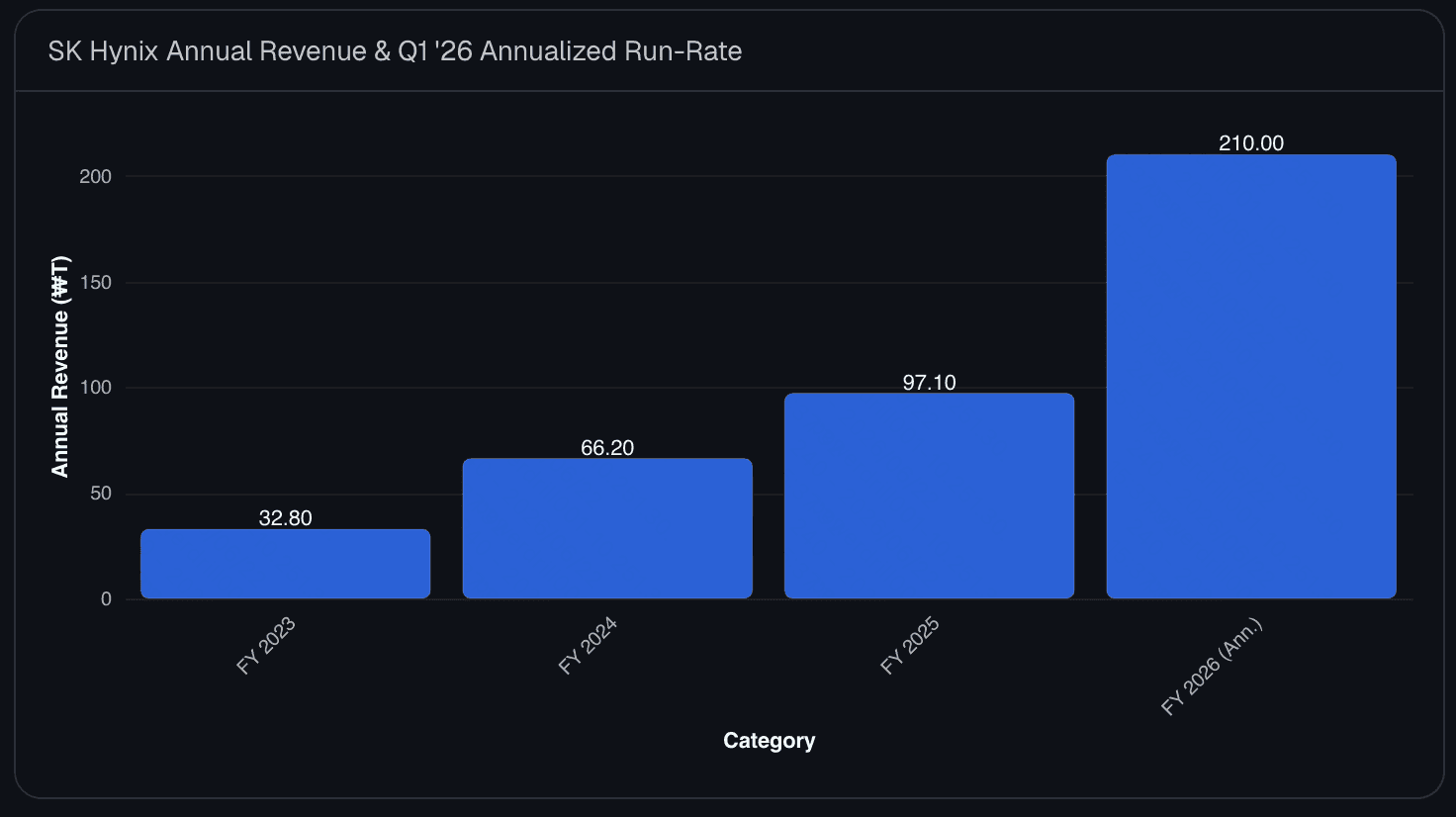
By Q4 2025, revenue hit 32.8T KRW, and in Q1 2026, it leaped to 52.6T KRW. To put this in perspective, SK Hynix's FY 2025 profit (47.2T KRW) was larger than its entire FY 2023 revenue (32.8T KRW).
Who controls the HBM market?
The HBM market is a strict oligopoly, and SK Hynix is the undisputed king. As of Q2 2025, SK Hynix held a massive 62% of the global market share, largely due to its flawless execution in HBM3E mass production and its tight partnership with NVIDIA (which accounts for ~90% of SK Hynix's supply).
Micron took second place with 21%, heavily bolstered by its 12-stack HBM3E shipments. Samsung, traditionally the memory heavyweight, saw its share plummet to 17% due to well-documented struggles in passing NVIDIA's stringent qualification tests.
How large is the total addressable market getting?
The global HBM market is experiencing a supercycle reminiscent of the dot-com boom. Valued at roughly $16 billion in 2024, the market ballooned by 138% to reach $38 billion in 2025.
In 2026, it is estimated to hit $58 billion. As hyperscalers continue to build trillion-dollar AI data centers, the HBM market is projected to reach an astounding $100 billion by 2028, representing a 40% CAGR.
What This Means for Businesses and Analysts?
For semiconductor analysts and tech investors, the data makes one thing clear: AI compute is heavily constrained by memory bandwidth. SK Hynix’s 72% operating margin proves that whoever holds the keys to memory bandwidth holds immense pricing power.
For cloud providers and AI startups, this means infrastructure costs will remain high, as suppliers are sold out through 2026. The technical barriers to entry (3D stacking, advanced packaging, 18-36 month capex cycles) mean this three-player oligopoly is completely insulated from outside disruption.
How We Made These Charts (in One Click)
You don't need a team of financial analysts to parse earnings reports like this. Here's the exact workflow we used:
- Start from a skill, a topic, or upload your own data. Instead of dropping in a raw spreadsheet, we leveraged Powerdrill Bloom’s built-in research skill to automatically gather and process SK Hynix's financial turnaround data.
- Let the canvas explore it. Bloom automatically cleaned the numbers, recognized the dramatic profit swing, and suggested the best visualization paths.
- Export to slides. We turned the analysis into presentation-ready charts with a single click.
No SQL. No Python. No formatting headaches. Want to uncover the hidden stories in your own financial data? Try Powerdrill Bloom free now.
FAQ
What is HBM?
High Bandwidth Memory (HBM) is a specialized, vertically stacked memory chip that allows for incredibly fast data transfer. It is crucial for AI accelerators like NVIDIA's GPUs to process Large Language Models.
How much did SK Hynix's revenue grow during the AI boom?
Quarterly revenue grew by an astonishing 931%, leaping from 5.1 trillion KRW in the first quarter of 2023 to 52.6 trillion KRW in Q1 2026.
Who are the main HBM suppliers?
Only three companies produce HBM globally: SK Hynix (62% market share), Micron (21%), and Samsung (17%), forming a tightly controlled oligopoly.
Is the HBM market expected to keep growing?
Yes. The market was valued at $38 billion in 2025 and is projected to reach $58 billion in 2026, with estimates pointing to a $100 billion market by 2028.
Can I analyze financial data like this myself?
Absolutely. You can upload any CSV or Excel file of earnings data into Powerdrill Bloom. The AI will clean the data and generate professional charts instantly, with no coding required.
A Wrap-Up
The numbers behind SK Hynix's record-breaking profits tell the true story of the AI revolution. It’s a story of a company perfectly positioned at the right time, turning a devastating market trough into a 72% operating margin. With HBM capacity sold out through 2026 and market sizes doubling, the memory supercycle is far from over.
Curious what trends are hiding in your company's financial data? Upload your spreadsheets to Powerdrill Bloom and let the AI build the charts for you.