Ever since Grok 4.1 rolled out in late 2025, I’ve been tracking xAI’s rapid release cadence closely, trying to anticipate the next milestone: Grok 4.2.
Using Powerdrill Bloom, I analyzed historical patterns, prediction-market data, and public signals to construct a structured forecast of Grok 4.2’s likely launch window. What emerges is a nuanced picture that balances near-term probability with the real uncertainties of safety, integration, and strategic branding.
1. Core Forecast: Most Likely Launch Window
Based on xAI’s release history, commentary on roadmaps, and prediction-market pricing as of January 16, 2026, my baseline forecast is:
Most likely public launch: Late January 2026
Reasonable extension: Early February 2026
Probability estimates:
Scenario | Probability |
|---|---|
Near-term (≤ Feb 1, 2026) | ~65% |
Mid-term slip (Feb 2 – Mar 31, 2026) | ~24% |
Delayed / major disruption (April 2026 or later) | ~11% |
The near-term window is anchored by:
xAI’s fast 4.x cadence (Grok 4 → 4.1 only ~4 months apart)
Multiple roadmap sources (DigitalApplied, BitBiasedAI, Zypa) pointing to late Dec 2025 / early Jan 2026 for 4.2
Prediction markets (Kalshi, Manifold) implying 68–89% odds of release by early February 2026
2. Probability Assessment: Scenario Breakdown
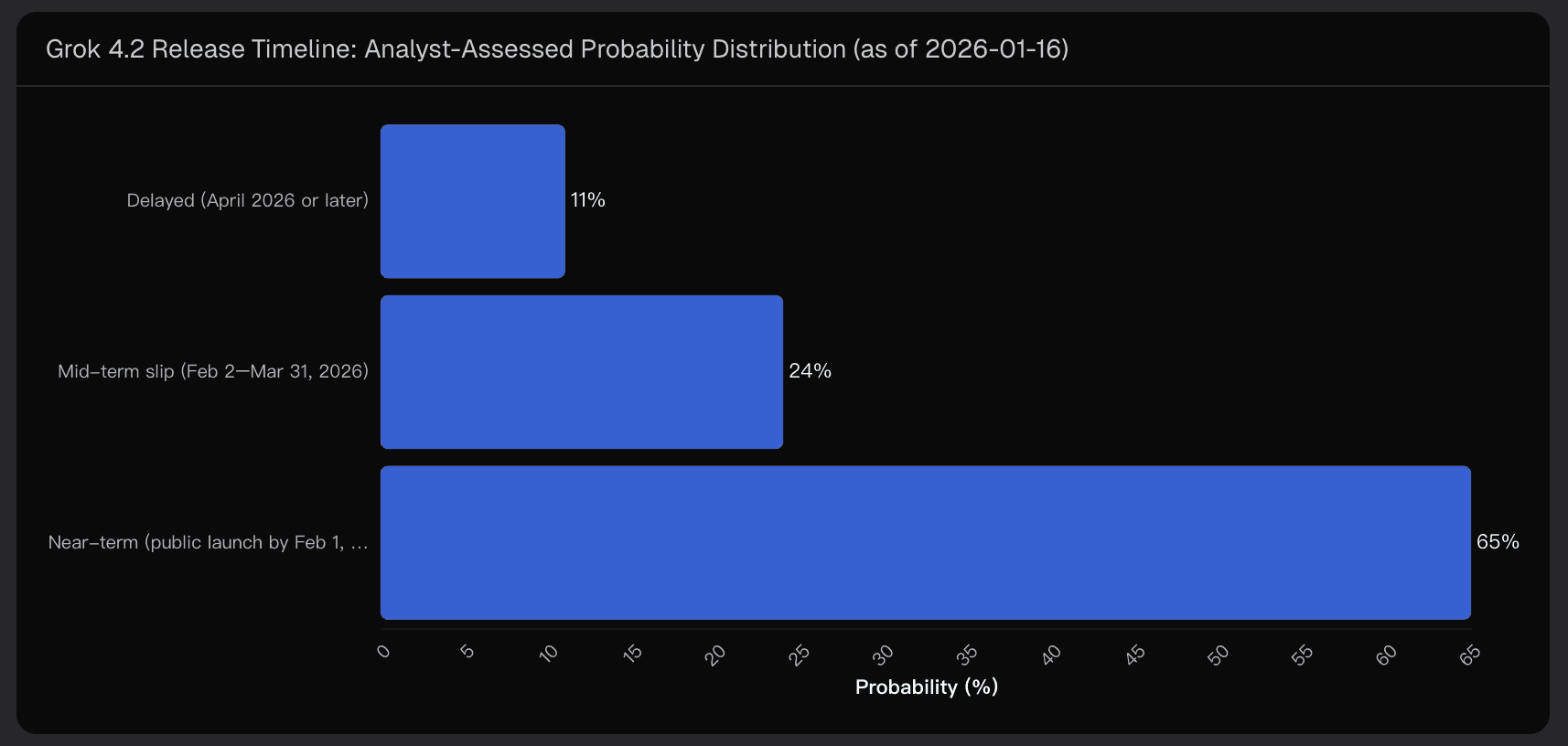
Near-Term Launch (High Probability)
Timing: Public release by Feb 1, 2026
Interpretation: xAI is in late-stage testing and QA. Minor schedule slippage is possible but aligns with original roadmap expectations.
Mid-Term Slip (Moderate Probability)
Timing: Feb 2 – Mar 31, 2026
Interpretation: Safety, regulatory, or integration issues may delay the release. 4.2 remains critical but could be slightly postponed.
Delayed / Major Disruption (Lower Probability)
Timing: April 2026 or later
Interpretation: Significant disruption (technical, regulatory, or strategic) could delay or merge 4.2 into 4.20 or Grok 5.
3. Market Signals: What Prediction Markets Are Indicating
Prediction markets provide an independent lens on launch expectations.
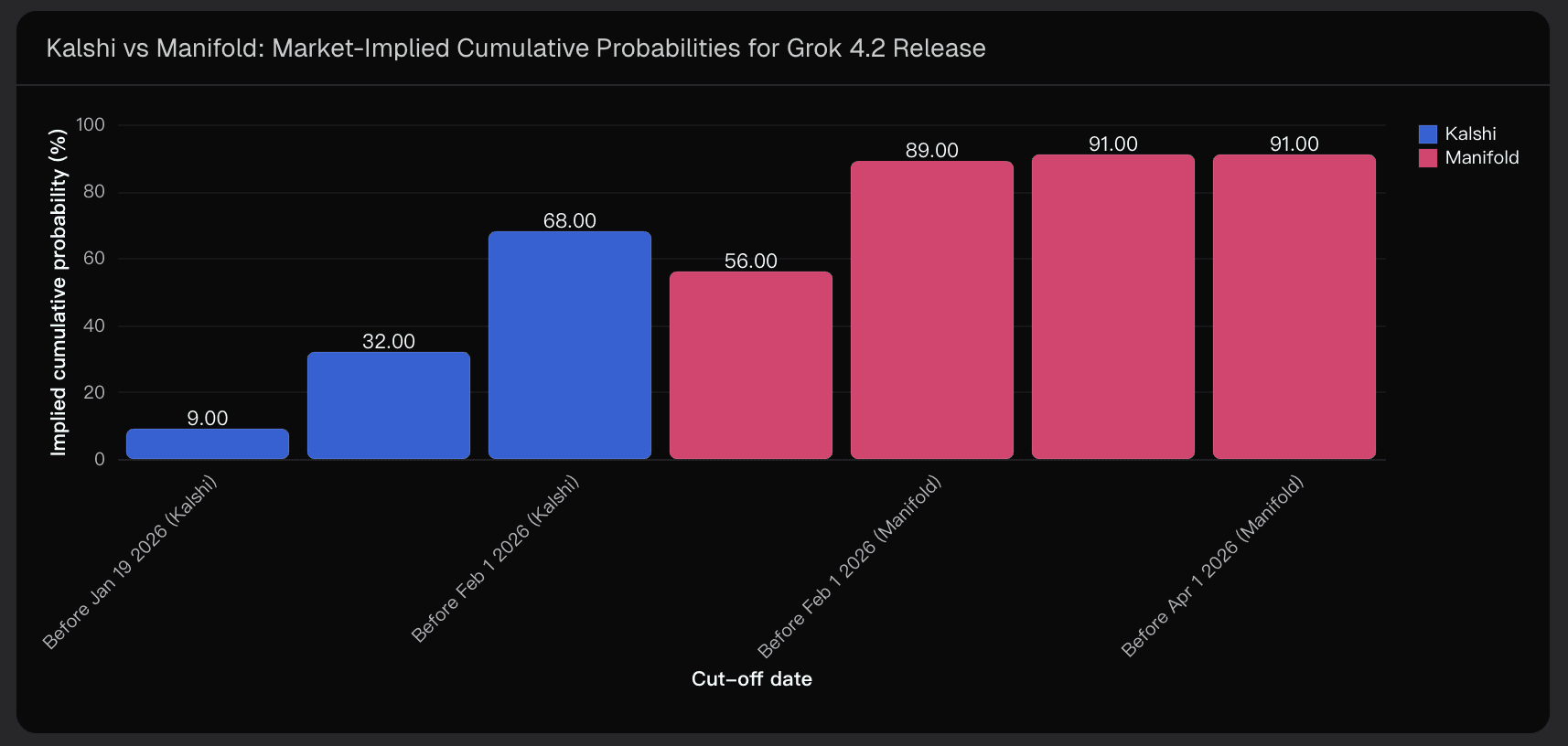
These markets show a heavy concentration of probability in late January to early February, with a thin tail extending into March. The incremental jump from Jan 26 → Feb 1 indicates the market anticipates minor slippage, consistent with xAI’s history.
4. Key Signals & Supporting Evidence
Historical Release Cadence
Grok 3 → Grok 4: ~5 months
Grok 4 → Grok 4.1: ~4 months
Grok 4.2 targeted initially for Nov–Dec 2025
This aggressive cadence supports a near-term release, suggesting late January 2026 is realistic.
Public Roadmap & Commentary
Sources like BitBiasedAI, DigitalApplied, and Zypa consistently indicate a late Dec 2025 / early Jan 2026 window.
Musk’s public hints reinforce this compressed schedule.
Recent xAI Shipping Behavior
Dec 22, 2025: Grok Collections API for RAG
Dec 30, 2025: Grok Business and Enterprise
Continued production-grade feature deployment supports a near-term release rather than a prolonged pause.
Related Product & Brand Sequencing
Grok 4.20 markets (~65% odds of release by Jan 31) suggest 4.2 is either in final testing or could be bundled into 4.20.
Historical over-optimism reminds us that slight slippage is plausible.
5. Uncertainty Factors: Risks That Could Shift the Timeline
Safety & Regulatory Headwinds
Heightened scrutiny may extend internal reviews or legal consultation, driving mid-term or delayed scenarios.Branding & Roadmap Reframing
xAI might merge 4.2 into 4.20 or accelerate 5.0, creating tail risk.Technical Integration & Ecosystem Dependencies
Multimodal polish, enterprise feature integration, and GPU scaling could cause minor delays.Strategic Considerations
Competitive pressure encourages fast release, while safety concerns encourage caution—supporting high near-term probability with moderate mid-term risk.
Conclusion
Synthesizing historical cadence, market signals, and xAI’s active shipping behavior, the most likely outcome is that Grok 4.2 launches publicly in late January 2026, with early February as a plausible extension.
Using Powerdrill Bloom, I was able to quantify probabilities, visualize scenarios, and systematically assess the key drivers and uncertainties affecting this release.
Disclaimer: This analysis is for informational purposes only and does not constitute financial or investment advice.