How to Write a Literature Review with AI: A 2026 Workflow
Reading forty papers is not the hard part. Holding forty papers in your head at once, so you can say what the field actually agrees on, is the hard part.
That is the task where an AI workspace genuinely helps. It is also a task with a strict boundary. The standards governing a literature review are about method and traceability, and no tool supplies either on your behalf.
This guide covers where the help is real, where the responsibility stays yours, and a workflow that produces a defensible draft.
What the review is actually for
A literature review is not a stack of summaries. It is an argument about a body of work. What has been established, where the findings conflict, and what nobody has examined yet.
The reader wants three things from it. What did the field study, how did it study it, and what does that add up to?
Every step below exists to answer one of those. A summary of each paper in sequence answers none of them. That is why a paper-by-paper literature review reads as a list rather than an argument.
What the reporting standards require
The most widely used standard here is worth reading before you write anything, because it clarifies what a review is judged on.
The PRISMA statement — Preferred Reporting Items for Systematic reviews and Meta-Analyses — describes itself as "a guideline designed to improve the reporting of systematic reviews."
Note the word reporting. The statement's own summary is specific about its scope. PRISMA "provides authors with guidance and examples of how to completely report why a systematic review was done." The same sentence continues: "what methods were used, and what results were found."
That sentence is the whole boundary condition for using AI here. A tool can help you see what the papers say. Your method becomes reportable through the decisions you made and recorded, which is work that sits with the author.
PRISMA 2020 is the main guideline. It is "complemented by various PRISMA extensions," which the statement says "provide guidance for the reporting of different types or aspects of systematic reviews." Scoping reviews, for instance, have their own extension.
Not every literature review is a systematic review, and most coursework assignments are not. But the reporting logic transfers to any literature review: say why, say how, say what you found.
Where AI helps and where it does not
Being precise about this saves trouble later, especially if your institution requires a disclosure statement alongside the literature review.
| Task | Realistic help | Who remains responsible |
|---|---|---|
| Finding the papers | Limited — a workspace reads what you give it | You assemble the corpus |
| Extracting method, sample, findings | Strong, across many documents at once | You verify against the source |
| Building a comparison matrix | Strong | You decide the columns |
| Spotting disagreement between studies | Strong at surfacing, weak at adjudicating | You judge which finding holds |
| Writing the synthesis prose | Useful as a first draft | You write the argument |
| Citations and quotes | Must be checked individually | You, every time |
The first row is the one people get wrong. An AI workspace works from the documents you upload. It does not search a subscription database on your behalf, which means the coverage of your review is set entirely by what you collected.
That is not a small caveat. Coverage is the first thing a reviewer questions about any literature review. It is also the one part of this process that is unambiguously manual.
Assembling the corpus first
Do this before opening any tool. The corpus determines everything downstream in a literature review.
Define the question narrowly enough to be answerable. "Remote work and productivity" is a topic; "measured productivity effects of fully remote work in knowledge roles since 2020" is a question with a boundary.
Search your field's databases directly. Record which databases, which search terms, and which date range — you will need all three for the methods section, and reconstructing them afterward is miserable.
Apply inclusion and exclusion criteria, and write down the count at each stage. How many records were found, how many remained after screening, how many were read in full. This is exactly the trail PRISMA asks you to report.
Then export the PDFs into one folder. That folder is your input.
One practical note on file quality. Scanned PDFs without a text layer extract poorly, and a corpus mixing clean and scanned files produces uneven results. Check a few before assuming the whole set is readable, and replace the scanned ones where a publisher version exists.
Building the synthesis matrix
A synthesis matrix is the intermediate artifact that turns a pile of papers into a literature review. Rows are sources, columns are themes or variables, and cells hold what each source says about each theme.
Reading across a row gives you one paper. Reading down a column gives you the field's position on one question — which is the thing you are actually writing about.
The matrix also makes absence visible, which prose does not. An empty region in a column marks a set of papers that never addressed something. That emptiness is frequently the most publishable observation in the whole exercise, and it is nearly invisible when you read sequentially.
Build it as a spreadsheet rather than a document. You will sort it, filter it, and re-sort it repeatedly, and a table tolerates that in a way a text file does not.
Step 1: Upload the corpus and define the columns
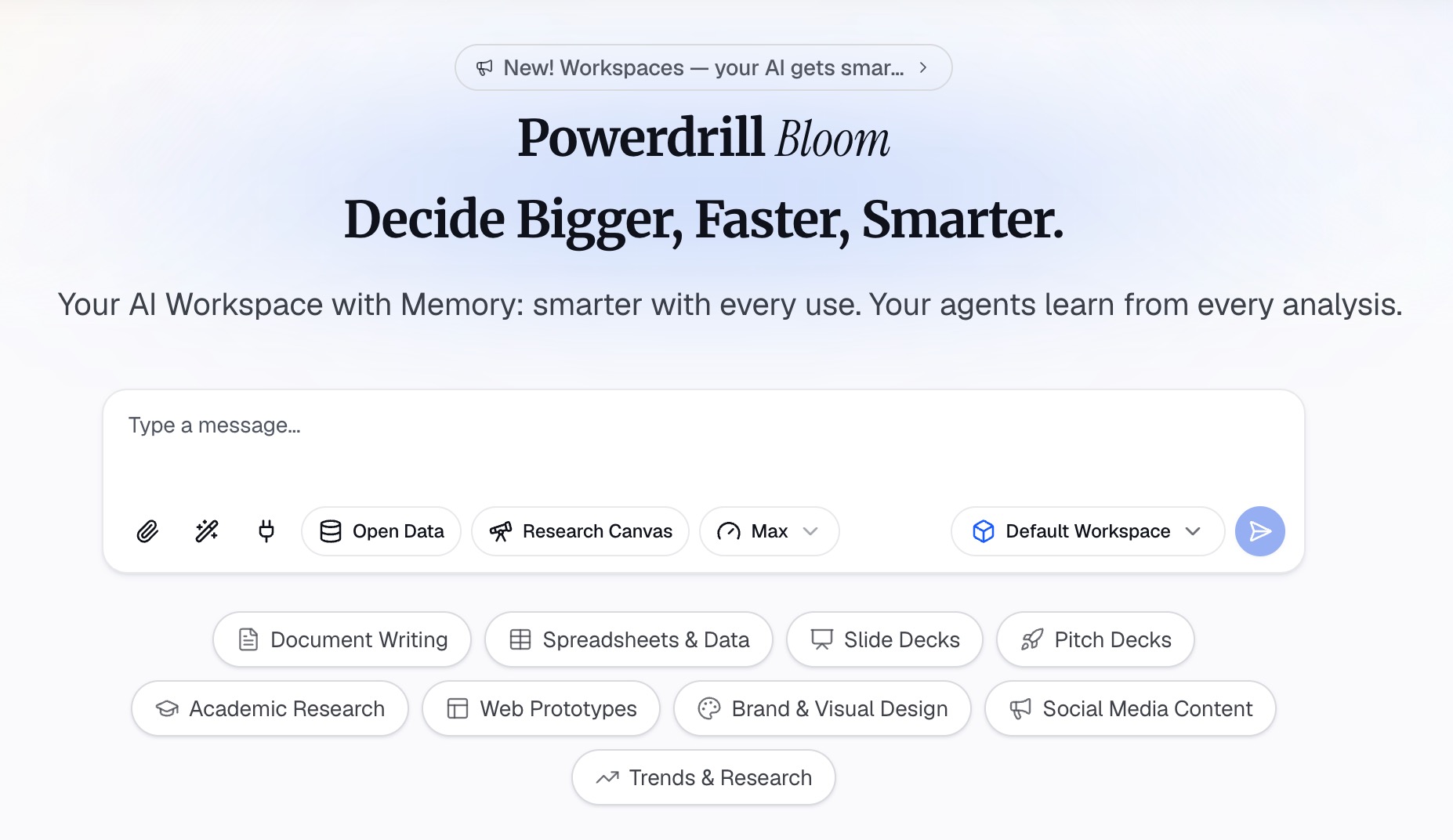
Open Powerdrill Bloom and upload the PDFs as a set. Describe the matrix you want in natural language, naming the columns explicitly.
Useful default columns are author and year, research question, method, sample and context, key findings, and stated limitations. Add one or two columns specific to your question — the variable you care about, or the theoretical framework each paper uses.
Defining the columns yourself is the part that matters. They encode what you think the debate is about, and a generic set produces a generic literature review.
Step 2: Verify each row against its source
Treat the generated matrix as a draft with a known failure mode. Extraction is reliable on explicit statements and less reliable on anything implied.
Check sample sizes, dates, and effect directions against the papers themselves. A reversed sign or a misread sample size propagates into your synthesis and is very hard to catch later.
Pay particular attention to the limitations column. Authors state limitations in varied places — sometimes the discussion, sometimes a footnote — and this is where extraction most often misses something.
Step 3: Read down the columns and name the disagreements
Now use the matrix for its purpose. Take one column at a time and ask what the field collectively says.
Ask the workspace to group sources by position on each theme, and to flag where findings conflict. Conflict is the most valuable output here — agreement is easy to write about, and disagreement is where a review earns its keep.
Then interrogate the conflicts yourself. Do two studies disagree because of method, sample, period, or definition? That question is the intellectual core of the review, and it is yours to answer.
Working with a large corpus of PDFs? Try Powerdrill Bloom.
Turning the matrix into prose
The matrix is scaffolding, not the literature review itself. Converting one into the other follows a reliable pattern.
Organize by theme, never by paper. Each section takes one question and reports what the body of work says about it, citing multiple sources per claim.
Lead each paragraph with the claim rather than the citation. "Three studies found no productivity difference" reads as an argument. "Smith (2023) found..." reads as a list.
Handle conflict explicitly. When studies disagree, say so, then explain the likely reason. A literature review that smooths over disagreement is less useful than one that maps it.
Close with the gap. What has not been examined, and why does it matter? This is what makes a literature review worth citing, and it comes directly from the empty cells in your matrix.
| Matrix element | What it becomes in prose |
|---|---|
| A column | A thematic section |
| Agreement down a column | A claim with multiple citations |
| Conflict down a column | A paragraph explaining why sources differ |
| An empty region | The research gap in your conclusion |
| The limitations column | Your assessment of the evidence quality |
For the reading step itself, there is a walkthrough on summarizing a long PDF report into key insights. For working directly with the documents, there is a guide to chat with PDF.
Keeping a record you can defend
Two documents matter as much as the review itself, and both are easier to keep as you go than to reconstruct.
The first is the search record. Databases queried, exact search strings, date ranges, and the count of records at each screening stage. This is what lets a reader judge coverage, and it is the part reviewers examine first when a conclusion looks surprising.
The second is a note of where a tool was involved. Which steps used an AI workspace, and what you did to verify the output of each. Many institutions now ask for this directly, and having it written down turns an awkward question into a two-line answer.
Neither document needs to be elaborate. A single page covers both for most projects, and a shared document works better than a private one.
There is a practical benefit beyond compliance. Six weeks after the extraction, you will not remember whether a particular sample size came from the abstract or the methods section. The record answers that without reopening forty PDFs.
| Keep a note of | Why you will need it |
|---|---|
| Databases and search strings | The methods section, and any coverage challenge |
| Counts at each screening stage | Reconstructing the selection process |
| Inclusion and exclusion criteria | Explaining why a known paper is absent |
| Which steps used a tool | Disclosure requirements |
| What you verified, and how | Answering a challenge to a specific number |
When this workflow is the wrong fit
It is worth naming the cases where the approach above adds effort rather than removing it.
A review of five or six papers does not need a matrix. You can hold six papers in your head, and building scaffolding for them costs more than it saves.
A review where the argument is genuinely about one theoretical tradition, rather than about accumulated findings, benefits less from tabulation. Extraction works well on measurable claims and less well on interpretive positions.
A meta-analysis has stricter requirements than anything described here. Effect sizes, heterogeneity, and risk-of-bias assessment all follow established protocols, and the extraction step needs to meet those protocols rather than a general-purpose column set.
And if your field requires a registered protocol, register it before extraction begins. Doing that afterward undermines the purpose.
Common mistakes
Summarizing paper by paper. The most common structural failure. It produces an annotated bibliography with the wrong title on it.
Letting the tool set the themes. Generic columns produce generic sections. The columns are your argument in outline form.
Skipping verification because the output looks confident. Fluent extraction and correct extraction are different properties, and the difference shows up in your methods section.
Failing to record the search. The papers you did not include are part of the method, and reconstructing the search after the fact rarely produces the same list.
Accepting citations without checking. Every reference goes back to the source. This is non-negotiable and takes less time than the consequence of getting it wrong.
Treating disagreement as noise. Conflicting findings are the most informative part of most literatures.
Writing the introduction first. The framing of a literature review should follow from what the matrix showed, not precede it. An introduction written before the reading tends to announce a conclusion the evidence does not support.
Over-collecting. Forty well-chosen papers beat a hundred gathered by a broad search. Every additional source costs verification time, and the marginal ones rarely change the argument.
Leaving the gap section until last and rushing it. The gap is usually the most cited part of a review, and it deserves more than a paragraph written at midnight.
Quick reference
| Stage | Output | Time saved by AI |
|---|---|---|
| Define the question | A bounded, answerable question | None — this is yours |
| Search and screen | A folder of PDFs plus a search record | None — databases are searched directly |
| Extract | A populated synthesis matrix | Substantial |
| Verify | A checked matrix | None — this is the trade for the previous row |
| Synthesize | Grouped positions and named conflicts | Substantial |
| Write | The review itself | Moderate, as a first draft |
| Cite | Verified references | None |
The pattern is visible in that last column. The help concentrates in the middle, where volume is the problem. The beginning and the end stay manual, because they are where judgment lives.
For tools aimed specifically at this domain, there are roundups of academic AI tools and AI tools for PDF data extraction and analysis.
Frequently asked questions
Can AI write a literature review for me?
It can draft sections once you have assembled and verified the material, and it is genuinely strong at extraction and comparison across many papers. Three things stay with you: setting the research question, guaranteeing coverage, and taking responsibility for accuracy. A reviewer will hold you to all three.
What is a synthesis matrix?
A table where rows are sources and columns are themes or variables. Reading across a row summarizes one paper; reading down a column shows what the field says about one question. It is the standard intermediate step between reading and writing.
Is using AI for a literature review allowed?
Policies vary by institution and journal, and many now require disclosure of how AI was used. Check the guidance that applies to you, and keep a record of which steps involved a tool. Responsibility for accuracy stays with the author regardless.
What does PRISMA require?
PRISMA is a reporting guideline for systematic reviews. It asks authors to report completely why the review was done, what methods were used, and what results were found. Extensions cover other review types, such as scoping reviews.
How many sources should a literature review include?
There is no fixed number, and it depends on the scope and the field. What matters more is that your search and screening process is recorded and defensible. A reader should be able to tell what was included and what was left out.
Sources: PRISMA statement, prisma-statement.org, including PRISMA 2020 and its extensions.