How to Do Thematic Analysis with AI: Step by Step
Thematic analysis is a method for finding patterns of meaning across qualitative data, such as interview transcripts or open-ended survey answers. To do it with AI, load your transcripts and research question, let the AI propose first-pass codes, then develop and check the themes yourself. AI speeds up the reading and sorting. The interpretation stays with you.
This guide explains what thematic analysis is, walks through the six phases, and shows where AI helps and where it should not decide. It includes a worked example, a results table format, and a comparison with content analysis.
What thematic analysis is
Virginia Braun and Victoria Clarke, who developed the most widely cited version of the method, define it on their site. "Thematic analysis (TA) refers to a range of qualitative research methods that are used for exploring and interpreting patterned meaning across datasets."
Two words in that definition matter. "Range" means thematic analysis is a family of approaches, not one fixed procedure. "Interpreting" means the output is an argument about what the data means, not a count of what it says.
Braun and Clarke group the family into three clusters: coding reliability approaches, codebook approaches, and their own reflexive approach. The difference affects how you use AI.
- Coding reliability fixes a codebook early and checks that different coders apply it the same way.
- Codebook approaches also use a structured framework, but allow it to evolve somewhat.
- Reflexive thematic analysis keeps coding open and lets it change as your understanding deepens. Their FAQ says plainly that "Reflexive TA avoids codebooks."
In reflexive thematic analysis, a theme is more than a topic. Braun and Clarke describe themes as "pattern of shared meaning underpinned by a central concept or idea." A topic such as "pricing" is not a theme. "Customers read price as a signal of trust" is.
The six phases
Braun and Clarke outline six phases. They stress that "These phases do not prescribe a rigid process you must follow." In practice, you move back and forth between them.
- Familiarising yourself with the dataset. Read and reread the data, and note first observations.
- Coding. Attach short labels to meaningful segments, across the whole dataset, in two or more rounds.
- Generating initial themes. Cluster the codes into candidate patterns of meaning.
- Developing and reviewing themes. Check each candidate against the coded data and the full dataset. Split, merge, or drop themes as needed.
- Refining, defining and naming themes. Work out the scope and story of each theme and give it an informative name.
- Writing up. Weave the analytic narrative together with data extracts, and connect it to existing literature.
Their site describes the process honestly: "analysis is typically a recursive process." Expect to return to coding after you start building themes.
Where AI helps and where it should not decide
AI is genuinely useful for the phases that involve volume. It can read forty transcripts quickly, suggest candidate codes, pull every extract that fits a code, and count how often a pattern appears.
It should not make the interpretive calls. Braun and Clarke write that "Qualitative analysis is a skilled, situated, subjective process." A model does not share your stake in the research question, and it only knows the context you give it.
Their FAQ makes a related point about analysis software. What matters, they write, is "being a knowing researcher." That means using any tool in a way that fits the values of the approach you have chosen.
A workable split looks like this:
| Phase | What AI can do | What you decide |
|---|---|---|
| Familiarising | Summarize each transcript, flag surprising passages | Which passages matter to your question |
| Coding | Propose first-pass codes and apply them consistently | Which codes to keep, merge, or rename |
| Generating themes | Cluster codes and pull supporting extracts | Whether a cluster is a real pattern of meaning |
| Reviewing themes | Search the dataset for counterexamples | Whether a theme holds up |
| Naming themes | Suggest names and one-line definitions | The final name and the story it tells |
| Writing up | Draft sections and assemble quotes | The argument and its claims |
If you use a codebook approach, AI output can serve as a draft codebook. If you use reflexive thematic analysis, treat AI codes as prompts to think with, not as the analysis itself.
Whichever approach you use, record how AI was involved. Note the tool, the phases it helped with, and what you changed afterward. A short methods paragraph answers the question before a reviewer, examiner, or stakeholder asks it.
What you need before you start
Prepare four things before any AI tool touches the data.
A clear research question. Every code and theme is judged against it. "What do customers experience during onboarding?" produces a different analysis from "Why do customers cancel in the first month?"
Clean, de-identified transcripts. Remove names, company names, emails, and any detail that identifies a participant. Do this before upload, not after. Check your ethics approval or consent forms for any limits on third-party tools.
A notes document for your own reflections. Reflexive thematic analysis foregrounds the researcher's perspective. Keep a running record of your assumptions and reactions as you read, separate from anything the AI produces.
A consistent file format. One file per interview, with speaker labels, makes it easier to trace every extract back to its source. Keep a simple index that maps participant codes to interview dates.
How to do thematic analysis with AI
The steps below follow the six phases, grouped into three working sessions.
Step 1: Load the transcripts and set the research question
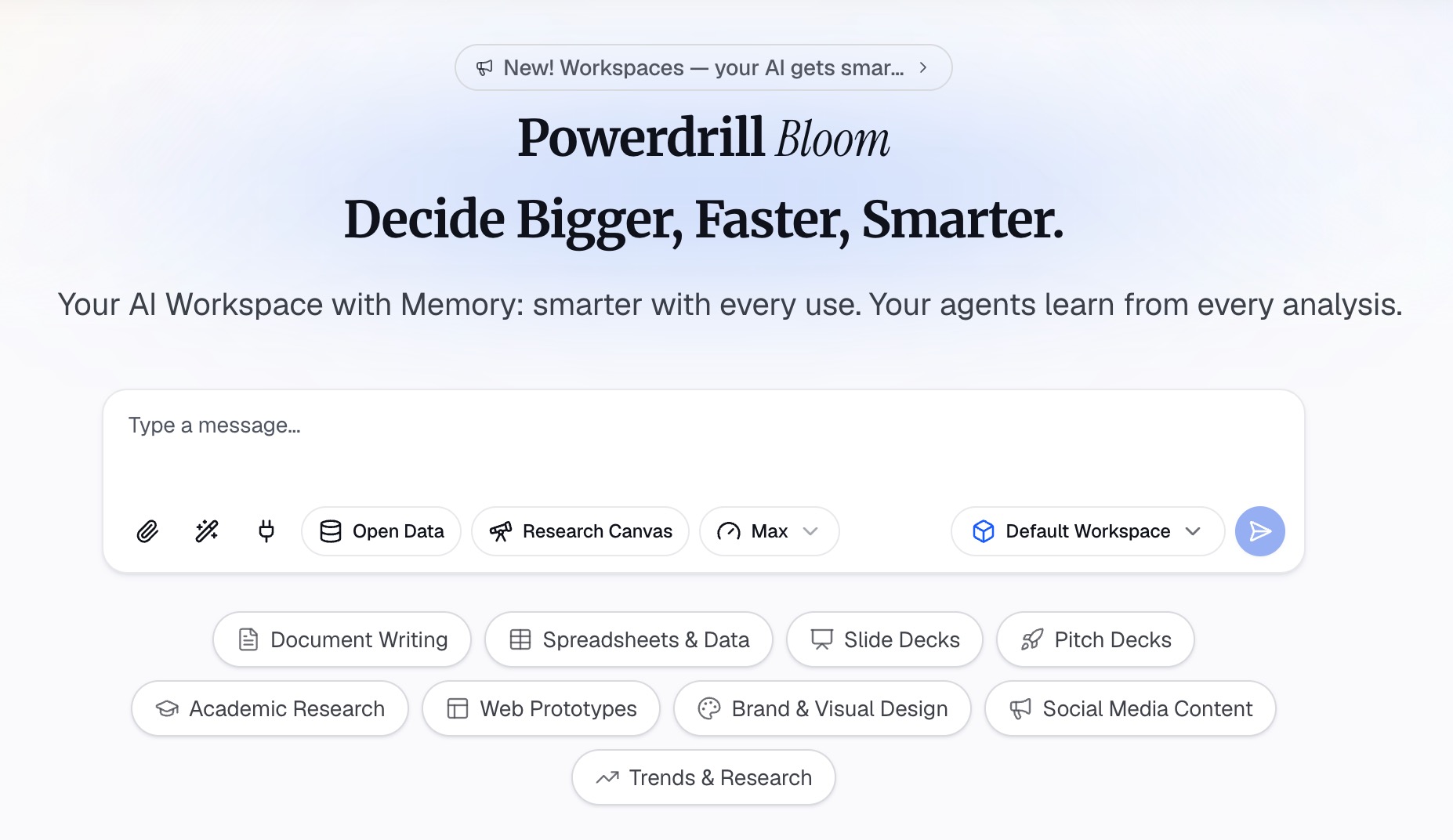
Upload the de-identified transcripts to an AI workspace such as Powerdrill Bloom. Its plans list uploads of Excel, CSV, PDF, and docs, so transcripts in Word or PDF work as they are. Open-ended survey answers exported to a spreadsheet work too.
State the research question first, before any request. Then ask for a short summary of each transcript and a list of passages that relate to the question.
Read those summaries, then read the transcripts yourself. AI summaries speed up familiarisation, but they are not a substitute for it. Note your own first impressions in a separate document before you look at any AI-generated codes.
Step 2: Generate first-pass codes, then code again yourself
Ask the AI to propose codes for each transcript. Request short labels, a one-line definition for each, and the exact extracts that support them.
A useful request is short and specific. Code the transcript for anything relevant to the research question, keep labels under five words, and quote the exact passage for each. Asking for exact passages makes it easy to spot a code that has drifted from what the participant actually said.
Then do a second round of coding on your own. Compare your codes with the AI's list. Where they agree, the code is probably describing something clearly present. Where they differ, look closely. Either the AI has noticed something you missed, or it has labeled surface wording rather than meaning.
Keep every extract traceable. Each code should point to a participant and a passage. Powerdrill Bloom's homepage says every number "comes back with the page, the row and the figure behind it," and the same traceability matters for quotes.
Step 3: Build candidate themes and check them against the data
Ask the AI to cluster your final codes into candidate themes, with the supporting extracts for each. Treat the clusters as a starting point.
For each candidate, ask one question: is there a central concept or idea behind it? If the answer is only a shared topic, it is not a theme yet. Split it, merge it, or drop it.
Then test each theme. Ask the AI to find extracts that contradict it. A theme that survives a deliberate search for counterexamples is stronger than one that was never challenged.
Finally, name each theme and write a two-sentence definition. Draft the write-up section by section, and check every quote against the original transcript before it goes into the report.
A worked example
Here is a short version of the process on a product research study with twelve customer interviews. The research question asked why new customers stopped using the product within 30 days.
First-pass AI codes included "setup took too long," "unclear pricing," and "needed IT approval."
After a second round of coding, the researcher noticed that all three appeared in interviews with people who had not chosen the product themselves.
The resulting theme was "adoption without ownership." Customers who inherited the product had no reason to push through early friction.
The researcher then asked the AI for counterexamples: customers who had not chosen the product but stayed anyway. Two interviews fit. Both described a colleague who showed them a quick win in the first week, which refined the theme rather than breaking it.
The AI surfaced the codes quickly. The theme came from the researcher noticing who was saying them, which no code captured on its own.
How to present thematic analysis results
A results section usually leads with a table of themes, then discusses each theme with supporting extracts. The table below shows a common format.
| Theme | Definition | Participants | Example extract |
|---|---|---|---|
| Adoption without ownership | Users who did not choose the product had little reason to persist | 7 of 12 | "I was told to use it, so I did the minimum." |
| Setup as a first impression | Early setup effort shaped the overall view of the product | 9 of 12 | "If the first hour is hard, you assume the rest will be." |
Follow the table with a short section for each theme. Explain the central idea, show two or three extracts, and connect it to your research question.
Choose extracts that show the theme from different angles, rather than three quotes saying the same thing. Keep them short, and always attribute them to a participant code. Readers trust a theme more when they can see it in several voices.
Participant counts are helpful context, but Braun and Clarke's approach does not treat frequency as the measure of importance. A theme mentioned by four people can matter more than one mentioned by ten.
For a stakeholder audience, the same results often become a short deck. The AI research synthesis tool describes this route, combining transcripts and surveys into themes, evidence, and a stakeholder deck.
Thematic analysis vs content analysis
The two methods are often confused because both work with qualitative data.
| Thematic analysis | Content analysis | |
|---|---|---|
| Main goal | Interpret patterns of meaning | Categorize and often count content |
| Output | Themes with a central idea | Categories with frequencies |
| Role of counting | Supporting context at most | Often central |
| Best for | Understanding experiences and views | Measuring how often something appears |
If your question is "how often do customers mention pricing?", content analysis fits. If it is "what does pricing mean to customers?", thematic analysis fits.
Some projects use both in sequence. A frequency pass across a large dataset shows where the volume is. A thematic pass on a smaller, focused sample then explains what that volume means.
For feedback at scale, such as thousands of reviews or support tickets, a frequency view is often the first need. The Voice of Customer Summarizer rolls feedback channels into themes with frequency and a representative verbatim for each.
Thematic analysis in Excel
Many researchers still code in a spreadsheet, and it works well for small studies. A simple layout uses one row per extract.
- Column A: participant code.
- Column B: the extract, copied exactly.
- Column C: first-round code.
- Column D: second-round code.
- Column E: candidate theme.
Filtering by theme then gives you every supporting extract in one view. A count of rows per theme and per participant also shows at a glance whether a theme rests on one talkative interviewee. The limit is scale. Past a few hundred extracts, sorting and recoding by hand becomes slow, which is where AI-assisted clustering saves the most time.
If your project also includes a review of published studies, our guide to writing a literature review with AI covers that part.
Common mistakes
- Treating topics as themes. "Communication" is a topic. A theme says something about it.
- Accepting AI codes without a second round. First-pass codes often label wording rather than meaning.
- Uploading identifiable data. De-identify transcripts before any upload.
- Counting as proof. Frequency supports a theme, but it does not establish one.
- Skipping the counterexample search. A theme that was never challenged is weaker than it looks.
- Letting the AI name the themes. Names carry the argument, so write them yourself once the themes are settled and defined.
Getting these right is what separates a credible analysis from a summary with headings. If you want the reading, coding, and clustering done faster on your own transcripts, you can try Powerdrill Bloom with one study.
Frequently asked questions
What is thematic analysis in simple terms?
Thematic analysis is a way of finding and interpreting patterns of meaning in qualitative data, such as interviews. The researcher codes the data, groups codes into themes, and explains what each theme says about the research question.
What are the six steps of thematic analysis?
Braun and Clarke's six phases are familiarising yourself with the dataset, coding, generating initial themes, developing and reviewing themes, and refining, defining and naming themes. The sixth is writing up. They note the phases are not rigid rules.
Can AI do thematic analysis?
AI can help with the volume work, such as summarizing transcripts, proposing codes, and pulling extracts. The interpretive work of deciding what a theme means still needs the researcher. Braun and Clarke describe qualitative analysis as a skilled, situated, subjective process.
How many themes should a thematic analysis have?
Braun and Clarke say "there is no precise formula for determining the number of themes in a TA." It depends on the data, the research question, and the length of the report. An analysis can report one theme in depth or give a broader overview.
What is the difference between thematic analysis and content analysis?
Thematic analysis interprets patterns of meaning and produces themes. Content analysis categorizes content and often counts how frequently categories appear. Choose thematic analysis to understand experiences, and content analysis to measure frequency.
Sources: Braun and Clarke, Thematic Analysis · Understanding TA · Doing Reflexive TA · Thematic Analysis FAQs. The worked example and results table are illustrative.