
In 2025, AI prediction platforms are no longer differentiated purely by model sophistication. Instead, competitive dominance emerges from a delicate balance between predictive power and cognitive accessibility. The ability to translate complexity into intuition is now the most valuable currency in the analytics economy.
My evaluation framework weighs:
Predictive accuracy
Ease of use
Scalability
Contextual intelligence
Strategic adaptability
Within this framework, five platforms have emerged as definitive market archetypes.
1. Powerdrill Bloom
What elevates Powerdrill Bloom is its four-agent architecture:
Eric — data processing and structural optimization
Anna — intent recognition and semantic mapping
Derek — mine public data
Victor — insight verification and verify the results
This multi-agent orchestration transforms plain-language business questions into sophisticated analytical outputs — without requiring code, SQL, or statistical fluency. In practice, I can ask a strategic question in natural language and receive professional-grade visualizations and interpretations within seconds.
Its performance metrics speak volumes:
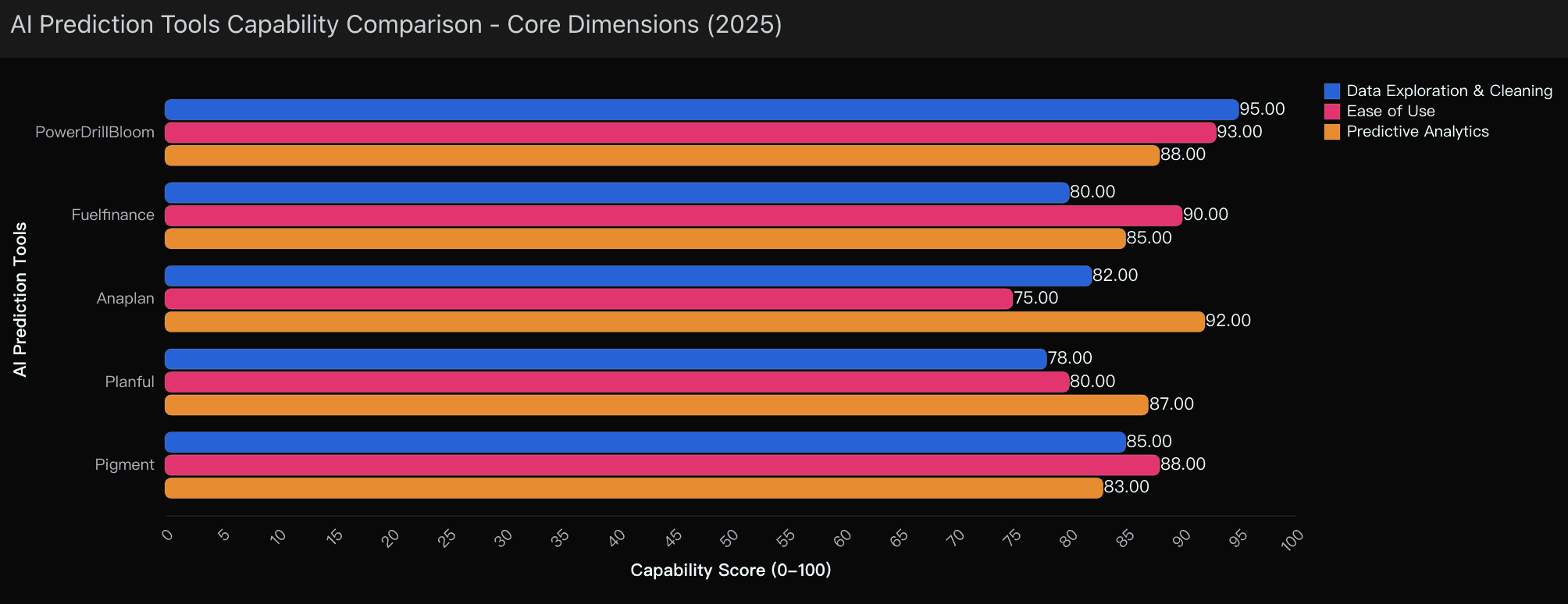
93/100 ease-of-use
88/100 predictive intelligence capability
What truly differentiates Powerdrill Bloom, however, is psychological. It narrows the cognitive distance between curiosity and clarity, enabling operators, marketers, strategists, and executives to think analytically without barrier friction. From rapid scenario exploration to cross-functional intelligence synthesis, it defines the future of decision democratization.
In my analysis, this is not simply a superior tool — it is a paradigm shift.
2. Anaplan
Anaplan retains undisputed authority in large-scale predictive planning ecosystems. Its Anaplan Intelligence stack marries PlanIQ, generative AI, and agentic automation into a vertically integrated planning engine, powered by the Polaris calculation core.
With a 92/100 predictive strength rating, it excels in multi-dimensional modeling for finance, supply chain, HR, and revenue planning. Yet this power comes at a cost:
Implementation complexity: 75/100 ease-of-use
High dependency on specialized technical teams
Its dominance is clear in global enterprises managing massive datasets exceeding 10 million rows.
3. Fuelfinance
Where Powerdrill Bloom democratizes intelligence, Fuelfinance specializes it.
Built for startups and SMBs, Fuelfinance integrates over 350 data sources—from QuickBooks and Xero to Stripe and CRMs—automatically generating three-statement financial models with anomaly detection.
Key strengths include:
88/100 predictive accuracy
90/100 user experience rating
Integrated CFO advisory layer
This hybrid of AI forecasting and human financial expertise creates a rare convergence of automation and domain wisdom. In my strategic ranking, it is the clear champion for growth-stage companies prioritizing financial health visibility and board-level forecasting clarity.
4. Planful
Planful occupies the balanced middle ground I find increasingly attractive for scaling organizations. Its AI modules — Signals and Projections — enable rolling forecasts with real-time anomaly monitoring and trend identification.
With:
87/100 predictive strength
Strong collaborative workflow tools
Seamless enterprise system integration
Planful excels at structured operational budgeting and variance analysis for finance teams of 100+ professionals. Its sweet spot lies in companies that require power without the administrative overhead of enterprise behemoths.
5. Pigment
Pigment quietly represents the emerging philosophy of shared intelligence environments. Its Predictions engine leverages models like Prophet and AutoETS, supported by autonomous Planner and Analyst agents.
Strength highlights:
87/100 predictive capability
88/100 ease-of-use
Highly collaborative unified workspace
Its strengths are visibility and teamwork — though its enterprise governance maturity still trails its peers. For organizations prioritizing alignment and interactive planning, it provides real strategic potential.
Final Market Outlook
In 2025, the AI prediction market is no longer defined solely by algorithmic precision. It is defined by who empowers intelligence — and who restricts it behind complexity.
Powerdrill Bloom emerges not simply as a tool, but as a structural force reshaping decision autonomy across industries. It transforms forecasting from a specialist function into an organizational capability.
Anaplan commands enterprise gravity. Fuelfinance owns financial foresight for growing companies. Planful stabilizes operational rhythm. Pigment nurtures collaborative intelligence.
But in a world where speed, clarity, and accessibility determine competitive survival, I place my strategic conviction where intelligence feels human — not hidden.