
When I first started modeling the timeline for MrBeast’s million-dollar puzzle, I wasn’t trying to guess — I was trying to understand incentives, structure, and crowd behavior.
Using structured trend tracking and probability modeling inside Powerdrill Bloom, I built a cumulative resolution curve rather than relying on social media speculation. The result was surprisingly clear:
The most likely solve window is mid-to-late March 2026 — with an 82% probability the puzzle is solved before the April 2, 2026 deadline.
Here’s how I arrived at that conclusion.
1. Core Predictive Conclusion: A Mid-to-Late March Breakthrough
My base-case forecast places the modal solve window between March 9 and March 22, 2026.
Within that range, the single most probable week is March 16–22.
Why?
Because this puzzle isn’t just a riddle — it’s a time-bounded promotional system.
The official contest terms specify that the promotion runs from February 8 to April 2, 2026, unless a correct and verified solution is submitted earlier. That deadline creates a strong convergence force:
Participants intensify effort as the deadline approaches.
Organizers design puzzles that are difficult — but solvable within weeks, not months.
Public attention compounds over time.
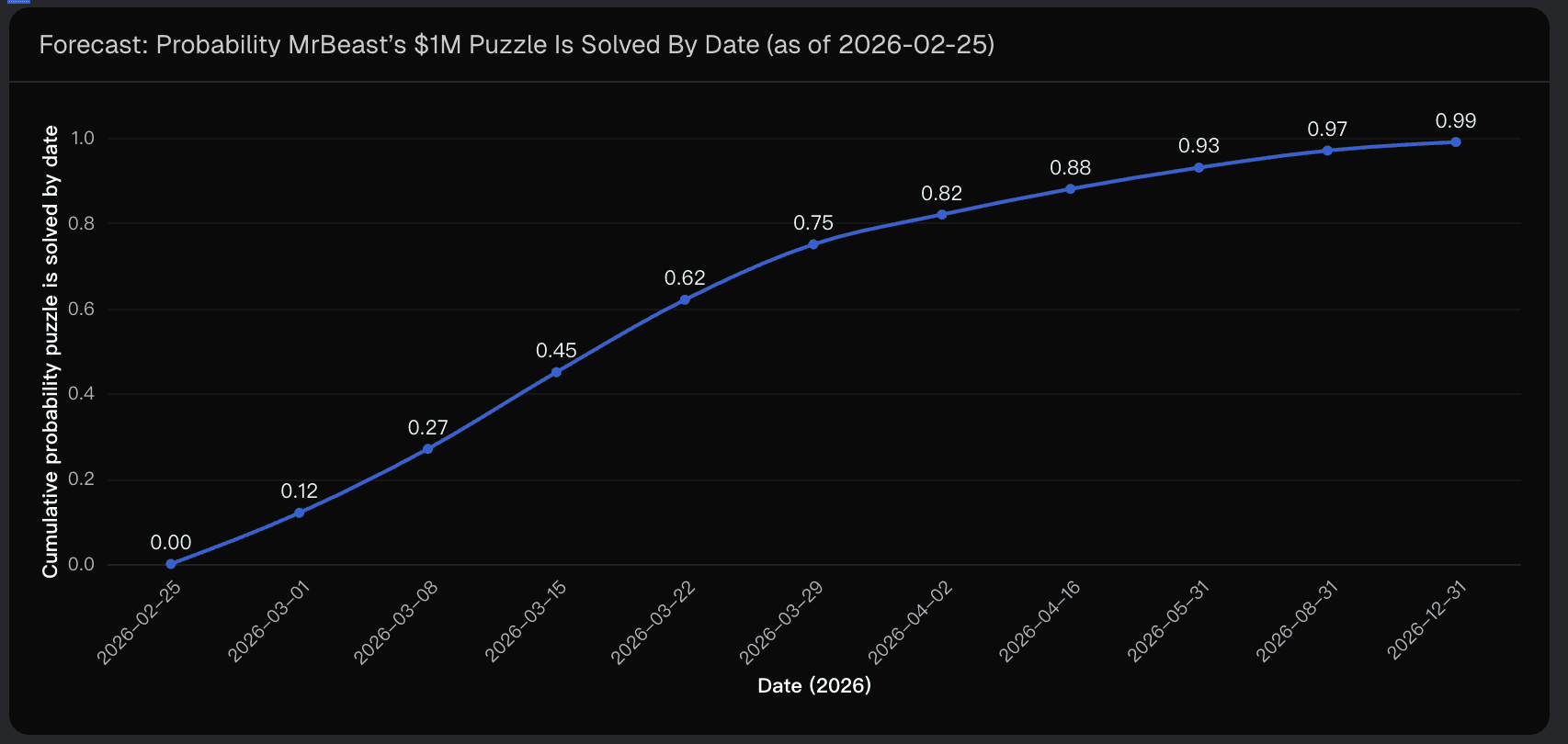
Based on the cumulative probability curve I constructed:
By March 1, 2026: 12% chance solved
By March 15, 2026: 45%
By March 29, 2026: 75%
By April 2, 2026 (deadline): 82%
After April 2: 18% tail risk
The forecast curve shows a classic acceleration pattern — slow early progress, then rapid convergence once key “linking steps” are discovered.
2. Why March Carries the Highest Probability Mass
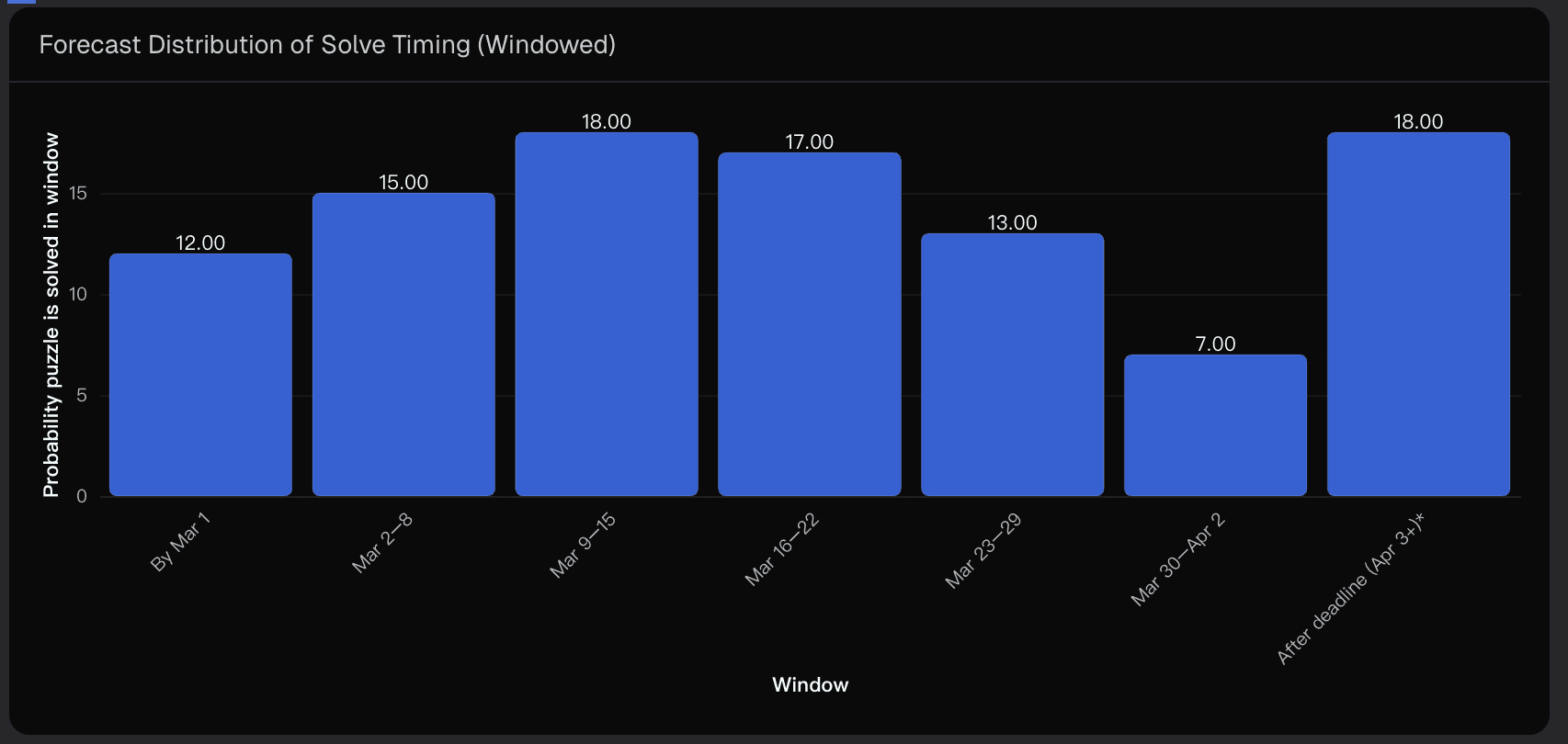
When I shifted from cumulative probability to windowed distribution (where the actual solve is most likely to occur), March dominated.
Solve probability by time window:
By March 1: 12%
March 2–8: 15%
March 9–15: 18%
March 16–22: 17%
March 23–29: 13%
March 30–April 2: 7%
After deadline: 18%
The distribution is front-loaded into March for three structural reasons.
2.1 The Puzzle Is Hard — But Not Multi-Month Impossible
Public commentary describes the challenge as “very hard” with “lots of steps.” That suggests delayed resolution — but not something that drags into summer.
Hard promotional puzzles typically follow a pattern:
Early confusion
Fragmented partial solves
A bottleneck “connecting insight”
Rapid final convergence
We are currently in the bottleneck phase.
2.2 Staged Clue Releases Create a Built-In Acceleration Phase
Clues were embedded across multiple channels — including the Super Bowl launch and subsequent videos.
This implies:
Full solution requires cross-referencing assets.
Assembly, not brute force, is the constraint.
Once the linking structure is understood, progress becomes exponential.
Historically, multi-step ARG-style puzzles behave exactly this way: a slow burn followed by a mid-cycle breakthrough.
2.3 The Deadline Acts as a Design Anchor
The contest ends April 2, 2026 unless solved earlier.
That matters more than most people realize.
If the puzzle were solved too quickly, the promotional campaign would lose momentum.
If it remained unsolved beyond the deadline, the narrative would feel anticlimactic.
This makes mid-to-late March the most structurally balanced outcome.
3. Evidence and Drivers That Could Move the Solve Date
Forecasting isn’t about certainty — it’s about understanding what shifts probability.
Here are the key drivers I’m watching.
3.1 Crowd Scale and Swarm Intelligence
Large online communities dramatically accelerate multi-step puzzles once coordination improves.
Reddit- or Discord-style collaboration typically:
Divides the search space
Identifies dead ends faster
Amplifies breakthroughs instantly
Current signal: High crowd engagement → pushes solve earlier.
3.2 The “Linking Step” Bottleneck
Most ARG-style puzzles hinge on one connective insight.
Until that step is discovered, progress looks stagnant.
Once discovered, resolution can occur within days.
Current signal: Unclear whether this has been fully identified → neutral to slightly delayed.
3.3 Additional Official Hints
If organizers release:
Clarifying social posts
Supplemental videos
Major “big hint” drops
The entropy of the search space collapses quickly.
Current signal: Medium-to-high likelihood of timed nudges → accelerative effect.
3.4 Verification and Submission Friction
Even if someone finds the correct solution, it must:
Be submitted correctly
Pass eligibility checks
Clear verification procedures
That introduces non-zero delay risk.
This is the primary driver behind the 18% probability mass assigned to post–April 2 outcomes.
4. What Could Break This Forecast
No model is complete without identifying its failure points.
Here are the major uncertainties:
Is the Entire Puzzle Already Released?
If critical pieces are being intentionally withheld for phased release, then the solve date becomes release-schedule-driven rather than search-driven. That would push probability later.
Slackbot / AI Assistance Boundaries
If the submission or hint mechanisms are rate-limited, narrowly scoped, or milestone-triggered, their real-world acceleration effect could be smaller than assumed.
False Positives and Administrative Disqualification
Large crowds generate many plausible but incorrect final codes.
Additionally:
Eligibility issues
Documentation errors
Procedural disqualification
could delay the official “solved” announcement even if a correct code exists.
Conclusion: The Most Defensible Prediction
After modeling the incentive structure, crowd dynamics, release mechanics, and verification friction, my conclusion is straightforward:
The highest-probability outcome is that MrBeast’s million-dollar puzzle is solved in March 2026, most likely between March 16 and March 22, with an 82% chance of resolution by the April 2 deadline.
There remains an 18% tail risk extending beyond the deadline — primarily driven by release timing and verification delays — but structurally, the system is designed for convergence within weeks, not months.
And as I continue tracking this forecast inside Powerdrill Bloom, I’ll be watching for one signal above all others: the discovery of the linking step that turns scattered clues into a single, coherent final code.
Because once that happens, this puzzle won’t linger — it will collapse.
Disclaimer: This analysis is a probabilistic forecast based on publicly available information and does not guarantee any specific outcome.
Related Post

2026年2月10日
/
Post by

2026年2月9日
/
Post by
2026年2月6日
/
Post by