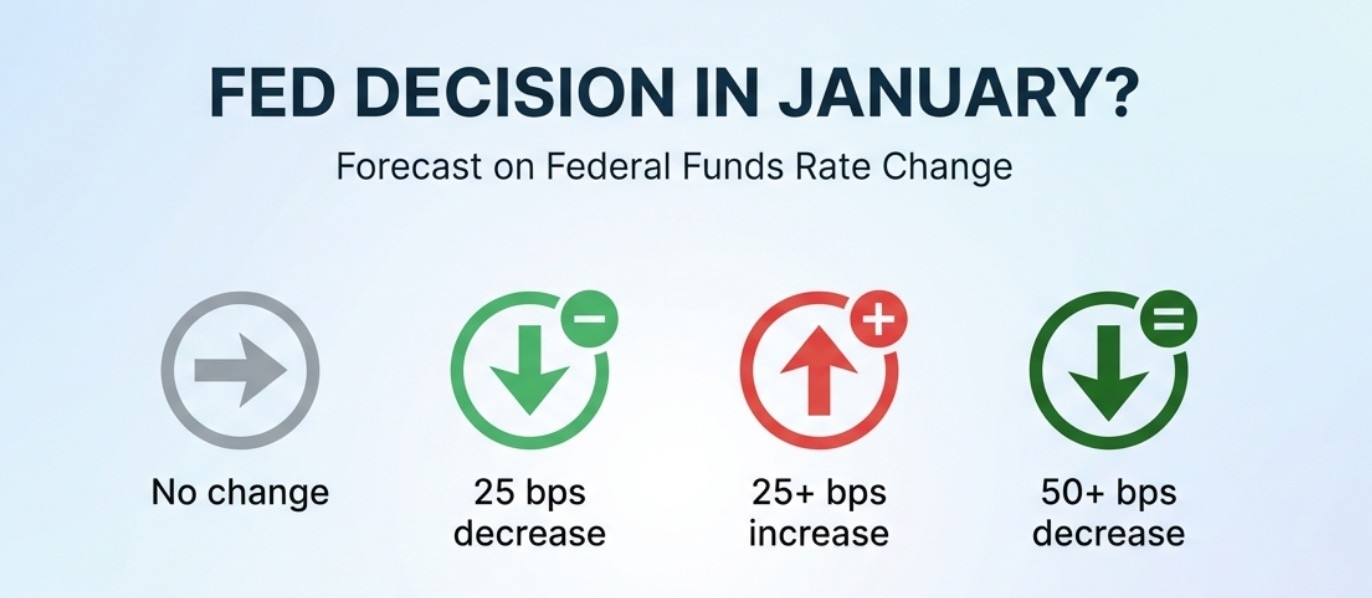
Over the past few months, I’ve been tracking the Federal Reserve’s signals with unusual intensity — not just headlines, but the subtle shifts hidden in projections, probabilities, and market reactions. When you step back and connect the dots, a clear picture emerges.
After running the numbers, stress-testing scenarios, and comparing institutional forecasts, my conclusion is straightforward:
The Federal Reserve is highly likely to hold rates steady in January 2026.
This isn’t a contrarian view. It’s a probability-weighted forecast grounded in market pricing, Fed guidance, and macro fundamentals — and it’s exactly the kind of conclusion that becomes obvious once you synthesize the data properly.
Prediction: No Change in January 2026
Base Case:
The Fed will maintain the federal funds rate at 3.50%–3.75% at its January 28–29, 2026 meeting.
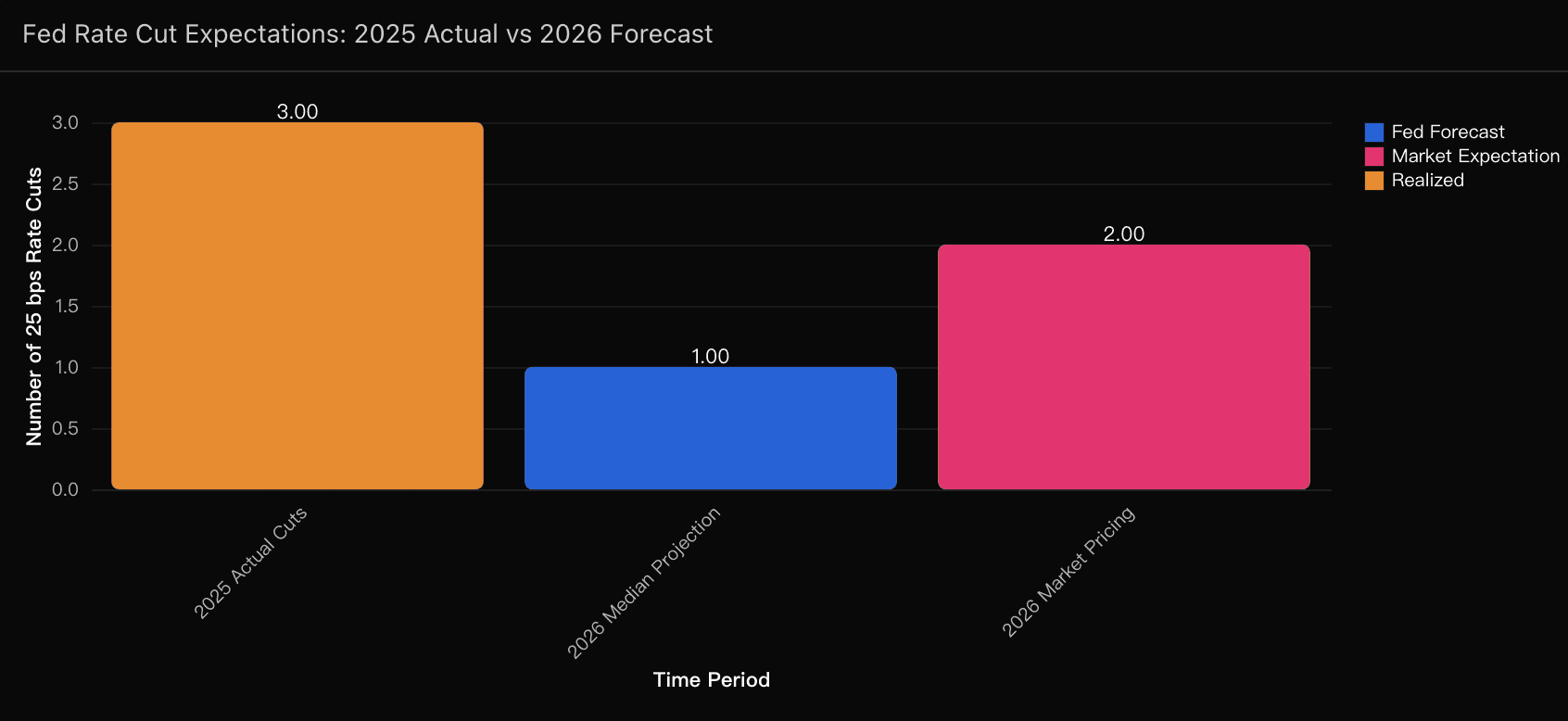
This decision would represent a strategic pause, following three consecutive 25-basis-point cuts delivered in September, November, and December 2025. In my view, those late-2025 cuts already fulfilled the Fed’s stated objective: providing insurance against downside labor-market risks.
January, therefore, is not about further easing — it’s about assessment.
What the Market Is Pricing In
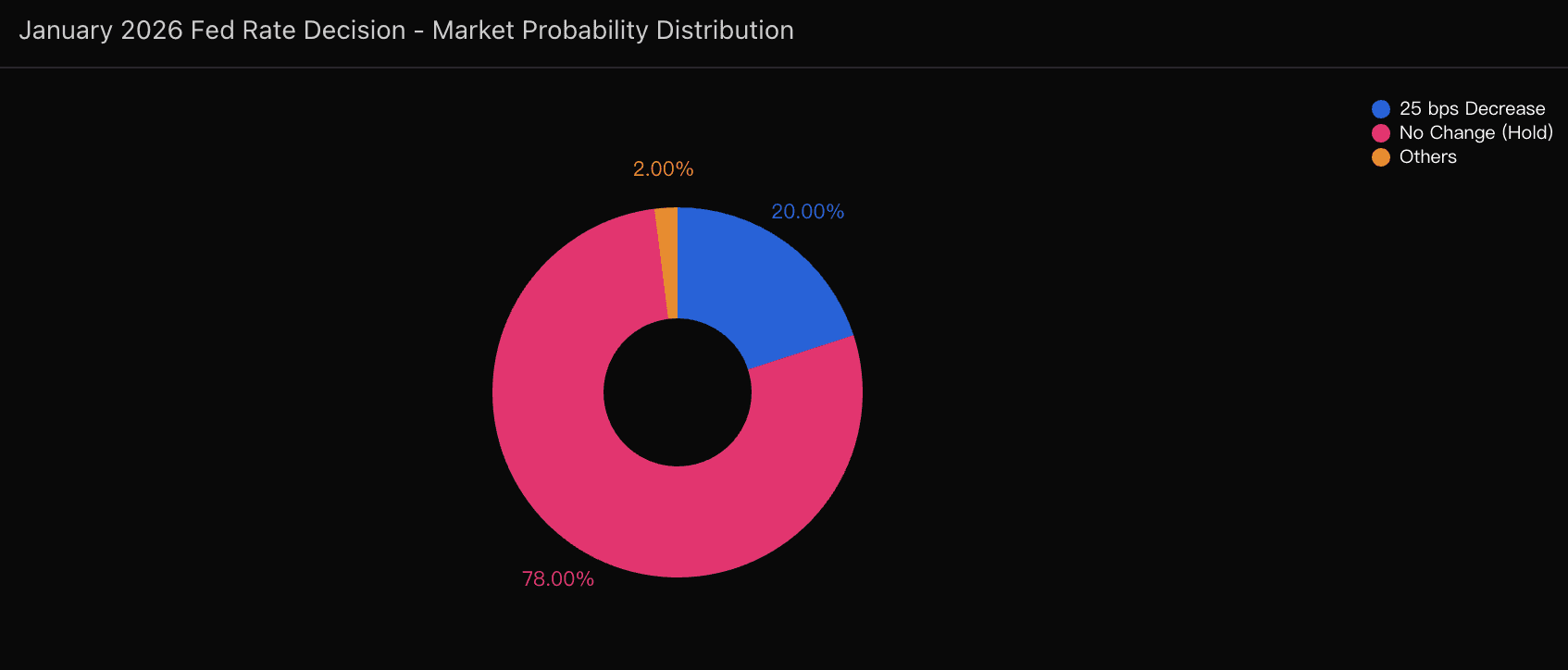
According to CME FedWatch probabilities released after the December 10 announcement, markets are already leaning heavily toward a pause:
No Change (Hold): 78% ← Primary scenario
25 bps Cut: ~20% ← Contingency scenario
50+ bps Cut: ~1%
*Any Rate Increase: ~1%
What’s notable here isn’t just the level, but the direction. The probability of a January hold climbed from roughly 70% pre-announcement to 78%, signaling growing market confidence after digesting the Fed’s updated guidance.
This is exactly the type of probability shift I track using Powerdrill Bloom — not just raw odds, but how expectations evolve after key policy signals.
Supporting Evidence for the Prediction
The Fed’s Own Signals: The December Dot Plot Shift
The most underappreciated data point, in my view, is the December 2025 dot plot.
Here’s what it tells us:
The median Fed projection shows only one 25 bps cut for all of 2026
7 of 19 policymakers (37%) expect zero cuts next year
Several others prefer holding rates steady even if they didn’t formally vote that way
This represents a clear hawkish shift from September. When I mapped this transition in Powerdrill Bloom’s trend-analysis module, the change was unmistakable: policymakers are no longer thinking in terms of sequential cuts — they’re thinking in terms of limits.
Institutional Consensus Is Remarkably Aligned
One of the strongest confirmations of my view comes from major institutions — not just one, but many:
Goldman Sachs: January hold, followed by cuts in March and June
Bank of America: No action again until mid-2026
Wells Fargo: Emphasizes the high bar for January after the “insurance cut” framing
Reuters consensus: “FOMC on pause starting in January”
Desjardins: Expects a pause through the first half of 2026
When this many independent models converge, the signal-to-noise ratio improves dramatically.
The Macro Backdrop Doesn’t Justify Urgency
The Fed’s December projections paint a surprisingly constructive picture:
2026 GDP growth: ~2.3% (above trend)
Core PCE inflation: ~2.4% by end-2026
Unemployment: ~4.4%, stable
This is not an economy screaming for rapid stimulus. If anything, it’s an economy where policymakers can afford to wait, observe, and recalibrate.
From a decision-theory perspective, pausing dominates cutting when risks are asymmetric — and right now, that asymmetry is real.
Leadership Transition Encourages Caution
There’s another factor markets tend to underestimate: institutional uncertainty.
Chair Powell’s term ends in May 2026
A Trump administration is expected to name a new Fed chair before year-end
Reporting suggests a committee with a strong hawkish bloc
In periods of leadership transition, central banks historically default to caution. Cutting aggressively right before a potential handover would be an unusual — and risky — move.
Why September’s “Insurance Cut” Matters More Than People Think
Powell explicitly framed September’s cut as risk management, not the start of a new easing cycle.
Since then:
No major labor shock has occurred
Two additional cuts have already been delivered
The Fed now needs time to evaluate whether those actions worked
What Could Change My Mind? (The 20% Scenario)
I assign roughly a 20% probability to a January cut, driven by three low-probability triggers:
A sudden labor-market shock
Timing works against this — key data arrives either too late or too close to the meeting.Unexpected inflation collapse
Core PCE would need to fall near 2.1% rapidly — highly unlikely given current trends.A surprisingly dovish Fed chair announcement
Even then, credibility argues for a pause-first approach.
None of these are impossible — but none are probable.
Final Take
After weighing probabilities, projections, institutional forecasts, and macro data, my probability-weighted conclusion is clear:
A January 2026 Fed rate hold at 3.50%–3.75% is the dominant outcome, with roughly 78% likelihood.
This forecast aligns with:
The Fed’s own dot plot
Analyst consensus across major banks
A resilient economic backdrop
A hawkish committee structure
Leadership transition dynamics
A cut remains a contingency — not the base case.
This kind of clarity is exactly why I rely on tools like Powerdrill Bloom to synthesize market probabilities, policy signals, and narrative shifts into one coherent analytical framework. In complex macro environments, the edge isn’t having more data — it’s understanding what actually matters.
And right now, what matters most is patience.
Related Post

2025年12月5日
/
Post by

2025年12月3日
/
Post by

2025年11月27日
/
Post by