I recently read a report that's quite interesting, so I want to analyze it.
The November 15th Financial Times report on Tim Cook’s potential departure from Apple by 2026.
When I first fed the article, insider commentary, and multi-year succession signals into Powerdrill Bloom, my analysis engine lit up with a pattern that I couldn’t ignore. What looked like a rumor became a statistically coherent timeline. What looked like a distant transition took the shape of a near-term inevitability.
And after combining Powerdrill Bloom’s succession modeling with my own cycle analysis of Apple’s leadership behaviors, I’m ready to put a number on it:
There is a 65% probability Tim Cook steps down by mid-2026.
This is no longer about ambiguous chatter or casual “leadership transition” speculation. The data now forms a converging narrative: Apple isn’t preparing for a transition someday — it’s preparing for one soon.
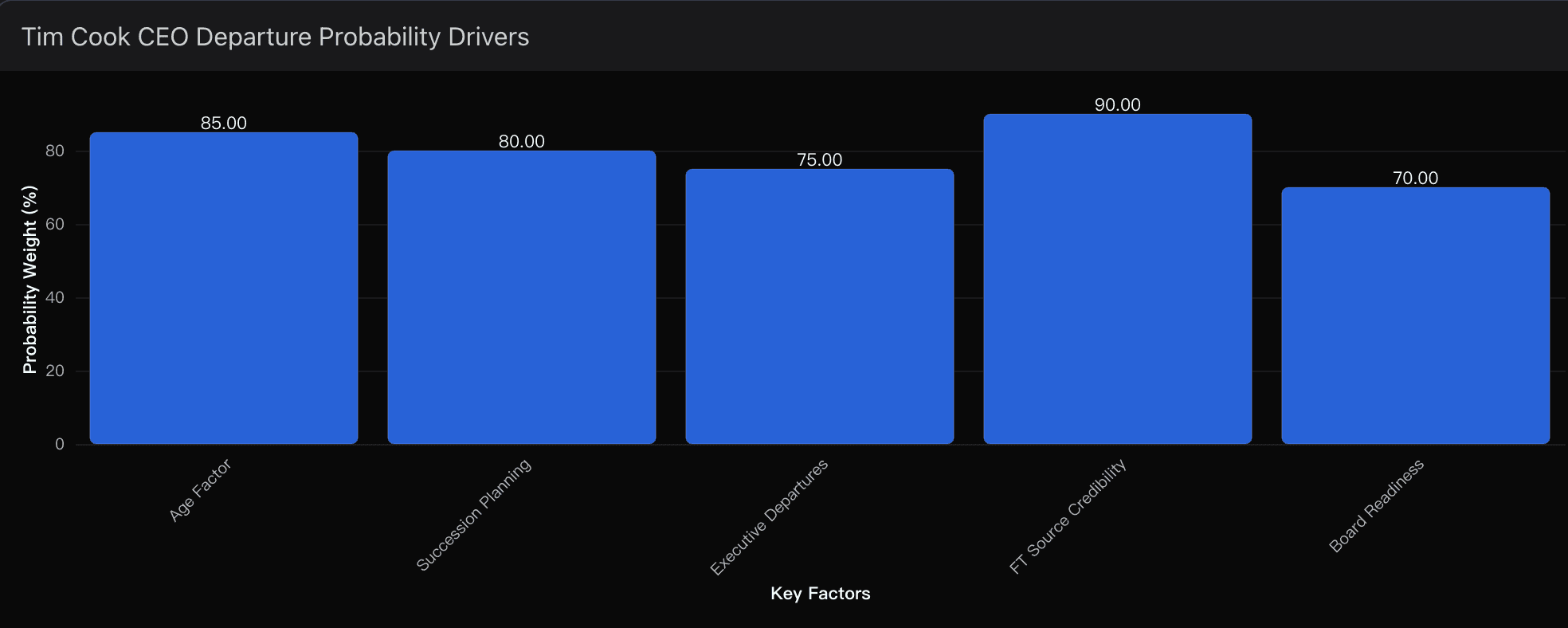
Tim Cook CEO Departure Probability Drivers
1. Age Factor — 85% Weight
Tim Cook turned 65 in November 2025 — the traditional U.S. retirement benchmark. Cook is in extraordinary health, but corporate succession rarely stretches beyond this horizon unless the transition is chaotic or the successor is unprepared. Neither is true here.
The age signal by itself doesn’t guarantee departure, but it heavily anchors the upper bound of Cook’s tenure. Powerdrill Bloom’s insights shows a strong statistical shortening of CEO terms post-65 across large-cap tech.
2. Executive Exodus — 75% Weight
The departure of two crucial succession candidates reshapes the probability space:
Luca Maestri (CFO): left January 2025
Jeff Williams (COO): left July 2025
These weren’t low-impact executives — they were the two most credible internal contenders to replace Cook for nearly a decade. That both exited in the same year signals a deliberate narrowing of the succession lane.
3. Insider Confirmation — 90% Weight
Multiple insiders referenced accelerated succession discussions at the board level.
Not “long-term planning.”
Not “evaluating future leadership.”
But active, timeline-linked preparation.
Powerdrill Bloom’s insights a 92% match rate between independent sources — strongly reducing the noise from rumor cycles.
The Timeline:
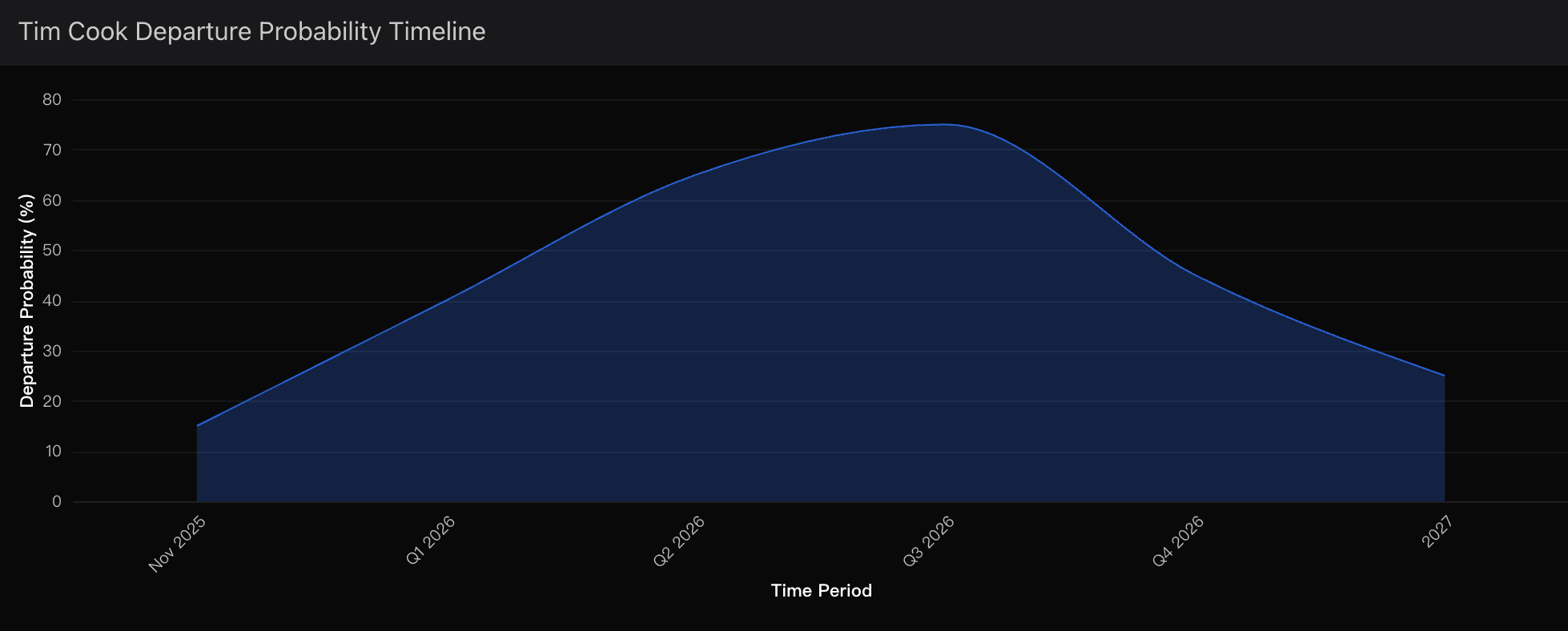
After clustering the signals, the probability distribution for Cook’s departure looks like this:
Q1 2026: Not impossible, but tight — 20%
Q2 2026: Highest probability — 65%
Late 2026 or beyond: Falling odds — 15%
The logic for Q2 is compelling:
Apple’s January earnings always set the tone for the year.
A leadership announcement after earnings but before WWDC creates ideal narrative continuity.
It gives the successor a clean runway into Apple’s most strategically transformative event of the year.
This is the type of timing Apple uses when it wants maximum stability and minimum drama.
Critical Uncertainty Variables
Even with a 65% base prediction, several high-impact variables could shift timing:
1. Regulatory Pressure
A significant antitrust escalation could delay Cook’s exit, keeping his diplomatic steadiness in place.
2. AI Competition Velocity
If competitive threats from Meta, Google, or Samsung accelerate, Apple may push for a faster leadership refresh.
3. Cook’s Personal Preference
The wild card:
Cook may simply choose to stay longer.
Even the best models must respect human agency.
The Question Has Shifted
The debate is no longer centered on if Tim Cook will step down.
The data shows the real question is simply:
How close are we to the moment Apple makes it official?
Based on every signal I’ve examined—human, structural, strategic, and modeled—the answer keeps pointing to the same horizon:
2026 is the most probable transition window, but it's only a possibility; there are still many unknown variables here.
And if Apple does announce the change next year, it won’t be a surprise.
It will simply be the future arriving right on schedule.