
Every Oscar season has a moment when noise gives way to signal. For the 98th Academy Awards, that moment has already arrived in the Best Actor race.
After aggregating prediction markets, awards trackers, critical signals, and betting liquidity—and stress-testing them through Powerdrill Bloom’s multi-source probability modeling—one conclusion consistently rises above the rest:
Timothée Chalamet, for Marty Supreme, is the clear front-runner to win Best Actor at the 2026 Oscars.
Not inevitable, but decisively ahead. In this article, I’ll walk through how the market sees this race, why Chalamet has separated from the field, and what scenarios could still derail him—using real probability data rather than award-season intuition.
The Core Prediction at a Glance
As of late December 2025, the Best Actor race has crystallized into a two-tier structure:
Tier 1 (True contenders):
Timothée Chalamet (Marty Supreme)
Leonardo DiCaprio (One Battle After Another)
Tier 2 (Long-shot spoilers):
Wagner Moura
Ethan Hawke
Michael B. Jordan
Others with fragmented support
Across every major prediction mechanism tracked by Powerdrill Bloom—including Polymarket and Kalshi—Chalamet holds the lead.
Aggregated win probability (Powerdrill Bloom consensus model):
Timothée Chalamet: ~57–63%
Leonardo DiCaprio: ~20–23%
All others combined: <25%
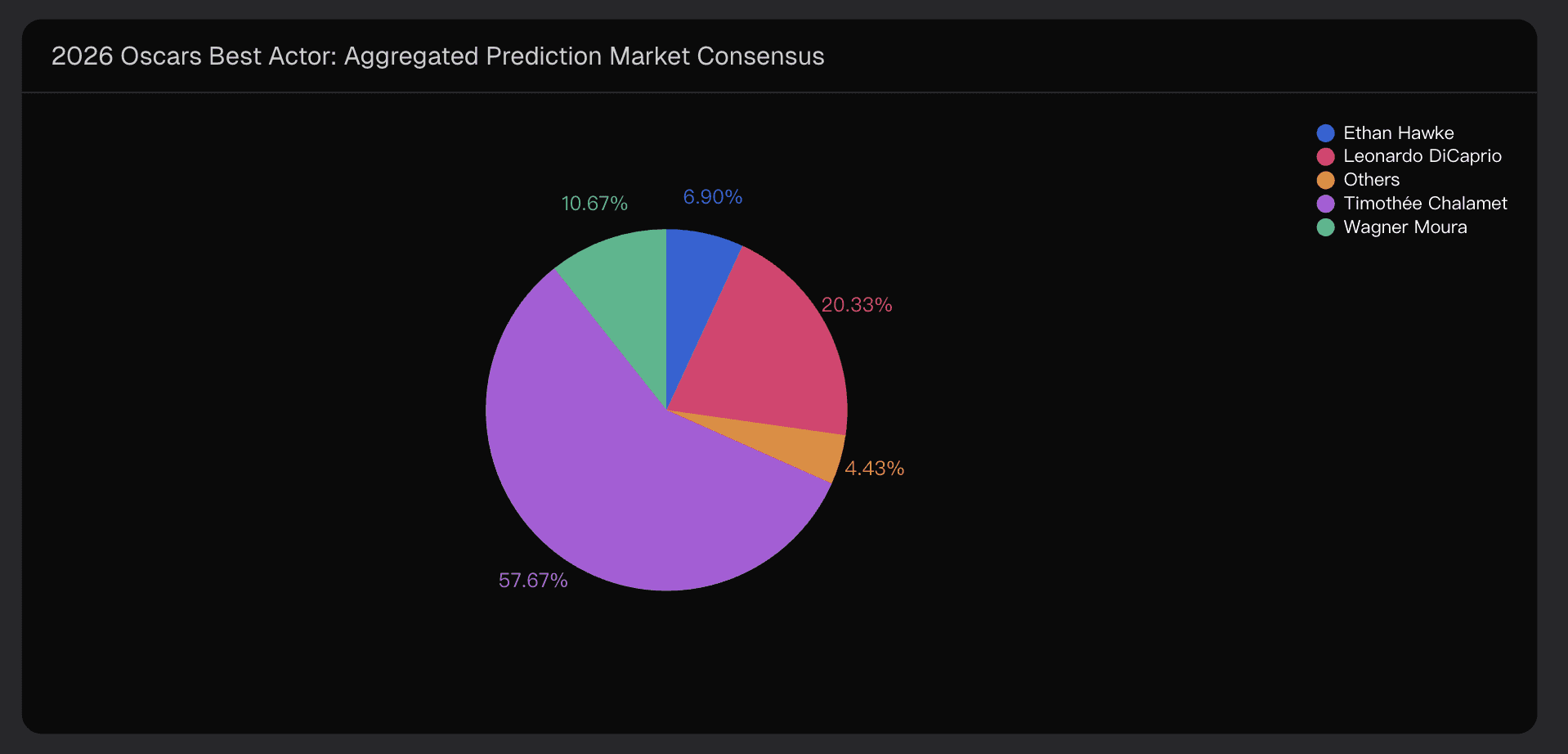
That translates to roughly a 2.5:1 odds advantage for Chalamet over DiCaprio. In Oscar terms, that’s a meaningful gap.
What the Prediction Markets Are Really Saying
Prediction markets don’t care about narratives. They care about information flow.
When I ran the latest awards-season data through Powerdrill Bloom—combining odds movement, liquidity concentration, and update velocity—a few patterns stood out immediately.
Market Convergence Is the Key Signal:
Polymarket holds Chalamet at ~57% to win
Kalshi is even more confident, pushing him to ~63% after a recent +6 point move
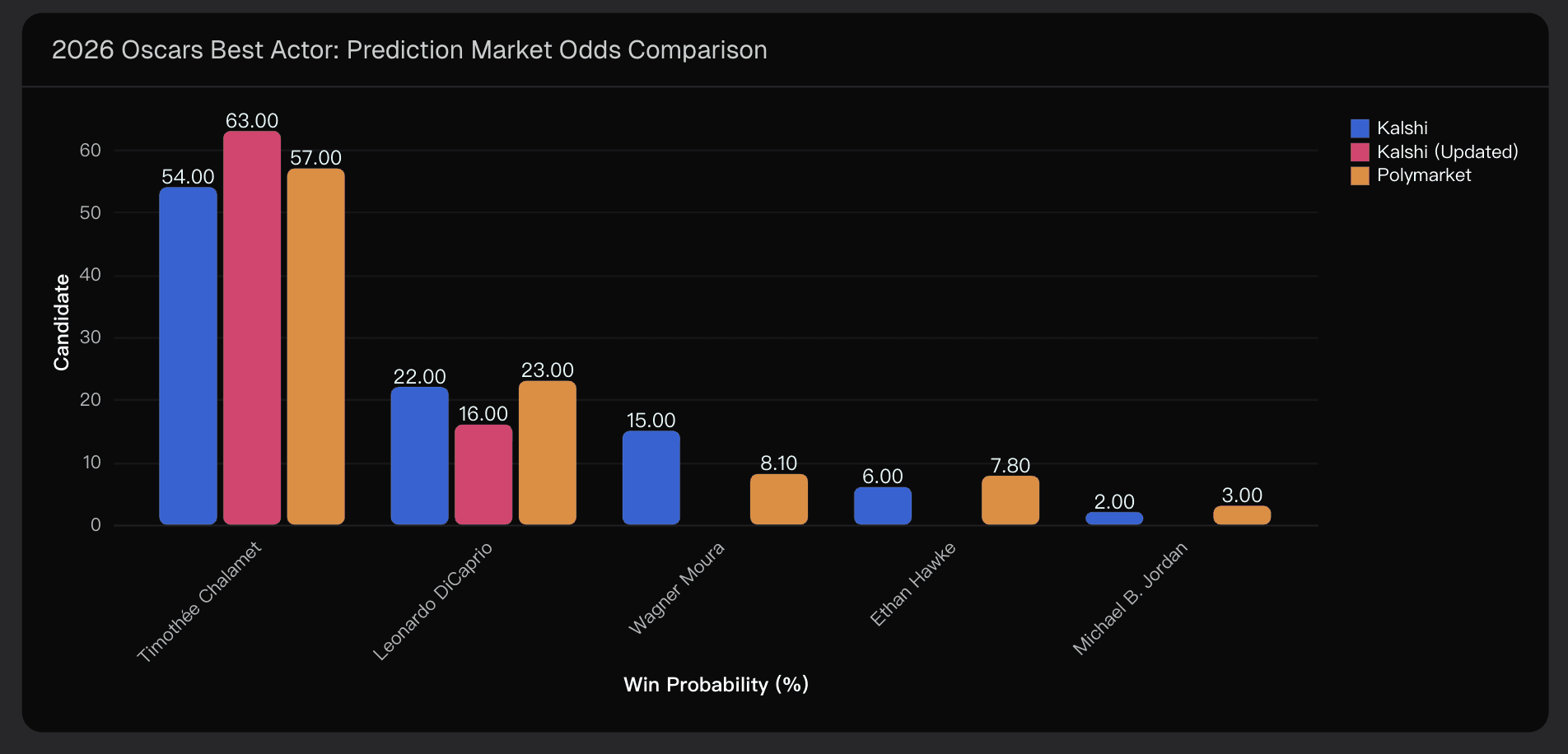
Crucially, these platforms operate independently—yet they’re converging on the same ranking. That kind of convergence is rarely accidental.
Nomination Odds vs. Win Odds: The Hidden Asymmetry
One of the most revealing insights emerges when nomination probability is separated from win probability. Across current forecasting signals, Leonardo DiCaprio remains widely viewed as a near-lock nominee; however, he trails Timothée Chalamet decisively when it comes to actual win probability. So what does that tell us?
Using Powerdrill Bloom’s voter-behavior clustering, this asymmetry points to three underlying dynamics:
Both actors are perceived as “safe” nominees across the Academy
Chalamet generates more concentrated enthusiasm, particularly within the acting branch
Voters appear comfortable nominating DiCaprio—but less motivated to ultimately crown him
In short: Nomination consensus ≠ winner passion. Oscar wins require the latter.
Why Marty Supreme Is Powering Chalamet’s Lead
Awards races are inseparable from films—and Marty Supreme is doing exactly what an Oscar vehicle needs to do.
1. Critical Reception Is Nearly Unanimous
Reviews consistently frame Chalamet’s performance as:
“A career best”
“Transformative rather than technical”
“Emotionally dominant without theatrical excess”
That language matters. Oscar voters respond more strongly to breakthrough framing than to competence alone.
2. Audience Validation Has Arrived Early
Unlike many prestige contenders, Marty Supreme didn’t stall at the box office. Early global receipts signal:
Strong word-of-mouth
Real audience engagement beyond critics
Cultural visibility, not just industry admiration
That combination—critical rapture plus audience traction—is rare and powerful.
3. Campaign Strategy Is Aggressive and Modern
A24 has executed a textbook awards rollout, and Chalamet’s own press strategy has been unusually proactive. Compared to DiCaprio’s restrained, traditional approach, Chalamet’s visibility is:
More frequent
More narrative-driven
More aligned with younger Academy voters
Momentum compounds when visibility is intentional.
The Narrative Gap: Why DiCaprio Trails Despite Prestige
Leonardo DiCaprio is not weak in this race; in fact, he remains the only genuine alternative, but his campaign faces clear structural headwinds.
One Battle After Another earned respect—but not “career-defining” language
His narrative leans toward accumulation (“still hasn’t won again”) rather than arrival
Multiple nominations over time can paradoxically dilute urgency
Oscar history shows this pattern repeatedly: When a veteran competes against a younger actor delivering a perceived peak performance, voters often tilt toward the moment, not the résumé.
What Would Have to Go Wrong for Chalamet?
A 57–63% probability is strong—but it’s not certainty. Based on Powerdrill Bloom’s scenario modeling, the main risk vectors look like this:
1. Late-Season Narrative Reversal (≈15–20%): If industry discourse reframes Marty Supreme as “technically impressive but mannered,” momentum could soften.
2. Voter Fatigue with Obvious Favorites (≈10–15%): Oscar history includes abrupt pivots away from consensus leaders when outcomes feel predetermined.
3. Acting Branch Divergence (≈8–12%): The acting branch occasionally rallies around a different emotional story—this is where DiCaprio’s institutional goodwill matters.
4. Low-Probability Wildcards (<5%): Unexpected controversies, late-breaking critical shifts, or voting-bloc realignments.
Stacked together, these risks explain why Chalamet isn’t at 80%—but they don’t erase his lead.
Final Verdict
Timothée Chalamet enters 2026 as a high-probability—but not inevitable—Best Actor winner. The data shows:
Strong market conviction
Clear narrative alignment
Critical and audience validation
A meaningful gap over the field
Leonardo DiCaprio remains a legitimate contingency—not symbolic, but real—hovering around a 1-in-5 chance. Everyone else is playing spoiler at best.
Unless the story changes materially in January or February, this race will be decided not by surprise, but by sustained enthusiasm—and right now, that enthusiasm belongs to Chalamet.
As reflected in the Powerdrill Bloom probability model, this race remains structurally stable unless disrupted by decisive guild-level momentum later in the season.
Disclaimer: This analysis reflects data-driven projections based on current information and market conditions and is not guaranteed or intended as financial or betting advice.
Related Post
Dec 24, 2025
/
Post by
Michael

Dec 23, 2025
/
Post by
Jasper

Dec 17, 2025
/
Post by
fox