Data Fact: The Numbers Behind the Global Rise of AI Startups (Up-to-Date 2026)

TL;DR — The Global AI Boom in 5 Numbers
AI startups went from a niche sub-sector to the absolute gravitational center of global venture capital faster than any technology before them. Here's the global AI startup market in five figures:
$255.5 billion was poured into AI startups in Q1 2026 alone — eclipsing the entire 2025 full-year total.
~80% of all global venture capital dollars in Q1 2026 went to AI startups.
70,000+ AI startups are now operating worldwide.
~50% of all new tech unicorns minted in 2026 are AI-related.
67% of all AI funding in Q1 2026 went to just three companies: OpenAI, Anthropic, and xAI.
The short version: the global rise of AI startups is simultaneously experiencing its greatest boom and its first real shakeout. AI is no longer just a piece of the startup ecosystem; it is the ecosystem.
A Little Background
A few years ago, an AI startup was a curiosity—often experimental, expensive to run, and lacking clear commercial paths. The conversation was about "if" foundation models and generative AI could be safely commercialized, not "when."
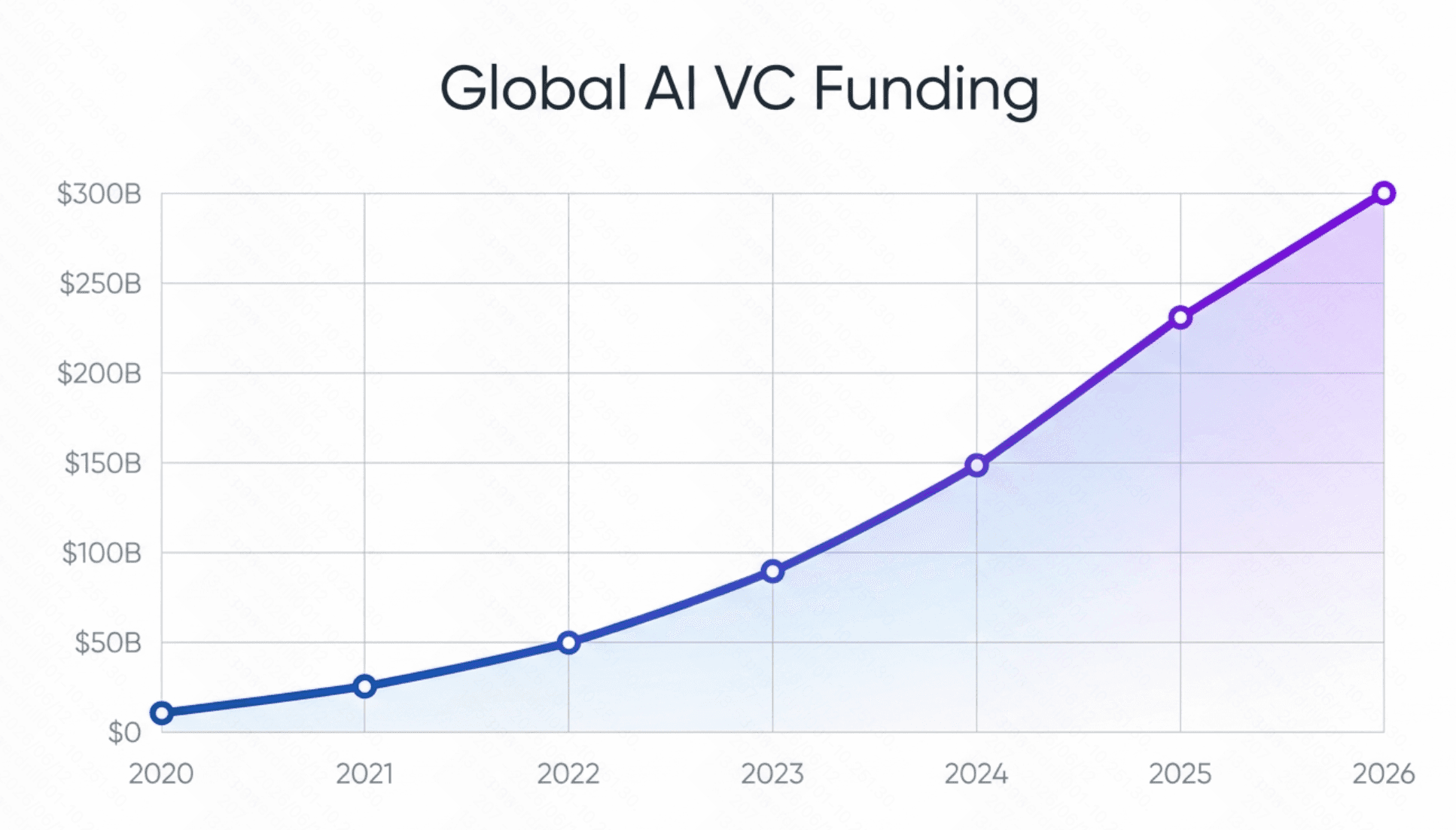
That question is settled. Between 2020 and Q1 2026, AI venture capital grew at a record-shattering pace. The global AI market is expected to reach $539 billion by the end of 2026. Falling computing costs, breakthroughs in foundation models, and a wave of aggressive sovereign wealth fund investments turned a steady climb into a vertical spike. To see just how steep, we pulled the numbers together and let the data tell the story.
About the Dataset
This report draws on multi-source, data-driven analysis compiled in June 2026. It covers global AI funding trends from 2020–2026: annual venture capital volumes, AI’s share of total VC, regional breakdowns (US, EU, UK, China), and startup ecosystem metrics. Sources include Crunchbase, PitchBook, OECD AI VC Report, and the Stanford HAI 2026 AI Index. Figures are approximate and rounded for readability.
About the Tool
Every chart in this report was generated with Powerdrill Bloom, an AI-first data analysis agent. We uploaded the raw spreadsheet, and Bloom cleaned it, suggested exploration paths, and produced the charts below automatically, no SQL, no Python, no manual formatting. If you want to explore the same data yourself, see our AI data visualization tool.
Key Takeaways
Funding exploded in 2025 and 2026. Global AI sales hit $211 billion in 2025 (up 85% YoY), and then Q1 2026 blew past it with $255.5 billion in a single quarter.
Half of the unicorn board is AI. About 50% of all tech unicorns in 2026 are AI-related. 47 seed- and early-stage companies joined the unicorn ranks in Q1 2026 alone.
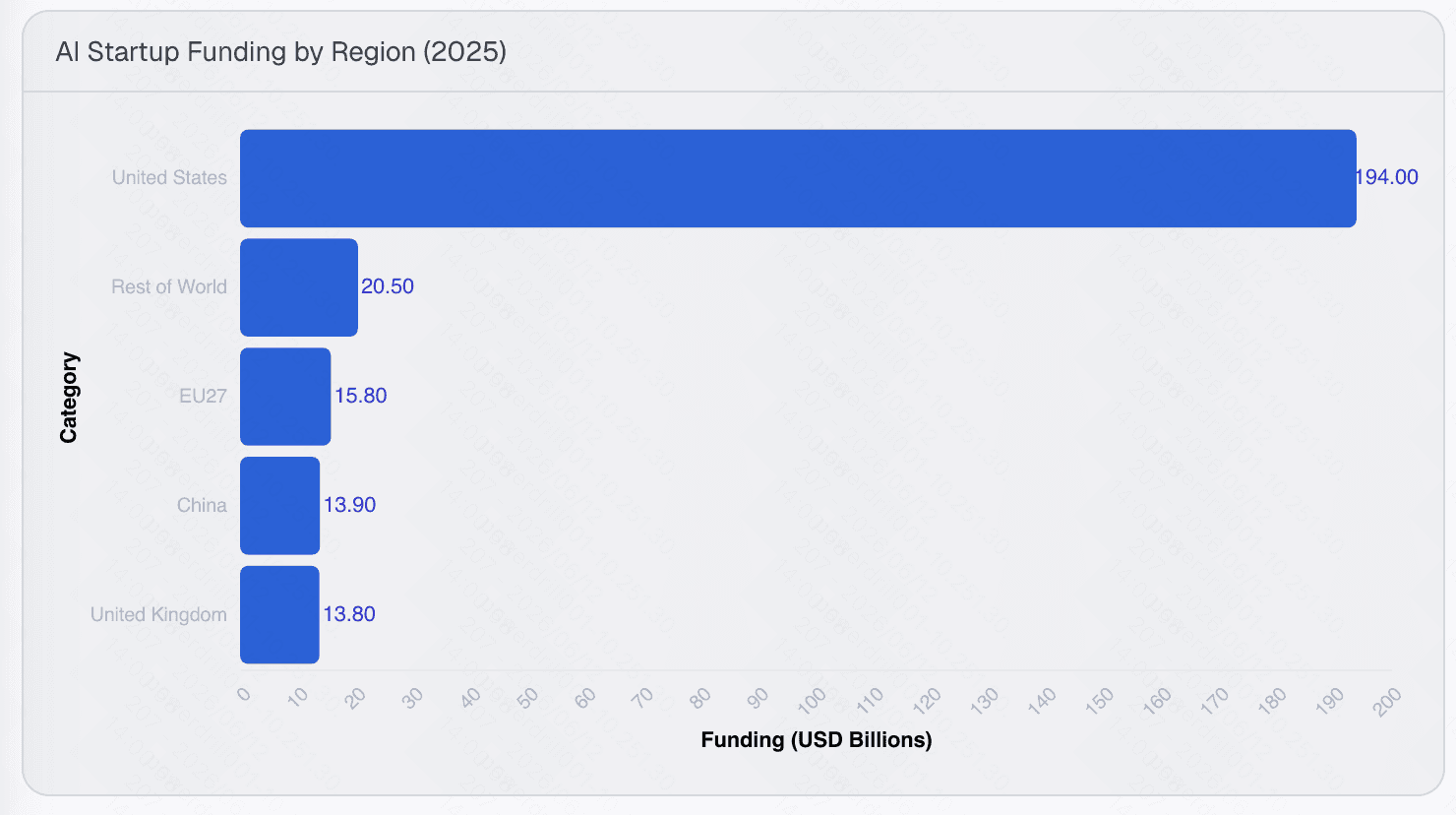
The U.S. is the engine. The US dominated with ~75% of global AI funding in 2025 (194B-286B) and grew to capture 83% of global VC in Q1 2026.
China leads in patents, Europe in regulation. China accounts for ~70% of all AI patent grants, while the EU27 ($15.8B funding) focuses heavily on applied AI for regulated industries.
AI-native efficiency is real. AI startups operate with 40% smaller teams, achieve $3.48M revenue per employee, and reach unicorn status a full year faster than non-AI SaaS counterparts.
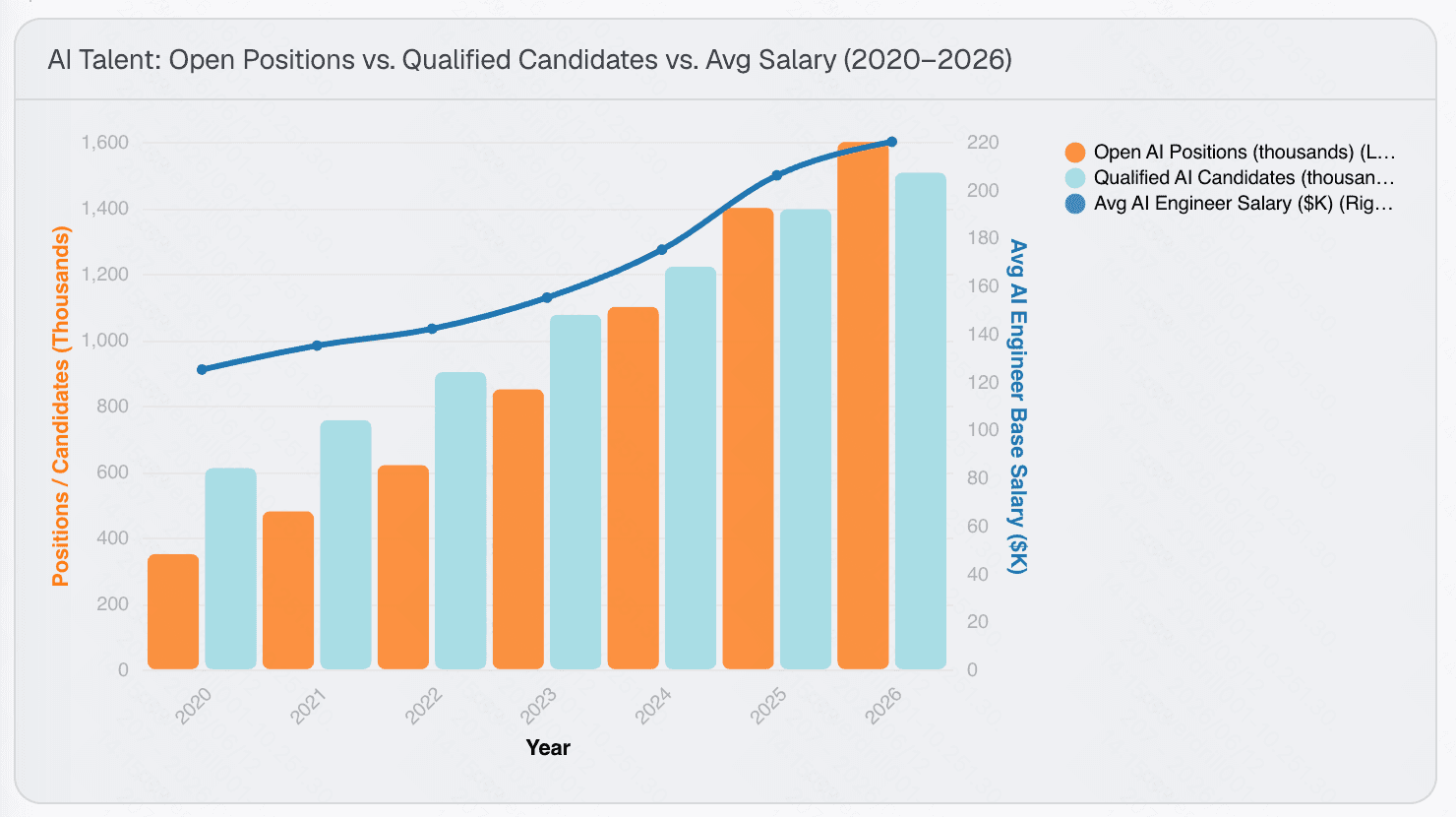
The talent shortage is severe. There is a 3.2:1 demand-to-supply ratio for AI talent. Frontier Lab Software Engineers are seeing median total compensation hit 600K-795K.
The Global AI Boom: The Full Data Breakdown
Q1: What is the trend in global AI startup funding from 2020 to Q1 2026?
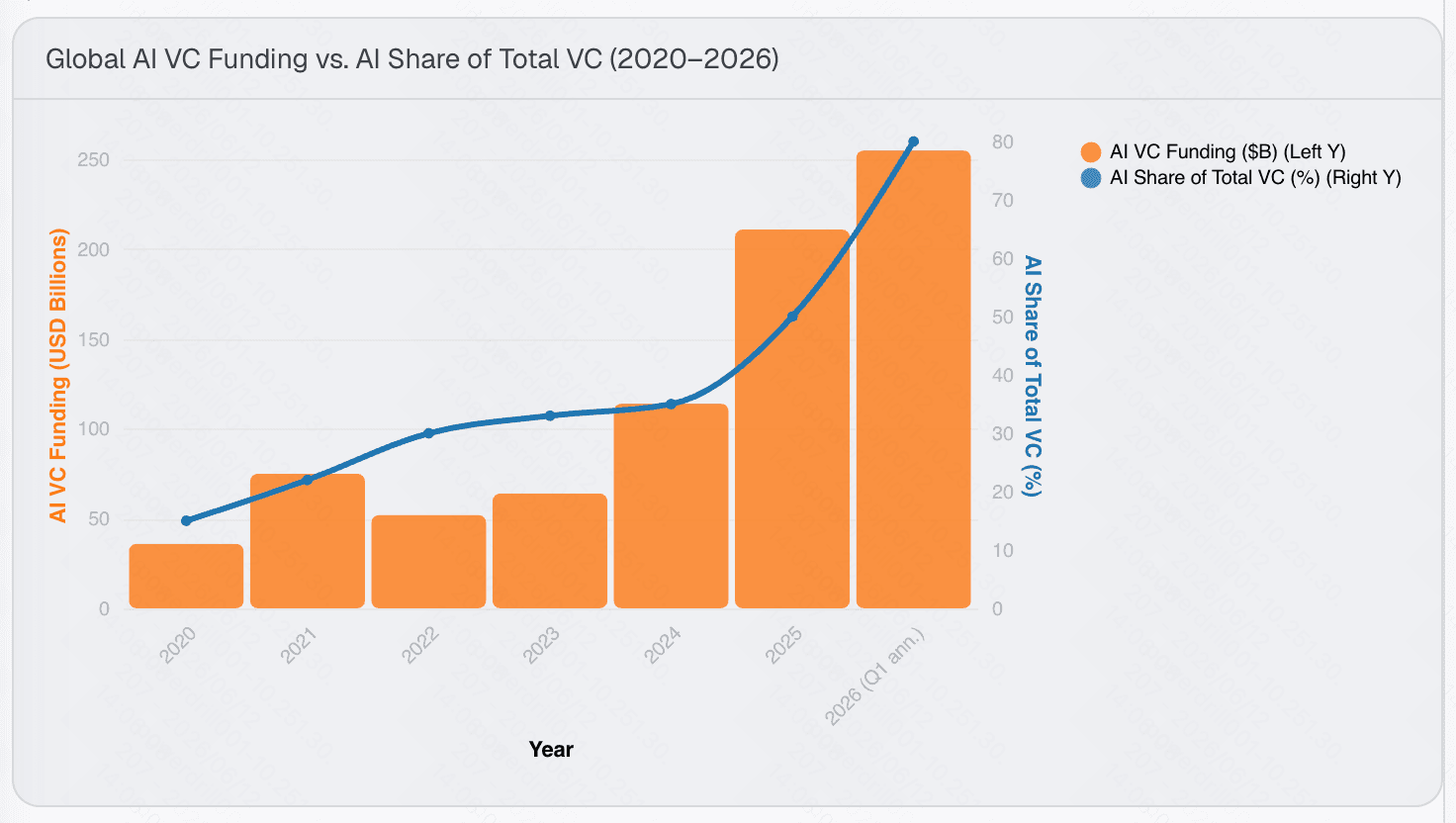
The headline trend is unprecedented hyper-growth. Funding hovered around $36B to $75B between 2020 and 2023. In 2025, it rocketed to $211 billion. Then, Q1 2026 shattered every historical precedent with roughly $255.5 billion in a single quarter.
Crucially, non-AI venture capital is actually shrinking, falling below 2020 levels when adjusted for inflation. AI’s share of total global VC grew from ~15% in 2020 to an astounding ~80% in early 2026.
Q2: Which companies and sectors are leading the pack?
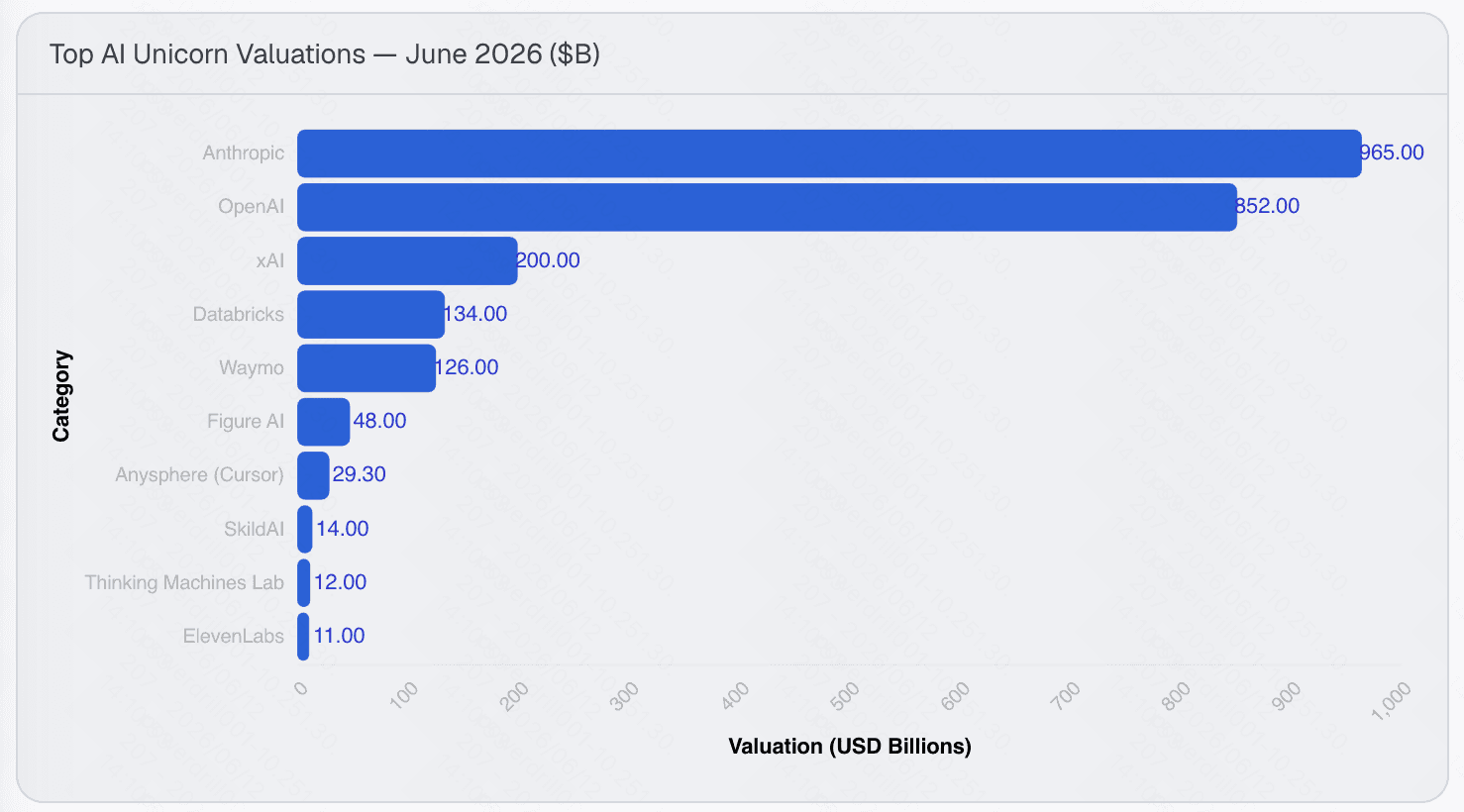
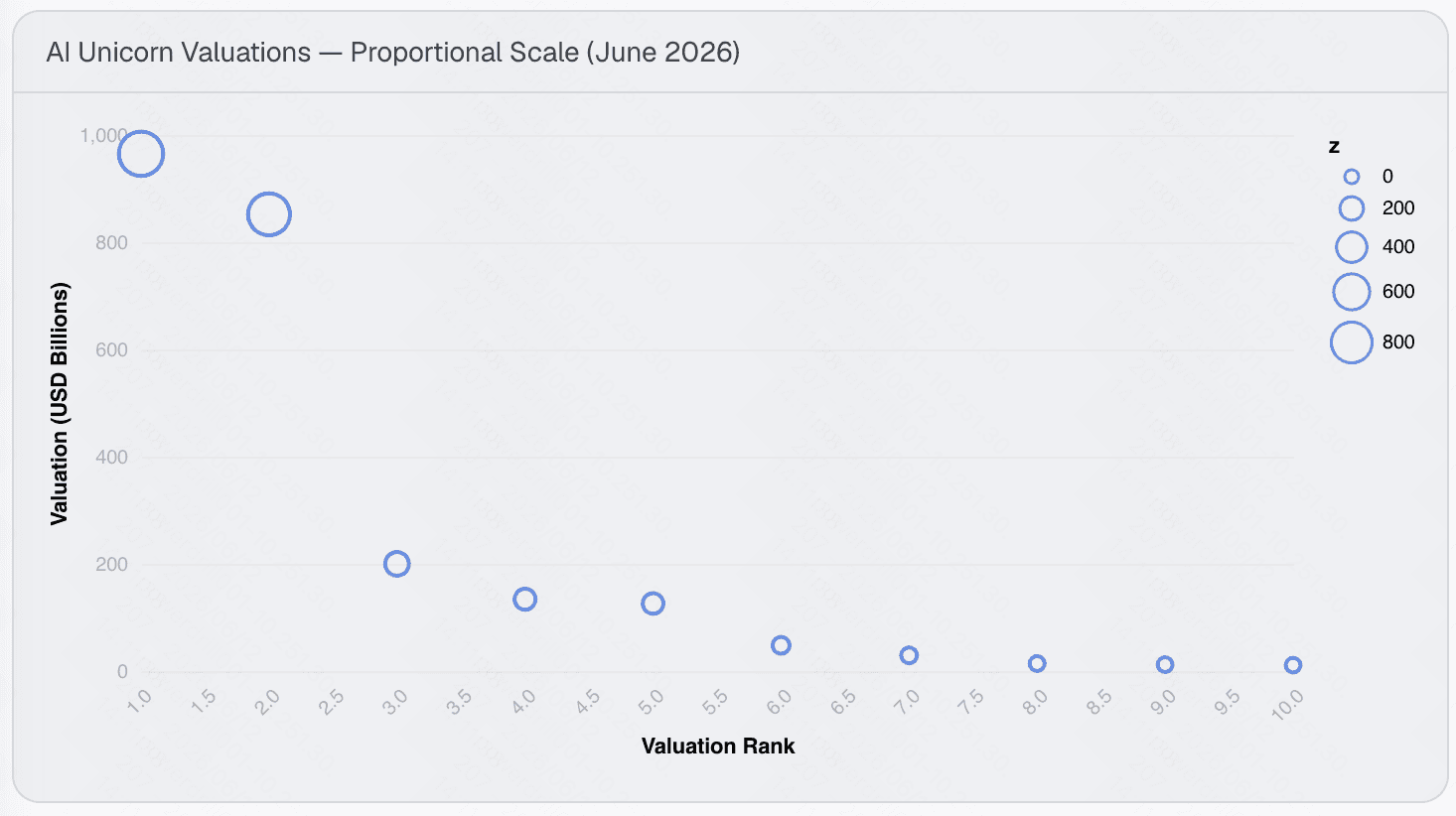
The market is highly concentrated at the top. In Q1 2026, OpenAI, Anthropic, and xAI accounted for 67% of all AI funding. Anthropic's valuation hit a staggering $965 billion, followed by OpenAI at $852 billion and xAI at $200B+.
Beyond foundation models (which took $80B+ in 2025), infrastructure is the hottest space, capturing $30B+ as companies like CoreWeave and Cerebras saw explosive IPOs and revenue growth. Healthcare AI is also booming, making up 75% of all health-tech deals.
Q3: How is the ecosystem handling this much capital?
We are seeing a massive bifurcation. While infrastructure and foundation labs attract capital at historically unprecedented scales, 2026 is also the "year of reckoning" for undifferentiated "AI wrapper" startups. Startups without data moats are shutting down as gross margins compress below 20%.
Meanwhile, big tech and sovereign wealth funds (like MGX, GIC, and PIF) have become the new kingmakers, investing $46 billion in just the first eight months of 2025.
What This Means for Businesses and Analysts
For founders and VC firms, the data says the "wrapper era" is over: the question isn't "can you build with an LLM" but "do you have a proprietary data moat and regulatory compliance?" For marketers and investors, the US dominance hides a global talent war, and regulatory readiness (like the EU AI Act) is now a core funding determinant.
And for anyone tracking the stock market, the IPO pipeline is the metric to watch: the combined float of upcoming AI listings—including Databricks, Cohere, OpenAI, and Anthropic—could exceed $3 trillion in the next 12 months.
How We Made These Charts
You don't need a data team to produce a report like this. Here's the exact workflow:
Upload your data or start from skills/a topic. Choose a skill, enter a topic, or drop a CSV or Excel file into Powerdrill Bloom.
Let the canvas explore it. Bloom auto-cleans the data and suggests three smart exploration paths, funding trends, regional breakdowns, valuations, then generates the charts for you.
Export to slides. Turn the whole canvas into a polished, presentation-ready deck and export to PowerPoint with one click.
No SQL. No Python. No copy-pasting charts into slides. Want to try it on your own dataset? You can also explore our AI graph maker or learn how to turn a spreadsheet into slides. Try Powerdrill Bloom free.
FAQ
How much funding did AI startups raise in 2025 and 2026?
Global AI venture funding reached $211 billion in 2025. In just Q1 of 2026, that number was obliterated with approximately $255.5 billion invested in AI startups.
How many artificial intelligence companies are there right now?
Over 70,000 AI startups currently operate globally, alongside more than 212,000 active AI-adjacent companies.
Who are the most valuable AI unicorns?
As of June 2026, Anthropic leads with a $965B valuation, followed tightly by OpenAI at $852B, xAI at $200B+, Databricks at $134B, and Waymo at $126B.
Can I analyze my own startup or market data like this?
Yes. Upload a CSV or Excel file to Powerdrill Bloom and it will clean the data, build the charts, and let you export a slide deck — no coding required.
A Wrap-Up
The numbers behind the global rise of AI startups tell a story of an ecosystem reshaping the entire global economy. With quarter-trillion-dollar funding rounds, trillion-dollar valuations, and the creation of tens of thousands of new startups, the scale is completely unprecedented. The interesting questions now are about the "shakeout"—who survives the commoditization of models and who wins the race to the IPO.
Curious what your data is hiding? Upload it to Powerdrill Bloom and let the charts tell the story.