Data Fact: The LLM Conversational Application Market Transitions from Single‑Provider Dominance to Multi‑Player Competition
The generative artificial intelligence landscape has reached a historic inflection point. For the first time since the revolutionary launch of ChatGPT in November 2022, the market is no longer dominated by a single entity.
We are currently witnessing a scenario where no single AI assistant holds a majority share of global users. This marks a profound shift in consumer behavior and market dynamics.
According to the "State of AI 2026" report released by data analytics firm Sensor Tower on June 16, 2026, the artificial intelligence assistant market has officially entered a multi-player era.
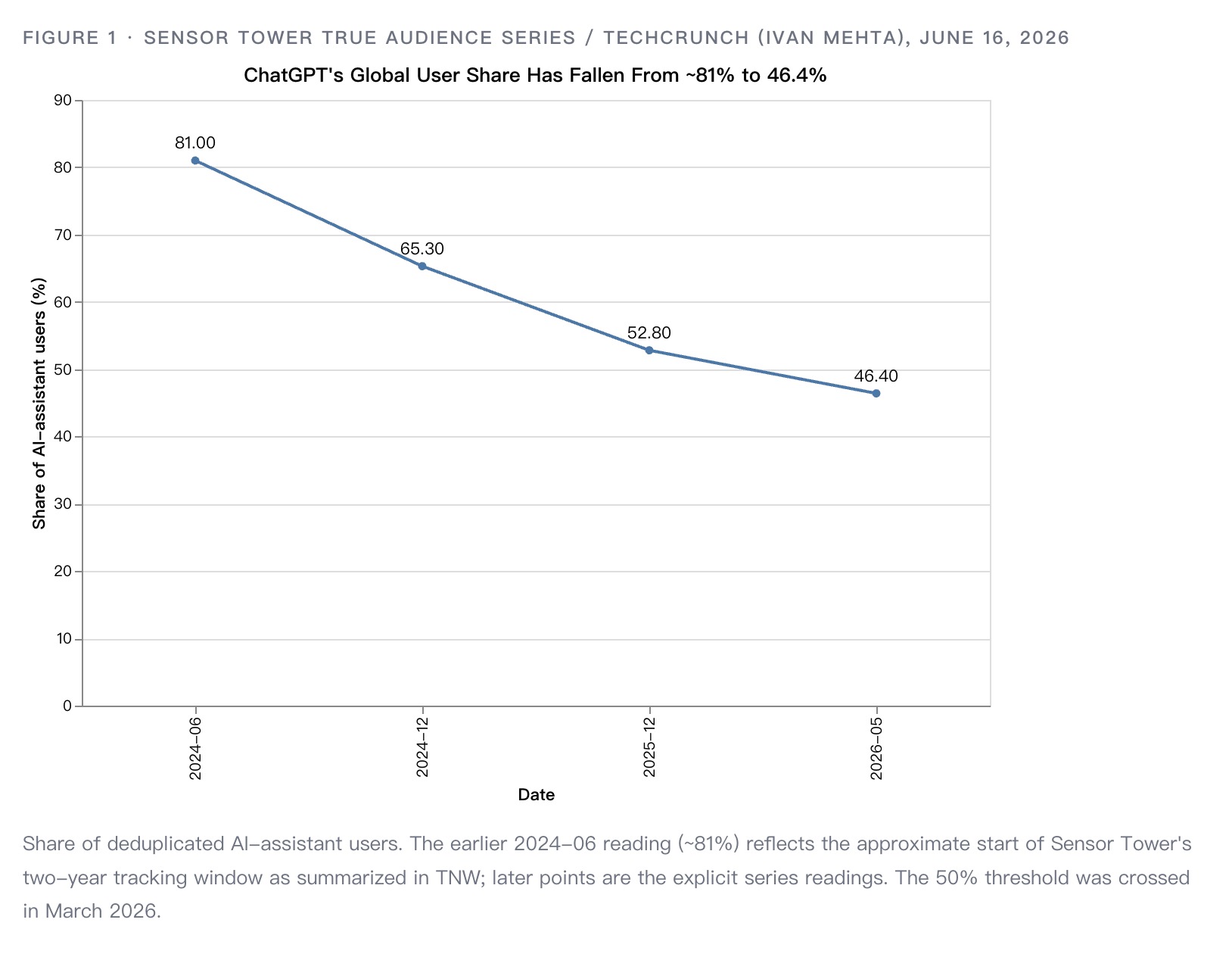
ChatGPT’s dominant market share slipped below the critical 50% threshold for the first time in March 2026. By the end of May 2026, it had further decreased to 46.4%.
Ironically, this decline in market share occurred exactly at the same time ChatGPT broke another massive record. It recently became the fastest mobile application in human history to reach one billion monthly active users.
This detailed analysis, compiled on August 28, 2026, cross-references primary data from Sensor Tower with insights from Similarweb, First Page Sage, Appfigures, Pew Research, and the Stanford HAI 2026 AI Index.
Executive Summary: The Key Market Metrics
Before diving into the detailed market shifts, it is essential to highlight the fundamental metrics defining this new era.
First, the ChatGPT user share sits at 46.4% as of late May 2026. This is a significant drop from its towering peak of approximately 81% in mid-2024.
Second, the duration of ChatGPT's absolute majority lasted roughly 3.5 years. From November 2022 until March 2026, its market share never dipped below the 50% line.
Third, Anthropic’s Claude has experienced immense growth, boasting a 4x increase in monthly active users. The platform surged from 60.2 million users in December 2025 to 245 million by May 2026, representing an astounding 452% year-over-year growth.
Finally, the most shocking financial metric is Anthropic’s Annual Recurring Revenue (ARR). By mid-May 2026, Anthropic hit an ARR of $47 billion. Despite having a consumer base that is only a fraction of OpenAI’s, Anthropic has financially eclipsed OpenAI’s reported $25 billion ARR.
1. The Core Conclusion: The End of a Three-and-a-Half-Year Monopoly
For roughly three and a half years, the generative AI market was synonymous with one name. From its explosive debut in late 2022 until February 2026, OpenAI’s flagship product maintained an iron grip on the majority share of the global AI assistant market.
However, that historic streak officially ended in March 2026. Sensor Tower’s highly regarded "True Audience" metric—which counts unique, deduplicated users across all platforms and channels—showed ChatGPT falling below 50% for the very first time.
By the end of May 2026, that share had contracted to 46.4%. In a span of just 17 months, the platform lost about 19 percentage points. Compared to its all-time high of approximately 81% in mid-2024, the pullback is a staggering 35 percentage points.
It is absolutely crucial to understand that this is not a story of decline or failure. The loss of majority share happened simultaneously with an incredible growth milestone.
In May 2026, ChatGPT crossed the 1.1 billion monthly active user (MAU) mark. This unprecedented achievement made it the fastest mobile app ever to reach a billion users, vastly outpacing legacy giants like TikTok, YouTube, and Instagram, which took anywhere from five to eight years to hit the same metric.
As one industry analyst eloquently summarized, reaching a billion users while simultaneously losing majority market share is not a contradiction. It simply proves that the rest of the market is growing much faster than the incumbent.
The generative AI category, single-handedly created by ChatGPT over the last three years, has outgrown its creator. The market is now too large to be defined by a single application.
2. The Formulate of a New Market Landscape
As of late May 2026, the global AI assistant user base has clearly segmented itself into a defined hierarchy. We now have one clear frontrunner, two highly credible challengers, and a diverse long tail of niche alternatives.
Google’s Gemini has captured a solid 27.7% of the global market. However, it is important to note that this share is heavily driven by operating-system-level default configurations across Android devices and deep integrations within Google Workspace, rather than standalone, organic app installations.
Following closely behind is Anthropic’s Claude, which now commands 10.3% of the market. Claude’s growth has been purely organic and highly targeted toward power users and enterprise professionals.
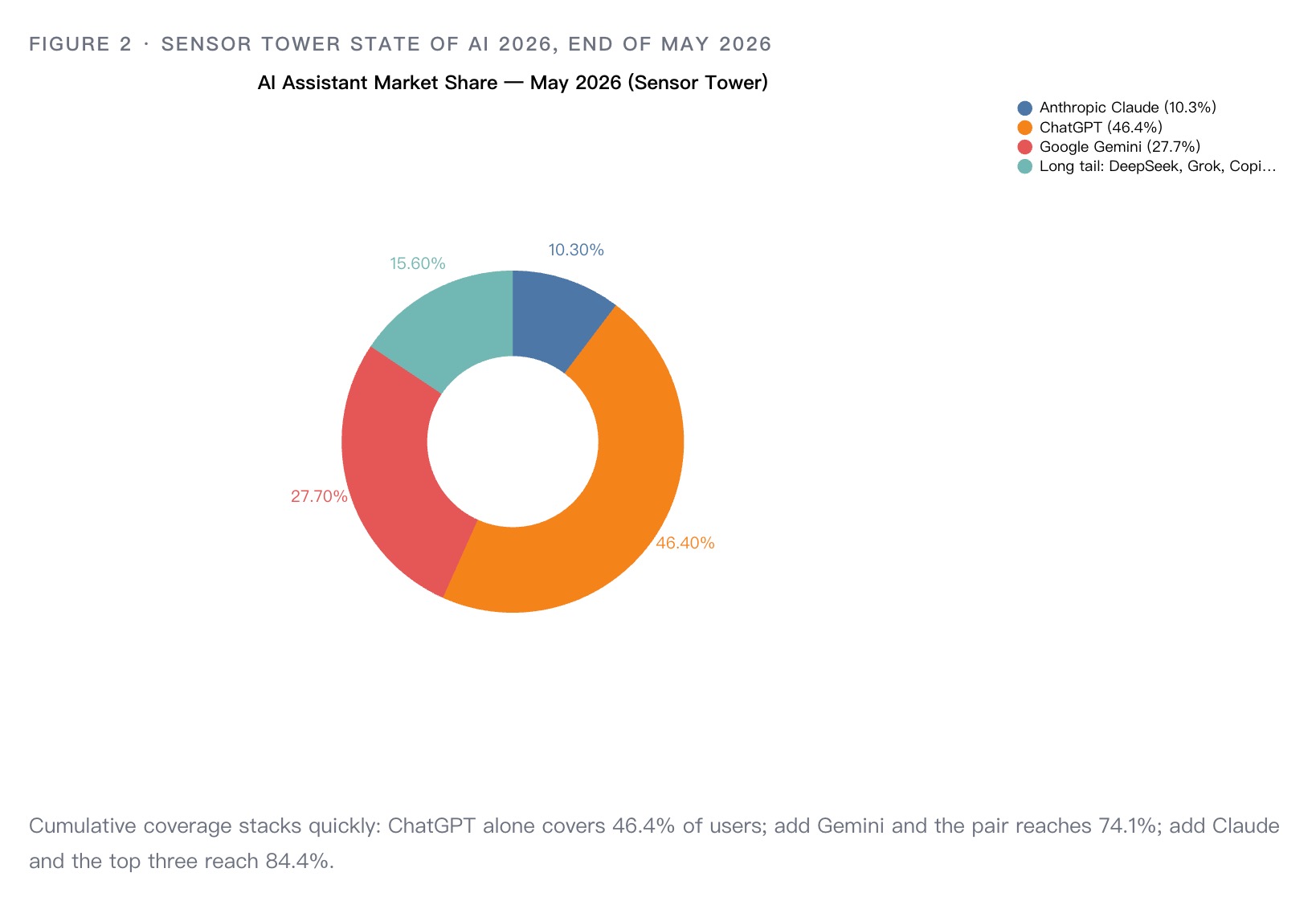
The remaining 15.6% of the market is fragmented. It is fiercely contested by a "long tail" of platforms including DeepSeek, Grok, Microsoft Copilot, Meta AI, and Perplexity. Currently, none of these individual long-tail platforms holds more than a 5% share.
When evaluating user attention, the concentration remains incredibly high at the top. The top three platforms—ChatGPT, Gemini, and Claude—account for an overwhelming 89% of all time spent using AI assistant applications globally.
Cumulative reach tells a similar story. ChatGPT touches 46.4% of users alone. Combined with Gemini, the top two cover 74.1% of the market. Add Claude into the mix, and the top three players dictate 84.4% of the entire industry's user base.
3. Reach Remains Top-Heavy, But Challengers Have Arrived
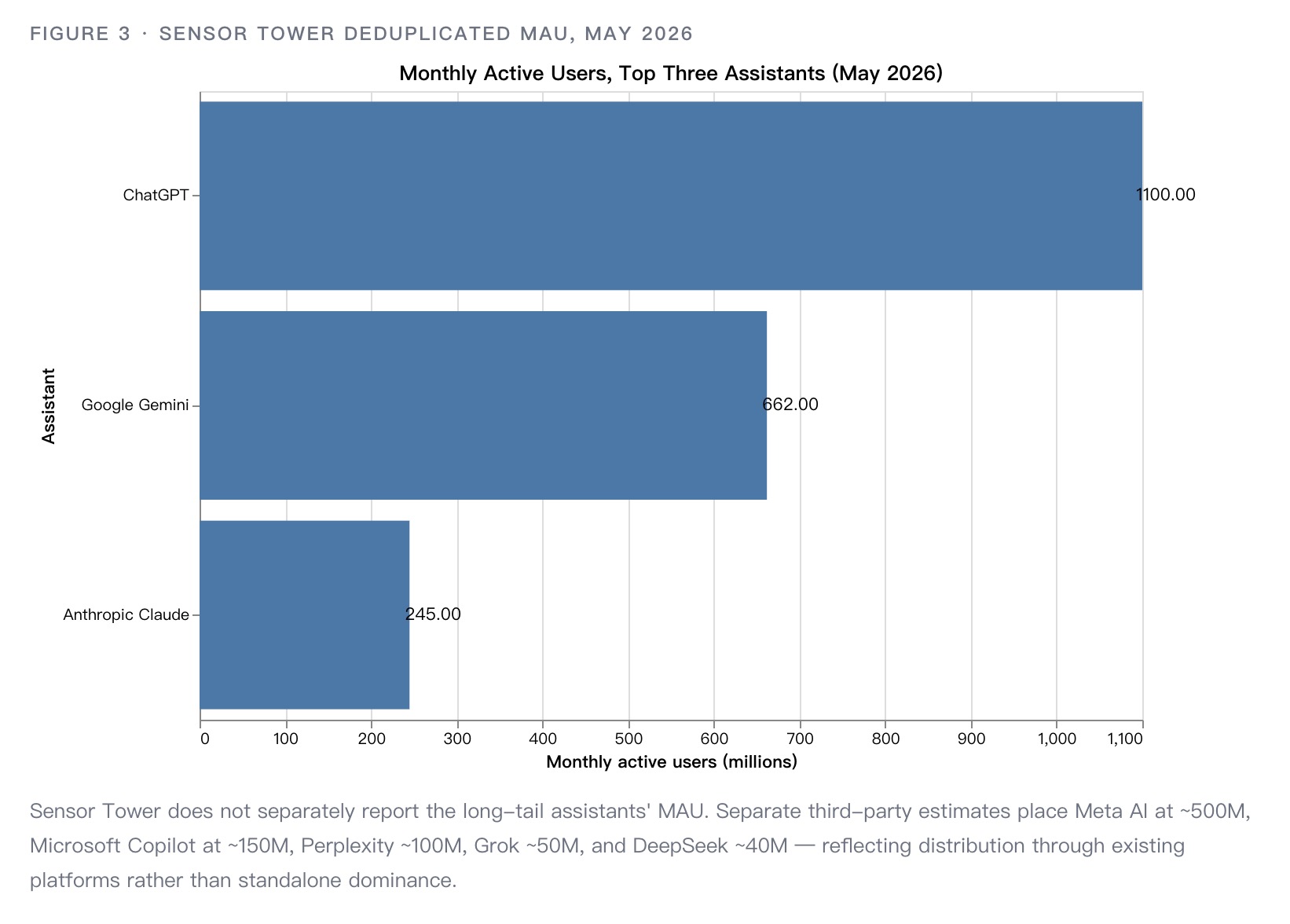
When examining raw, unfiltered reach, ChatGPT is still miles ahead of the competition. Sitting at 1.1 billion MAUs, it vastly outnumbers its closest rivals.
Google Gemini follows with approximately 662 million MAUs, according to Sensor Tower's deduplicated counts. (Note: Google disclosed 750+ million users in a February 2026 lawsuit, but this is a methodological variance in internal versus third-party counting, not a factual contradiction).
Anthropic’s Claude sits in third place with approximately 245 million monthly active users. While smaller in raw numbers, the trajectory of these three user bases reveals a sharply diverging market.
Gemini’s growth strategy has relied heavily on ecosystem integration. Because of its deep embedding into the Android OS, Gemini's average user engagement leaped from a mere 14 minutes per month to over 100 minutes per month—a spectacular seven-fold increase.
Claude, on the other hand, is relying on rapid, word-of-mouth professional adoption. In just five months, Claude’s user base nearly quadrupled, skyrocketing from 60.2 million in December 2025.
While Sensor Tower does not break down the long tail in its primary MAU chart, independent estimates offer a glimpse into the broader ecosystem. Meta AI claims roughly 500 million users, Microsoft Copilot hovers around 150 million, Perplexity touches 100 million, Grok sees 50 million, and DeepSeek tracks at 40 million.
Crucially, figures for Meta AI and Copilot reflect distribution through pre-existing mega-platforms (like Facebook, Instagram, and Windows) rather than the dominance of standalone conversational AI destinations.
4. Smaller Base, Higher Output: The Monetization Reversal
Perhaps the most counter-intuitive signal emerging from this market transition is the state of monetization. Having the most users no longer guarantees the most revenue.
Looking at the Average Revenue Per User (ARPU) for US mobile users in May 2026, Claude generated an impressive $2.76 per user. In stark contrast, ChatGPT generated only $1.74 per user.
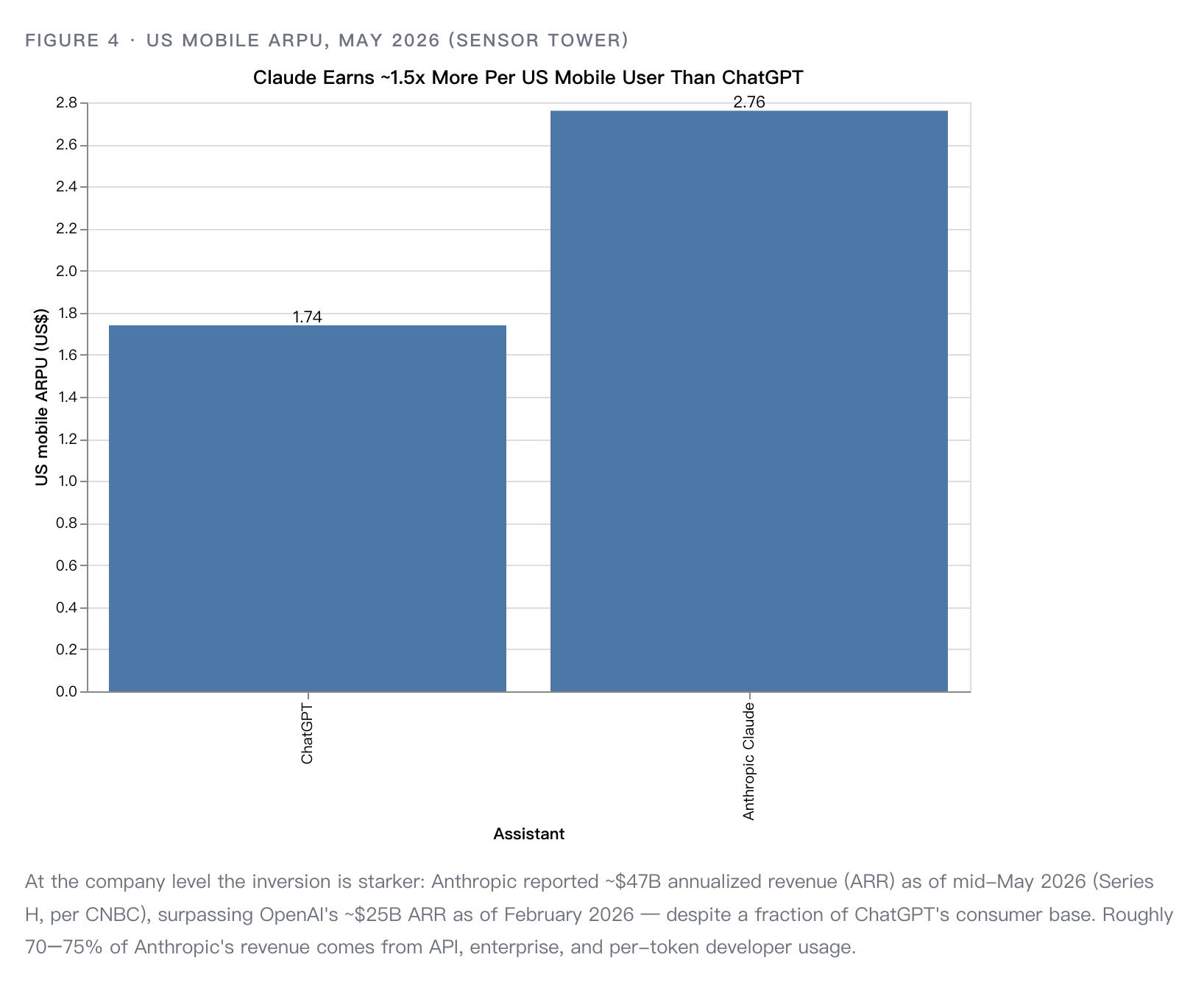
This means Claude is earning roughly 1.5 times more per mobile user than the market leader. This is a massive leap for Anthropic, considering Claude's ARPU was sitting below $0.50 just months ago in September 2025.
Furthermore, Claude currently leads the entire tech industry with a staggering 13% conversion rate from free users to paid subscriptions. ChatGPT users still contribute more total time (averaging 215 minutes per user, per month), but Claude is vastly superior at converting that attention into actual revenue.
At the corporate level, this financial reversal is even more jarring. According to a recent CNBC report, Anthropic disclosed an Annual Recurring Revenue (ARR) of approximately $47 billion during its Series H funding round in mid-May 2026.
This completely eclipsed OpenAI’s reported ARR of $25 billion from February 2026. How did Anthropic achieve this with a consumer base that is merely a fraction of OpenAI’s? The secret lies in the backend: roughly 70% to 75% of Anthropic’s astronomical revenue is derived from API usage, enterprise contracts, and token-based developer consumption.
5. The Category is Bifurcating, Not Shrinking
It would be a severe analytical error to interpret ChatGPT’s declining market share as a sign of industry contraction. The AI market is not shrinking; the pie is simply growing much faster than any single player can consume.
The global generative AI application market is expanding at an unprecedented rate. Total usage time is projected to more than double year-over-year.
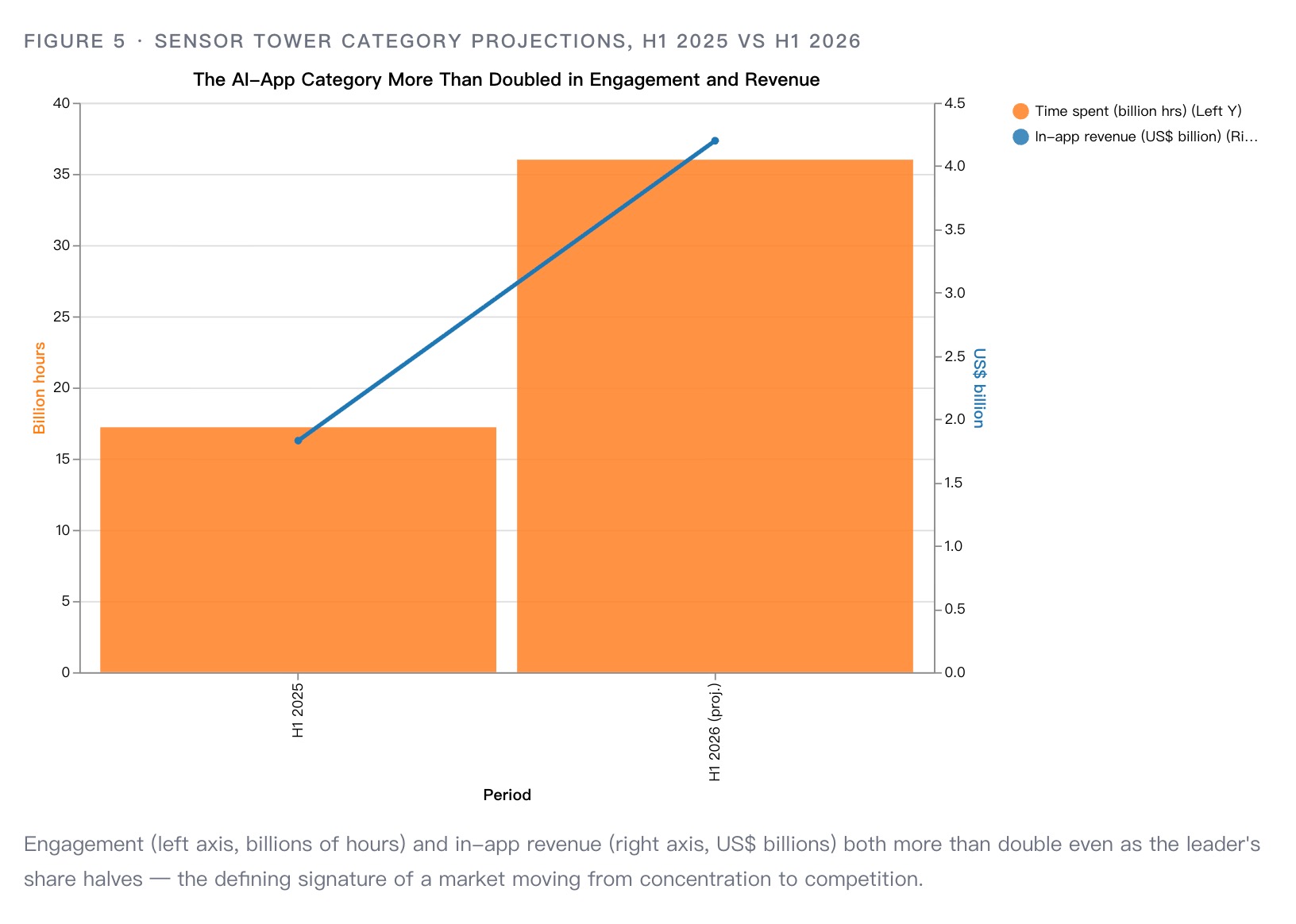
In the first half (H1) of 2025, global users spent 17.2 billion hours in AI apps. By H1 2026, that number is expected to skyrocket to approximately 36 billion hours.
Similarly, global in-app purchase revenue is forecasted to surge from $1.83 billion in H1 2025 to a massive $4.2 billion by H1 2026. App downloads are equally robust, with an estimated 2.3 billion AI application downloads expected in the first half of 2026 alone.
The structural changes we are witnessing represent the natural distribution of massive industry growth, not a loss of interest. When both user engagement and total revenue more than double while the top player's share gets cut in half, it is the textbook definition of a market maturing from a monopoly into a healthy, competitive ecosystem.
6. Trust, Not Benchmarks, Drives User Migration
This dramatic market transition is not purely driven by underlying technological capabilities. We are moving into an era where consumer sentiment and ethical alignment matter just as much as coding capabilities or reasoning benchmarks.
A massive trust shock in late February 2026 perfectly illustrated how quickly modern users will abandon a platform. On February 28, OpenAI officially announced a strategic partnership with the United States Department of Defense.
The public backlash was immediate and severe. In the US market alone, ChatGPT uninstalls surged by an astonishing 295% day-over-day. On that same day, one-star app reviews skyrocketed by 775%, resulting in a 13% immediate drop in new US downloads for ChatGPT.
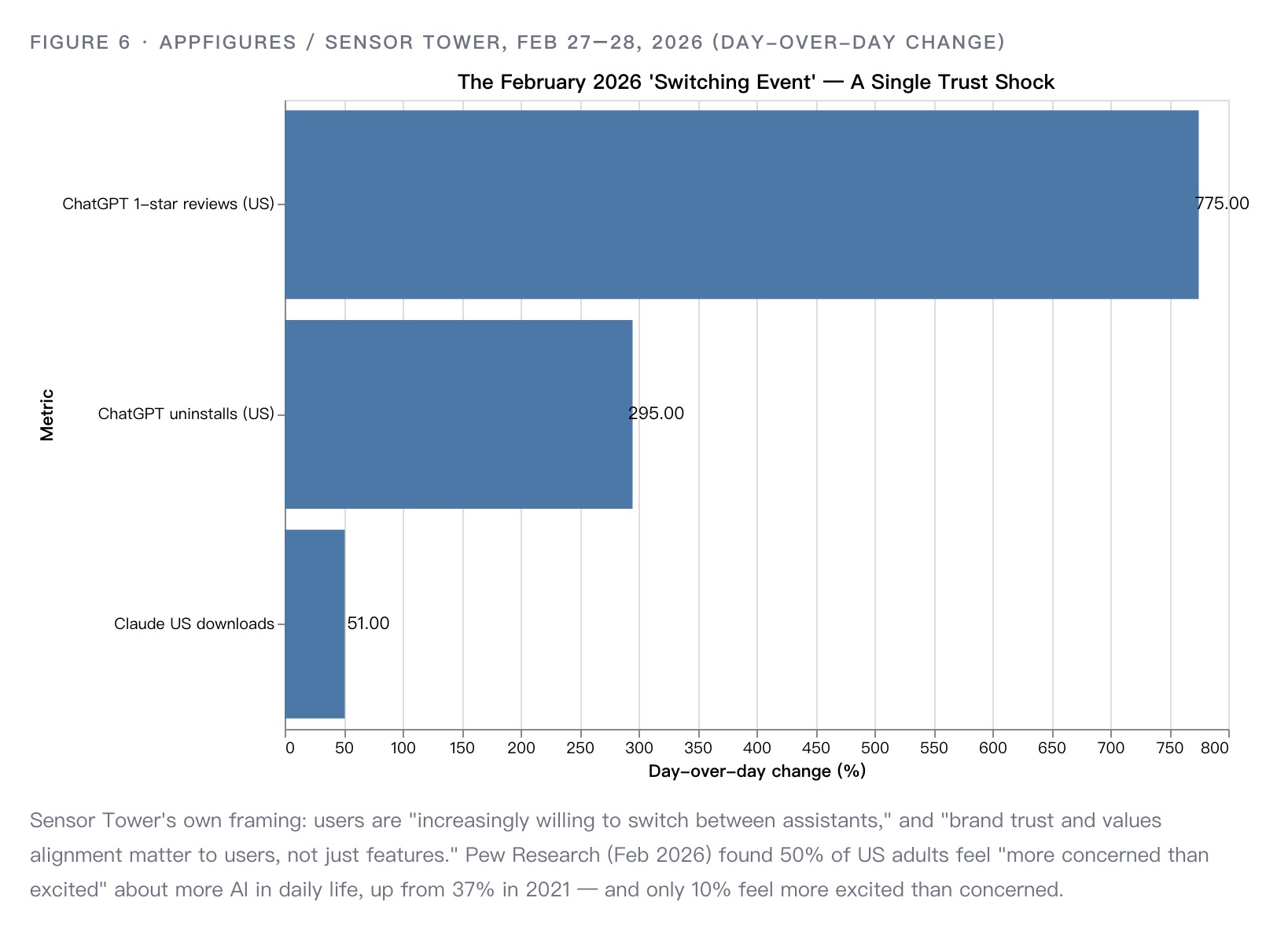
Simultaneously, the market reacted by fleeing to a perceived ethical alternative. Claude’s US downloads jumped by 37% on February 27 in anticipation of the news, and surged another 51% day-over-day on February 28.
This momentum briefly propelled Claude to the number one spot on the US daily download charts, allowing it to temporarily crown the US App Store. This mass migration was heavily fueled by Anthropic’s prior public commitments refusing military and Pentagon partnerships.
Sensor Tower analysts noted that modern users are becoming "increasingly willing to switch between assistants." They emphasized that brand trust and alignment with personal values are now just as critical as baseline functionality.
This sentiment is backed by February 2026 data from the Pew Research Center. The study found that 50% of American adults are now "more concerned than excited" about the increasing presence of AI in daily life. This is a sharp increase from 37% in 2021. Conversely, only 10% reported feeling "more excited than concerned."
7. The Enterprise Market Flip: Where Competition is Fiercest
While the consumer market is slowly evolving into a multi-player race, the enterprise B2B market has already experienced a complete inversion.
Enterprise LLM API spending is the true lifeblood of foundational model developers. It dictates long-term sustainability. Over the past few quarters, OpenAI's share of enterprise API spend has plummeted from a dominant 50% to roughly 27%.
Meanwhile, Anthropic has surged forward, capturing approximately 40% of the enterprise budget. Industry reports from August 2026 reveal that in blind, head-to-head corporate evaluations, enterprise buyers chose Claude over competitors in nearly 70% of all cases.
The enterprise landscape looks entirely different from the consumer side. Anthropic’s massive $47 billion revenue run-rate is the ultimate financial proof of this shift. We are seeing a dual-front diversification: everyday consumers and massive corporate buyers are both actively exploring alternatives.
Methodology and Analytical Clarity
Understanding the different metrics utilized across the industry is vital. Data sources measure different types of engagement, which can sometimes appear contradictory if not properly contextualized.
Sensor Tower utilizes the "True Audience" metric, which deduplicates unique users across both app and web channels. This is the precise metric that captured the historic drop below the 50% threshold.
Alternatively, First Page Sage measures "Activity Share," showing ChatGPT at 51.3% in July 2026. Similarweb tracks purely browser-based visits, putting ChatGPT at ~54% and Gemini at ~28%. Statcounter tracks raw web page visits, where ChatGPT's legacy direct-traffic advantage artificially inflates its share to 77.9%.
Despite these methodological variances, the directional conclusion is unanimous across all comparable time-series panels. ChatGPT’s lead is steadily eroding across every single measurable dimension. As confirmed by August 2026 reports, Gemini and Claude are successfully "carving out durable, long-term strongholds."
What This Means for the Future
The data fact is undeniable: the conversational large language model market has officially crossed the threshold from single-provider dominance to a durable, multi-player competitive arena.
The market pioneer is losing its absolute majority not because it is failing, but because it is breaking reach records in an industry that is growing faster than any one company can capture.
Two massive structural forces are driving this evolution. The first is distribution (seen through Gemini’s default OS placements and Meta AI's social embeds). The second is trust and differentiated monetization (evidenced by Claude’s enterprise victories, ARPU leadership, and ARR dominance).
For both incumbents and challengers, the strategic takeaways are clear. Market share is no longer won merely by having the smartest model. According to the Stanford 2026 AI Index, raw model capabilities are rapidly converging, with SWE-bench Verified scores leaping from 60% to nearly 100% in just one year.
As underlying AI capabilities become commoditized, the battleground shifts entirely. Competition is now about everything surrounding the model: brand values, enterprise economics, data privacy, and seamless distribution.
This insightful market analysis and data compilation report was generated through Powerdril Bloom.
Frequently Asked Questions (FAQ)
When did ChatGPT officially lose its absolute majority market share?
ChatGPT's global user market share officially fell below the 50% threshold for the very first time in March 2026.
How much annual revenue is Anthropic generating compared to OpenAI?
By mid-May 2026, Anthropic reported an Annual Recurring Revenue of roughly $47 billion, surpassing OpenAI’s reported $25 billion.
What specific event caused users to rapidly leave ChatGPT in February 2026?
A major trust shock occurred when OpenAI announced a military partnership with the US Department of Defense, prompting uninstalls.
How is Google Gemini capturing such a large portion of the market?
Gemini’s vast reach is primarily driven by operating-system-level default integrations across Android devices and the Google Workspace ecosystem.
Is the loss of ChatGPT's market share a sign that AI is dying?
No, the overall market is expanding rapidly, with global engagement hours and in-app revenue expected to double in 2026.