Data Fact: The Global Short-Drama Economy Is Booming in 2026
The global short-drama economy is exploding at an unprecedented rate. What was once a niche experiment in China has quickly become a worldwide phenomenon. This comprehensive data-fact briefing is written and analyzed through Powerdrill Bloom, providing you with a deep dive into the micro-drama market in 2026. We will explore platforms, the AI cost revolution, audience demographics, popular genres, and the structural pain points of this booming industry.
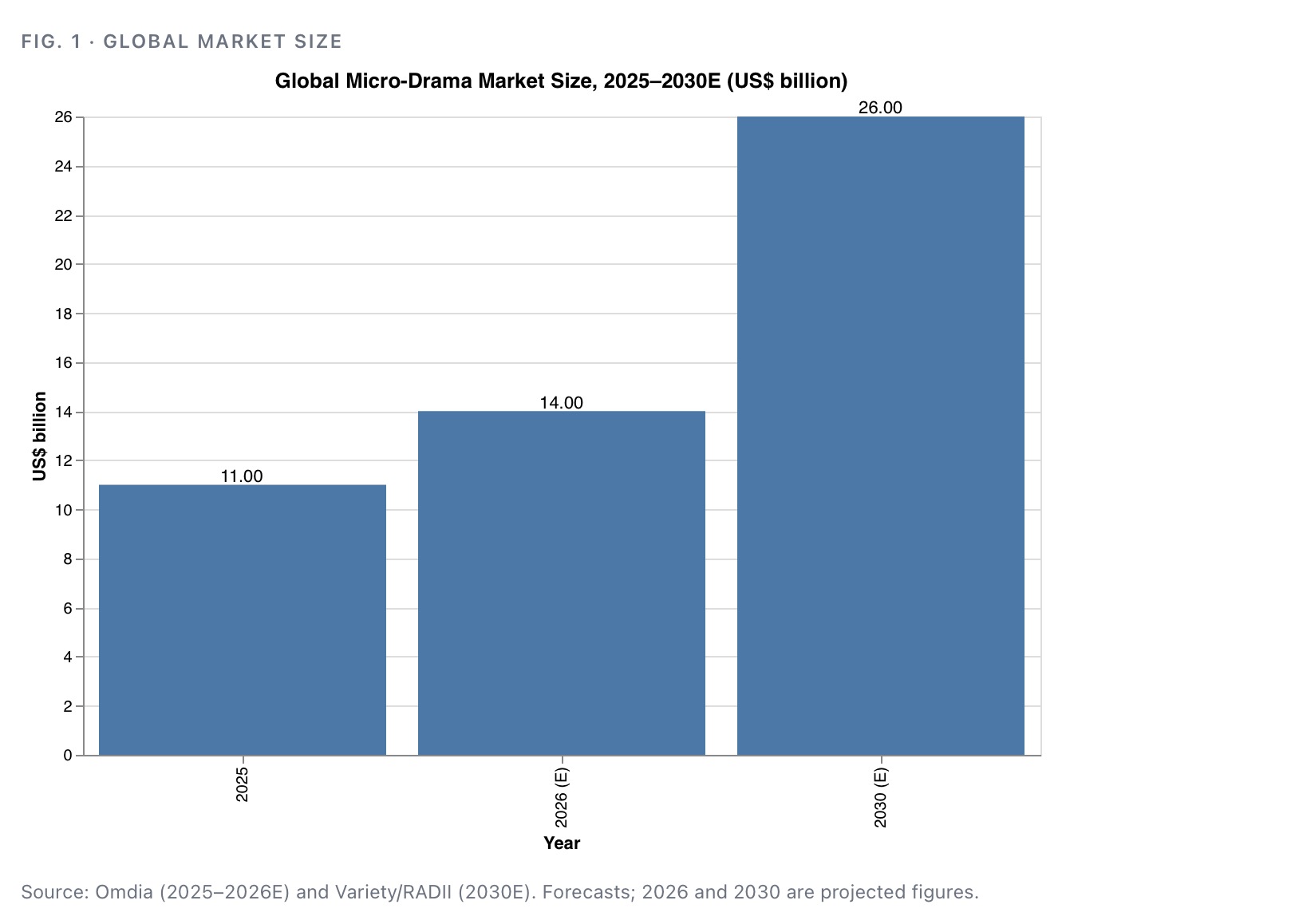
The numbers are staggering. Global micro-drama revenue is projected to reach $14 billion in 2026. It does not stop there. Omdia forecasts this market will grow to an incredible $26 billion by the year 2030. Driven by a massive 140% year-on-year growth, total app downloads for short-drama platforms exceeded 850 million in just the first quarter of 2026.
Let us break down the data and see exactly what is driving this vertical video revolution.
1. The Macro View: Market Performance and Major Platforms
The micro-drama economy consists of vertical, 1-to-3-minute episodic videos. These are adapted largely from popular web novels. In under five years, this format has become a globally tracked entertainment category.
Omdia estimates global micro-drama revenue hit $11 billion in 2025. This figure is rising to approximately $14 billion in 2026. Variety and RADII both forecast a $26 billion worldwide market by 2030. China remains the undisputed engine of this growth. The State Administration of Radio and Television recorded a 50.4 billion RMB (around $7 billion) market in 2024. Industry estimates put 2025 well above 100 billion RMB (roughly $14 billion) when including ad-supported free dramas.
By February 2026, QuestMobile measured an astonishing 718 million monthly active users (MAU) in China alone. This user base spans standalone apps and WeChat mini-programs. Standalone apps saw a 74.3% year-on-year increase. Mini-programs saw a 59.9% boost.
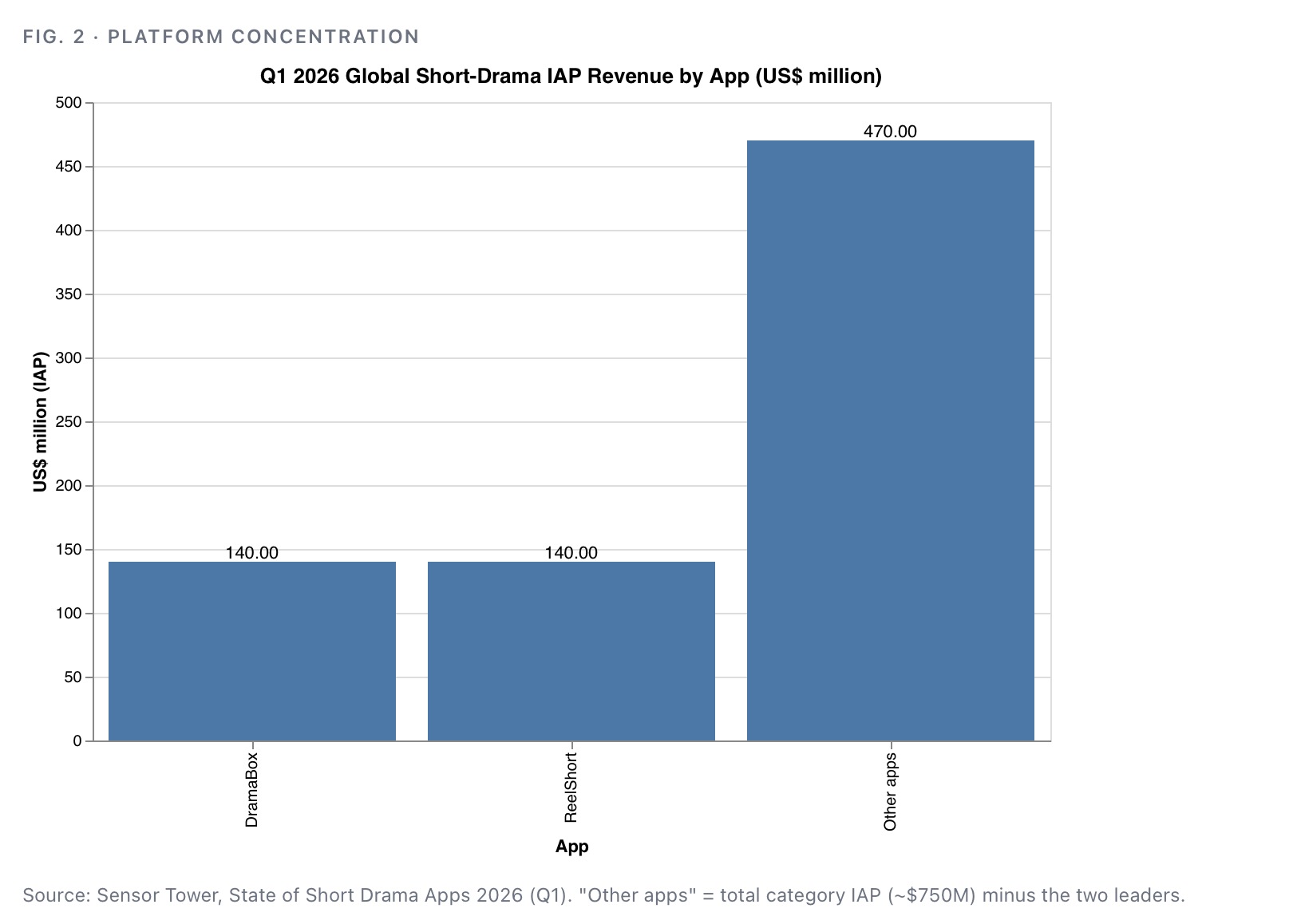
On the platform side, two apps with Chinese origins lead global in-app-purchase (IAP) revenue. According to a Sensor Tower Q1 2026 report, DramaBox and ReelShort are the titans. They each generated close to $140 million in IAP revenue during the first quarter. The total category IAP for the quarter was roughly $750 million. The remaining $470 million was split across dozens of smaller challenger apps.
Globally, the first quarter of 2026 brought over 850 million downloads. This marks a 140% year-on-year increase. Six short-drama apps broke into the worldwide Top 40 by overall downloads. NetShort took the No. 3 spot globally, boasting a 196% quarter-on-quarter growth. FreeReels took the No. 8 spot, crossing 100 million installs.
Here is a look at the headline platforms dominating 2026:
ReelShort: Owned by China's COL Group. It boasts roughly $1.05 billion in projected revenue. It is the US revenue and engagement leader. It famously uses an app-store-bypass strategy.
DramaBox: A Chinese origin app. It generated $140M IAP in Q1 2026. It is a global revenue co-leader and has been profitable since 2024.
NetShort: A massive global challenger. It ranks No. 3 globally by downloads. It is highly popular in Japan, Korea, and Southeast Asia.
FreeReels / Melolo: This platform drives ad-supported volume. It dominates markets in India and Southeast Asia.
Hongguo: Owned by ByteDance. It is the free, ad-supported domestic giant in China. It hit 304 million MAU in Feb 2026.
Vigloo: A South Korean platform. It shows strong revenue gains. It represents the "third wave" of local ecosystems by remixing K-drama tropes.
AI-Native Studios (Crisp, Holywater): International players. They use AI for discovery, story testing, and localization.
iReader/COL: These Chinese studios are pivoting hard to AI. COL Group's AI-drama output grew 300% in Q1. They target 3,000 titles a year.
2. Global Footprint and Soaring Engagement
Regionally, the short-drama boom is shifting. It is no longer just a "China-then-US" story. It is now a multi-polar global phenomenon.
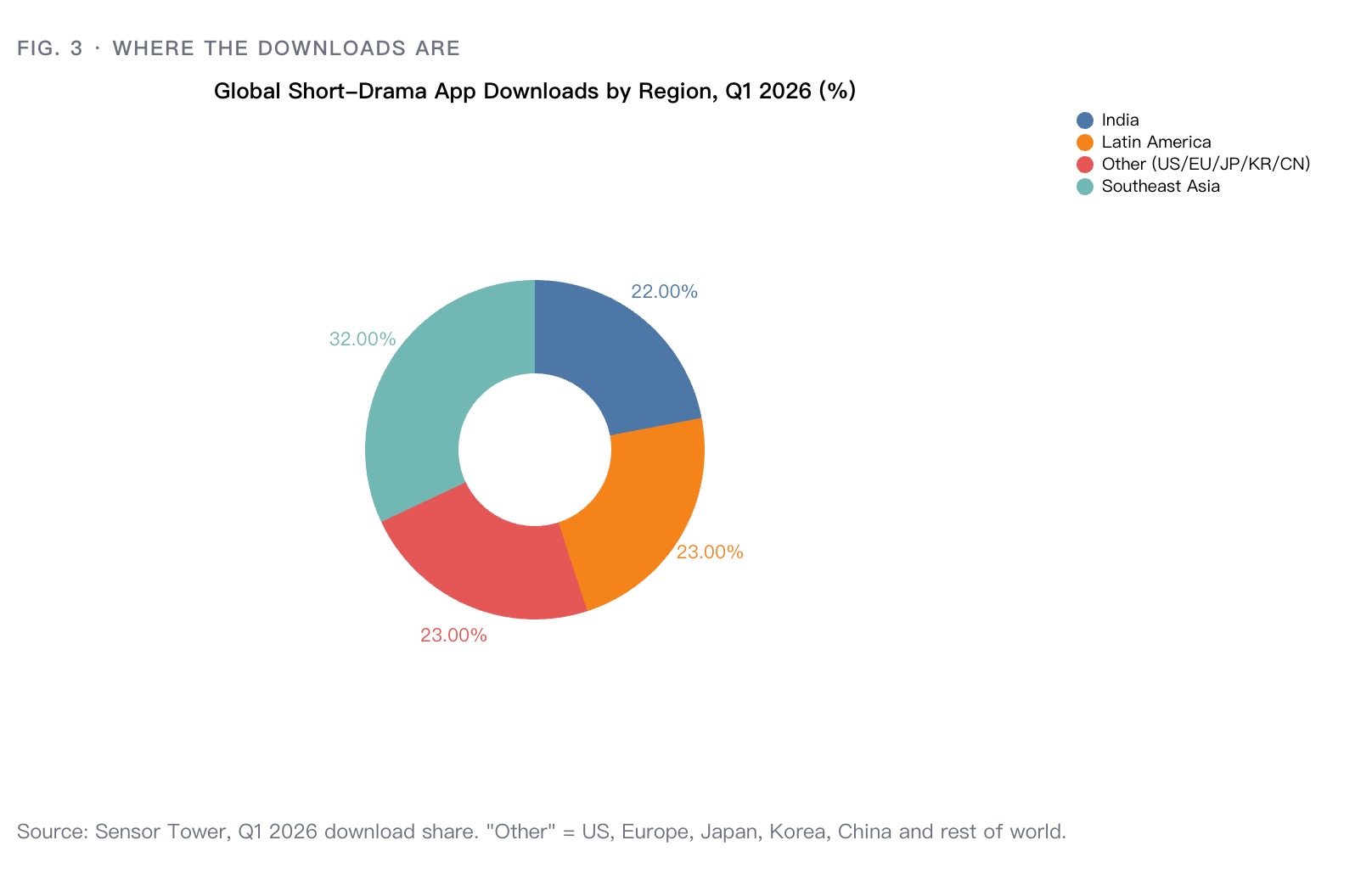
Southeast Asia accounts for 32% of global downloads. Latin America accounts for 23%. India accounts for 22%. Together, these three regions drive over three-quarters of global app installs. Each region is posting triple-digit year-on-year growth. However, the United States remains the absolute highest-revenue territory. Omdia notes the US accounts for roughly 50% of all overseas revenue. It is the primary profit engine for giants like ReelShort.
Meanwhile, localized markets are maturing. Japan is forecast to cross $1.2 billion in market size by 2030. South Korea, Thailand, and Latin America are building their own local production ecosystems. They are no longer just importing dubbed Chinese titles.
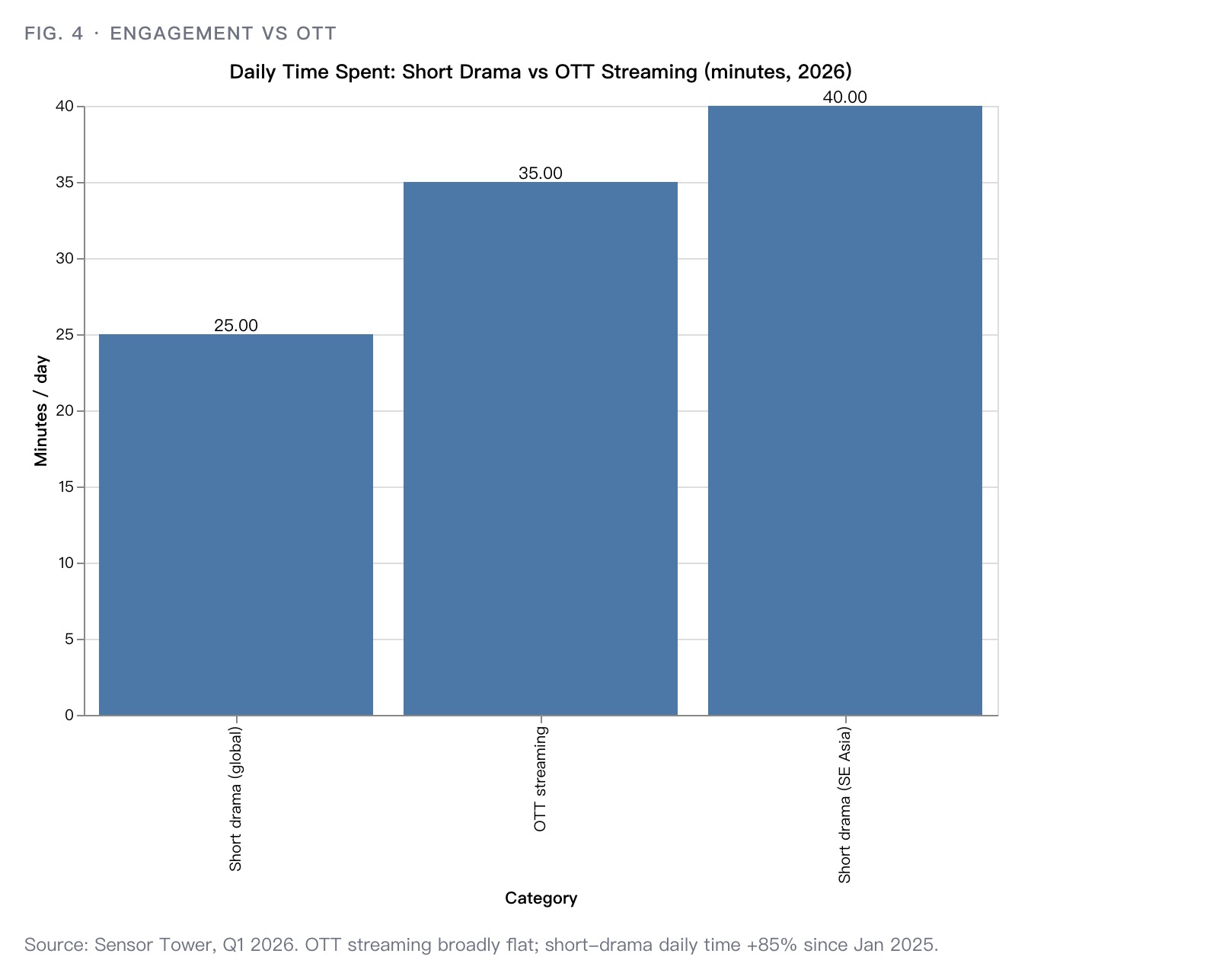
User engagement is incredibly high. By April 2026, users spent an average of 25 minutes per day in short-drama apps globally. This is an 85% increase since January 2025. It is rapidly nearing traditional OTT streaming, which sits flat at around 35 minutes a day. In highly engaged regions like Southeast Asia, short-drama screen time reaches up to 40 minutes a day. Sensor Tower notes that users now spend nearly six times more time in these apps than they did a year earlier.
3. Live-Action vs. The AI Cost Revolution
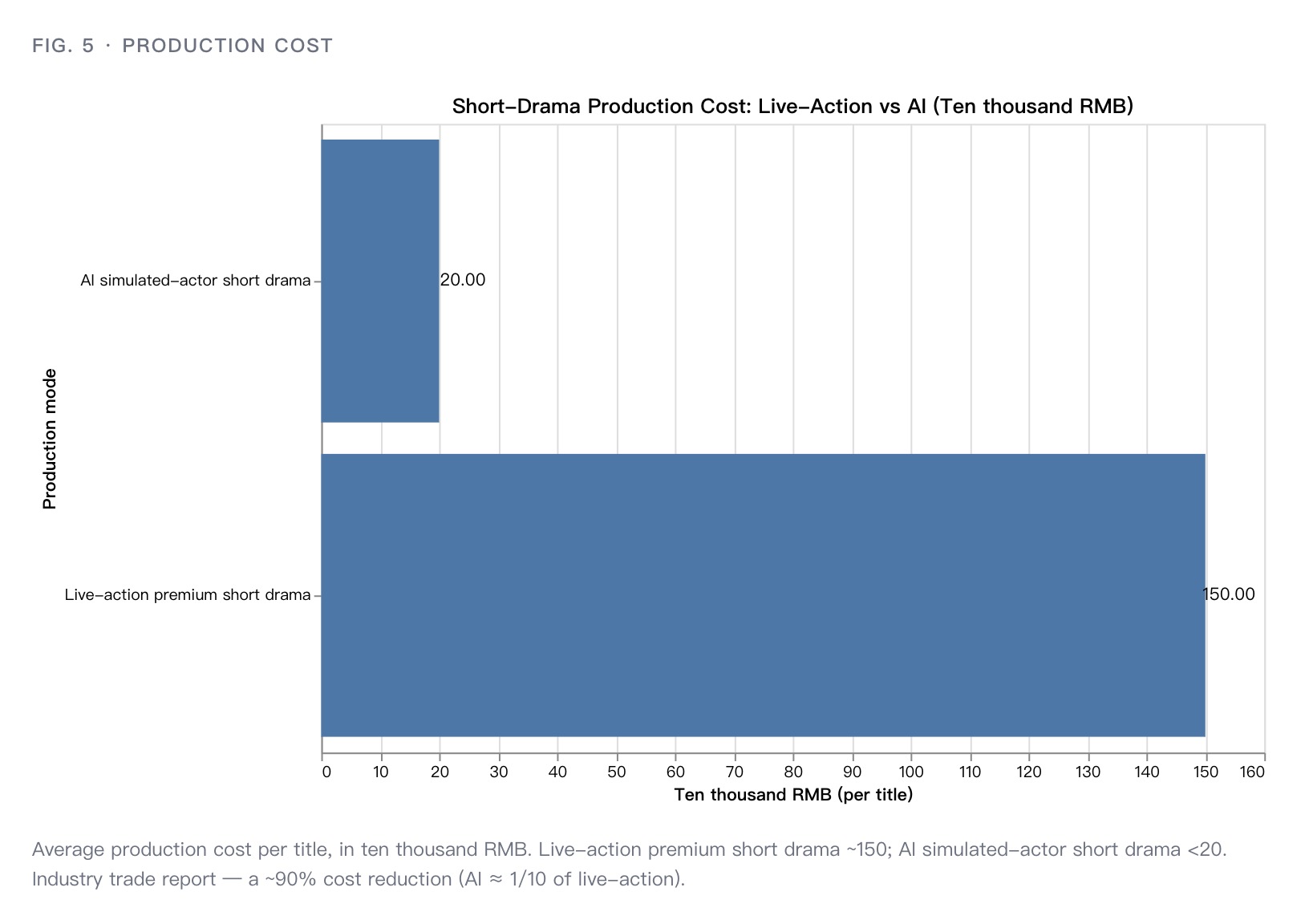
The defining structural shift of the 2025–2026 period is the AI cost revolution. Leveraging AI-generated content can slash video production costs by a staggering 90%.
| Dimension | Live-action Premium | AI Simulated Human |
|---|---|---|
| Production cost per title | ~¥1.5M (≈$208K) | <¥200K (≈$28K) |
| Production cycle | Weeks–months | 1–3 days / 1 person |
| Revenue per 1,000 plays (RPM) | Higher baseline | ¥60 (H2 2025) → ¥15–30 (2026) |
| Traffic spend as % of gross revenue | ~70% | ~70% & rising |
| Mature team ROI | — | 1.03–1.07 (thin profit) |
| Ordinary project ROI | — | <0.8 (loss-making) |
| Hit rate | Low | <0.1% (1 in 1,000) |
A traditional live-action "premium" short drama costs about 1.5 million RMB (roughly $208,000) to produce. Today, an AI-simulated-human short drama can be produced for under 200,000 RMB (around $28,000). The production cycles have collapsed entirely. Traditional filming takes weeks or months. AI production promises a new industry norm: "one person, one-to-three days per drama."
The supply consequence of this AI revolution is absolutely dramatic. In the first quarter of 2026, roughly 128,000 new short dramas launched across the industry. Out of these, over 122,000 (more than 95%) were AI-generated. The China Network Audiovisual Association reports that 95% of micro-drama "faces" seen in Q1 2026 were made by AI.
By March 2026, a single month saw the addition of nearly 50,000 new series. This one month almost matched the entire output of 2025. Now, over 1,300 new dramas launch every single day. Nine out of every ten new titles are completely AI-led.
However, the economics cut both ways. Live-action dramas exported globally still command premium revenue. Platforms like ReelShort rely on high-quality live-action serialized romance to drive their $1.05 billion revenue. AI-generated micro-dramas win on sheer volume, low cost, and localization speed. Yet, they are currently trapped in a low-margin, high-traffic-cost economic loop. Most AI projects actually lose money.
4. Audience Demographics and Payment Behavior
Who is watching and paying for these micro-dramas? The consumer base skews heavily young and female.
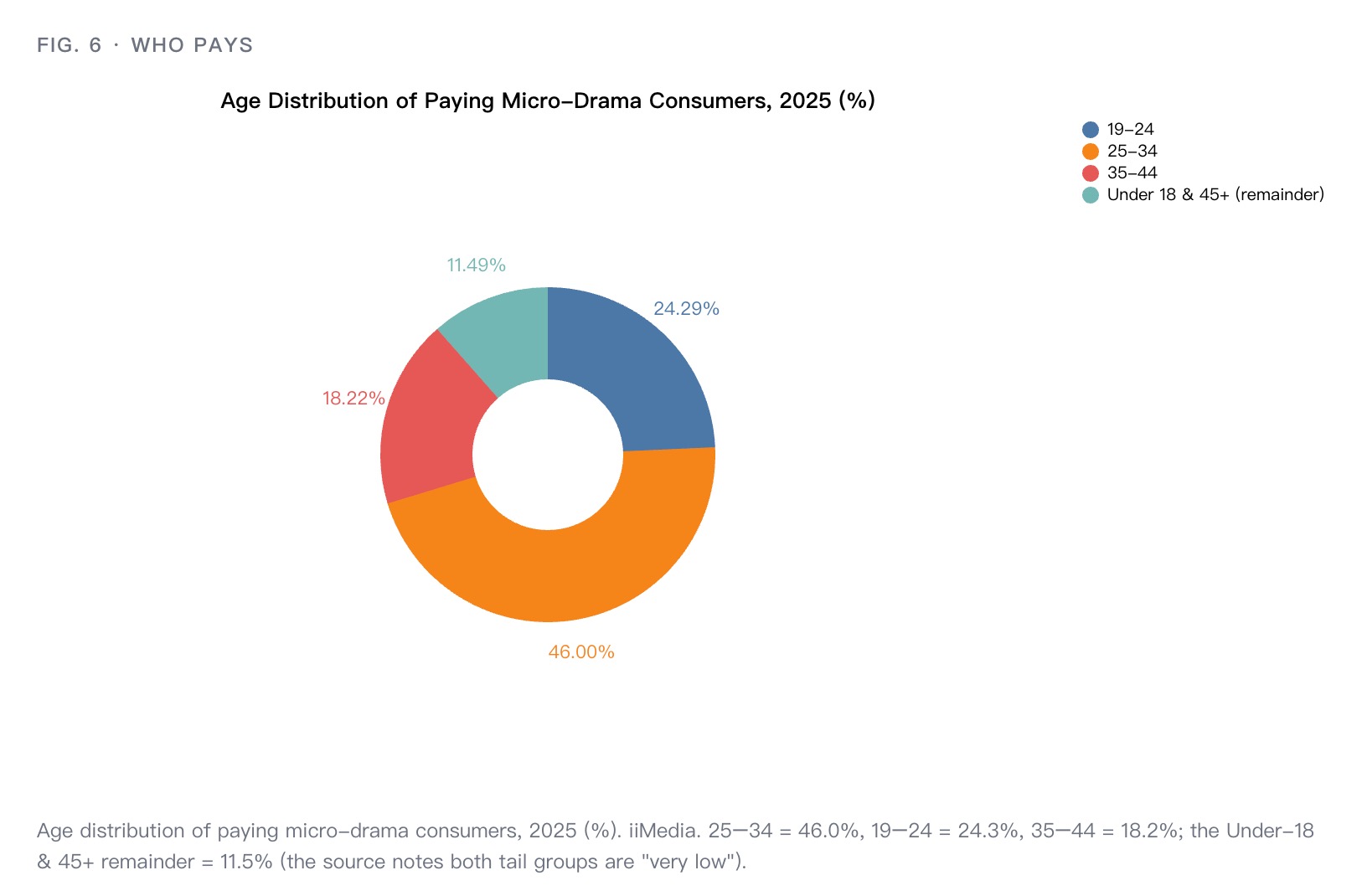
According to iiMedia research, the 25–34 age band makes up 46.0% of paying micro-drama consumers. The 19–24 age group accounts for 24.3%. The 35–44 group makes up 18.2%. Those under 18 and over 45 combined make up the residual 11.5%. In the United States, the core paying demographic is older. Women aged 30–60 drive the bulk of US revenue.
RADII reports roughly 830 million total viewers in China. Surprisingly, nearly 60% of them pay for content. This is an unusually high pay-conversion rate for ad-supported mobile video formats.
Payment models are maturing fast. The dominant mechanic is pay-per-episode in-app purchases. Subscriptions and ad-supported free tiers are also popular. Revenue-share models with host platforms were systemically upgraded in 2026.
A fascinating new segment is the "silver-haired" audience. Older users are flocking to short dramas. QuestMobile measured over 46.5 million silver-haired users on short-drama apps in Feb 2026. This is a 50% year-on-year jump. Apps like Hippo Theater have reached a massive 60% penetration among this older demographic.
5. Popular Genres and the Quibi Contrast
Overseas, the breakout content tropes are remarkably consistent. Audiences love werewolf and vampire romance. They binge on billionaire-CEO and "boss" romance plots. Revenge arcs, underdog stories, and rags-to-riches tales dominate the charts. These stories are heavily adapted from Chinese web novels. They are then re-localized for Western audiences. Tropes like "werewolf exes" drive massive engagement. Western media outlets note these function as modern, hand-held soap operas. They rely heavily on massive cliffhangers to trigger micro-payments.
New content trends are shaping 2026. AI comic-dramas are the ultimate breakout sub-track. ByteDance's free comic-drama app hit 24 million users in just four months. Users spend over 1.5 hours daily on it. Interestingly, comic-dramas skew about 90% male. This successfully broadens the industry audience beyond the female-dominated romance core.
Localization is winning over pure export. The market has entered a "third wave." South Korea's Vigloo remixes local K-drama tropes. Thailand blends streaming with local carrier billing. Latin America and India are ascending fast with customized local content.
The industry is now entering what Xinhua calls the "2.0 era." This means moving away from raw volume towards higher quality, regulation, and sustainable monetization.
It is impossible to ignore the historical contrast with Quibi. In 2020, Hollywood's Quibi raised $1.75 billion for premium short-form video. It drew fewer than 1 million subscribers and collapsed in six months. Micro-dramas succeeded exactly where Quibi failed. They inverted the model. They used near-zero production costs, existing web-novel IP, cliffhanger micro-payments, and native mobile distribution. They skipped the expensive Hollywood A-list celebrities and won the audience.
6. Industry Pain Points and Breakthroughs
Despite the boom, the industry faces severe structural pain points.
Oversupply is crashing returns. The AI revolution created a hyper-supply. Revenue per thousand views (RPM) for AI content fell drastically. It dropped from 60 RMB in late 2025 to just 15–30 RMB in 2026. Mature teams barely scrape a return on investment (ROI) of 1.03 to 1.07. Ordinary projects run at a loss below 0.8 ROI. Profitability is razor-thin. Mid-tier firms only see 3-5% profit margins.
The Traffic-Cost Trap. Paid user acquisition eats up massive revenue. Traffic buying (投流) consumes roughly 70% of gross revenue. Traffic costs rose over 100% year-on-year. Ultimately, big ad platforms capture the surplus, not the studios.
Quality, IP, and Copyright Risks. Mass AI production causes extreme content homogenization. Deepfake faces trigger rights exposure. Furthermore, China tightened micro-drama filing regulations to push the industry into a more compliant 2.0 era.
Measurement Fog and Channel Policy. Trackers often undercount China's massive ad-supported mini-program ecosystem. This makes global numbers look contradictory. Overseas, ReelShort bypasses app stores to avoid 30% fees. This helps margins but invites intense policy scrutiny from Apple and Google.
However, breakthroughs are happening. The AI cost stack allows for incredible A/B story testing. It helps predict viral trends before shooting begins. Free models combined with revenue-sharing are proving that ad-supported platforms can thrive alongside premium IAP apps. AI comic-dramas are opening massive new male-skewing audiences. Finally, platform consolidation is occurring. Revenue is pooling at the top with leaders like ReelShort, DramaBox, and ByteDance. The future belongs to high-quality productions.
The Bottom Line
The short-drama economy is undeniably booming at the global category level. Quarterly downloads top 850 million. App revenues are scaling toward $14 billion. Yet, it is bleeding at the unit level. ROI is hovering near breakeven for the long tail of creators. AI's incredible 90% cost reduction manufactured this boom, but also created the oversupply that crushes margins today.
The true winners of 2026 and 2027 will not be those who simply generate the most AI titles. The winners will be those who convert cheap AI supply into durable IP, defensible global distribution, and smart hybrid monetization.
Once again, this deep dive data analysis was completely written through Powerdrill Bloom. The micro-drama revolution is just getting started, and the data proves it is here to stay.
Frequently Asked Questions (FAQs)
1. What exactly is a short-drama?
A short-drama is a vertical 1-to-3-minute video series, usually adapted from web novels, designed for mobile micro-payments and binges.
2. How much is the global market worth?
Global micro-drama revenue is projected to reach an impressive $14 billion in 2026, aiming for $26 billion by 2030.
3. Why is AI so important to this industry?
AI slashes production costs by 90 percent. It allows single creators to produce full series in just one to three days.
4. Who watches these short vertical dramas?
Paying viewers are mostly young women. However, the older "silver-haired" demographic is growing incredibly fast, creating massive new audiences.
5. What are the most popular content genres?
Fan-favorite genres include werewolf romance, billionaire-CEO plots, and intense underdog revenge stories built on extreme episode cliffhangers.