Data Fact: The Completion Rates of 10 Popular Video Games
Everybody says these games are absolute masterpieces. You see them on Twitter, Reddit, and every gaming forum. People call them "Game of the Year," "Game of the Decade," and give them perfect 10/10 scores. But let’s be totally honest for a second. Did you actually beat them? Did you see the end credits roll?
Welcome to the hard truth. Today, we are looking at 10 of the world’s top-tier, legendary games from the last decade. This research and data analysis was conducted through Powerdrill Bloom. Thanks to Powerdrill Bloom’s powerful capabilities, we were able to dive deep into the real, verifiable trophy and achievement data across major gaming platforms. What we uncovered is a magical, almost hilarious reality: more than half of the players who paid full price for these acclaimed games have never even seen the ending.
Yes, you read that right. Millions of people buy these games, play the tutorial, maybe beat a few bosses, and then wander off to do something else. Forever. Get ready to face your own gaming guilt. Come see which game’s "gathering dust" rate you personally contributed to!
The Ground Rules: What Does "Beating" a Game Even Mean?
Before you jump into the comments to defend your honor, let’s establish the rules. We are not talking about getting the Platinum trophy. We are not asking if you found all 900 Korok seeds, completed every fetch quest, or maxed out your skill tree.
We are looking at one single, undeniable metric: the story-completion trophy.
This is the achievement that pops up the literal second the final credits start rolling on the main campaign. It is the ultimate proxy for "Did you beat the game?" Nine of the ten games here pull from PlayStation Network (PSN) trophy data, while Elden Ring uses Steam PC achievement data. (And yes, offline players aren't counted, so the real numbers might be a tiny fraction higher, but the overall trend is undeniable).
Alright, deep breath. Let’s look at the master ranking. Prepare to feel attacked.
The Hall of Shame (and the Three Overachievers)
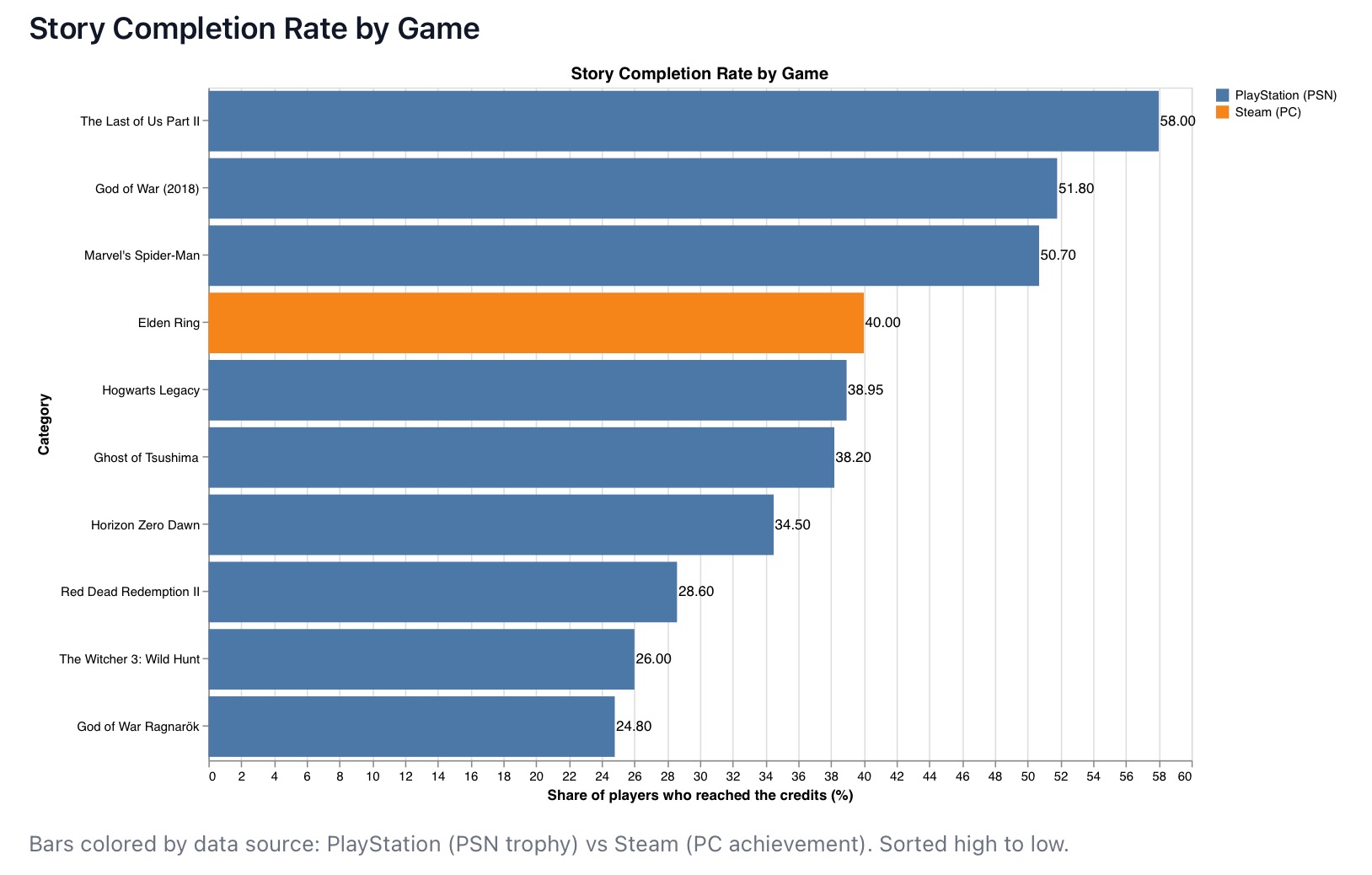
Let’s break down the exact numbers from the chart. We sorted them from the highest completion rate down to the absolute lowest. Read them and weep:
| GAME | COMPLETION | PLATFORM / SOURCE | RELEASE | |
|---|---|---|---|---|
| 1 | The Last of Us Part II | 58.0% | PlayStation · PSN | 2020 |
| 2 | God of War (2018) | 51.8% | PlayStation · PSN | 2018 |
| 3 | Marvel's Spider-Man | 50.7% | PlayStation · PSN | 2018 |
| 4 | Elden Ring | ≈40.0% | Steam · PC | 2022 |
| 5 | Hogwarts Legacy | 38.95% | PlayStation · PSN | 2023 |
| 6 | Ghost of Tsushima | 38.2% | PlayStation · PSN | 2020 |
| 7 | Horizon Zero Dawn | 34.5% | PlayStation · PSN | 2017 |
| 8 | Red Dead Redemption II | 28.6% | PlayStation · PSN | 2018 |
| 9 | The Witcher 3: Wild Hunt | 26.0% | PlayStation · PSN | 2015 |
| 10 | God of War Ragnarök | 24.8% | PlayStation · PSN | 2022 |
Look at that list. Only three games managed to drag more than half of their players across the finish line. The Last of Us Part II takes the crown at 58.0%.
But then... look at the bottom. God of War Ragnarök is sitting there at a shocking 24.8%. Think about that. Roughly 75% of the people who bought one of the most hyped sequels of the generation just... stopped playing. Maybe life got in the way. Maybe they got distracted by TikTok. Or maybe they are still stuck trying to find some random crafting material in Svartalfheim.
Which one of these did you drop halfway through? Drop a comment below and confess your sins. We won't judge (much).
The Law of Averages: Why We All Suffer from Backlog Guilt
If you are sitting there feeling guilty about your massive pile of unfinished games, take comfort in the data. You are not weird; you are the majority.
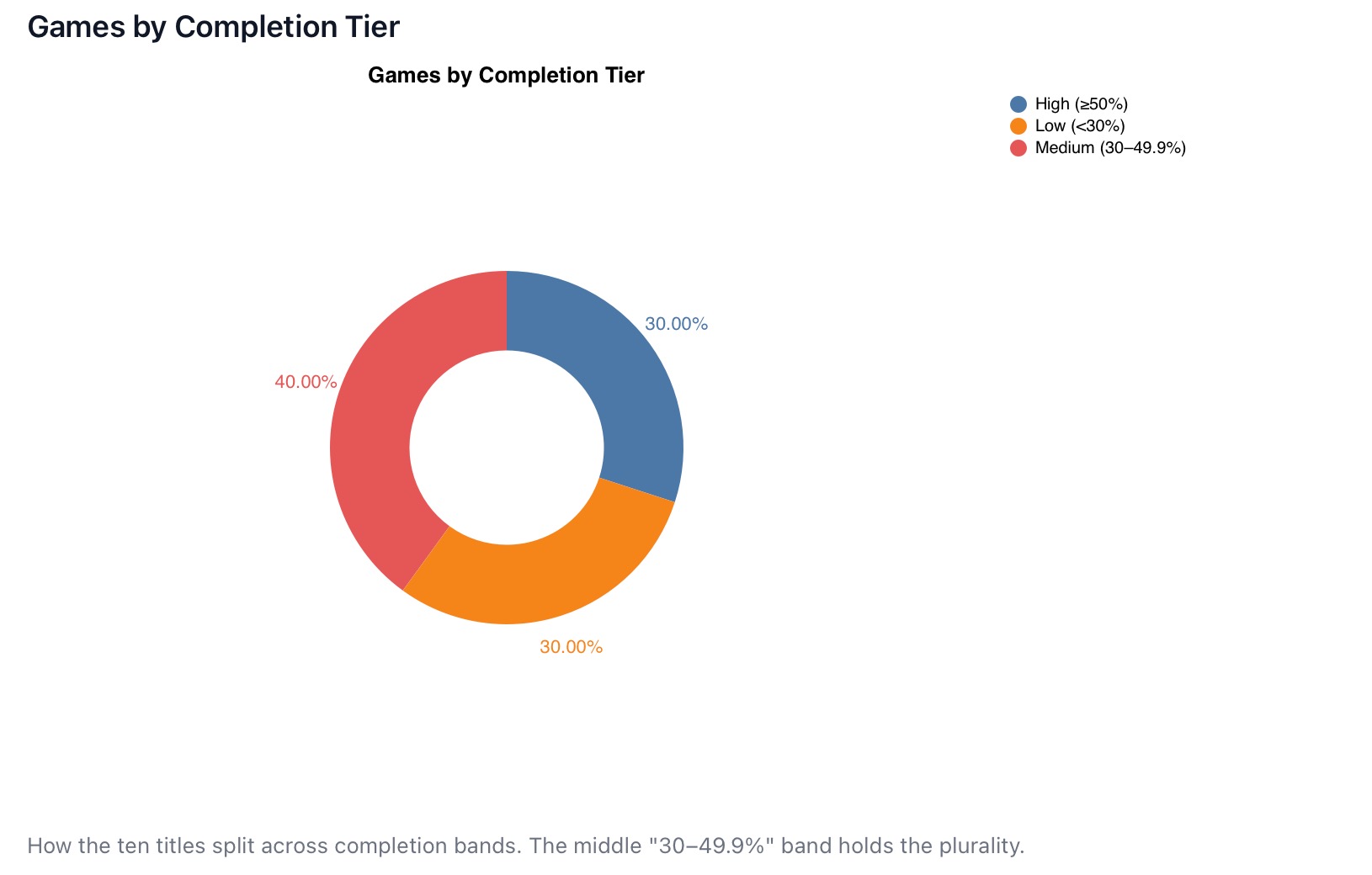
When we split these ten mega-hits into completion tiers, the pattern is glaringly obvious.
The High Tier (50%+): Only 3 games made the cut.
The Low Tier (Under 30%): Also 3 games.
The Medium Tier (30% to 49.9%): The largest chunk, holding 4 games.
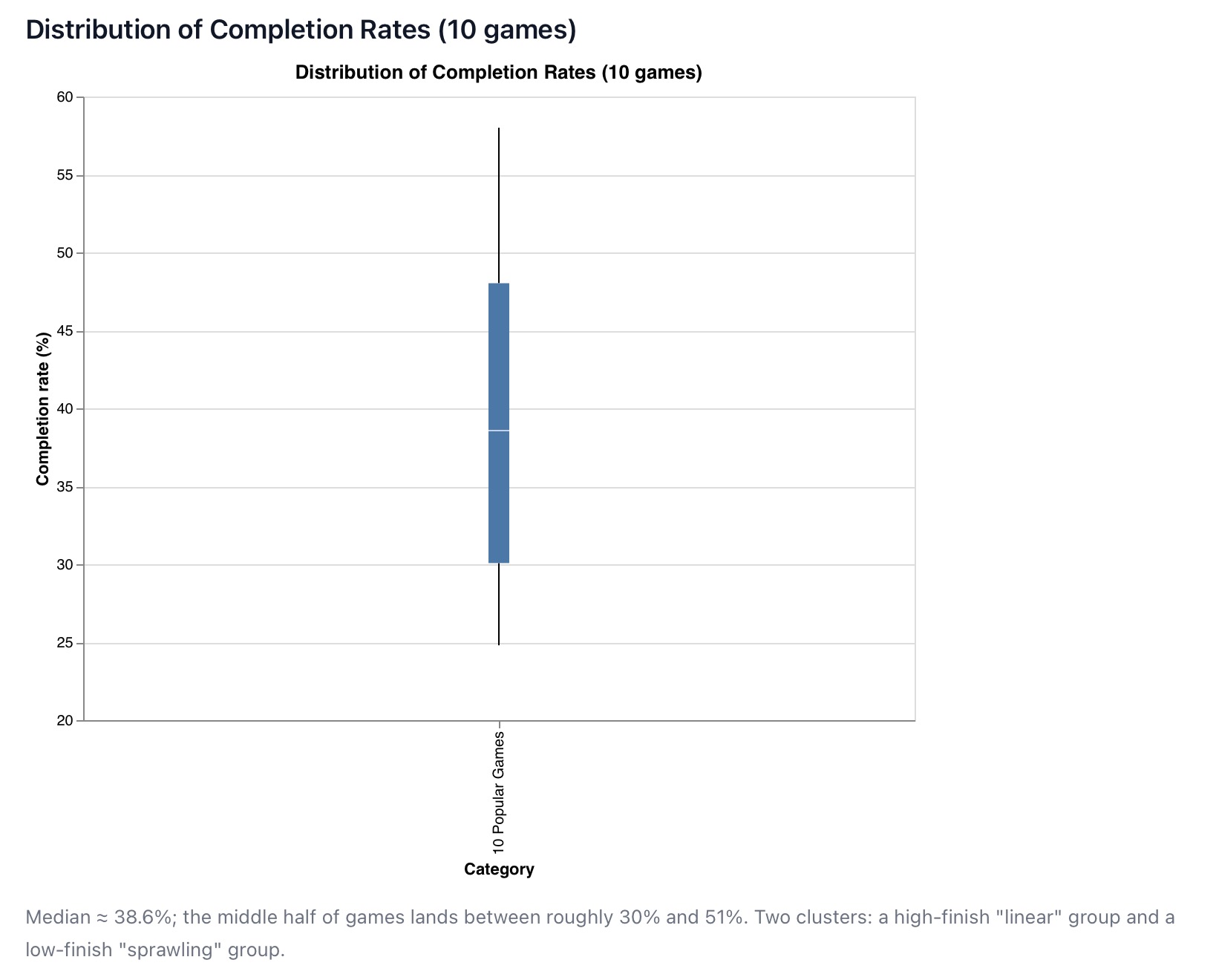
Across these 10 celebrated masterpieces, the average completion rate is around 39.2%, with the median sitting at 38.6%.
Let’s translate that into plain English: For the broader gaming industry, only about ONE in THREE players will actually finish a typical game. Developers spend five years of their lives coding breathtaking final boss fights and emotional cinematic endings, and two-thirds of the audience is basically like, "Nah, I’m good, I’m gonna go play Fortnite."
Let’s look at how these rates are distributed.
Why do we do this? Why do we spend $70 just to ghost a game after 15 hours? The data reveals some surprisingly funny and relatable patterns.
Pattern 1: Open Worlds Are the Ultimate Attention Trap
Gamers are constantly begging for bigger games. "Give us a massive open world!" "Give us 100 hours of content!" But the data proves that we are totally lying to ourselves. The bigger the world, the less likely we are to finish it.
The three games that cleared the 50% mark—The Last of Us Part II, God of War (2018), and Spider-Man—are incredibly focused. They have strong, linear narratives. The game grabs you by the collar and aggressively shoves you toward the ending. And guess what? It works.
Now look at the bottom. Red Dead Redemption II (28.6%) and The Witcher 3: Wild Hunt (26%). These are universally agreed upon as two of the greatest games ever created. Yet, almost nobody finishes them! Why? Because they are distraction factories.
You boot up The Witcher 3 intending to save your adopted daughter, but then a peasant challenges you to a card game, and suddenly you’ve spent 40 hours playing Gwent in a tavern. You start Red Dead 2 wanting to be a badass outlaw, but then you spend three real-life weeks trying to photograph a woodpecker to craft a hat. The more a game sprawls into side content, the faster we lose our minds and drift off.
And then there is Elden Ring (≈40%). It’s brutally difficult. It actively wants you to suffer. Yet, it finishes higher than chill open-world games. Why? Because the goal is singular: kill the giant monster. Difficulty doesn't stop gamers. Getting distracted by 400 icons on a map does.
Pattern 2: The Sequel Curse (Bigger Isn't Better)
Here is where the data gets incredibly spicy. What happens when a tight, focused game gets a massive, sprawling sequel?
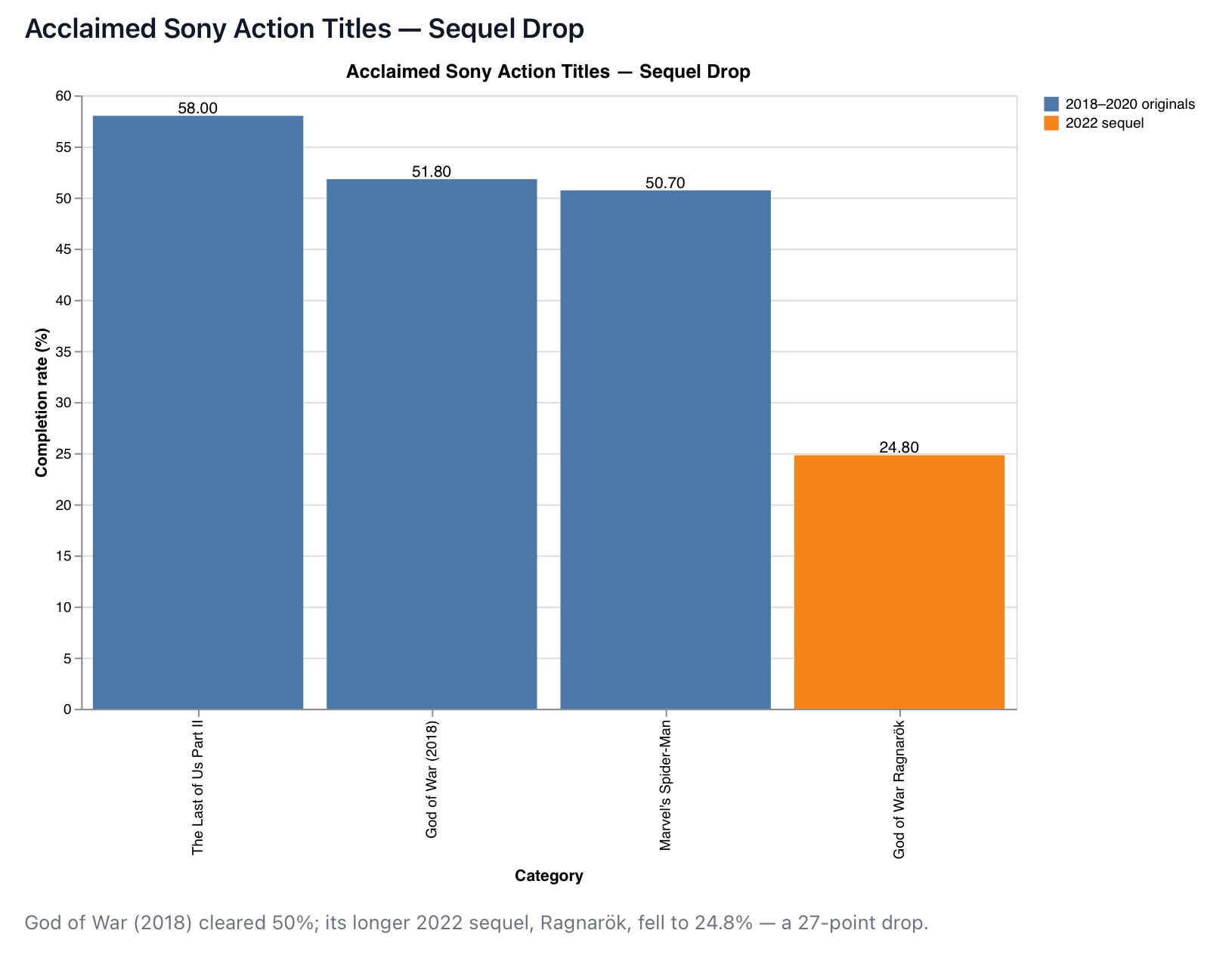
Look at this bloodbath. The original God of War from 2018 had perfect pacing. It cleared 51.8%. Fast forward to its 2022 sequel, God of War Ragnarök. It had amazing reviews. Everyone loved it. But its completion rate absolutely tanked to 24.8%.
That is a 27-point drop! How did a sequel to one of the most finished games become the least finished game on our list?
Simple: It got too big. Ragnarök is much longer and packed with way more side quests and loot grinding than the original. Even a beloved franchise can't beat the basic arithmetic of gamer fatigue. "The game got bigger, so fewer people saw the end." It’s the ultimate irony of the gaming industry. We demand more content, and when developers give it to us, we get exhausted and quit.
Pattern 3: Platform Wars (Console Players vs. PC Hoarders)
If you play on PC, prepare to feel called out. Where you play your games actually predicts whether you will finish them.
To prove this, we looked at Hogwarts Legacy, which launched on PlayStation, Xbox, and Steam at the same time. Let’s look at the receipts.
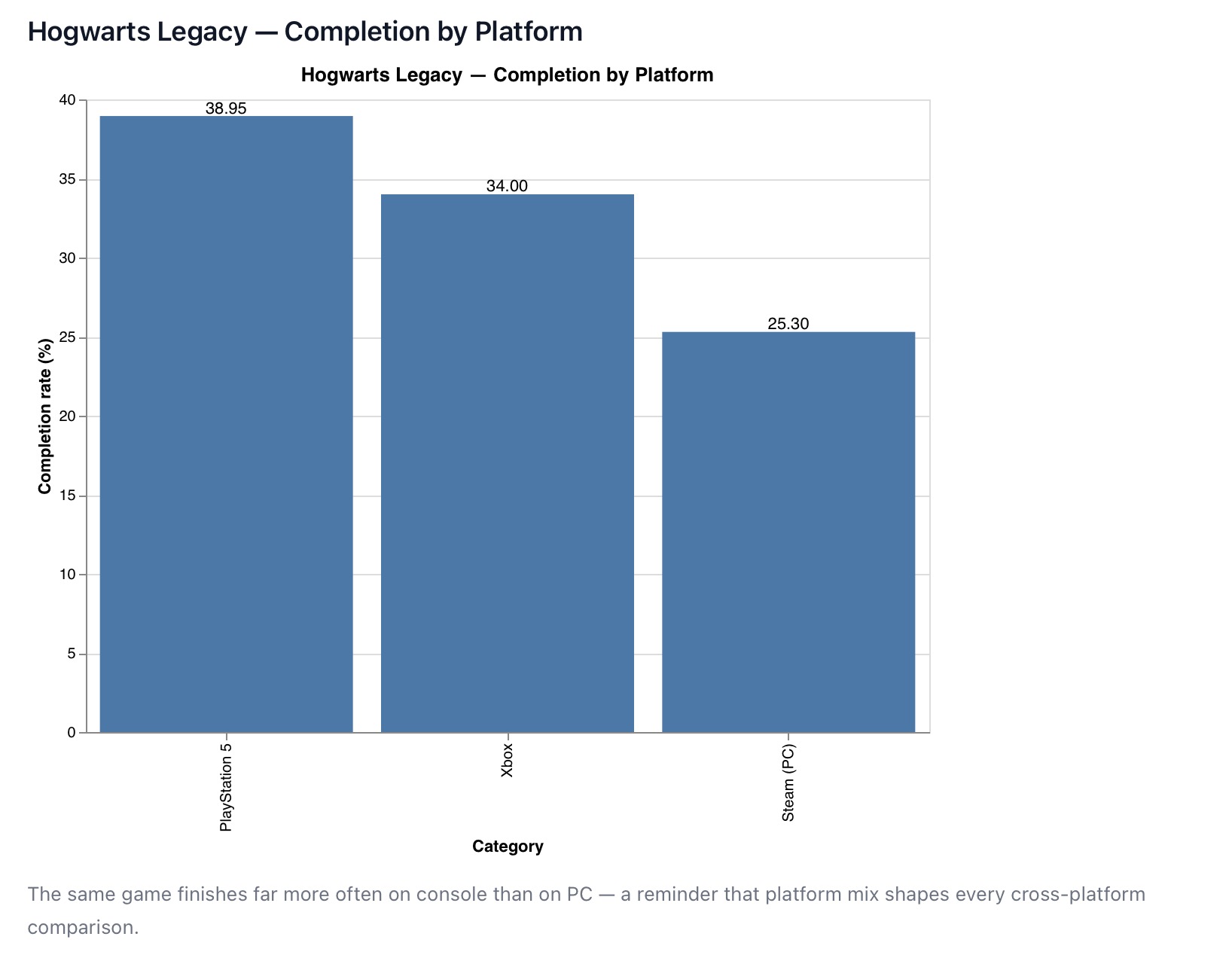
The platform gap is wild:
PlayStation 5: 38.95%
Xbox: 34.00%
Steam (PC): 25.30%
It’s the exact same game! So why are PC players bailing out at such a massive rate?
It comes down to library culture. Console players typically buy a $70 game, put it on their TV, and play it until they beat it. They want their money's worth.
Steam players? Steam players are hoarders. Steam libraries are graveyards of good intentions. A PC gamer will buy Hogwarts Legacy, play it for four hours, and then a Steam Sale will hit. Suddenly, they buy six indie games for $15, get distracted by Palworld or Counter-Strike, and completely forget they were supposed to be a wizard. Attention on PC is brutally fragmented. That’s why Elden Ring’s 40% completion rate on Steam is actually a miracle—if it were a PlayStation exclusive, that number would likely be way higher.
Time to Face the Music
So, what have we learned from this brutal look in the mirror?
You are not alone. The average completion rate is 39%. Most people do not finish their games. Two-thirds of the audience never reaches the credits.
We have no attention span. Linear games (Spider-Man) get finished. Massive open worlds (Red Dead 2) get abandoned.
Sequels are exhausting. Making a game 20 hours longer just guarantees half your players will quit.
PC gamers have a hoarding problem. If you play on Steam, your backlog is probably a lost cause.
We love the hype more than the ending. We love to buy masterpieces, tweet about how great they are, and then quietly stop playing them at Chapter 3.
It’s okay. Gaming is supposed to be fun, not a second job. If you want to drop a game halfway through, drop it!
But the next time someone in your group chat claims they are an elite, hardcore gamer who only plays 10/10 masterpieces... ask them if they actually saw the credits. Better yet, send them this article and demand they open their trophy list.
As we wrap up this massive reality check, we have to give a huge shoutout to Powerdrill Bloom. This entire viral investigation, turning boring backend statistics into a highly exposing, social-media-ready data fact—was completely built and powered by Powerdrill Bloom. By effortlessly analyzing massive datasets from across the internet, Powerdrill Bloom helped us uncover the funniest, most relatable truth in modern gaming.
FAQs
What does "completion rate" actually mean here?
It means the percentage of players who finished the main campaign and unlocked the final story trophy, excluding 100% completion or platinum trophies.
Why is the completion rate of Red Dead Redemption II so low?
The massive open world and endless side distractions severely pull players away, causing most of them to quit before seeing the end.
Which platform has a higher game completion rate?
Console players finish games more often, while Steam PC players get easily distracted because their massive game libraries are fueled by constant sales.
Why did God of War Ragnarök suffer such a massive drop?
The sequel grew much larger and denser with side content. When a game becomes too bloated, fewer players stick around to reach the credits.
Does extreme game difficulty always ruin the completion rate?
Difficulty is not destiny. Thanks to real-time analytics tracked via Powerdrill Bloom, even brutal games like Elden Ring outperform sprawling casual titles.