Data Fact: People Are Keeping Their iPhones Longer Than Ever
The iPhone replacement cycle is getting longer, and the change is no longer subtle. In the United States, the average iPhone was retired at 3.84 years in 2025, the highest level on record. At the same time, 42% of iPhone buyers were replacing a device that was at least three years old, compared with just 24% five years earlier. Through the 12 months ending June 2026, people keeping their phones for three years or longer remained the largest segment of the market.
To better understand how American iPhone ownership is changing, we analyzed the available multi-year data with Powerdrill Bloom, comparing replacement age, upgrade-cycle distributions, platform differences, consumer motivations, and demographic patterns. The results point to a clear structural shift: iPhones are increasingly being treated less like products that need regular upgrading and more like durable devices that people keep until there is a compelling reason to replace them.
The trend briefly moved in the opposite direction during 2024 and early 2025, but that reversal did not last. By late 2025 and into mid-2026, long-term ownership had regained its position as the defining pattern in the U.S. iPhone market.
From a Two-Year Cycle to Nearly Four Years
For much of the 2010s, upgrading a smartphone every two years was relatively normal. Carrier contracts often lasted 24 months, and many consumers viewed the end of a contract as a natural moment to get a new device. The iPhone market was also evolving quickly, with visible changes in display quality, camera performance, processing power, and design giving consumers more reasons to upgrade frequently.
That model has gradually disappeared.
Two-year contracts gave way to longer installment plans, with 36-month financing becoming increasingly common. At the same time, smartphones became more durable, software support lasted longer, and flagship prices climbed beyond $1,000. The economic and practical logic of replacing a perfectly functional phone every two years became harder to justify.
The result is visible in Assurant's trade-in data. The average U.S. iPhone entering the replacement or trade-in channel reached 3.84 years in 2025, compared with 3.27 years in 2020. That represents an increase of roughly seven months in only five years.
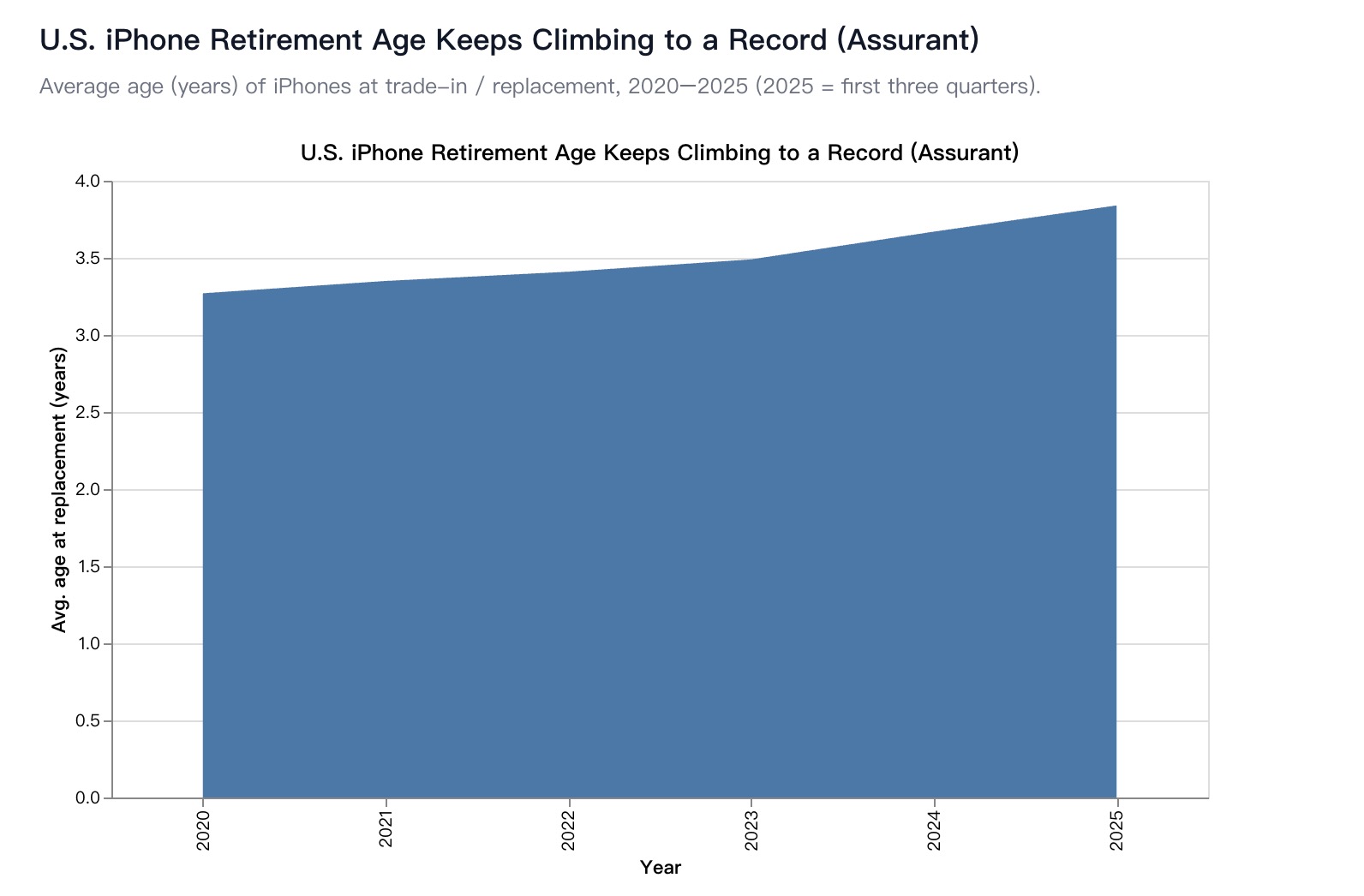
The chart illustrates a steady long-term climb rather than a sudden one-year jump. That distinction matters because it suggests that the longer replacement cycle is not simply the result of one successful iPhone generation or a temporary economic slowdown. Instead, several structural factors are pushing consumers toward longer ownership.
An iPhone now receives software updates for years, while improvements in battery technology, chip performance, cameras, and physical durability mean that a three-year-old device can still meet the needs of most users. Unless the phone develops a serious problem, many consumers simply do not feel enough pressure to replace it.
The Share Keeping iPhones for Three or More Years Has Nearly Doubled
The change becomes even clearer when looking at how long buyers owned their previous iPhone before replacing it.
According to CIRP's rolling 12-month data ending each September, the share of U.S. iPhone buyers replacing a phone that was three years old or older rose from 24% in 2020 to 32% in 2024, before reaching a record 42% in 2025.
In other words, the proportion of long-term iPhone owners increased by 18 percentage points in five years.
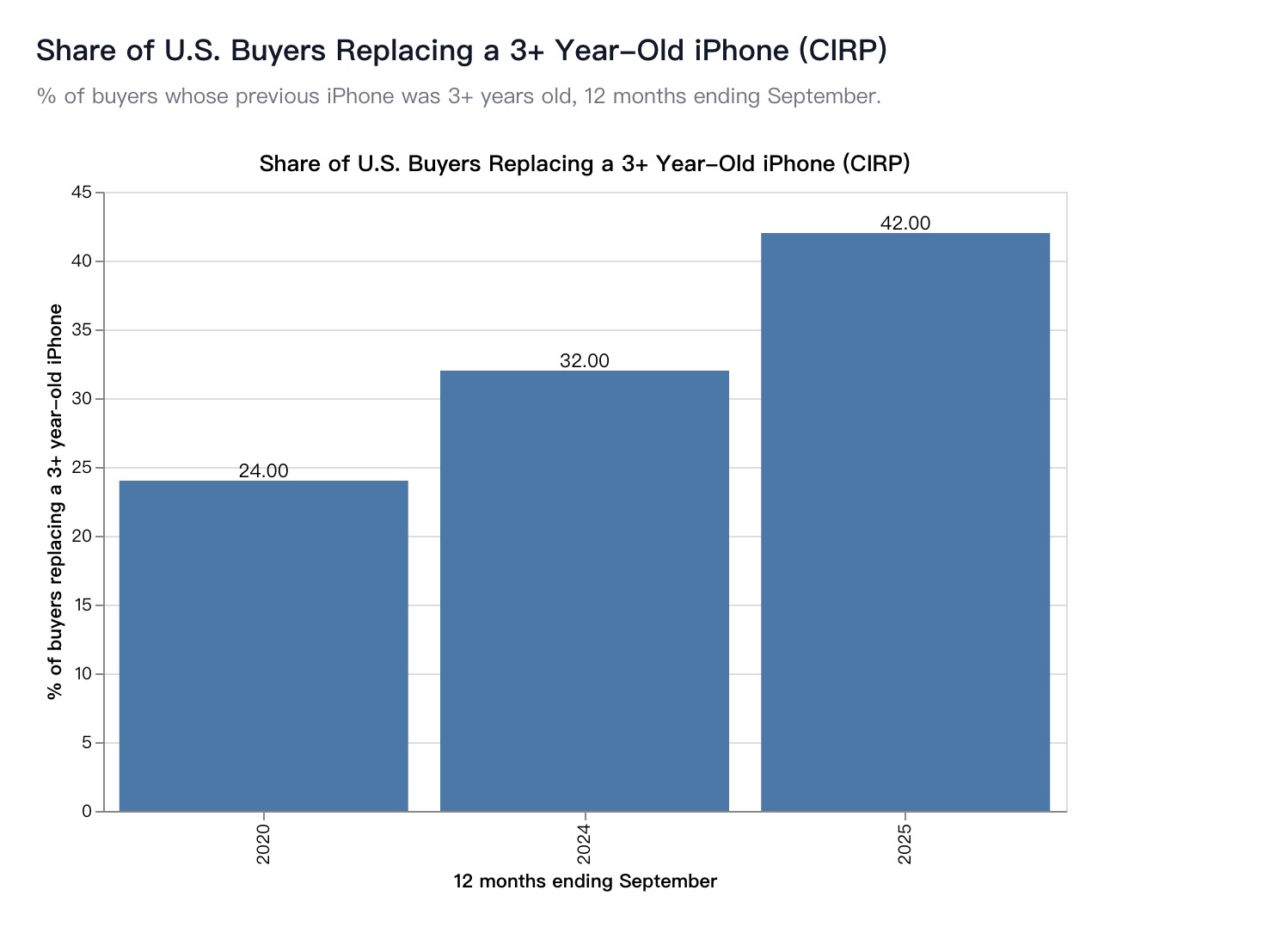
At the same time, shorter replacement cycles have become less common. The share of buyers replacing an iPhone that was two years old or newer fell from 41% in 2020 to 29% in 2025. The market is gradually moving away from the once-standard two-year upgrade rhythm.
The latest data shows that this is continuing. During the 12 months ending June 2026, 39% of U.S. iPhone buyers had kept their previous device for at least three years, making long-term holders the largest single group.
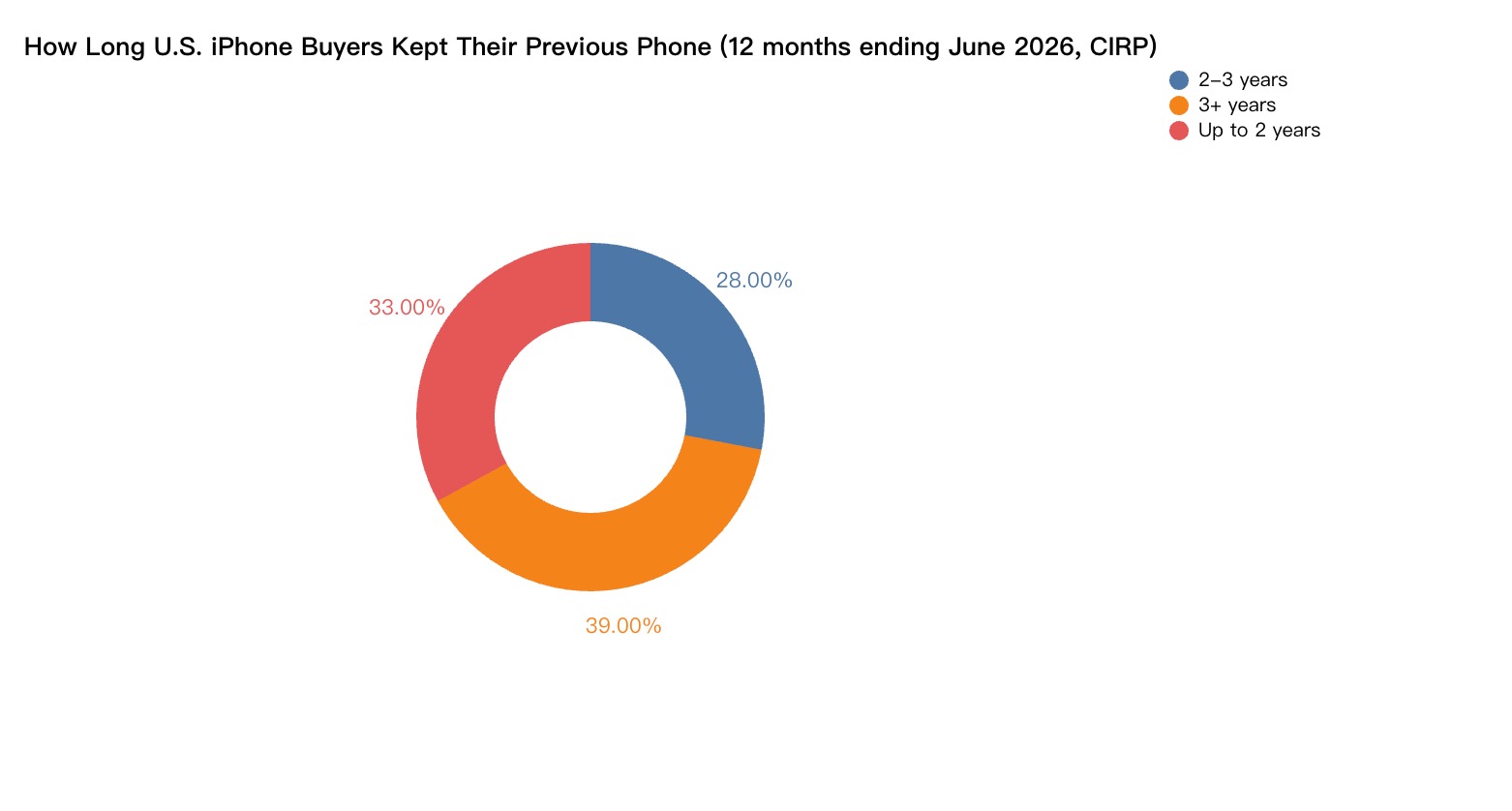
The distribution also suggests that the market is becoming more polarized. There are still consumers who upgrade relatively quickly, but the middle ground is shrinking. The two-to-three-year ownership group has become less dominant, while the market increasingly separates into faster upgraders and people willing to hold onto a device for much longer.
That matters for Apple because a growing installed base does not necessarily translate into proportionally faster hardware sales. If more customers remain within the Apple ecosystem while upgrading less frequently, the company can continue expanding its user base even as the annual replacement cycle becomes slower.
iPhones Still Outlast Android Phones in the Trade-In Channel
Longer ownership is not limited to iPhone users. Smartphone replacement cycles have been lengthening across the broader market as devices become more capable and expensive.
However, iPhones still tend to remain in use longer than Android devices.
Assurant's trade-in data shows that iPhones entered the channel at an average age of 3.67 years in 2024, compared with 3.52 years for Android devices. The gap narrowed considerably compared with 2020, when iPhone trade-in age exceeded Android by 0.48 years, but Apple devices still remained in use longer.
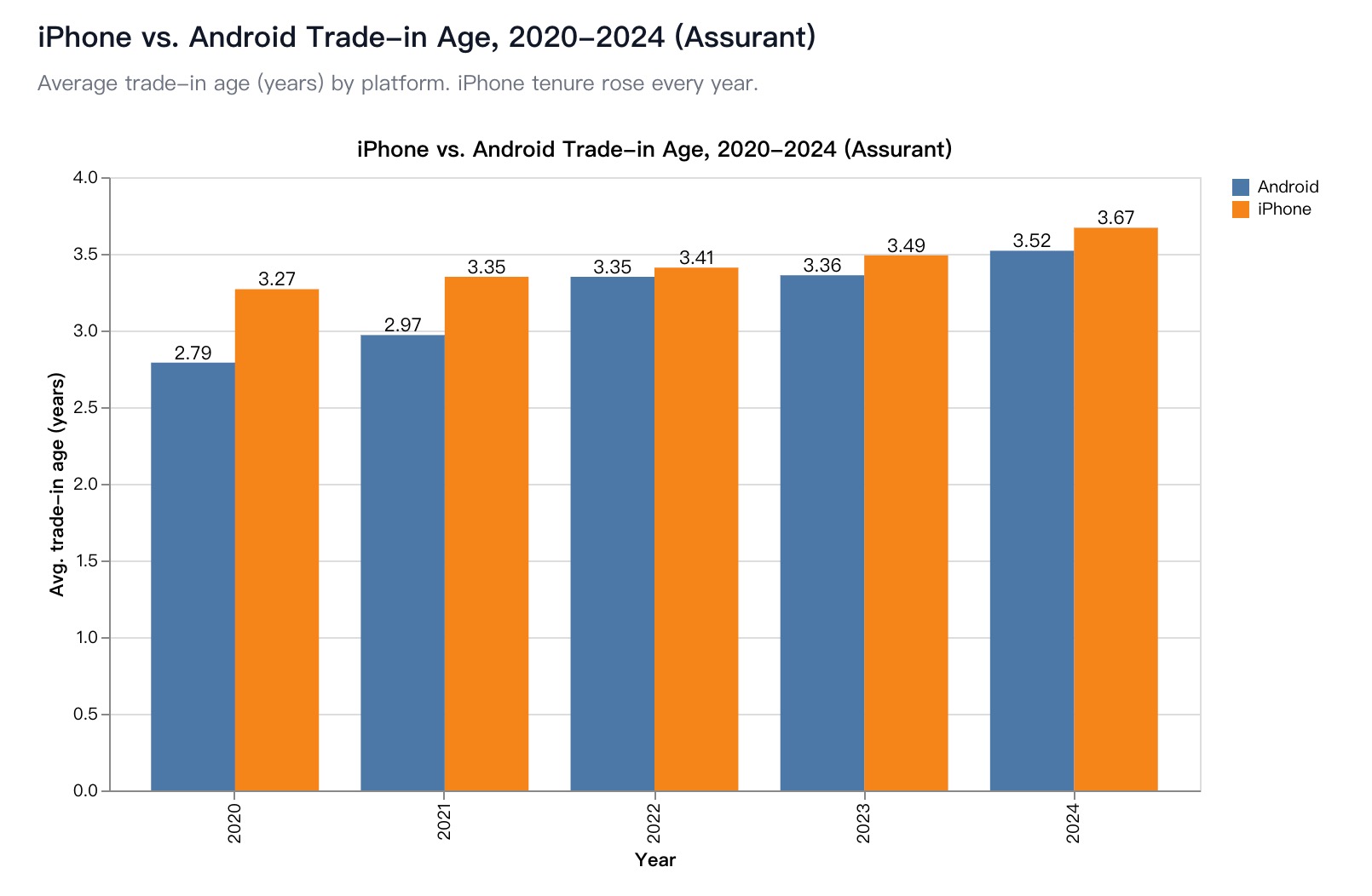
One particularly important pattern is that iPhone tenure increased every year from 2020 through 2024. Android ownership also became longer, but the consistent upward movement of the iPhone suggests that Apple's devices continue to benefit from strong resale value, extended software support, and a large ecosystem of users who remain satisfied with older hardware.
The gap may not always remain large, especially as Android manufacturers extend software support and improve device durability. Still, the 2025 data indicates that iPhone replacement age continued climbing to a new record, suggesting that Apple's ownership cycle remains one of the longest in the smartphone market.
Functional Failure Matters More Than New Features
One reason the replacement cycle is becoming longer is surprisingly simple: many consumers are not upgrading because they want something new. They are upgrading because their existing phone is no longer working as well as it used to.
CIRP has described the pattern as consumers replacing iPhones when they lose functionality rather than because owners are attracted by new or improved capabilities.
Consumer survey data supports that explanation. Battery degradation, cited by 75% of respondents, is the leading reason for upgrading, followed by screen damage at 55%. By comparison, more aspirational reasons are far less influential. Only 24% cited a better camera, while just 17% pointed to wanting a prettier or more attractive phone.
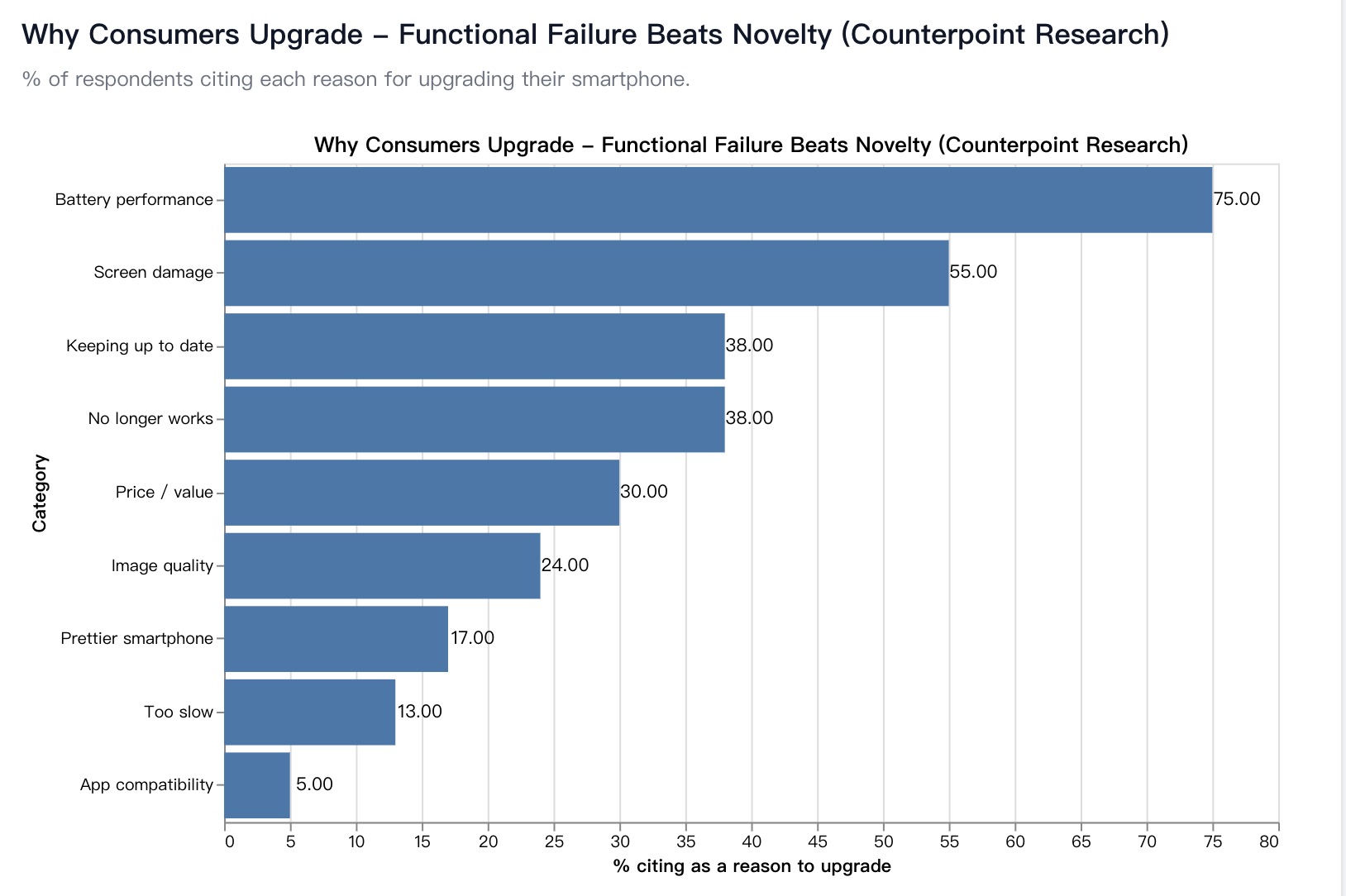
This helps explain why the replacement cycle has stretched toward four years. If the main reason to upgrade is that the old device is failing, then improvements in durability directly reduce the frequency of purchases.
A stronger battery, a more durable display, better repair options, and longer software support can all delay replacement. Meanwhile, a faster processor or a modestly improved camera may be impressive at launch but may not be enough to convince an owner of a two- or three-year-old device to spend $1,000 or more.
The smartphone market has effectively reached a point of maturity. For many consumers, recent models are better than previous generations, but they are not always dramatically different from devices that remain fully functional.
Older Consumers Are the Most Patient iPhone Owners
Age is another important factor behind the lengthening replacement cycle.
The willingness to keep a phone for at least three years rises significantly among older Apple users. Among people aged 25–34, only around one in five keeps their phone for three years or longer. That figure increases to 43% among users aged 55–64 and reaches 65% among those aged 65 and older.
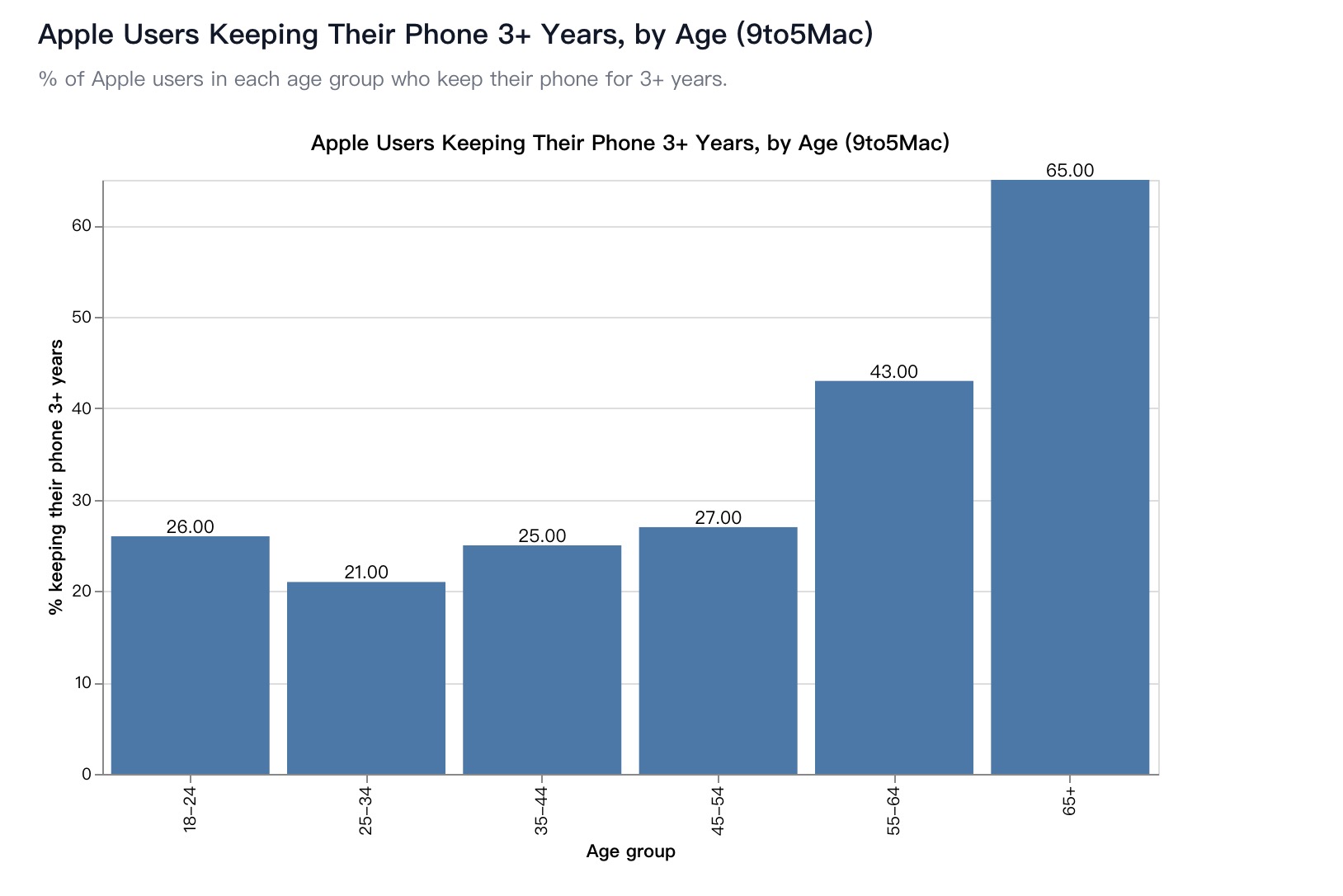
This creates an important demographic pattern. As the iPhone user base ages, a larger share of customers may naturally belong to groups that are less motivated to upgrade frequently.
However, long-term ownership does not necessarily mean these consumers are buying cheaper phones. CIRP has noted that longer-term holders can be economically rational rather than simply price-sensitive. Many are willing to purchase a more expensive current-generation device, use it for several years, and spread the cost over a much longer ownership period.
That behavior creates a different purchasing model from the traditional annual-upgrade customer. Instead of buying a new iPhone every year or two, the consumer may purchase a premium model, keep it for four or five years, and then return to the market when there is a genuine need for replacement.
In that sense, a longer replacement cycle does not automatically mean lower lifetime spending. It changes the timing of spending.
The 2024–25 Detour: A Brief Return to Faster Upgrades
The trend toward longer ownership has not been perfectly linear.
In the quarter ending December 2024, CIRP identified what it described as the first notable deviation in iPhone upgrade cycles since 2014. The share of consumers replacing an iPhone that was two years old or newer increased to 36%, returning to roughly the level seen in 2020, while the proportion of long-term holders temporarily declined.
Several factors likely contributed to this acceleration.
First, the launch of Apple Intelligence gave Apple a new feature set to promote, particularly among consumers interested in the latest AI capabilities. Second, carrier promotions and bill credits made upgrading financially attractive for some users. Finally, concerns about potential tariffs and future price increases may have encouraged some consumers to purchase earlier than planned.
These factors created a temporary boost in upgrade activity, especially among Apple's most engaged customers. Yet the broader market did not abandon its long-term trajectory.
By the 12 months ending September 2025, the share of buyers replacing a three-year-old-or-older iPhone had climbed back to a record 42%. Through June 2026, long-term holders remained the largest ownership segment at 39%.
The temporary acceleration therefore looks more like a detour than a reversal.
The deeper trend is still being driven by durable forces: longer financing periods, higher smartphone prices, improved hardware reliability, and software support that extends well beyond the first few years of ownership.
What This Means for Apple's Upgrade Cycle
The move toward longer ownership creates both opportunities and challenges for Apple.
The challenge is obvious. If consumers keep their iPhones for four years instead of two, the company cannot rely as heavily on frequent hardware replacement to drive growth. Each annual iPhone launch has to compete not only with the previous generation but also with devices that may still be two, three, or even four years old.
That makes the value proposition of new features increasingly important.
At the same time, Apple benefits from a large and growing installed base. Even if users upgrade less frequently, they may continue spending on services, accessories, apps, subscriptions, and other products within the ecosystem.
A longer ownership cycle can therefore coexist with strong customer lifetime value.
The bigger question is whether Apple can create a future catalyst powerful enough to shorten replacement cycles again. CIRP has pointed to possibilities such as device leasing, foldable products, and more compelling premium features. A major change in smartphone form factors or a genuinely essential AI capability could potentially persuade more consumers to upgrade earlier.
For now, however, the evidence points in the opposite direction.
The Future Outlook: Four Years May Become the New Normal
The conditions that pushed replacement cycles longer remain firmly in place heading into late 2026.
Premium iPhones remain expensive, 36-month financing plans encourage consumers to keep devices longer, and software support ensures that older phones remain useful. Hardware improvements are increasingly incremental, while many consumers appear willing to wait until battery performance, damage, or other functional issues create a clear reason to upgrade.
Further price increases could extend the cycle even more.
If consumers are already comfortable keeping an iPhone for nearly four years, a higher entry price for premium smartphones could make holding onto an existing device for another year an even more rational decision. On the other hand, a breakthrough product category or a major technological shift could eventually pull some upgrades forward.
For now, the baseline expectation is clear: the multi-year trend toward longer iPhone ownership is likely to continue.
The average replacement age is already 3.84 years, and the next milestone may be four.
Final Thoughts
The era of replacing an iPhone every two years is gradually fading.
What the data shows is not a temporary slowdown but a fundamental change in consumer behavior. Americans are keeping iPhones longer because the devices last longer, software remains supported for years, financing periods have expanded, and the cost of upgrading has increased. Most importantly, consumers increasingly appear to wait for a practical reason to replace their phones rather than upgrading simply because a newer model exists.
Using Powerdrill Bloom to analyze the replacement-age data, ownership distributions, upgrade motivations, and demographic patterns makes the broader picture especially clear: iPhone users are moving toward a more deliberate ownership model. They may still buy premium devices, but they are increasingly expecting those devices to deliver value for three, four, or even more years.
That shift could reshape how Apple thinks about future hardware growth. The next big challenge may not be convincing consumers that the latest iPhone is better. It may be convincing them that their current one is no longer good enough.
FAQs
1. How long do Americans keep their iPhones?
The average U.S. iPhone was retired after 3.84 years in 2025, the longest replacement age recorded.
2. What percentage of iPhone buyers keep their phone for three years or more?
42% replaced a three-year-old-or-older iPhone in 2025, while 39% remained long-term holders through mid-2026.
3. Why are people keeping iPhones longer?
Higher prices, durable hardware, longer software support, extended financing, and fewer compelling upgrade triggers all contribute to longer ownership.
4. Do iPhone users keep their phones longer than Android users?
Yes. Trade-in data shows iPhones generally enter replacement channels at an older average age than Android devices.
5. Will iPhone replacement cycles continue getting longer?
Probably. Unless major new products or features change behavior, structural factors suggest average ownership could reach four years or more.