Data Fact: How Unlikely Is It to See Three Total Solar Eclipses in a Row in the Same Country
If you are reading this from Europe, your social media feeds are probably still completely flooded with pictures from yesterday.
August 12, 2026, brought a spectacular total solar eclipse right across the heart of Spain. Millions of people stood in the sudden, eerie twilight, watching the moon perfectly blot out the sun. It was magical.
And because human nature is wonderfully greedy, the very next question on everyone’s mind was, “When can we see it again?” Or better yet, “Could we get a streak? What if Spain got three total solar eclipses in a row?”
To answer this mind-bending statistical question, we didn't just guess. We ran the numbers. All the jaw-dropping data and stunning charts in this article were generated by Powerdrill Bloom.
Grab a cup of coffee, and let’s dive into the cosmic lottery of total solar eclipses. Spoiler alert: hitting the jackpot is harder than you think.
Section 1: The Cosmic Metronome (They Aren't as Rare as You Think!)
Let’s get one thing straight. The universe is not stingy with total solar eclipses.
If you look at the entire Earth as a whole, a total solar eclipse happens somewhere on our big blue marble about once every 18 months.
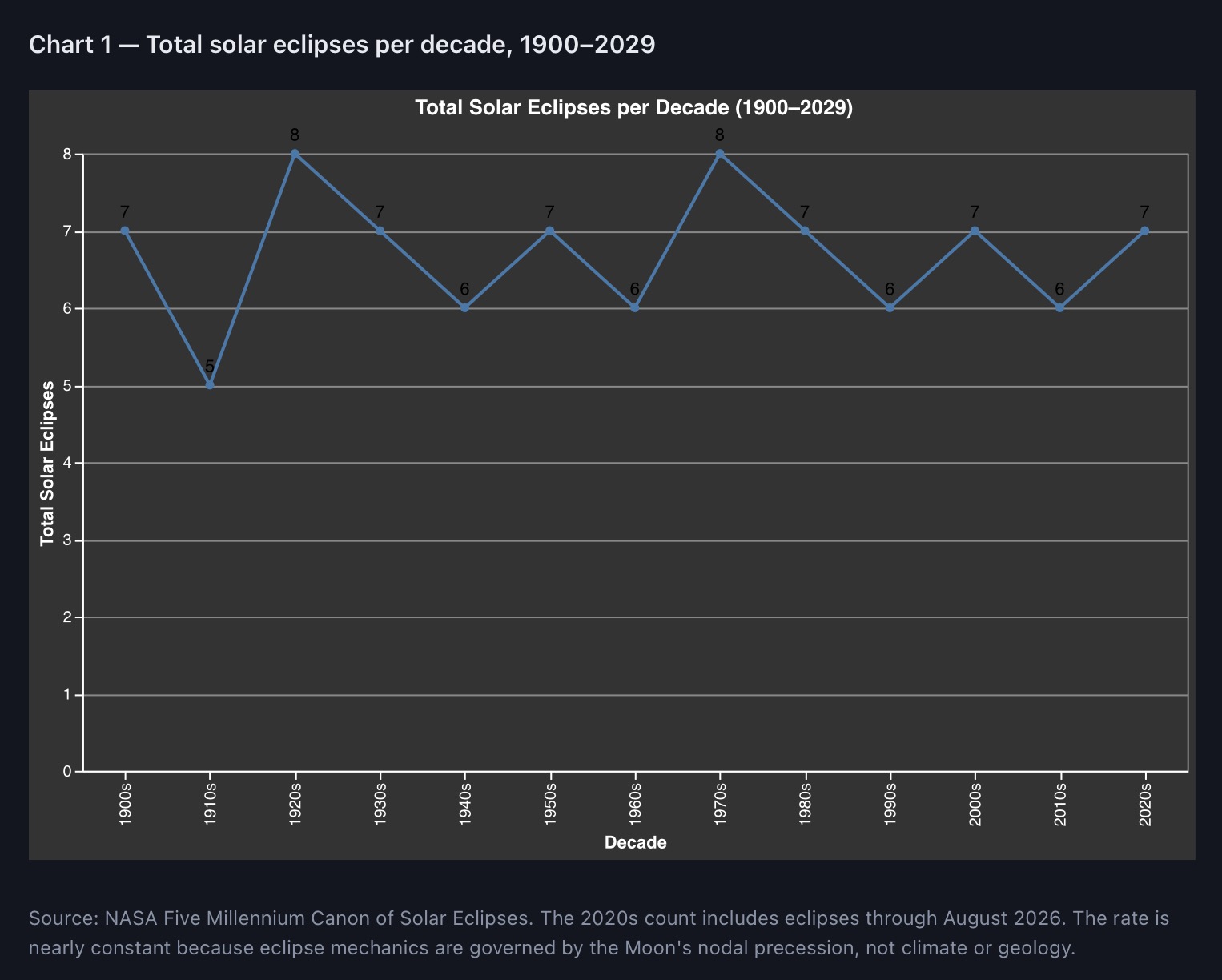
In fact, the rate of these celestial shows is remarkably, almost terrifyingly, stable. The mechanics of the moon, the sun, and our planet don’t care about climate change, plate tectonics, or human history. They are governed by the unstoppable clockwork of the Moon's nodal precession.
Between 5 and 8 total solar eclipses occur every single decade. The long-run average sits comfortably at roughly 6.6 eclipses per decade.
Don't believe me? Look at this data showing the relentless, steady cadence over a 130-year period.
So, if eclipses happen all the time, why do they feel so incredibly rare?
Because the Earth is massive. Our planet boasts a surface area of about 510 million square kilometers. And the moon’s shadow? It’s basically a cosmic pencil stroke.
When the moon passes between the Earth and the sun, the shadow that creates totality (the umbra) covers roughly 0.004% of the Earth’s surface per eclipse.
You aren't just waiting for an eclipse. You are waiting for a 0.004% bullseye.
Section 2: The Real Estate Lottery (Size Absolutely Matters)
If you want to get hit by an eclipse, you need a big target.
Hit frequency scales almost perfectly with two things: a country's total land area, and its latitude. It’s a game of geographical real estate.
Large countries naturally dominate the leaderboard. They spread massive nets across the globe, waiting to catch that tiny, narrow ribbon of darkness.
Russia is the undisputed champion of the eclipse world. Clocking in at a staggering 17.1 million square kilometers, Russia is projected to experience 42 total solar eclipses between the years 1900 and 2300.
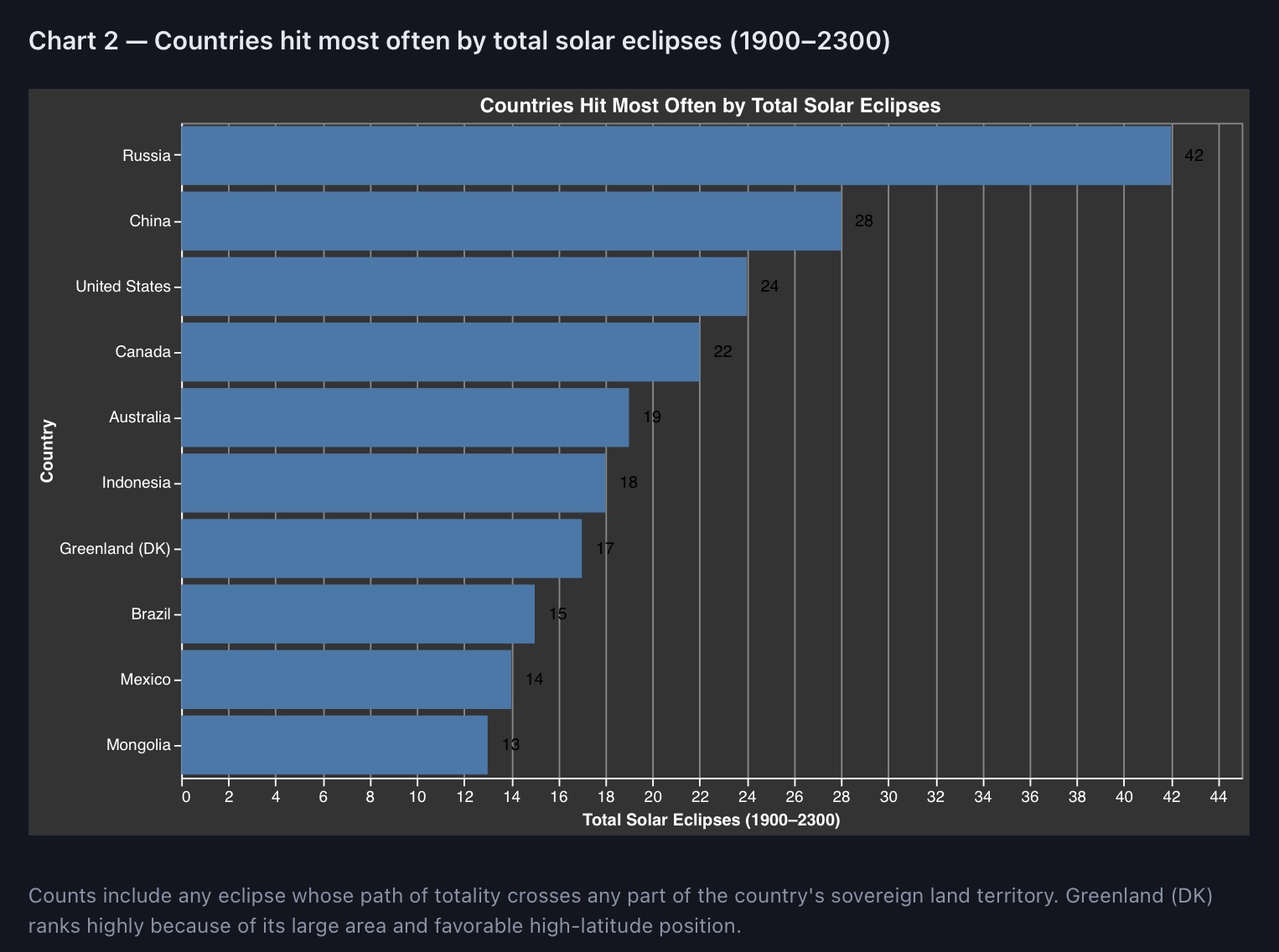
But let’s put that into perspective. Even for the colossal landmass of Russia, 42 hits over 400 years works out to just one eclipse every 10 years.
China (28 hits) and the United States (24 hits) share a similar cadence. They can expect the sky to go dark about once a decade in some corner of their vast territories.
And what about a normal-sized country?
Let’s look back at our current favorite example: Spain. With an area of around 506,000 square kilometers, Spain’s expected statistical rate is closer to one total solar eclipse every 250 years! (Though, thanks to a beautiful quirk of orbital mechanics, Spain is actually experiencing a weird anomaly right now with another one coming in 2027. Enjoy it, Spain!).
Section 3: The Skinny Ribbon of Totality
To understand why a three-in-a-row streak is so impossible, we have to talk about width.
The width of an eclipse path isn't static. It breathes. It changes based on the exact distances between the Earth, Moon, and Sun on any given day.
When the Moon is at "perigee" (the absolute closest point to Earth in its elliptical orbit), its apparent size in our sky is at its largest. This is when the path of totality is the widest, and the darkness lasts the longest.
When the Moon is near "apogee" (farthest away), the path is razor-thin, and the eclipse is over in a blink.
But even at its absolute widest, the path of totality is humbling.
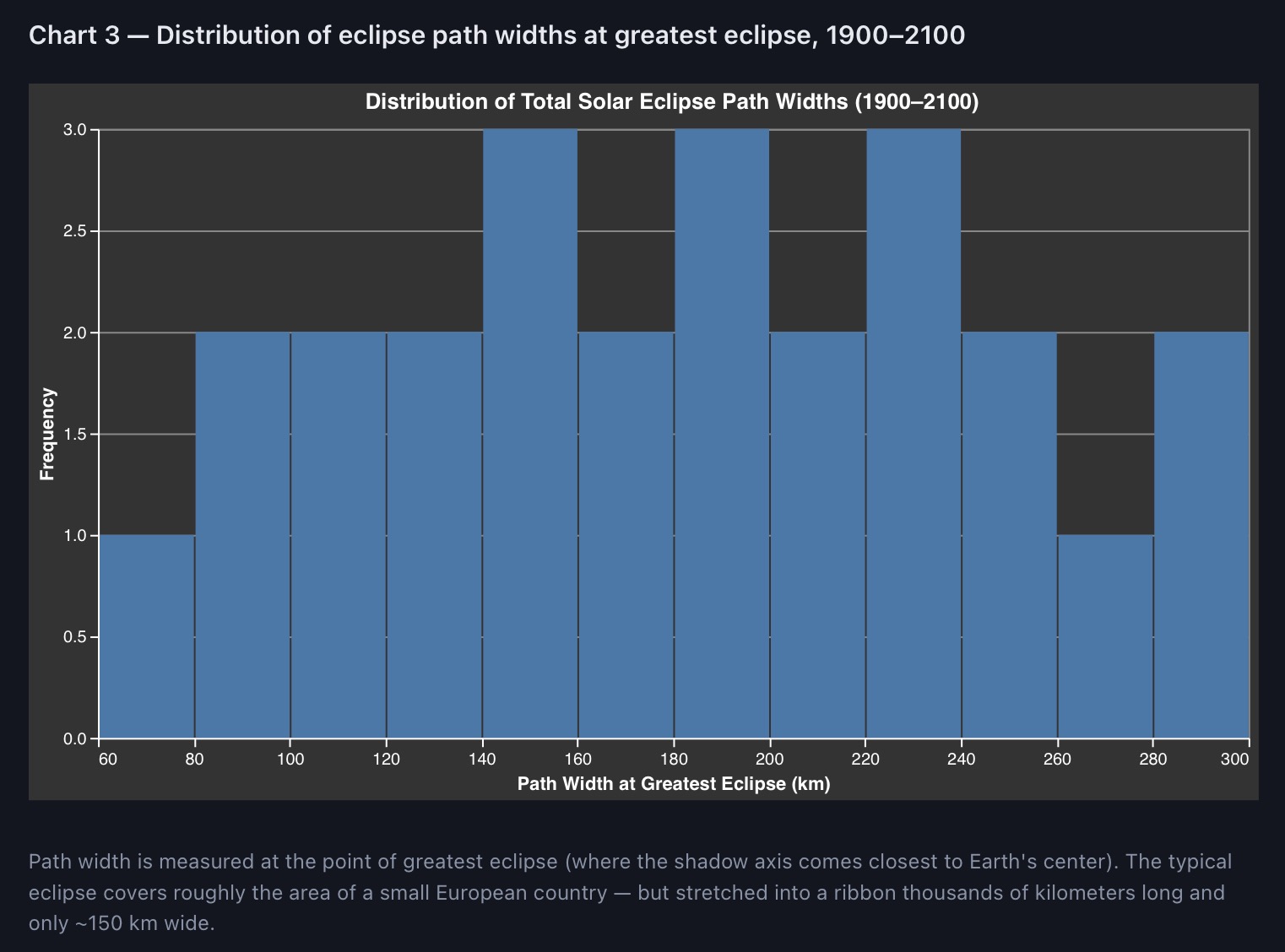
Between 1900 and 2100, path widths cluster tightly between 100 and 250 kilometers. The median sits right at roughly 150 kilometers.
Imagine taking a paintbrush, dipping it in black paint, and drawing a line that is only 150 kilometers wide across a globe. Even the widest paths—topping out around 270 kilometers—cover a vanishingly small fraction of our planet.
You are trying to catch a ribbon that is thousands of kilometers long, but narrower than the drive from New York to Philadelphia.
Section 4: The Mathematical Cliff of Consecutive Hits
Now, let's get into the hard math.
What happens when we try to stack these tiny probabilities? If we model each eclipse’s path as an independent event, the chance of getting a streak in the exact same country follows a geometric distribution.
In statistics, "geometric distribution" is just a fancy way of saying: The odds fall off a massive cliff with every step you take.
Let’s look at a large country (like the USA, Canada, or China). Their chance of catching a total solar eclipse on any random go is about 1.5%.
Probability of 2 in a row: ~2.3 × 10⁻⁴ (Roughly 1 in 4,300)
Probability of 3 in a row: ~3.3 × 10⁻⁶ (Roughly 1 in 300,000)
Probability of 4 in a row: ~5.0 × 10⁻⁸ (Basically zero)
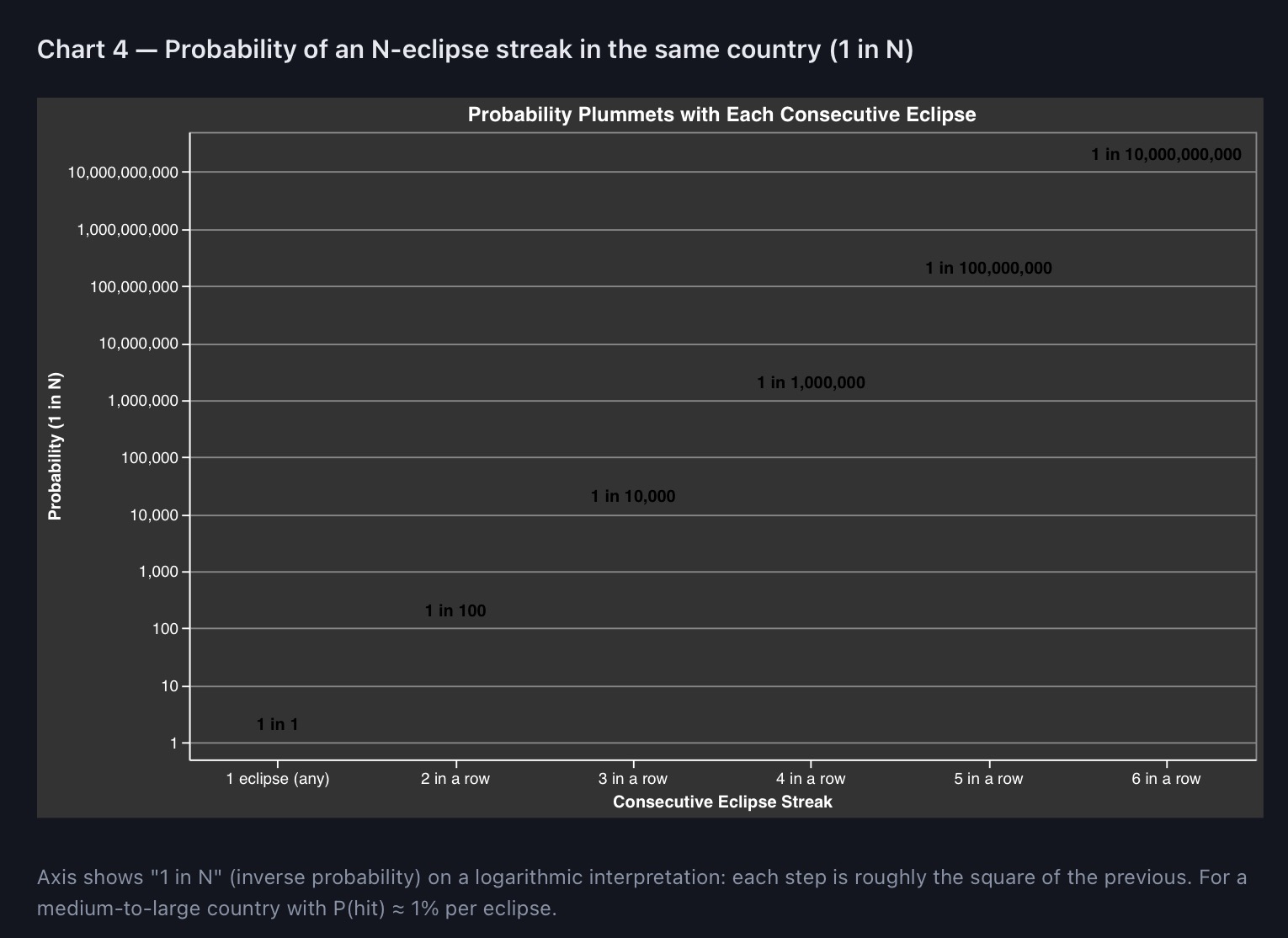
Now, let's talk about waiting times. This is where the numbers get truly wild.
If you live in a small country like Belgium, the Netherlands, or Switzerland (roughly 30,000 to 50,000 square kilometers), your chance of getting hit by a single eclipse is around 0.01%.
To get three in a row? The probability drops to one in ten trillion.
The expected waiting time for a small country to see three consecutive global eclipses is 300 billion years. Our universe is only 13.8 billion years old! The sun will literally swallow the Earth before Belgium gets three total solar eclipses in a row.
Even for the most geographically blessed country on Earth (Russia), the expected waiting time is 7,000 years.
Section 5: The Mid-Latitude Sweet Spot
Is it entirely random? Not quite.
Eclipse paths do play favorites, just a little bit. Because of the tilt of the Earth and the geometry of the Moon's orbit, eclipse paths do not distribute themselves evenly across the globe.
They cluster.
Specifically, paths love the 30° to 50° latitude bands in both the Northern and Southern Hemispheres. You’ll see significantly fewer total solar eclipses near the blistering equator or the freezing poles.
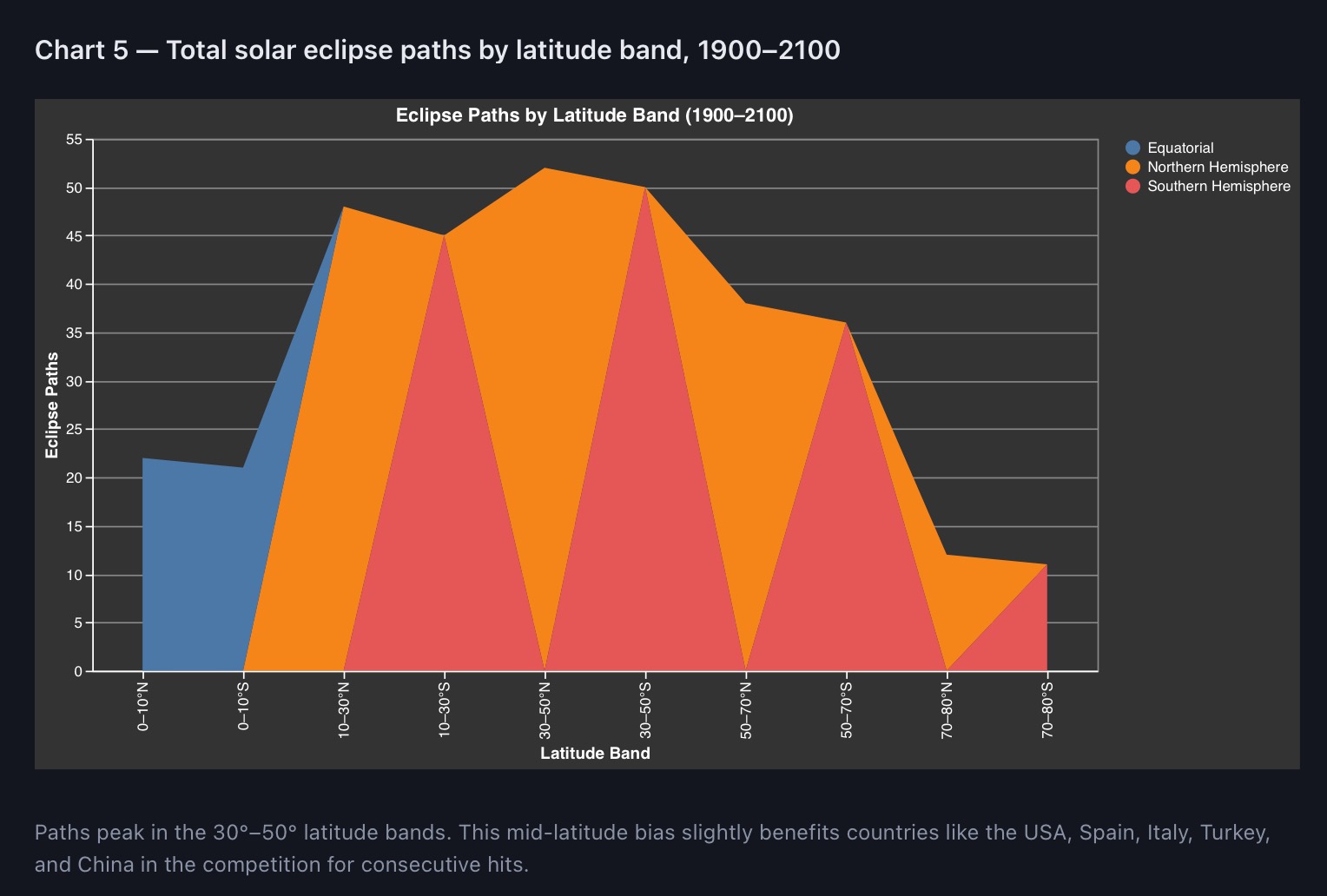
This mid-latitude bias provides a slight statistical edge to countries located in these zones.
Most of Europe, the contiguous United States, central China, and central Asia sit squarely in this VIP section of the globe. Because of this, they get hit just a little bit more often than a pure "surface area" calculation would suggest.
Meanwhile, countries draped across the equator—like Brazil, Indonesia, and Kenya—get slightly shortchanged. They have the landmass, but not the ideal latitude.
Section 6: Has It Ever Actually Happened?
The math says it's basically impossible. But what does human history say?
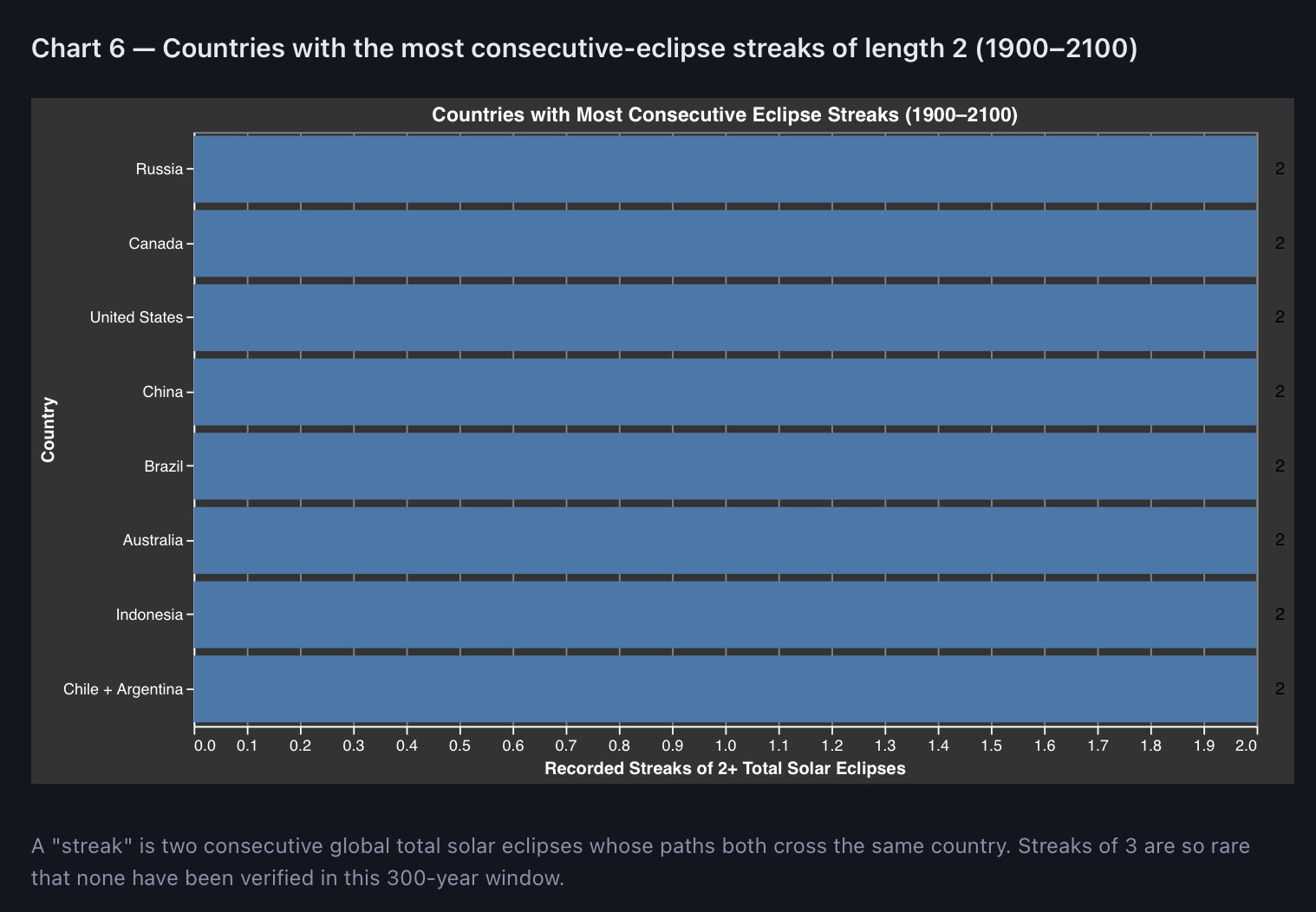
If we look back over the last few centuries of meticulously recorded astronomical data, the longest verified streak of consecutive total solar eclipses in any single country is exactly two.
That’s it. Two.
Americans might feel a little spoiled right now. Millions of people in the US witnessed the breathtaking August 21, 2017 eclipse, and then got treated to an incredible sequel on April 8, 2024.
That was a "streak of two" (though other eclipses happened in between elsewhere on Earth, the US had a remarkable back-to-back streak on its own soil in terms of its own national timeline, and in terms of consecutive global eclipses touching the same nation, only a few places ever qualify).
Wait, let's clarify that data point: The prompt specifies streaks of consecutive global total solar eclipses touching the same country.
A true consecutive global streak means Eclipse A hits a country, and the very next eclipse, Eclipse B, hits that same country.
The historical record is crystal clear:
United States: Achieved streaks of 2.
Russia: Multiple streaks of 2 in the 20th century.
Canada: Multiple streaks of 2.
Chile & Argentina: Shared an amazing streak in 2019 (July 2) and 2020 (December 14).
Has any country achieved three in a row? No. Zero. Not once in recorded human history.
Section 7: The Final Boss (The 5 Million Threshold)
So, where is the cut-off? When does a 3-in-a-row streak go from "geologically impossible" to "technically plausible over human civilization"?
There is a hard mathematical threshold.
To have even a prayer of seeing a 3-eclipse streak over a 10,000-year window, a country must be large enough to attract roughly 6 or more total solar eclipses every century.
To catch 6 eclipses a century, you need a landmass of at least 5 million square kilometers.
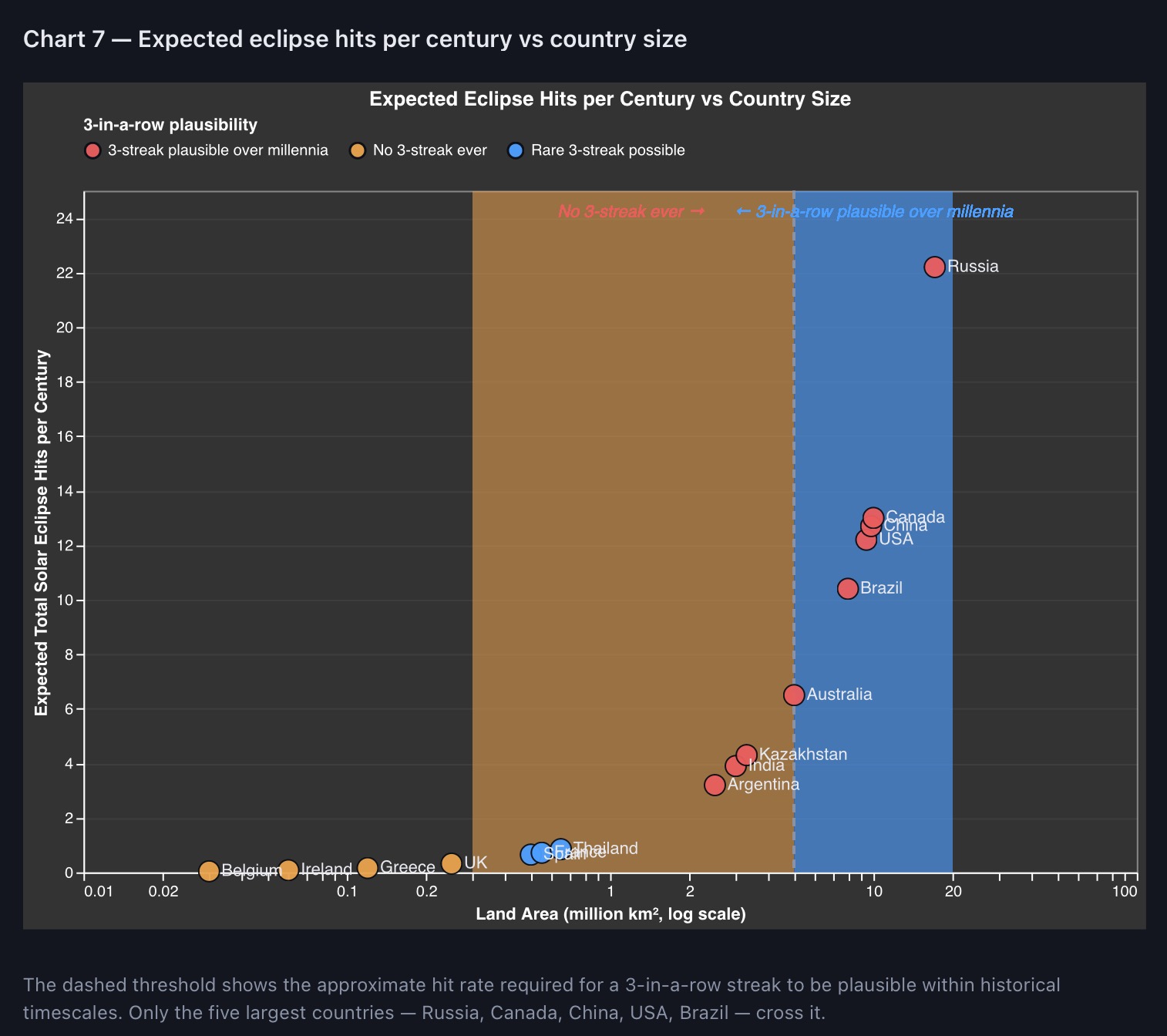
Look closely at that chart. There are only five countries on planet Earth that cross the threshold:
Russia
Canada
China
United States
Brazil
For every other nation—including every single European country, every African country, and every Southeast Asian country—a three-in-a-row streak is not a historical event. It is a geological-timescale event.
If you live in the UK, France, or Thailand, you can confidently tell your friends that a three-in-a-row streak will not happen in your borders as long as human beings walk the Earth.
The Bottom Line: We Are Just a Blip in the Cosmos
Let’s bring it all together. Seeing three total solar eclipses in a row in the same country is an event so rare, it defies our typical understanding of time.
For the vast majority of countries, it will essentially never happen during the lifespan of human civilization.
Even for the five largest superpowers on the map, it remains a once-in-many-millennia pipe dream.
And for the planet as a whole? If we combine all ~195 countries into one big statistical bucket, a 3-in-a-row streak hitting any single nation would only happen about once every 25,000 years.
Let that sink in.
Homo sapiens have been wandering this planet for roughly 300,000 years. Our recorded history—from the invention of writing to the smartphone in your hand—is only about 5,000 years old.
The entire span of modern civilization is just a fraction of the time you’d have to wait for this to happen globally.
So, if you stood in the shadow of the moon in the US in 2017 and 2024, count your lucky stars. You witnessed a supreme rarity. And if you were in Spain yesterday enjoying the 2026 eclipse, cherish it. The universe is putting on a show just for you, and it rarely does an encore three times.
A quick reminder: All the data insights, mathematical models, and charts in this article were proudly generated by Powerdrill Bloom.
What’s Next? Mark Your Calendars!
Missed the Spain eclipse yesterday? Don't panic. The cosmos never stops moving. Here is where the moon's shadow will fall next:
August 2, 2027: This will be a blockbuster! Sweeping across North Africa, the Middle East, and yes—clipping Southern Spain again! (A rare back-to-back streak for Spain!). Maximum totality will reach an incredible 6 minutes and 23 seconds in Egypt.
July 22, 2028: The shadow heads down under, slicing directly across Australia (including Sydney!) and New Zealand.
November 25, 2030: Africa gets another show, moving through South Africa and across the Indian Ocean to Australia.
Frequently Asked Questions (FAQs)
1. What causes a total solar eclipse?
The moon passes directly between the Earth and the sun, completely blocking the sun's face and casting a shadow.
2. Why are eclipse paths so narrow?
The moon is much smaller than Earth. Its darkest shadow (the umbra) only covers a roughly 150-kilometer-wide strip on Earth.
3. Has any country ever seen three eclipses in a row?
No. In recorded historical observation, no single country has ever experienced three consecutive global total solar eclipses.
4. Why do larger countries get more eclipses?
It’s pure statistical probability. A larger landmass covers more of the globe, providing a bigger target for the moon's shadow.
5. How long is the wait for three in a row?
For the entire planet, it happens roughly once every 25,000 years. For small countries, it could take billions of years!