Data Fact: Grindr Generates Higher Revenue Per Employee Than Almost All Big Tech
When discussing the giants of the technology sector, the conversation inevitably gravitates toward sprawling behemoths. We think of companies like Apple, Alphabet, Meta, and Microsoft. These corporations command valuations in the trillions and employ hundreds of thousands of people globally.
However, when we look beneath the surface of gross revenue and examine structural efficiency, a very different picture emerges. Operating quietly in the shadow of these titans is Grindr. Often pigeonholed simply as a niche dating and social application, Grindr has evolved into a masterclass in modern corporate efficiency.
As of the second quarter of 2026, Grindr is redefining what it means to be a lean technology enterprise. Through aggressive adoption of artificial intelligence and a highly lucrative direct-to-consumer subscription model, Grindr is generating numbers that defy traditional software benchmarks.
This report will unpack the structural advantages, per-capita metrics, and pricing power that make Grindr one of the most uniquely profitable companies per employee in the world today.
The Lean Giant Phenomenon
In a business era defined by corporate bloat, Grindr has opted for a radically different path. The company’s Q2 2026 10-Q filing reveals a shockingly low headcount of just 178 total employees. This consists of 172 full-time staff and 6 part-time workers as of June 30, 2026.
To put this in perspective, this headcount is up only marginally from 183 employees in the first quarter of 2026. This stagnation in hiring is not a sign of a struggling business. Instead, it reflects a deliberate strategy by Grindr’s leadership.
The CEO has explicitly focused on using artificial intelligence as an output multiplier. Management recently stated that their engineering team, consisting of roughly 100 individuals, is currently executing the equivalent output of a 350-person department.
This is a monumental paradigm shift in software development. By leveraging cutting-edge AI tools such as Cursor, Claude Code, and Devin, Grindr reports that an astonishing 80% of its codebase is now AI-written.
This integration has resulted in a 2.5× increase in engineering productivity compared to the previous year. The company successfully avoided hiring approximately 200 additional engineers. This operational efficiency translates directly to massive bottom-line savings and unparalleled revenue per employee.
With $138.1 million in Q2 2026 revenue (a 33% year-over-year increase) and a trailing twelve-month (TTM) revenue of roughly $509.8 million, this lean workforce generates massive capital. Dividing that TTM revenue by 178 employees yields a staggering $2.86 million in revenue per employee.
Decoding the Benchmark Dominance
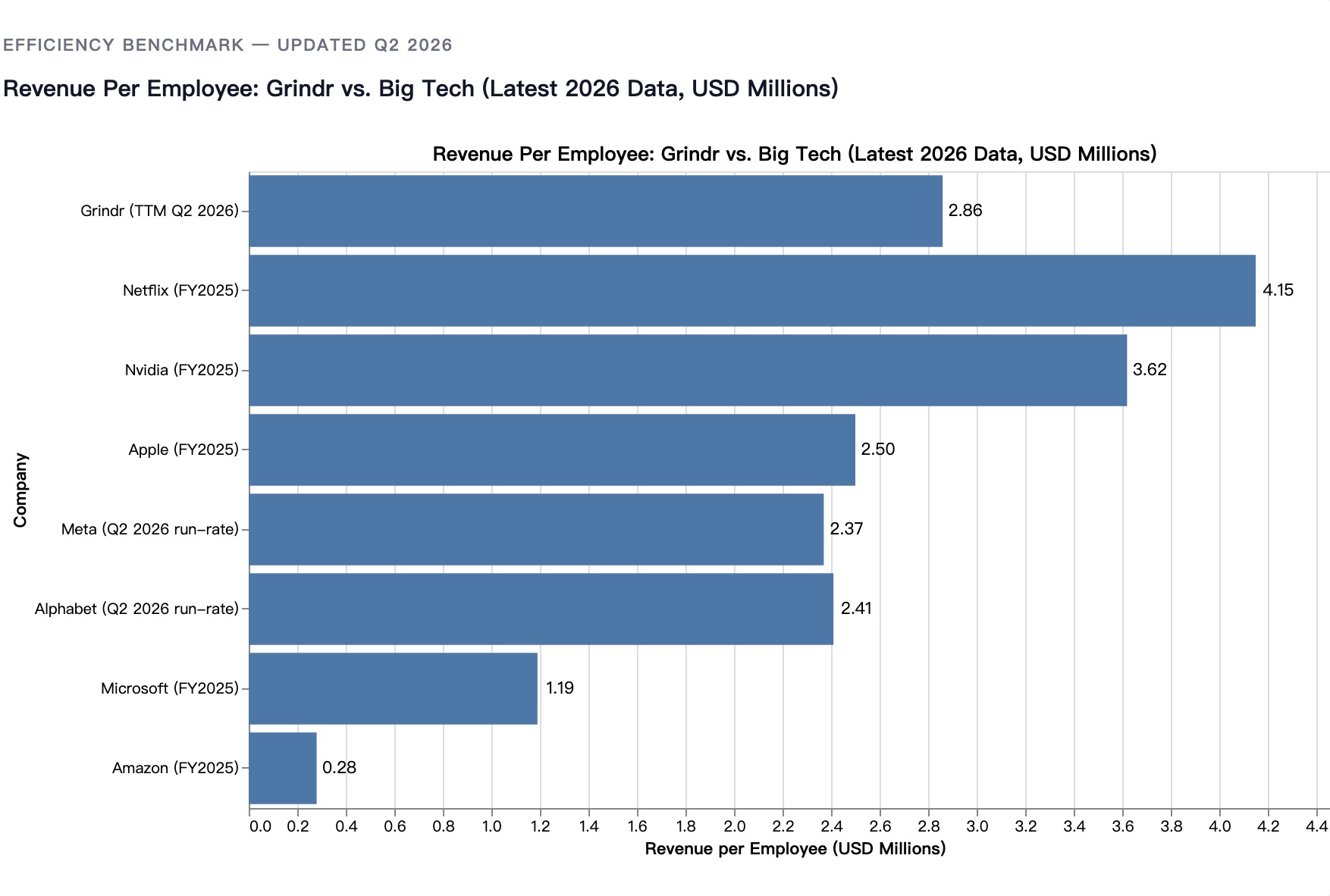
Looking closely at the table above, Grindr’s $2.86 million per-employee metric easily clears Apple ($2.50M), Alphabet ($2.41M), Meta ($2.37M), and Microsoft ($1.19M).
It is worth noting that Alphabet has begun to close the gap slightly. Buoyed by a 24% year-over-year AI-driven revenue surge in Q2 2026, Alphabet pushed its annualized run-rate up. They improved their per-employee metric from $1.98 million in 2025 to $2.41 million today.
However, even with this massive acceleration from one of the world's most powerful search monopolies, Grindr still maintains a comfortable 16% lead on a per-capita basis.
The only companies currently beating Grindr in this metric are Netflix and Nvidia. Yet, these two companies operate on fundamentally different structural paradigms.
Netflix benefits from a highly scalable, asset-heavy content distribution model. Once a show is produced, there is zero marginal cost for delivering it to another user. Nvidia, meanwhile, operates a hardware monopoly in the AI semiconductor space. Their unit economics are dictated by global data center demand rather than software user acquisition.
Among pure-play consumer software and platform technology companies, Grindr operates in a class of its own. Even when comparing Grindr to Meta’s highly optimized ad-tech workforce, the sheer efficiency of Grindr’s AI-first operational structure is undeniably superior.
Subscription vs. Advertising: The Structural Moat
A viral discussion on Reddit in late August 2026 highlighted a crucial structural divergence between Grindr and legacy tech giants. The core difference lies in how these companies extract value from their user bases.
Grindr monetizes primarily through direct subscription willingness-to-pay. When a user pays for Grindr, they are actively choosing to hand over their own capital for a premium, frictionless, and feature-rich experience.
In contrast, a Meta Daily Active Person (DAP) generating roughly $67 a year is being monetized indirectly. Meta is essentially selling that user's attention and data proxies to third-party advertisers.
This distinction is vital for long-term revenue durability. Subscription Average Revenue Per User (ARPU) is driven by tangible product value, platform lock-in, pricing power, and churn management.
Advertising ARPU, on the other hand, is heavily dependent on macroeconomic ad spend cycles. It is vulnerable to fluctuating Cost Per Mille (CPM) rates and tightening global privacy regulations regarding user targeting.
When macro advertising markets compress during economic downturns, ad-dependent giants suffer immediate revenue shocks. Grindr’s direct subscriber relationship insulates it from these macroeconomic advertising fluctuations.
Analyzing the ARPU Supremacy
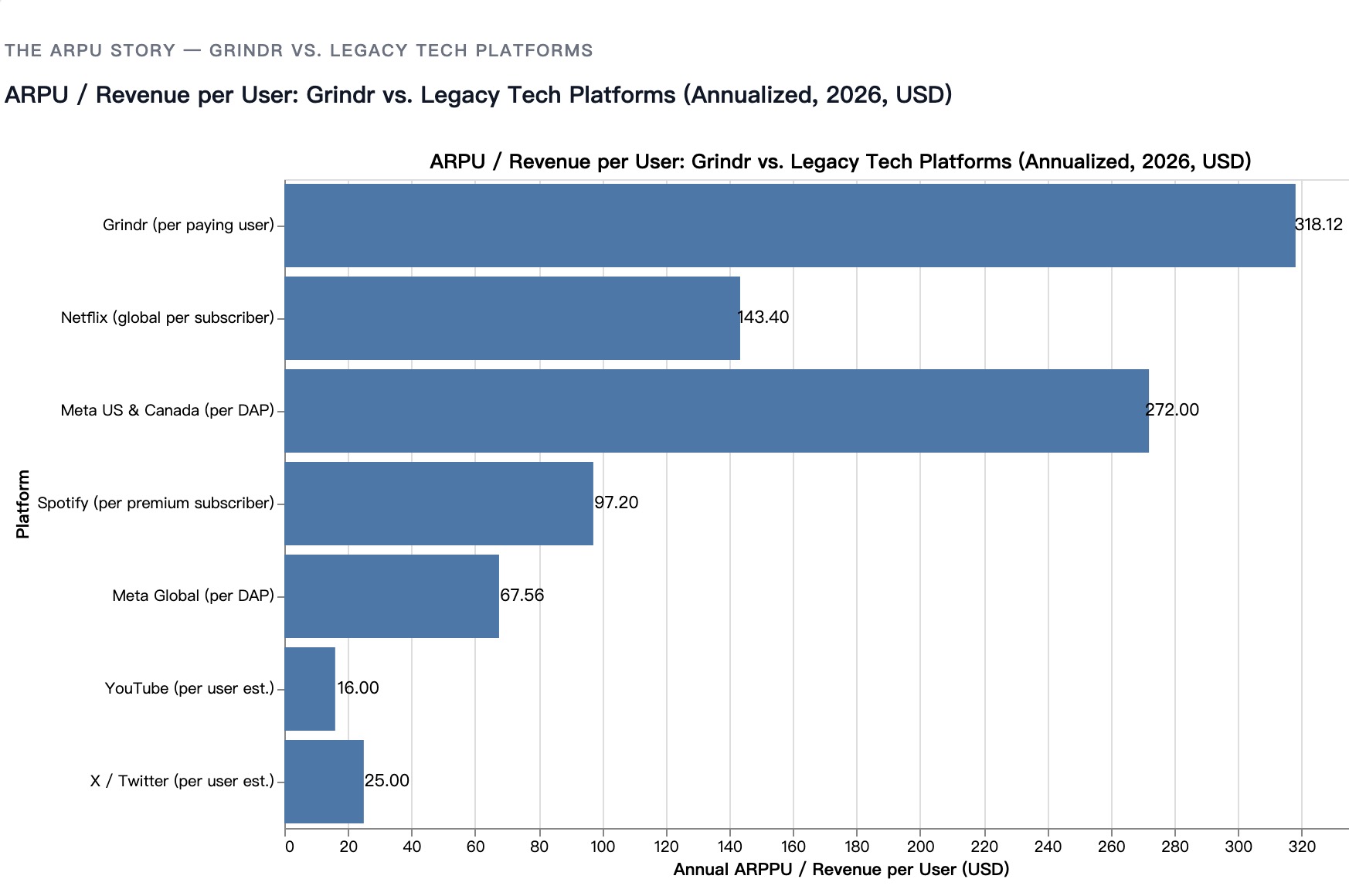
Grindr’s annualized Average Revenue Per Paying User (ARPPU) of $318.12 is nothing short of extraordinary. As the chart illustrates, it dwarfs virtually every other platform in the consumer tech space.
This figure is roughly 2.2 times larger than Netflix’s global ARPU. Furthermore, it is a staggering 4.7 times larger than Meta’s global DAP monetization.
Astonishingly, Grindr's global paying user metric even beats Meta's highly lucrative premium US & Canada segment. Meta's North American ARPU sits at roughly $272 per year, which is still lower than Grindr's global average.
This proves that providing a highly targeted, identity-driven utility creates a far deeper willingness to pay than general-purpose social media consumption.
The Second Engine: Rising Advertising Revenue
While direct subscription is the crown jewel of Grindr's structural moat, the company has not ignored the secondary monetization lever of advertising.
The Q2 2026 financials show a company that is successfully running two high-growth revenue engines simultaneously. Grindr is not just a subscription business; it is a highly attractive targeted advertising platform.
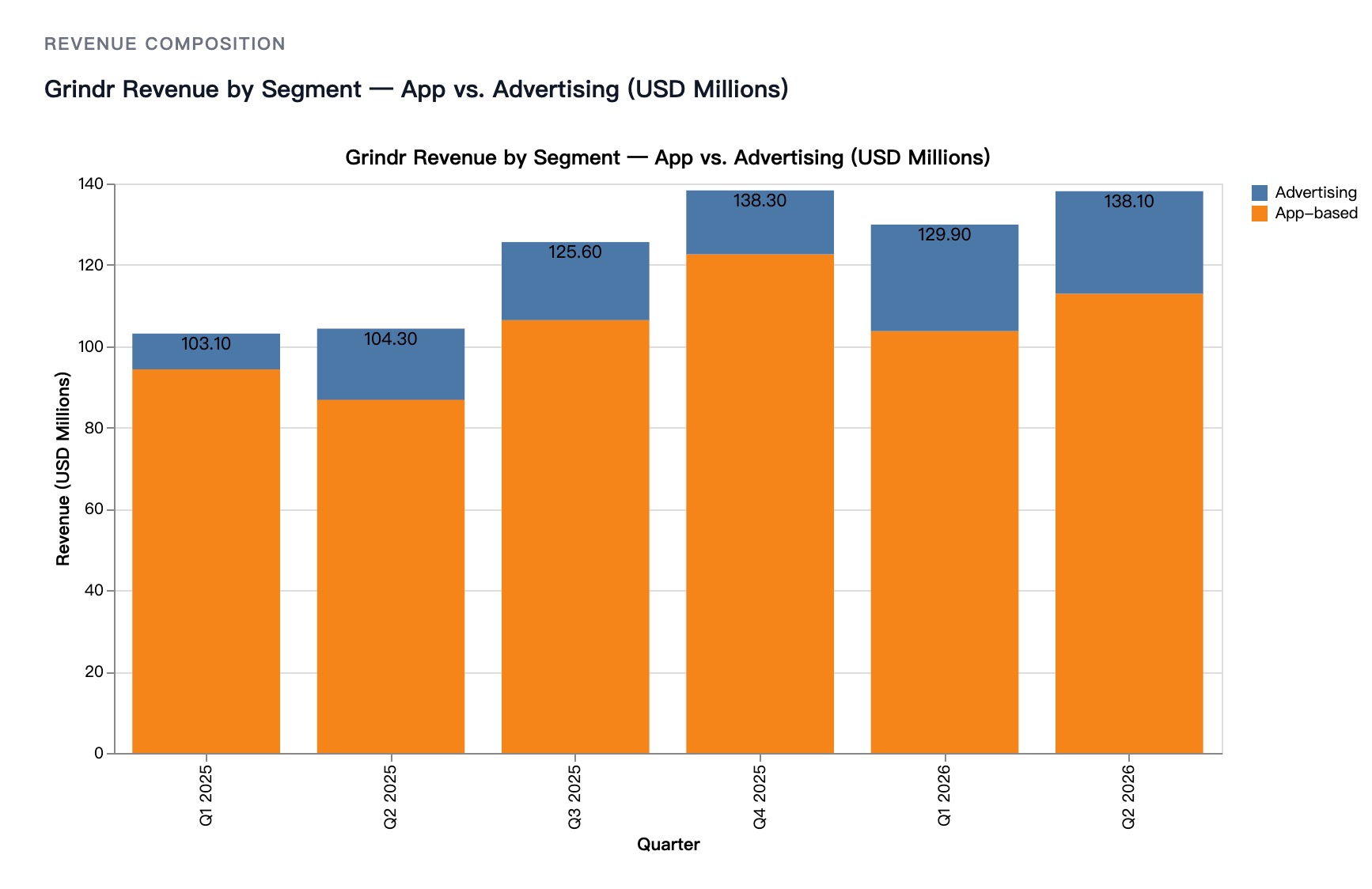
In the second quarter of 2026, Grindr reported total revenue of $138.1 million. While the vast majority of this was driven by premium user subscriptions, the advertising segment saw explosive growth.
Advertising revenue jumped an impressive 44% year-over-year, reaching $25.2 million for the quarter. This means that advertising now accounts for approximately 18% of the company's total revenue mix.
By cultivating a highly engaged, specific, and often affluent demographic, Grindr is able to command premium ad placements. Brands looking to directly target the LGBTQ+ community find unmatched value in Grindr's user base.
Pricing Power and Inelastic Demand
One of the most difficult feats in consumer technology is raising prices without suffering a corresponding loss in user volume. Typically, the basic laws of economics dictate that higher prices lead to higher churn rates.
Grindr, however, has demonstrated a rare and powerful inelasticity of demand. In late 2025, Grindr's management executed a series of strategic subscription price increases.
Rather than fleeing the platform, users absorbed the cost. Management proudly noted in their Q2 2026 remarks that users "didn't churn as much as expected." The core utility of the app outweighed the increased financial friction.
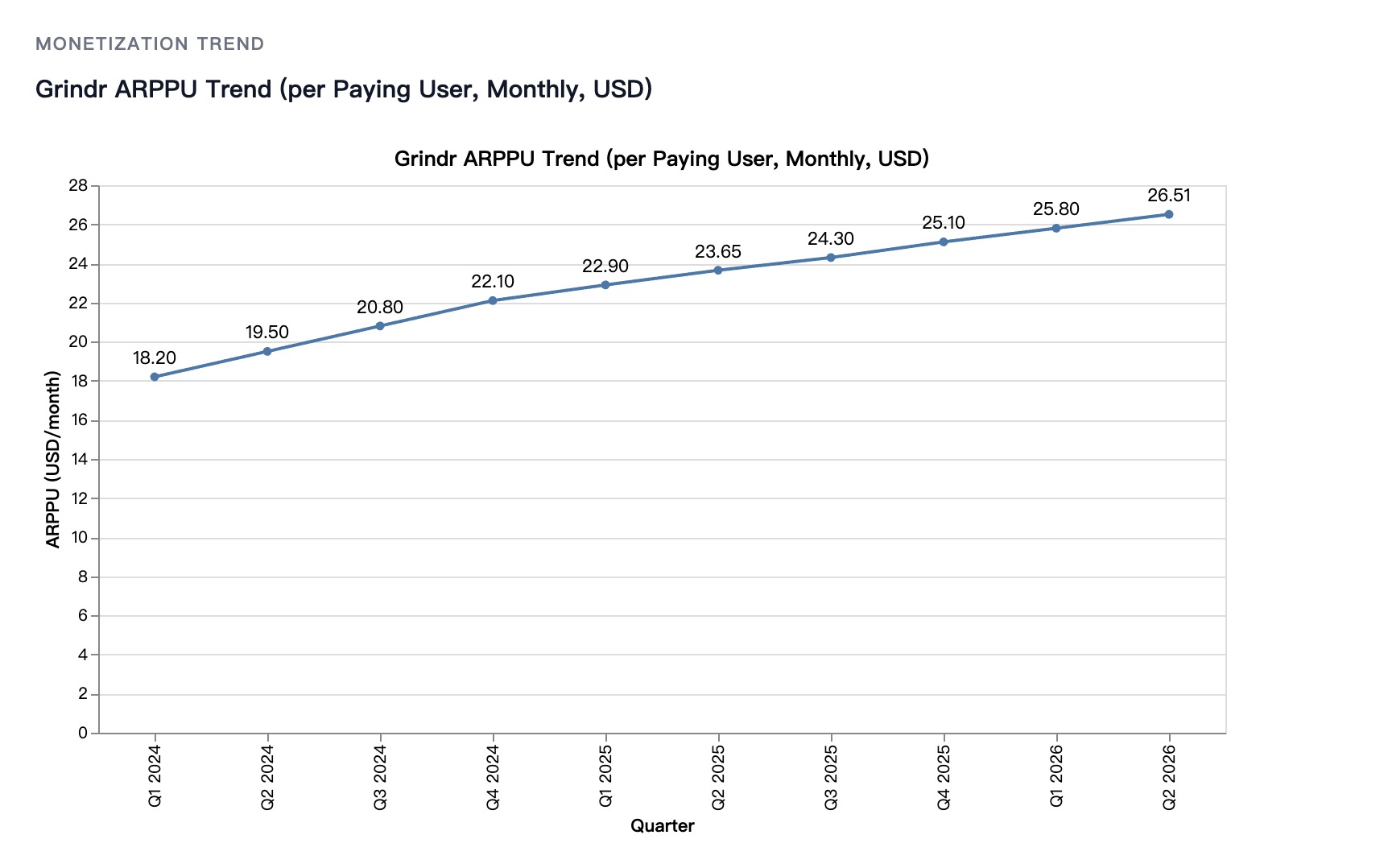
The data validates this claim spectacularly. By Q2 2026, Grindr's monthly ARPPU hit $26.51. This represents a highly impressive 12% year-over-year growth.
Simultaneously, the total number of paying users grew by 16% year-over-year, reaching a milestone of 1.4 million. Experiencing simultaneous expansion of both price and volume is the holy grail of SaaS and subscription economics.
The "Edge" Tier: The Next ARPU Lever
This unprecedented pricing power gives management extreme confidence in their future product roadmap. Rather than resting on their laurels, Grindr is aggressively exploring the upper limits of user willingness to pay.
The company is currently testing a new, ultra-premium tier dubbed "Edge." This is not a standard feature update; it is a complete reimagining of premium social networking.
The Edge tier is being tested at a staggering CAD $500 per month. It is designed to act as an AI-powered matchmaking and elite social layer. This tier is tailored specifically for high-net-worth individuals within their core demographic.
This strategy mirrors the "whale" monetization models frequently seen in the mobile gaming industry. In those models, a very small percentage of power users contribute a massive portion of total revenue.
If the Edge tier reaches even a fraction of the current 1.4 million paying user base, the financial impact will be monumental. Grindr's overall ARPPU could compound exponentially as we move into 2027, pushing their per-employee revenue into uncharted territory.
Forward Guidance and Aggressive Capital Returns
The financial cascading effects of lean operations, AI-written code, and high pricing power are clearly evident in Grindr’s forward-looking statements.
For the full year of 2026, Grindr has raised its guidance to roughly $540 million in total revenue. More importantly, the company expects an Adjusted EBITDA of approximately $232 million.
This translates to an incredibly healthy 43% profit margin. While management conservatively expects second-half 2026 growth to moderate slightly as the company laps the late-2025 price hikes, the underlying cash generation remains immense.
Because Grindr requires so little capital expenditure and overhead to maintain its core product, it is practically swimming in free cash flow. Management has decided the best use of this cash is to return it directly to shareholders.
The company is currently executing an aggressive $900 million stock buyback program. As of June 30, 2026, there is $300 million remaining in this program.
Considering Grindr’s market capitalization hovers around $2.69 billion, returning $900 million represents an absolutely massive capital return relative to the company's size. It is a profound signal of management's unwavering confidence in their structural moat.
Conclusion
Grindr has fundamentally proven that a modern consumer technology platform does not need a massive headcount to generate market-leading revenues.
By embracing artificial intelligence to multiply engineering output by 2.5 times, the company has kept its headcount strictly below 200 employees. Combined with a deeply entrenched direct-subscription model, Grindr is easily out-earning legacy giants on a per-capita basis.
With an ARPPU that dwarfs Netflix and Meta, the business model is structurally superior. The simultaneous growth in user volume and pricing power demonstrates unmatched brand loyalty.
Furthermore, the upcoming launch of the ultra-premium AI matchmaking Edge tier suggests that Grindr’s financial trajectory is still in its early stages. It stands as a premier example of how AI leverage and niche market dominance can create a highly durable, fiercely profitable enterprise.
This report and its insights were successfully generated and verified through Powerdrill Bloom.
Frequently Asked Questions
How much revenue does Grindr generate per employee?
As of Q2 2026, Grindr generates $2.86 million per employee, utilizing just 178 employees for massive financial output.
Why is Grindr's ARPU significantly higher than Meta's?
Grindr monetizes through direct premium subscriptions, creating higher, more durable revenue than Meta's indirect, advertising-based monetization model.
What role does AI play in Grindr's engineering?
AI tools write 80% of Grindr's code, boosting productivity by 2.5 times and avoiding roughly 200 new engineering hires.
What is the new "Edge" tier being tested?
It is a premium AI-powered matchmaking tier tested at CAD $500 monthly, targeting high-net-worth users for exponential revenue growth.
How is Grindr returning its capital to shareholders?
Grindr is actively executing a massive $900 million stock buyback program, with $300 million remaining as of mid-2026.