Data Fact: The Global Foldable Phone Market Moves Beyond Early Adopters in 2026

In the vast and ever-evolving history of consumer electronics, there is an unwritten rule deeply understood by industry veterans: for a disruptive hardware form factor to transition from an expensive "geek toy" to an everyday mainstream necessity, it typically has to survive a grueling five-to-seven-year chasm. If we trace the modern foldable smartphone back to its commercial genesis in 2019, the timeline points to a critical maturation phase right about now. According to the latest comprehensive data from industry trackers in July 2026, the foldable smartphone market has officially crossed that treacherous chasm. The year 2026 is universally recognized as the watershed moment when foldables graduate from a premium niche to a mass-market phenomenon.
The signs of this seismic shift are everywhere. We are witnessing projected shipments hitting an unprecedented 27 million units globally. In the tech-forward market of China, foldable penetration is soaring to 4.2% of all smartphone sales. Most importantly, the long-awaited entry of Apple with its highly anticipated iPhone Fold has triggered the most dramatic competitive realignment since the category’s inception.
This blog post dives deep into the numbers—extracted, synthesized, and visualized using Powerdrill Bloom, exploring how shifting consumer behaviors, price bifurcation, and fierce vendor competition have finally pushed the global foldable phone market beyond early adopters and into the mainstream spotlight.
A Note on Our Methodology
Before we dive into the specific trends, it is worth noting how these insights were compiled. The extensive research data, market synthesis, and all the interactive charts embedded within this article were seamlessly generated using Powerdrill Bloom. By leveraging its advanced AI-driven data processing capabilities, we were able to instantly transform raw, complex industry reports into the comprehensive and beautifully structured visual analysis you will see below.
1. The Growth Curve: Surging Past the Niche
To truly appreciate the magnitude of the 2026 foldable market, one must zoom out and look at the broader growth trajectory over the past six years. Between 2020 and 2026, the foldable smartphone market has compounded at a staggering roughly 64% Compound Annual Growth Rate (CAGR). This represents one of the fastest and most aggressive growth arcs in the history of personal computing devices, severely outpacing the growth of the broader, currently stagnant flat-slab smartphone market.
The journey hasn't been without its speed bumps. Following a period of aggressive expansion, the market experienced a brief consolidation phase in 2024. Shipments dipped slightly to 17.7 million units, down from 18.1 million in 2023, as consumers tightened their belts amid macroeconomic uncertainties and waited for more significant hardware upgrades. However, the market quickly rebounded, shipping an estimated 21.5 million units in 2025.
Now, in 2026, the market is exploding. Forecasts predict shipments will reach a towering 27 million units, representing a massive 26% year-on-year increase.
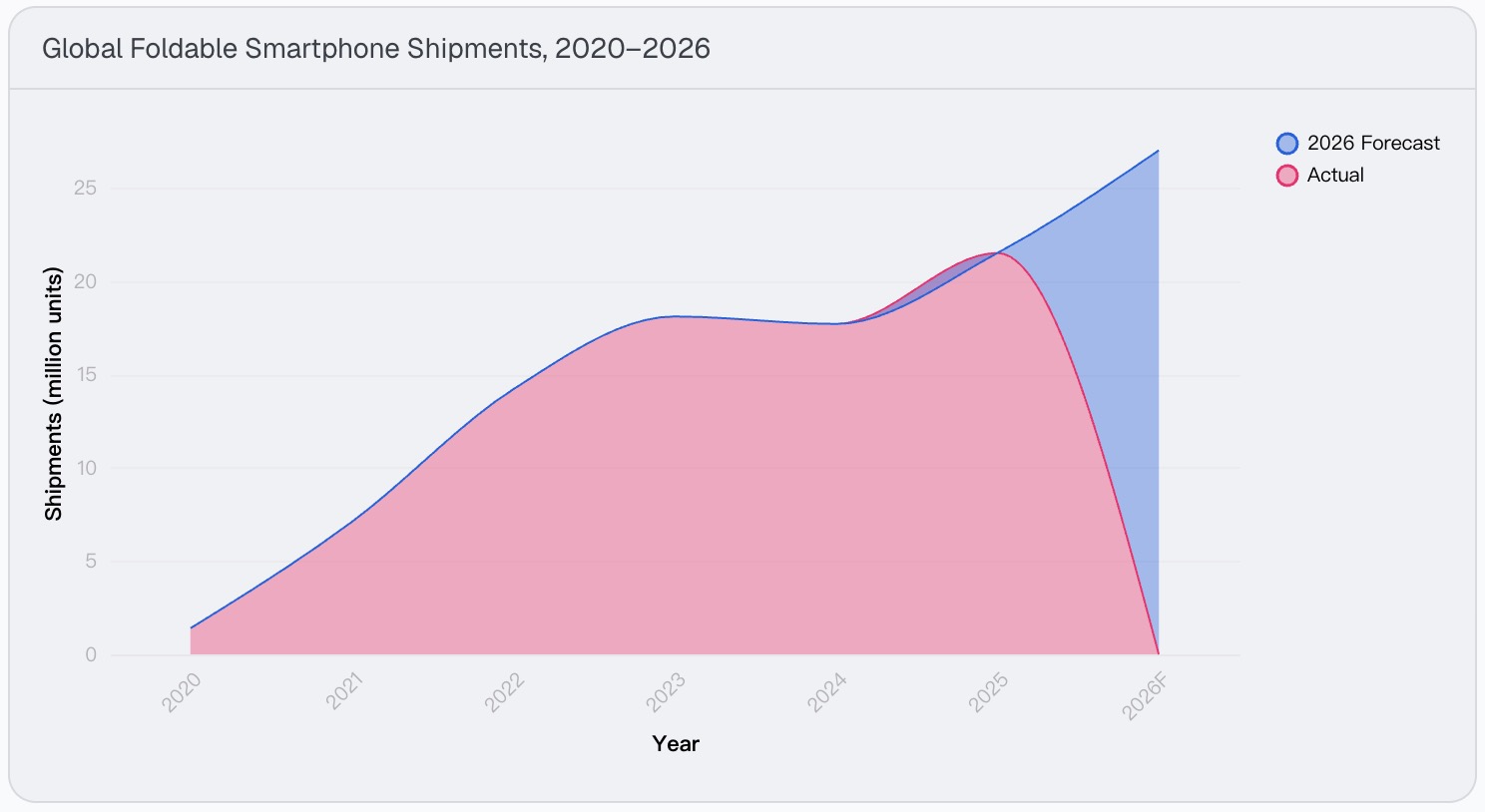
What makes 2026 fundamentally different from prior years of growth is the underlying quality and demographic makeup of this expansion. In the early 2020s, the foldable demographic was largely confined to Samsung tech enthusiasts and loyal Huawei power users. Today, the demographic has fractured and expanded. The 2026 growth engine is being fueled by mainstream iPhone upgraders transitioning to foldable technology, a burgeoning Chinese middle-class consumer base seeking status-symbol electronics, and, for the very first time, massive cohorts of first-time foldable buyers in emerging markets such as India, Southeast Asia, and Latin America.
2. A Three-Way Battle Royale: Apple's Arrival Shakes the Foundation
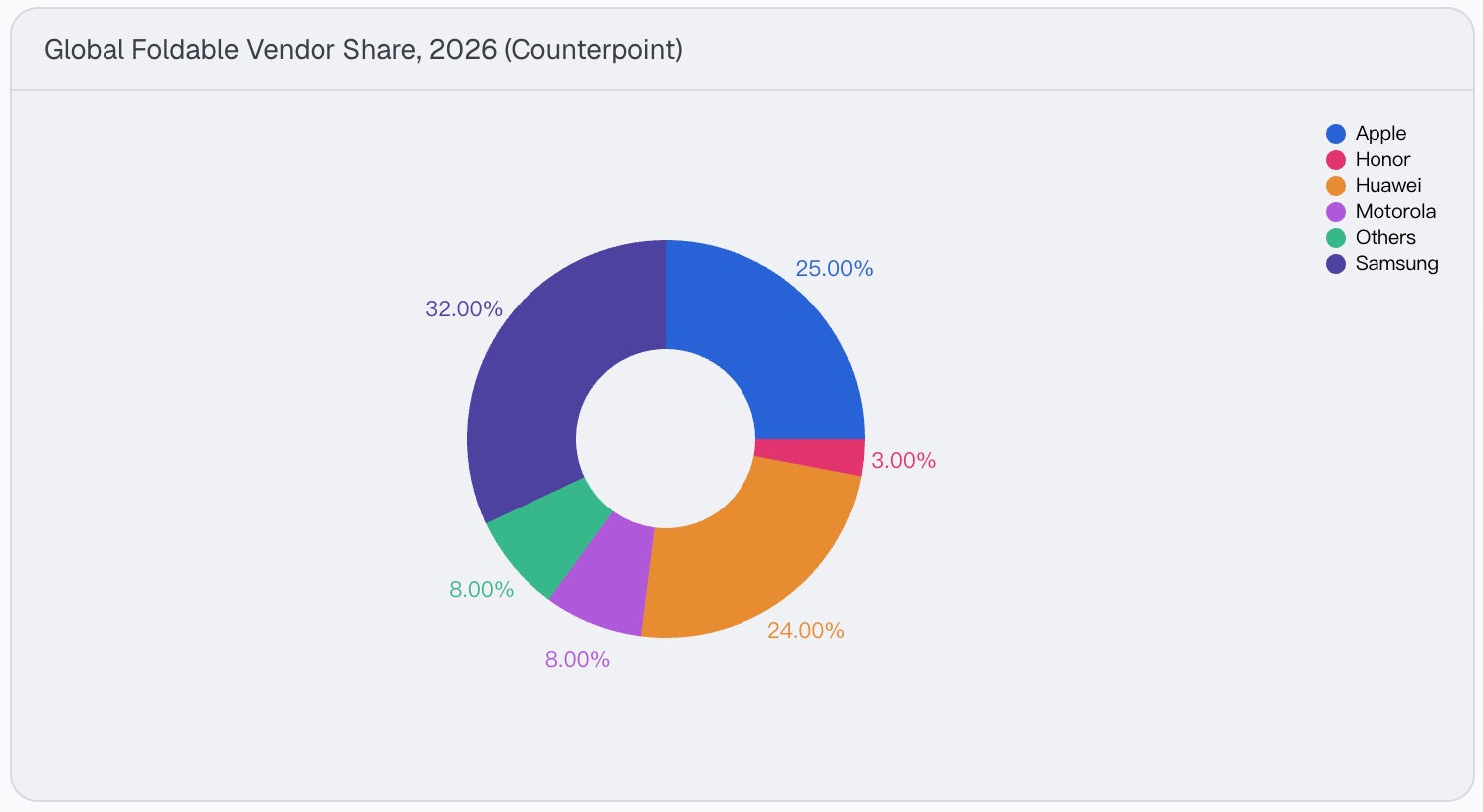
For years, analyzing the foldable market essentially meant analyzing Samsung’s monopoly, occasionally punctuated by Huawei's regional dominance. The 2026 vendor landscape shatters this old paradigm, presenting the most fiercely competitive environment the foldable sector has ever experienced. According to Counterpoint Research's July 2026 forecast, the industry has morphed into a high-stakes, three-way battle between Samsung, Apple, and Huawei. Together, these three behemoths command 81% of the total global market.
Samsung manages to retain its global volume crown with a 32% share, driven by strong absolute growth of 25% year-on-year thanks to its Z Fold8 and Z Flip8 portfolios. However, the most disruptive storyline of the decade is Apple’s grand entrance.
Expected to officially hit shelves in September 2026 with a jaw-dropping price tag estimated between $2,400 and $3,000, the iPhone Fold is entirely rewriting the rules of engagement. Despite only having one full quarter of sales in the calendar year, Counterpoint forecasts that Apple will immediately capture 25% of the global unit shipment share in 2026. Even more astonishing is its revenue footprint: Apple is projected to command an unprecedented 34% of the entire foldable category's revenue in its first year. Furthermore, supply chain data reveals Apple has secured 29% of all foldable screen orders for 2026, signaling the sheer scale of Cupertino's commitment to dominating this space.
Meanwhile, Huawei's narrative remains extraordinarily potent, albeit heavily concentrated regionally. Despite geopolitical headwinds, Huawei completely dominated the first half of 2026. The company captured a staggering 40% unit share globally in Q1, accelerating to an unbelievable 48% in Q2, riding on the coattails of its Mate X series, which is the undisputed king of the Chinese premium market. Huawei is also actively using this momentum to force its way into select markets in Europe and the Middle East.
Beyond the top three, the remaining 19% of the market is highly fragmented. Motorola holds an 8% share but is facing intense pressure and declining year-on-year growth (-28% in Q2) as it struggles to defend its clamshell territory in North America. Conversely, Honor is the fastest-growing underdog, capturing a 3% global share with a blistering 82% YoY growth rate in Q2, propelled by its ultra-thin Magic V series. The remaining 8% consists of a diverse mix of Chinese OEMs like OPPO, vivo, Xiaomi, and Google’s Pixel Fold iterations.
3. Global Hotspots: China Maintains Gravity While North America Rises
The geographic distribution of foldable adoption is experiencing a fascinating realignment in 2026. Historically, China has been the absolute center of gravity for the foldable ecosystem, acting as both the primary manufacturing hub and the largest consumer market. In 2026, China still leads the pack, accounting for 38% of all global foldable shipments. However, this is a slight downward drift from its 43% share in 2025. This relative dilution is not due to a slowdown in Chinese demand, but rather the explosive, accelerated growth occurring in Western markets.
North America is undeniably the geographic growth story of the year. The region's share of global foldable shipments is projected to leap from 19% in 2025 to a massive 24% in 2026. This sudden surge can be attributed almost entirely to the anticipated launch of the iPhone Fold. Because Apple historically prioritizes the U.S. market for its initial launch waves and massive carrier subsidy programs, North America is experiencing an artificial but massive spike in foldable adoption.
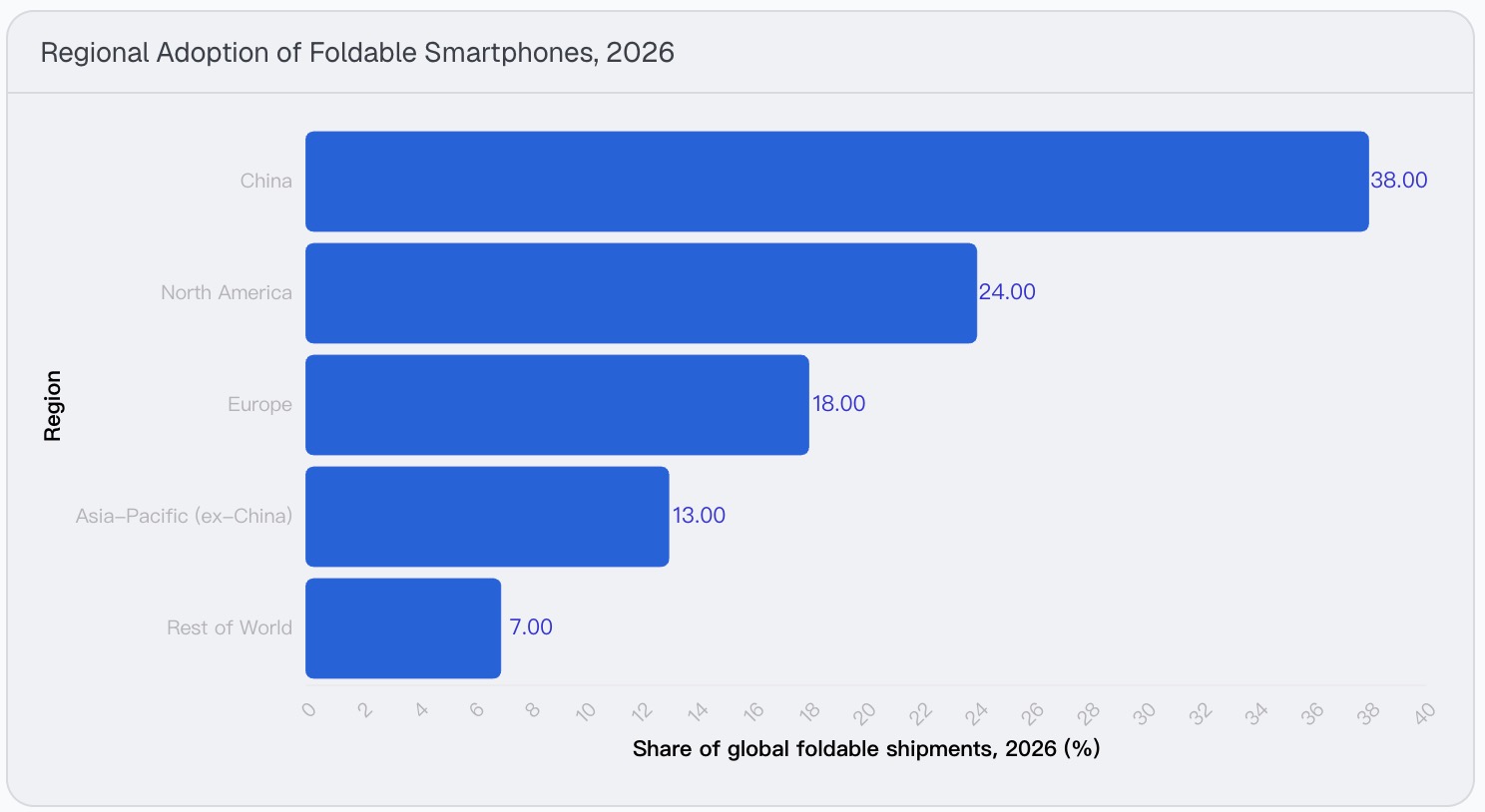
Across the Atlantic, Europe is holding relatively steady, capturing approximately 18% of global shipments. The European arena has evolved into a strategic battleground where Huawei and Samsung are engaging in a fierce tug-of-war for premium retail shelf space.
Perhaps the most exciting long-term trend is the rise of the Asia-Pacific region (excluding China), which now accounts for 13% of the market. This region is the fastest-growing territory originating from a low base. India, in particular, is a standout performer; the subcontinent alone is expected to absorb over 3 million foldable units in 2026. Unlike the premium-heavy Western markets, India's volume is largely driven by aggressive pricing strategies, with Samsung and various Chinese OEMs flooding the market with sub-$800 export clamshell models. Finally, the Rest of the World (including the Middle East and Latin America) makes up 7%, emerging as a surprising pocket of demand for ultra-premium devices, particularly where status-conscious consumers are seeking the prestige of Huawei's Mate X and Samsung's Ultra variants.
4. Penetration Rates: The True Metric of Mainstream Adoption
While shipment volumes and regional market shares provide excellent headlines, the most critical metric for tracking the "niche-to-mainstream" thesis is the penetration rate. This metric calculates foldables as a pure percentage of total smartphone shipments. By looking at penetration, we strip away the noise of the overall smartphone market's macroeconomic fluctuations and look purely at consumer preference. By this measure, 2026 is a clear and undeniable inflection point.
Globally, the penetration rate of foldable smartphones is rising from a modest 2.5% in 2025 to approximately 3.1% in 2026. While 3.1% may sound like we are still in the early innings, the 24% year-on-year growth rate of this specific metric is vastly outpacing the broader smartphone market, which remains flat or slightly negative.
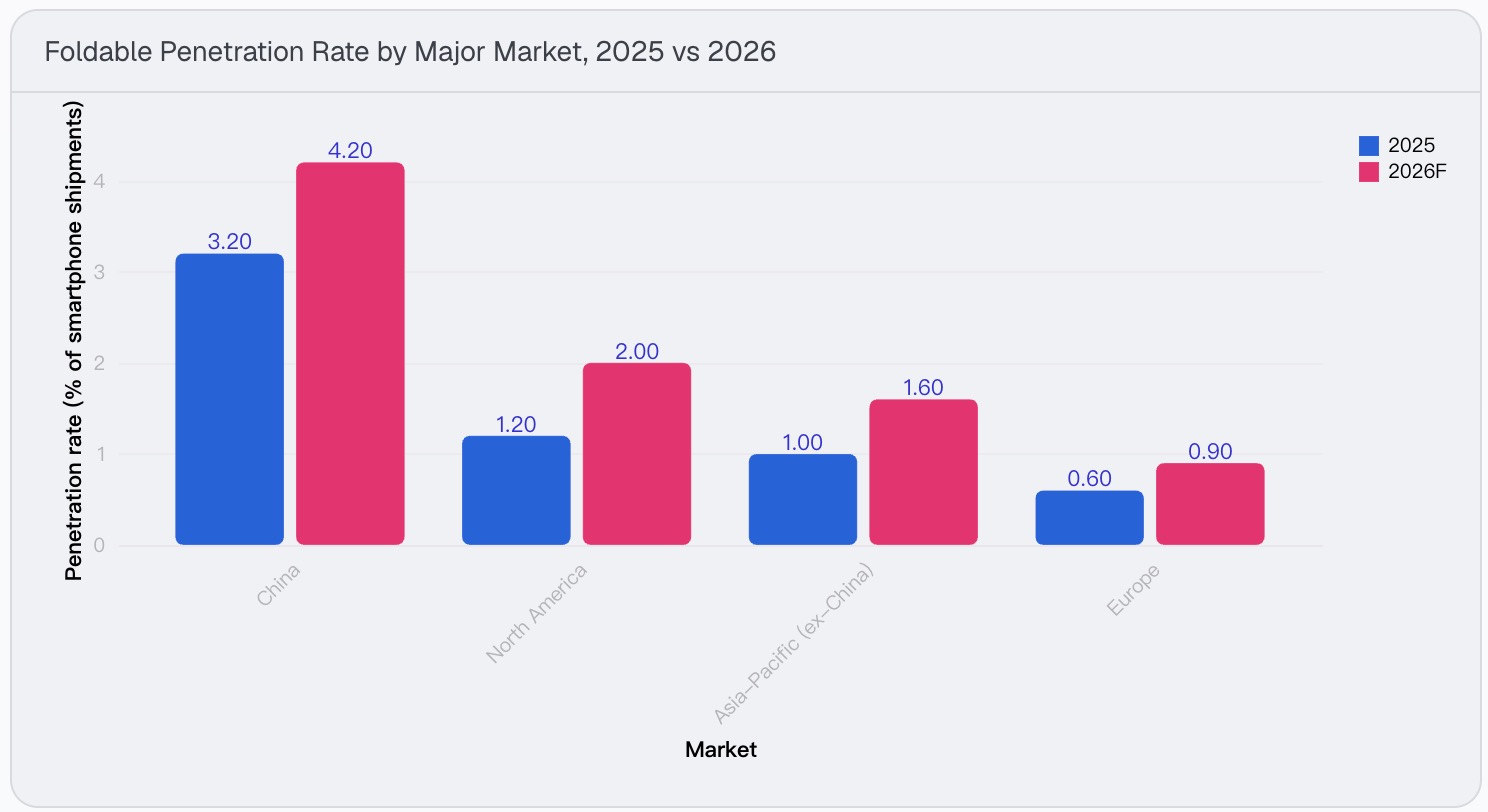
When we break this down by region, the numbers become even more compelling. In China, foldable penetration has hit an impressive 4.2%. To put that into perspective, roughly one out of every 24 smartphones sold in China right now is a foldable device. In North America, the metric crosses the 2% threshold for the very first time (jumping from 1.2% in 2025 to 2.0% in 2026), heavily lifted by the impending Apple super-cycle. Europe, meanwhile, lags slightly behind, crawling from 0.6% to 0.9%. Europe's slower adoption curve is largely a reflection of weaker telecom carrier subsidy cultures and an incredibly fiercely contested mid-range "slab" phone market that makes it harder for high-priced foldables to compete.
Why do these percentages matter? In the consumer electronics industry, analysts widely consider a 5% penetration rate as the magic threshold at which a new form factor officially becomes "mainstream." At 5%, a cascading network effect occurs: carrier retail stores dedicate permanent, prominent shelf space; third-party repair infrastructure becomes economically viable; software developers are financially incentivized to optimize their app ecosystems for the new screen ratios; and generalized consumer awareness reaches a self-sustaining critical mass. Current data suggests China will cross this 5% Rubicon in 2027, with the global average crossing the threshold between 2028 and 2029.
5. The Price Bifurcation: Premium Climbs Higher, Mainstream Gets Cheaper
If you want to understand how a technology reaches the masses, you have to follow the money. In 2026, the foldable market is witnessing a striking and counterintuitive bifurcation in its price architecture. Usually, as a technology matures, the average selling price (ASP) steadily drops. However, in 2026, the overall ASP of a foldable phone actually rose by 18% year-on-year to hit $1,485. But relying on this overall average is highly deceptive, as it masks two violently divergent trends pulling the market in opposite directions.
On the high end, the premium book-style ASP is rocketing into the stratosphere. Driven by the entry of the ultra-expensive iPhone Fold (costing upwards of $3,000 for top-tier storage) and Samsung's premium Z Fold8 Ultra (approaching $2,100), the average price of a book-style foldable has increased from $1,649 in 2025 to roughly $1,899 in 2026.
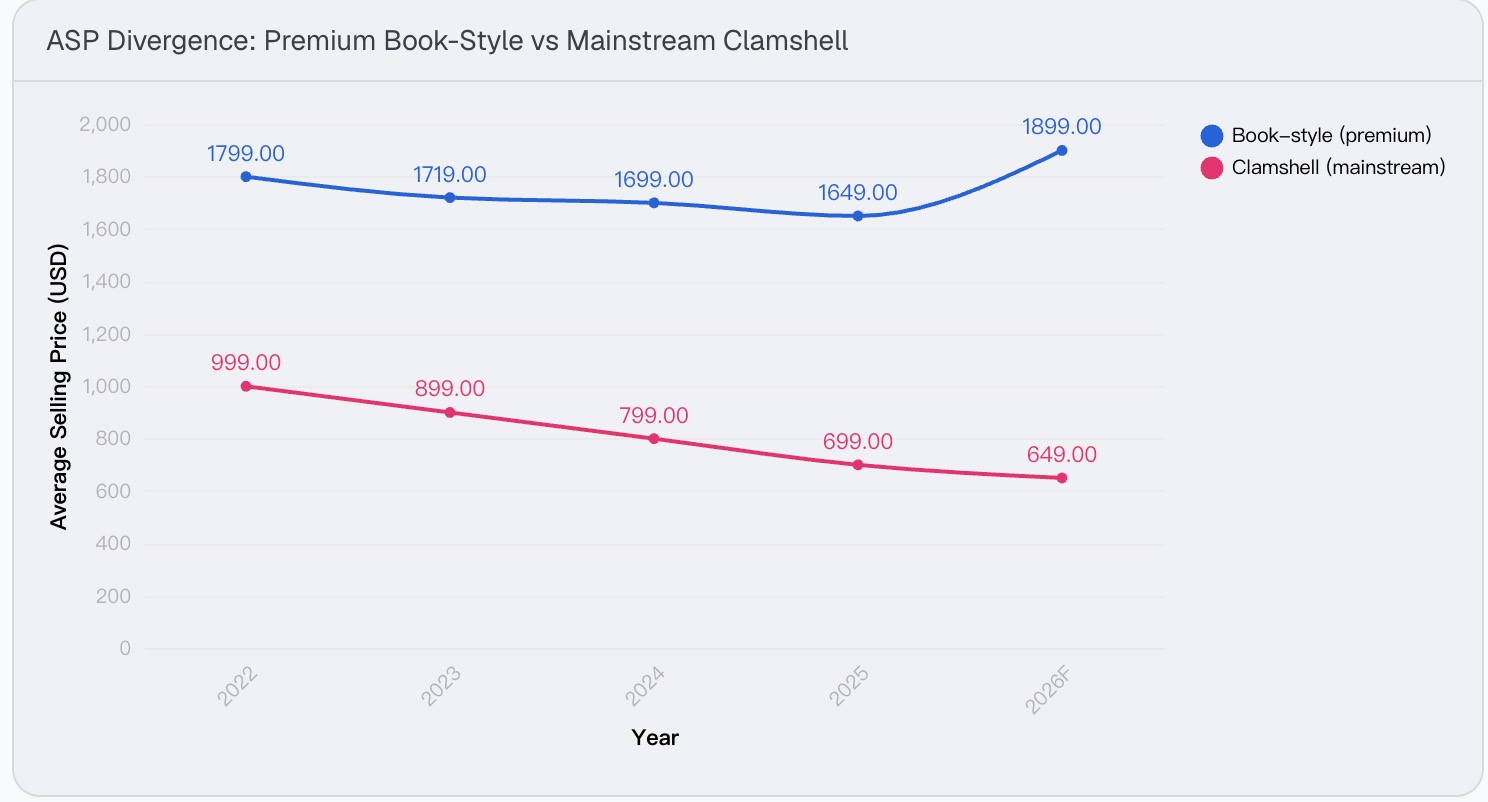
Simultaneously, the bottom of the market is aggressively hollowing out to capture mainstream, price-sensitive consumers. The ASP of clamshell (flip) foldables has plummeted from $699 in 2025 to an estimated $649 in 2026. We are now seeing highly capable budget clamshells hitting the market at the pivotal $499 price point, led by aggressive pushes from Motorola and Chinese OEMs seeking to capture the entry-level demographic.
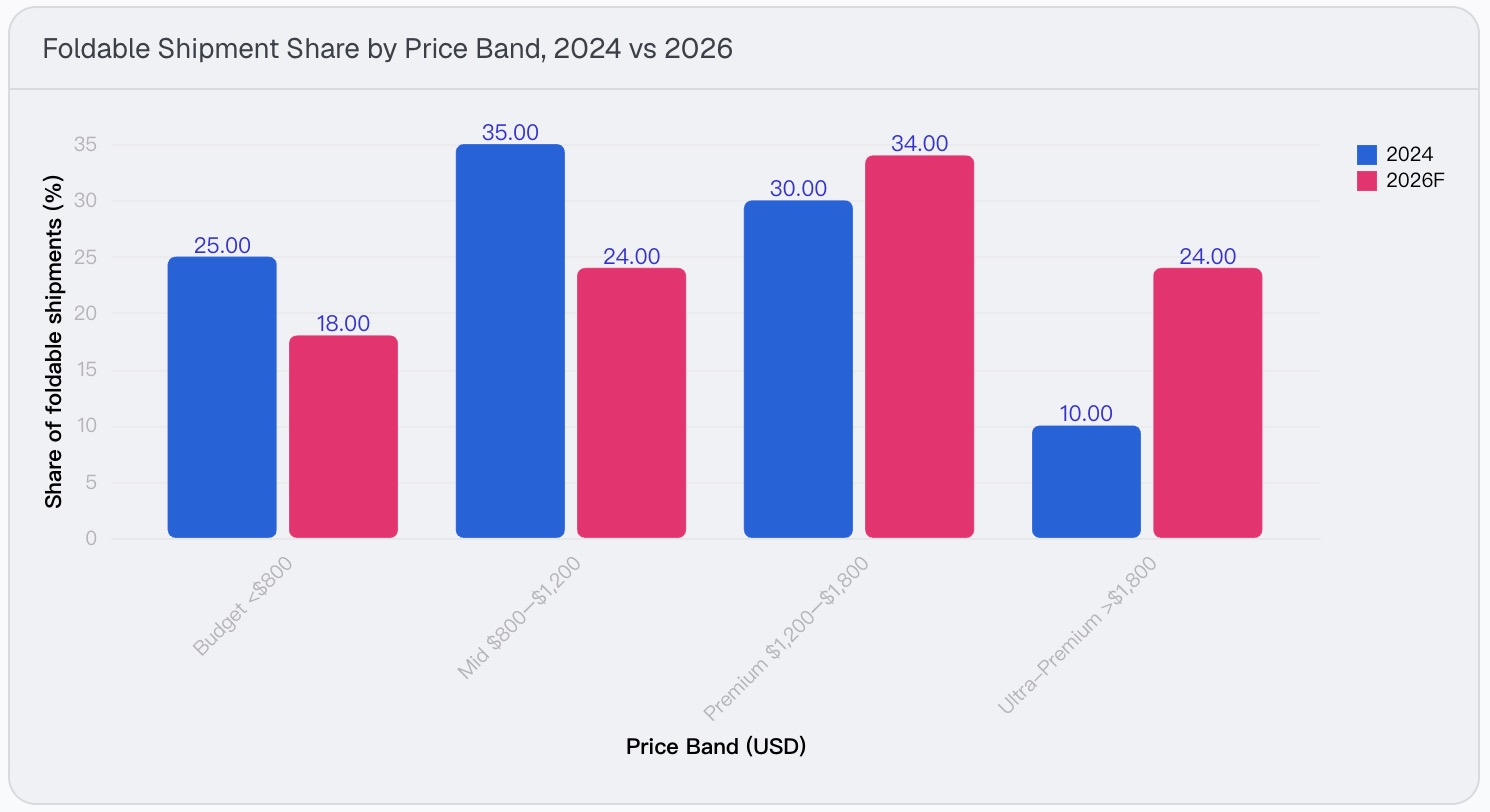
The foldable phone market is becoming increasingly polarized. While affordable foldable models are attracting more price-conscious consumers, ultra-premium devices priced above $1,800 are gaining stronger demand among flagship buyers. Meanwhile, the traditional $800–$1,200 segment is losing momentum as consumers move toward either more affordable entry points or premium flagship experiences.
6. The Great Inversion: Book-Style Dethrones Clamshell
For the first four years of the foldable era, the clamshell (flip) form factor was the undisputed king. Smaller, cheaper, and dripping with nostalgic flip-phone aesthetics, clamshells were the perfect entry-level drug for foldable curiosity. As recently as 2022, clamshells accounted for 65% of all foldable shipments.
In 2026, the script has definitively and permanently flipped. We are experiencing the "Great Inversion."
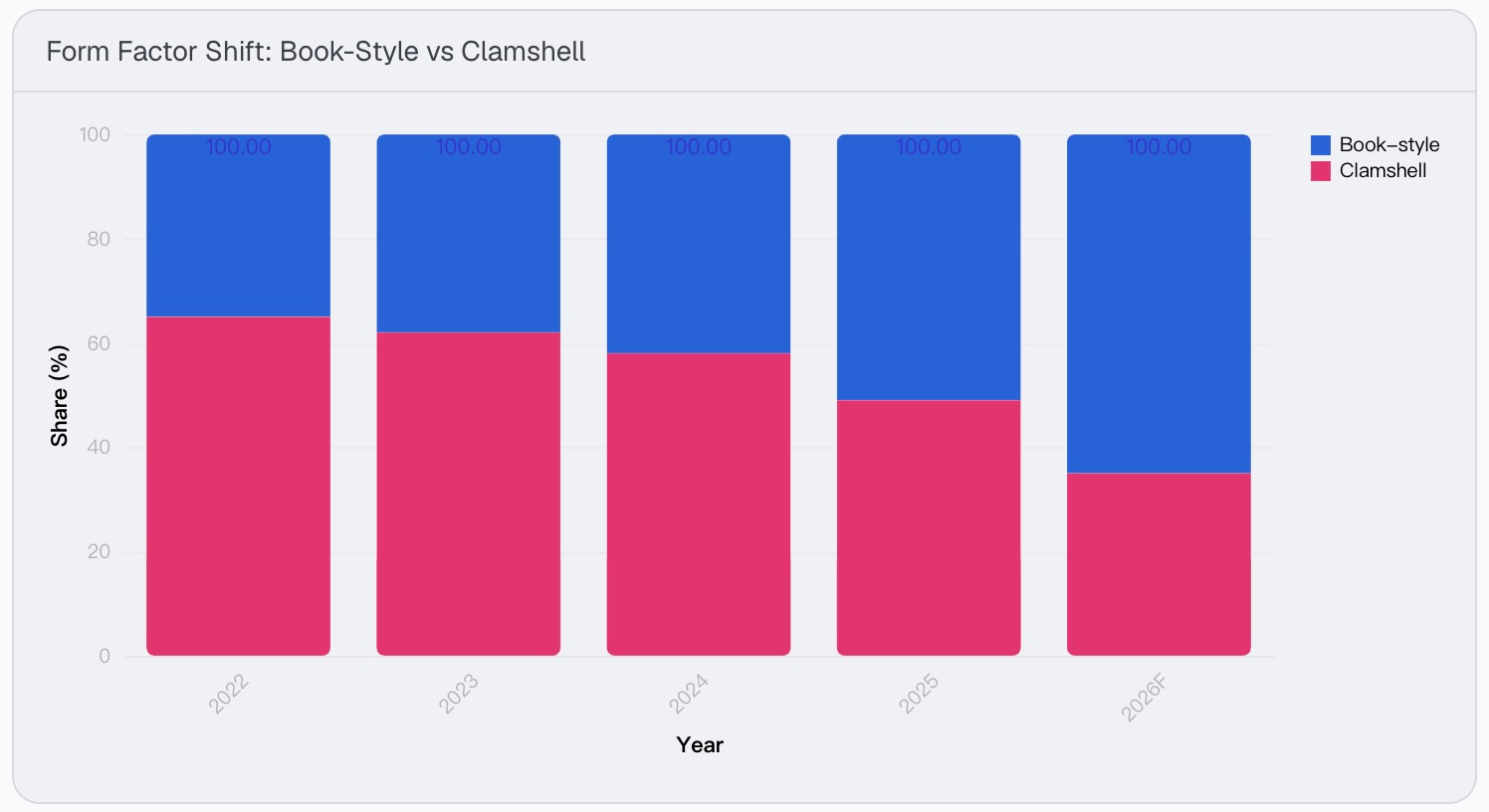
According to 2026 forecasts, book-style foldables will capture 65% of total market shipments, perfectly reversing the ratio from four years ago. This massive form factor shift is driven by three primary structural forces.
First and foremost is Apple. The iPhone Fold is a book-style device. Because Apple is projected to instantly capture 25% of the global market with this single device, it mathematically forces the global ratio heavily in favor of the book-style form factor.
Second is the cultural impact of Huawei in China. The Mate X series has become the ultimate prestige device among Chinese business elites and executives. In this massive demographic, the book-style foldable carries significantly stronger business-status connotations than the fashion-forward clamshell, driving massive high-end volume.
Third is the evolution of software and use-cases. We are firmly in the era of mobile Artificial Intelligence and advanced productivity. The physical constraints of a clamshell screen are ill-suited for split-screen multitasking, complex AI-driven workflows, and stylus-based creativity. Power users are demanding the expansive canvas that only a book-style foldable can provide.
This isn't to say the clamshell is dying—far from it. The clamshell is simply fulfilling its ultimate destiny: becoming the mainstream standard. Budget clamshells under $600 remain the vital on-ramp for first-time foldable buyers globally. However, the true growth engine of the category—both in sheer unit volume and absolutely in revenue generation—has decisively shifted to the book-style form factor.
Conclusion: The Road Ahead
As the data makes abundantly clear, 2026 is the year foldable smartphones graduated from a curious niche to a fundamental pillar of the global consumer tech ecosystem. The unique convergence of Apple’s long-awaited entry, Huawei’s unyielding dominance in the East, a fundamental shift toward productivity-focused book-style screens, and the proliferation of accessible sub-$600 clamshells means that, for the first time in history, consumers have a credible, polished foldable option at literally every price point—from $499 to $3,000.
Looking ahead, the trajectory is locked in. As China crosses the magical 5% penetration mark in 2027 and the rest of the globe follows suit by 2028 and 2029, the foldable phone will cease to be a novelty. While risks remain, the early adopters have officially passed the baton. The foldable era has arrived for the rest of us.
If you want to uncover similar hidden trends, process complex datasets, or generate professional-grade interactive charts for your own reports, head over to Powerdrill Bloom and empower your data-driven research today!
FAQs
What is Powerdrill Bloom?
It is an advanced AI data analysis tool that helps users process complex datasets and generate professional charts instantly.
How were the charts in this blog created?
All charts were automatically generated by Powerdrill Bloom, which seamlessly transformed raw 2026 smartphone market data into visual insights.
Can Powerdrill Bloom handle large industry reports?
Yes, it is specifically designed to parse massive industry reports, extract key statistics, and synthesize them into understandable formats.
Do I need coding skills to use Powerdrill Bloom?
Not at all. Powerdrill Bloom uses an intuitive interface, allowing anyone to analyze data and create visualizations without programming knowledge.
Where can I try Powerdrill Bloom for my research?
You can easily access Powerdrill Bloom online to start transforming your own raw data into actionable insights and beautiful charts.