Data Fact: ChatGPT Hits 1 Billion Users as AI Adoption Expands Beyond Younger Generations
In June 2026, the artificial intelligence landscape witnessed a historic milestone. According to the comprehensive data analysis and charts generated exclusively by Powerdrill Bloom for this article, ChatGPT has officially crossed the one-billion weekly active users mark. What began as a viral novelty for tech enthusiasts and younger demographics has rapidly matured into an essential infrastructure for global enterprises and users of all ages.
Here is a deep dive into the numbers driving this unprecedented growth, the shifting demographics, and the fierce market competition, all brought to life through Powerdrill Bloom's advanced data capabilities.
The Road to One Billion
ChatGPT achieved its one-billion weekly active users milestone in under four years since its November 2022 launch—a feat no consumer application has ever matched. According to Sensor Tower data, the platform is now processing 2.5 billion prompts per day and 18 billion messages per week as of mid-2026.
The growth curve has been remarkably steep. Starting from 50 million weekly users in January 2023, the platform doubled to 200 million by the end of that year and accelerated through 2025 by adding 400 million users in a single year. Driven by multimodal capabilities, voice features, and deep integration into professional workflows, the massive leap from 400 million to 1 billion took only 18 months.
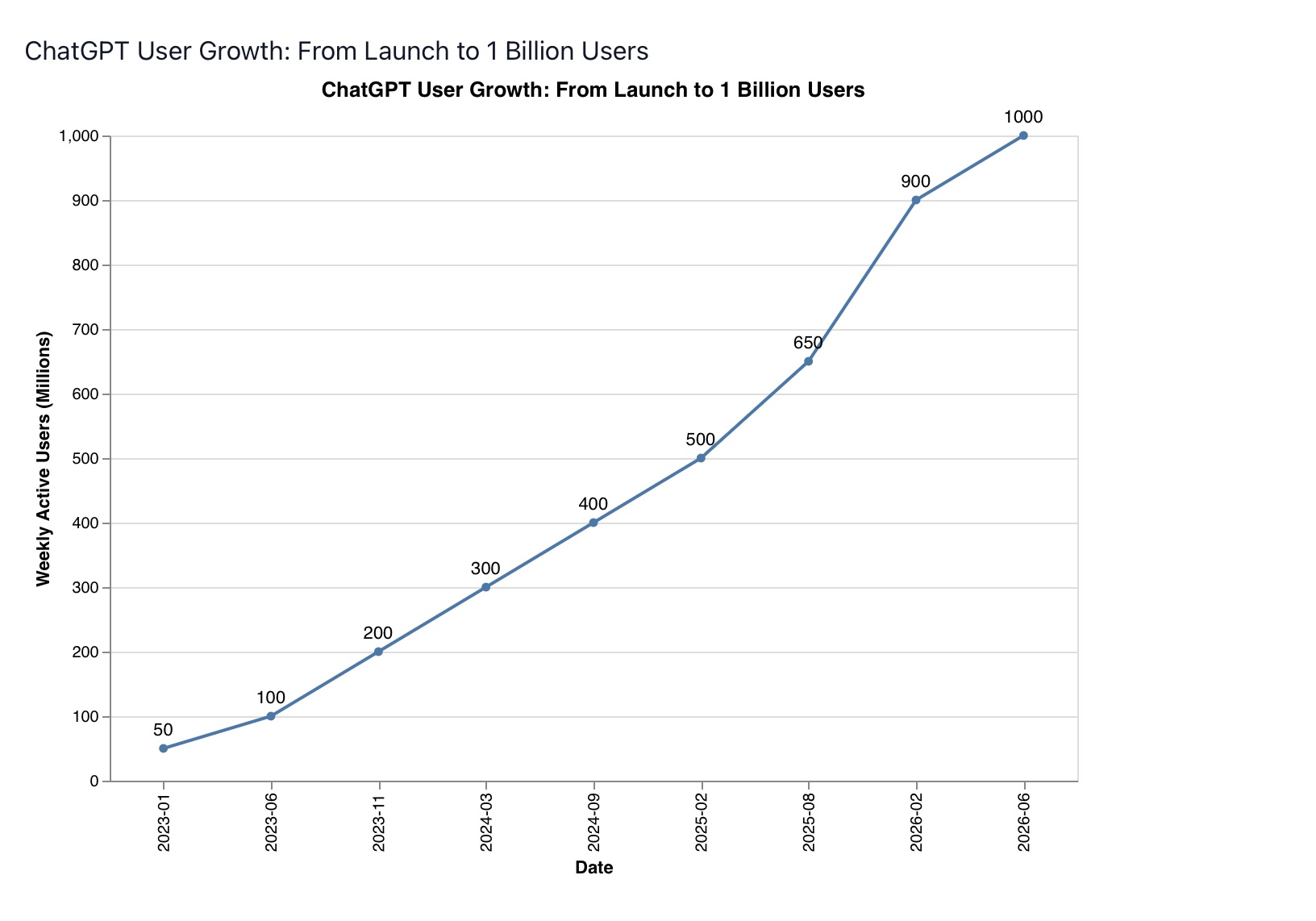
Key Insight: ChatGPT reached 1 billion users in approximately 3.5 years. By comparison, TikTok took 9 months to hit 100 million, Instagram took 1 year to reach 100 million, and Facebook took nearly a decade to reach its first billion.
The Generational Shift in AI Adoption
Initially dominated by digital-native Gen Z users, the demographic landscape of AI is changing. Pew Research's February 2026 survey (n=5,119) reveals that older generations are catching up at an extraordinary pace. Over just two years, the 50–64 age group nearly doubled its chatbot usage from 25% to 42%. Similarly, among those aged 65 and older, usage almost doubled from 12% to 23%.
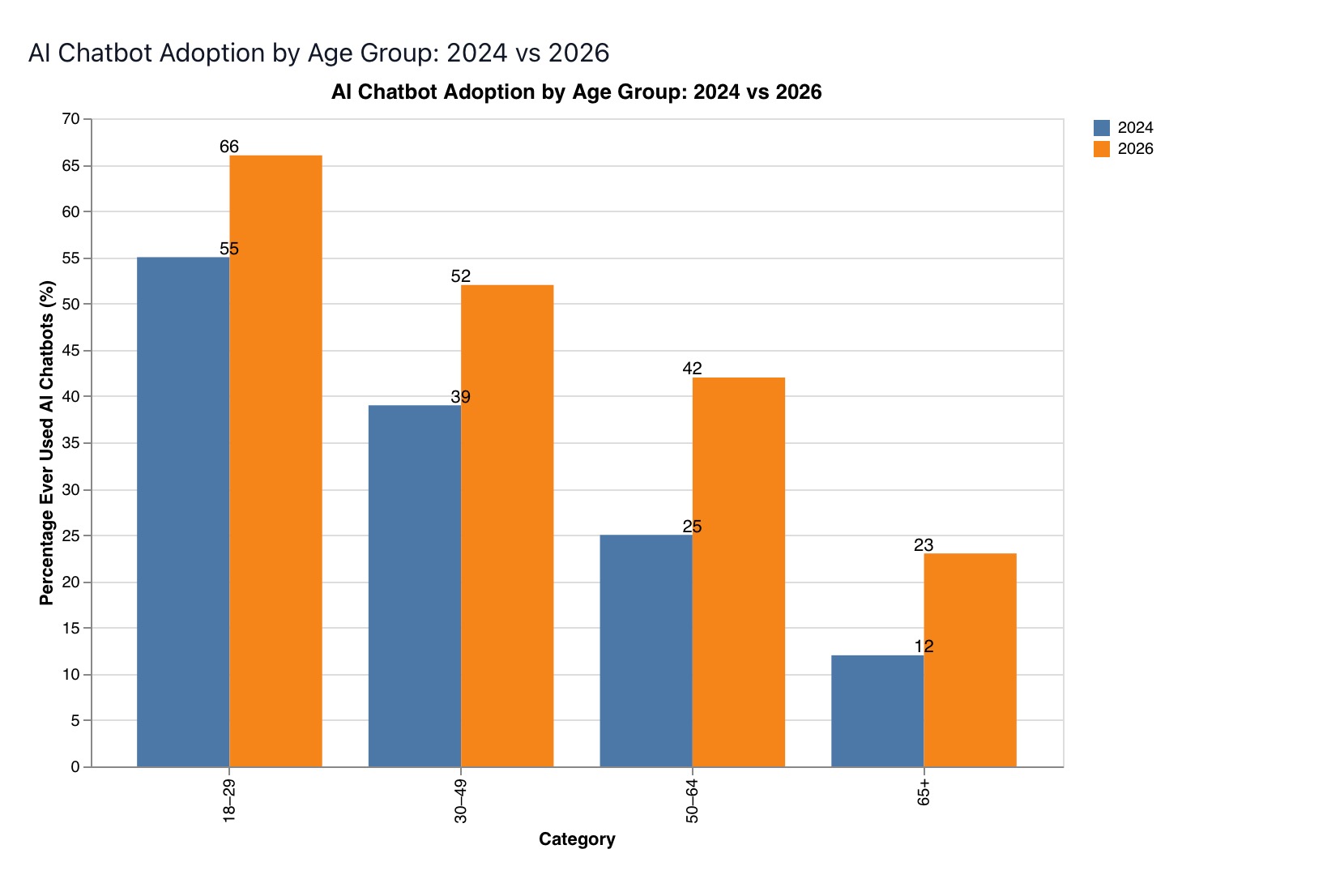
While the 18–29 cohort continues to lead overall adoption at 66% (up from 55% in 2024), the generational gap is narrowing. Even more surprising is the frequency of use. Daily usage actually peaks in the 30–49 age bracket at 34%, surpassing the 18–29 group's 31%. This critical data point suggests that middle-aged professionals have integrated AI tools more deeply into their daily routines than younger users.
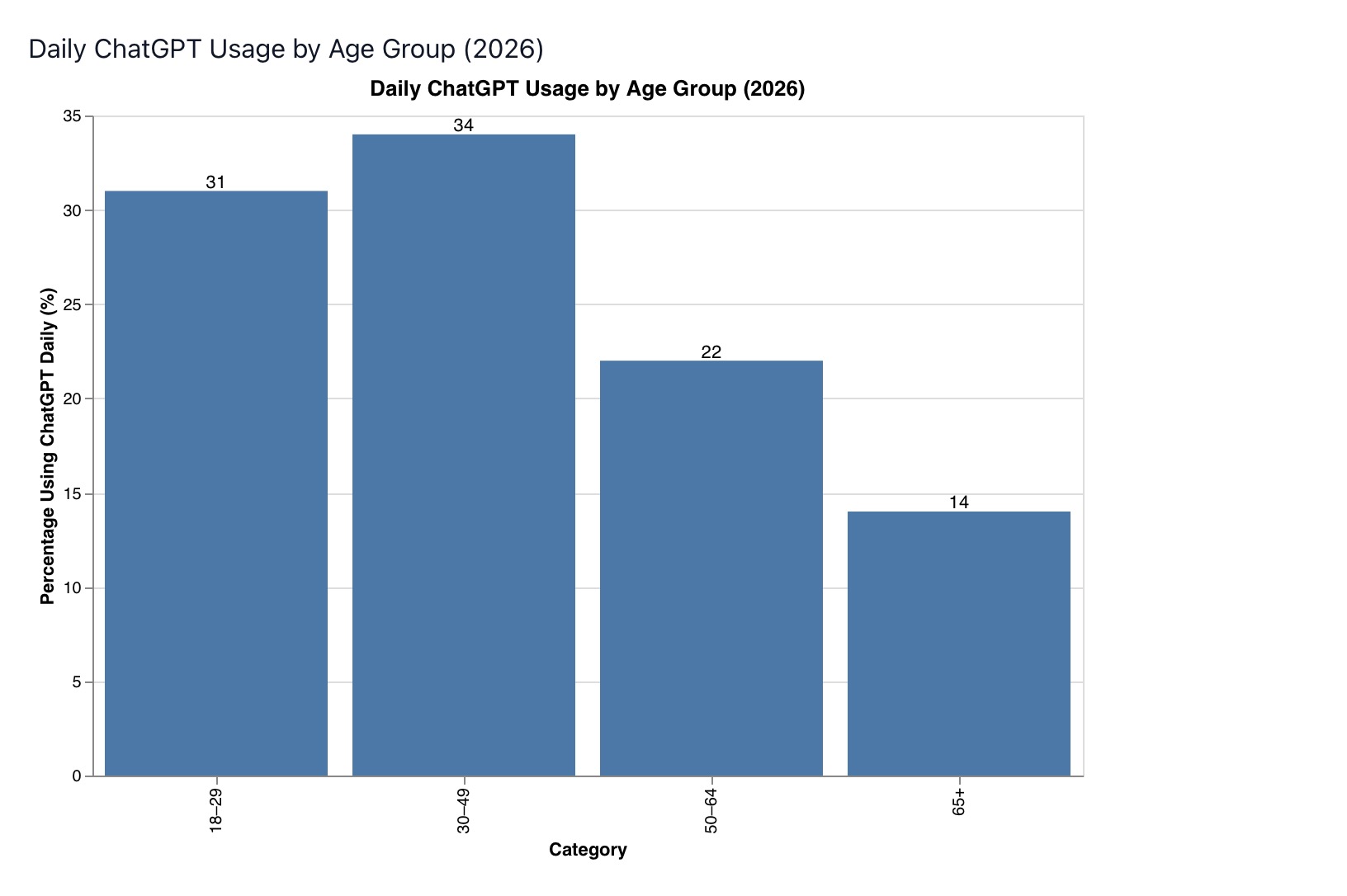
Key Insight: The 30–49 age group now uses ChatGPT more intensively on a daily basis than any other cohort. The narrative that AI is a "young person's tool" is rapidly becoming obsolete — middle-aged professionals and increasingly older adults are the growth engine.
The Competitive Landscape: A Fragmenting Market
Despite maintaining a dominant 53.9% share of web traffic as of May 2026, ChatGPT's market position has eroded over the past year. Twelve months ago, it commanded roughly 79% of AI chatbot traffic. Today, Google's Gemini has surged to 27.9% (up from just 5.4%), and Anthropic's Claude has grown to 9.2%—a staggering 855% year-over-year increase.
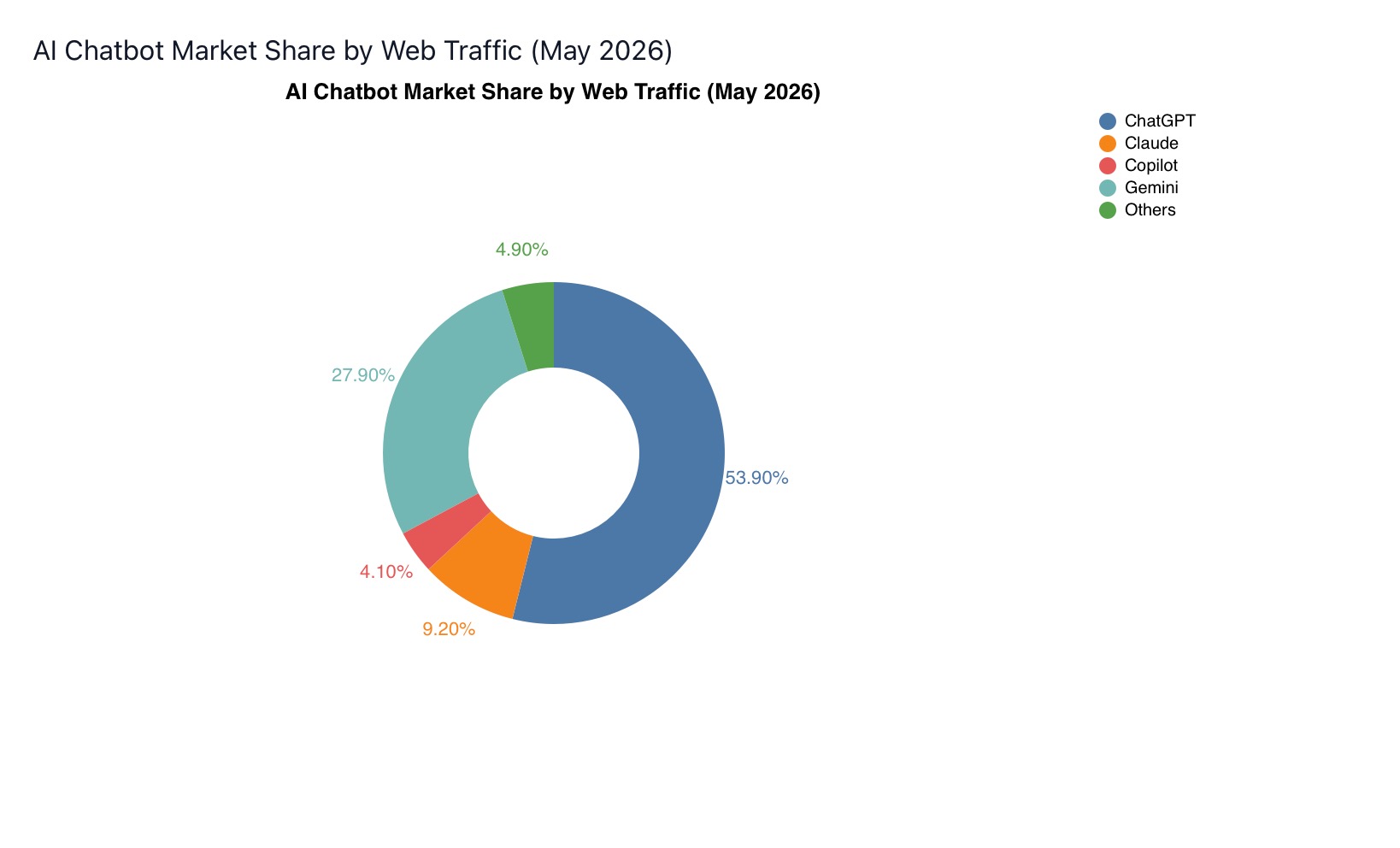
The enterprise market reveals an even deeper fragmentation. In enterprise API spending, Anthropic now leads at 40% compared to OpenAI's 27%. This suggests that while ChatGPT wins the consumer traffic battle, enterprise buyers are actively diversifying their AI infrastructure. Meanwhile, Microsoft Copilot holds a modest 4.1% of consumer traffic but enjoys massive enterprise penetration through its Microsoft 365 integration.
Enterprise AI Adoption Accelerates Across Industries
Enterprise AI adoption has officially reached an inflection point. A 2026 McKinsey survey reports that 78% of enterprises now use AI in at least one business function, up significantly from 55% in 2023. Financial services leads the charge at 87% adoption, followed closely by technology (85%) and healthcare (76%).
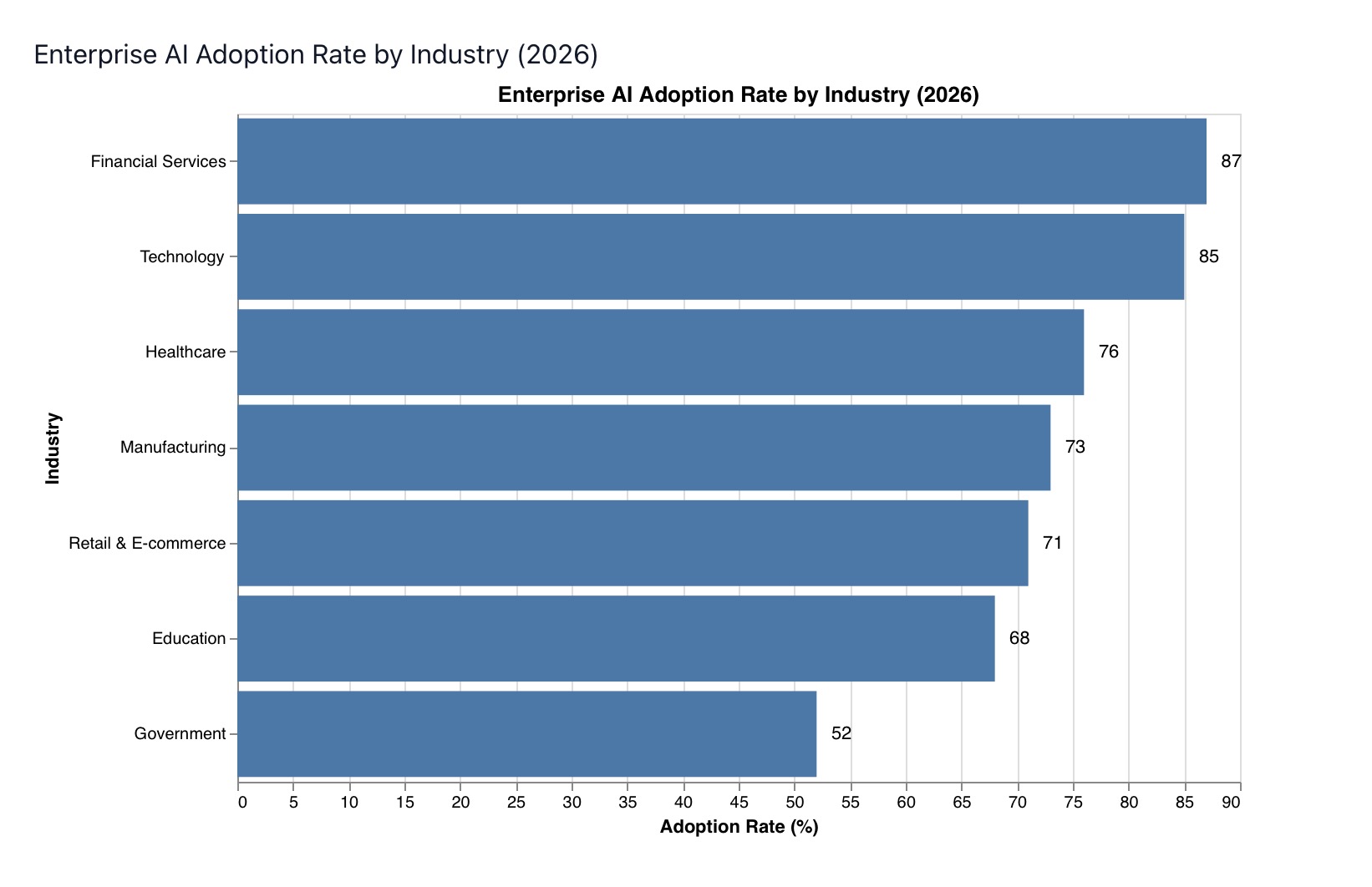
Global enterprise AI spending is projected to reach $407 billion in 2026, marking a 42% year-over-year increase. The fastest-growing use cases are customer service automation, document processing, and code generation. Reflecting this B2B boom, over 50 million users now subscribe to ChatGPT's paid tiers, and enterprise seats have exceeded 7 million.
The Economics: Revenue, Valuation, and the Profitability Gap
OpenAI's financial trajectory remains one of the most explosive in technology history. From a mere $28 million in 2022, the company's annualized revenue surged to $25 billion by early 2026—an almost 900x increase in four years.
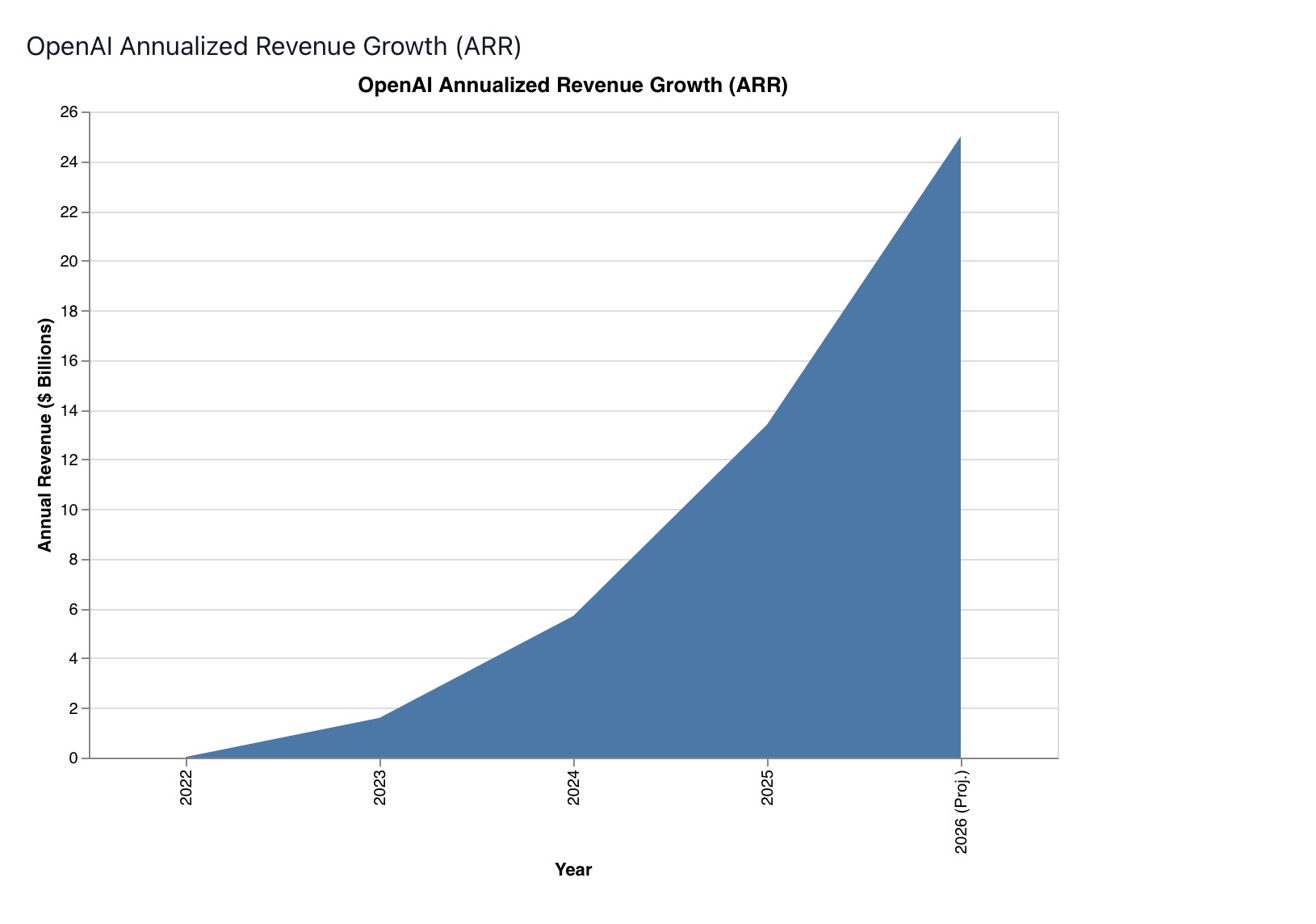
However, profitability remains elusive. Driven by massive infrastructure spending on compute power and model training, OpenAI reported a net loss of $38.5 billion in 2025. The projected loss for 2026 sits at approximately $14 billion. To sustain this momentum, the company raised $122 billion in March 2026 in one of the largest funding rounds ever, skyrocketing its valuation to an astronomical $852 billion.
OpenAI Financial Milestones
| METRIC | VALUE | CONTEXT |
|---|---|---|
| ARR (Feb 2026) | $25B | Up from $100M in 2022 |
| Paid Subscribers | 50M+ | Consumer + enterprise |
| Net Loss (2025) | $38.5B | Infrastructure-heavy |
| Projected Loss (2026) | ~$14B | Improving trajectory |
| Valuation | $852B | Post-$122B raise (Mar 2026) |
| Enterprise Seats | 7M+ | Growing 3x YoY |
What This Means
ChatGPT's billion-user milestone is a landmark moment, but the underlying dynamics are more nuanced than the headline suggests. Three structural shifts define this moment:
1. AI is becoming age-agnostic. The fastest growth in adoption now comes from users over 50, not digital natives. Daily usage peaks in the 30–49 professional cohort. This has profound implications for product design, marketing, and accessibility — the "default user" of AI tools is shifting from a tech-savvy twenty-something to a mid-career professional.
2. The moat is narrowing. ChatGPT's consumer dominance is real but declining — from 79% to 54% traffic share in a single year. Google's distribution advantage (Gemini embedded in Search, Android, and Workspace) and Anthropic's enterprise strength (40% of API spend) represent genuine competitive threats.
3. Revenue and profitability are diverging. $25 billion in ARR is extraordinary, but $38.5 billion in losses is equally so. The question for 2026–2027 is whether the unit economics of AI inference can converge toward profitability before the capital markets lose patience.
Conclusion
The journey of ChatGPT to one billion users highlights a profound shift in human-computer interaction. AI is no longer a niche tool for the youth; it is a daily essential for middle-aged professionals and a core operational pillar for global enterprises. As the market fragments and competitors like Google and Anthropic aggressively close the gap, the next phase of the AI revolution will be defined by enterprise integration and the pursuit of profitability.
Thank you for reading this data-driven report. We proudly acknowledge Powerdrill Bloom for seamlessly generating the data analytics, insights, and charts that made this comprehensive overview possible.
FAQ
When did ChatGPT hit 1 billion weekly active users?
ChatGPT officially crossed the one-billion weekly active users milestone in June 2026.
Which age group uses ChatGPT the most on a daily basis?
The 30–49 age group leads daily usage at 34%, surpassing the younger 18–29 demographic.
What is ChatGPT's market share in AI web traffic?
As of May 2026, ChatGPT maintains a dominant 53.9% share of AI chatbot web traffic.
What percentage of enterprises use AI today?
According to a 2026 survey, 78% of enterprises use AI in at least one business function.
What is OpenAI’s current company valuation?
Following a massive funding round in March 2026, OpenAI's valuation reached a staggering $852 billion.