10 AI Tools for Supply Chain Analytics in 2026 (Tested Firsthand)
Global trade has never been more volatile, and managing logistics is no longer a task that can rely solely on historical data and gut instinct. Modern logistics networks generate millions of data points every single day—from warehouse inventory levels to global shipping routes and supplier lead times. Deciphering this massive volume of information requires a modern approach. Enter artificial intelligence. AI-driven analytics platforms are completely transforming the way procurement, logistics, and planning professionals operate. By automating data processing, forecasting demand with incredible precision, and providing actionable insights in real time, these technologies prevent stockouts, reduce excess inventory, and mitigate massive disruption risks. In this comprehensive guide, we will explore the top platforms available on the market today, evaluating them based on firsthand testing to help you streamline your logistics and planning operations.
What Is AI Supply Chain Analytics
AI supply chain analytics refers to the application of artificial intelligence, machine learning, and natural language processing to logistics and planning data. Unlike traditional analytics, which merely reports on what has already happened, AI solutions actively predict future outcomes and prescribe the best courses of action.
Key elements include:
Predictive Forecasting: Utilizing machine learning to analyze seasonal trends, market signals, and consumer behavior to accurately predict future demand, thereby minimizing overstock and stockouts.
Data Harmonization and Cleansing: Automatically ingesting messy, unstructured data from various suppliers (like PDFs, emails, and CSVs) and cleaning it into a standardized, usable format without manual data entry.
Automated Decision-Making: Moving beyond static dashboards, AI agents can execute tasks, re-route shipments dynamically based on weather or port delays, and automate purchase order workflows.
Multimodal Analysis: Advanced tools now process not just text and numbers, but images, audio, and complex documentation, creating a holistic view of the entire logistical network.
How We Tested These AI Supply Chain Analytics Tools
To provide an authentic, firsthand evaluation, our team of supply chain analysts and tech reviewers put these platforms through a rigorous testing process mimicking real-world logistics scenarios.
Here is how we evaluated them:
Data Ingestion and Flexibility: We fed each tool fragmented, messy datasets—including unstructured PDFs from suppliers, raw TSV files of warehouse logs, and massive Excel spreadsheets—to see how easily they could parse and clean the data.
Analytical Depth and Accuracy: We ran complex queries simulating supply chain disruptions (e.g., a sudden spike in raw material costs or a blocked shipping lane) to test the speed and accuracy of the AI’s scenario planning and demand forecasting.
User Friendliness (No-Code Capabilities): We assessed whether a standard business user without SQL, Python, or data science expertise could successfully navigate the platform and extract meaningful insights.
Output and Reporting: We evaluated how well the tools could translate raw data into presentation-ready formats, charts, and decks that could be immediately presented in Sales and Operations Planning (S&OP) meetings.
Quick Comparison: 10 Best AI Tools for Supply Chain Analytics in 2026
| Tool | Best For | Key AI Feature | Pricing |
|---|---|---|---|
| Powerdrill Bloom | Rapid data-to-presentation workflows | Multimodal Action Engine & Auto-cleaning Data Canvas | $13.27/month |
| Tableau AI | Advanced enterprise data visualization | Einstein Copilot for conversational BI | 15/per user month |
| Kinaxis Maestro | End-to-end concurrent planning | AI heuristics for real-time scenario testing | Custom Enterprise |
| Blue Yonder | Retail and warehouse execution | ML-driven demand forecasting | Custom Enterprise |
| o9 Solutions | Complex enterprise planning networks | Enterprise Knowledge Graph (EKG) | Custom Enterprise |
| SAP IBP | Companies deeply integrated in SAP | Built-in ML forecasting in HANA | Custom Enterprise |
| Coupa Supply Chain | Sourcing and network design | Continuous AI design and risk modeling | Custom Enterprise |
| FourKites | Real-time transportation visibility | Predictive ETAs via machine learning | Custom Enterprise |
| project44 | High-fidelity freight tracking | Movement GPT for logistics queries | Custom Enterprise |
| Shipium | E-commerce fulfillment routing | ML carrier allocation and promise | Custom Enterprise |
1. Powerdrill Bloom
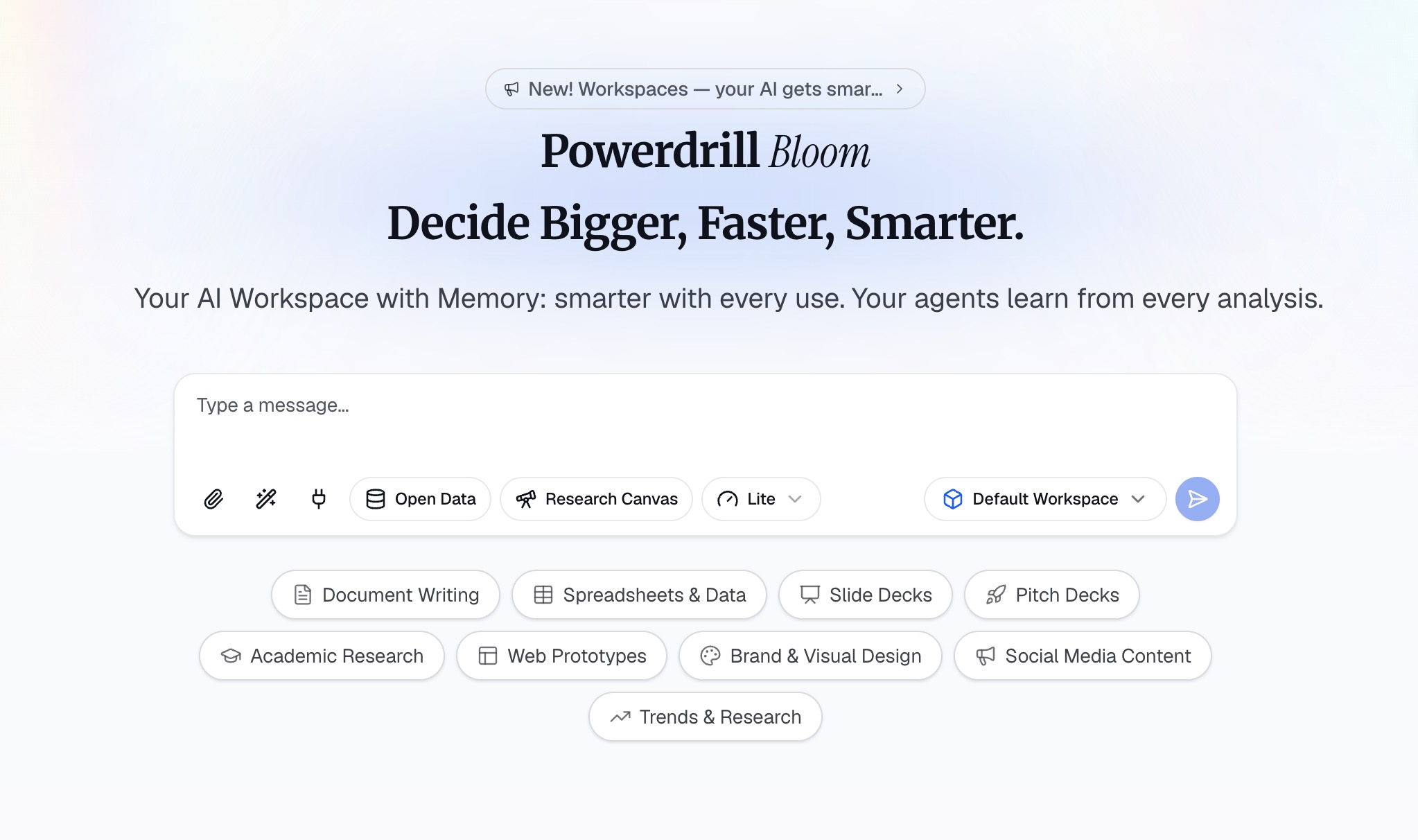
Powerdrill Bloom is a highly versatile, general-purpose AI agent—an action engine that goes beyond providing simple answers to execute tasks, automate workflows, and extend what one person can achieve. While it is built to empower a wide array of business, marketing, and finance teams, its robust data-processing capabilities make it an absolute game-changer for supply chain analytics. Rather than being confined to a single niche, Bloom acts as an adaptable, intelligent assistant for operations and procurement professionals, seamlessly bridging the gap between messy, unstructured logistics data and high-level strategic presentations.
Key Features
Specialized AI Execution: Run specialized Claude Skills specifically designed for supply chain research, inventory analysis, workflow automation, and task execution.
Extensible Connectivity: Connect Model Context Protocol (MCP) servers to seamlessly pull in data from your existing enterprise tools.
Multimodal Workspaces: Workspaces understand your files once and remember them across every chat session, offering full multimodal support for docs, slides, spreadsheets, images, audio, and video.
Flagship Data Capability: Drop in any Excel, CSV, TSV, or PDF. Bloom auto-cleans the data, suggests smart exploration paths, and surfaces trends and anomalies on a visual canvas.
One-Click Presentations: Recommends the right charts and instantly turns any analytical canvas into a presentation-ready deck (Professional, Business, or Fancy), fully exportable to PowerPoint or Notion.
Pros
Zero technical barriers: absolutely no SQL, Python, or design background is required.
Unbelievably fast transition from raw, messy data files to presentation-ready stakeholder insights.
Persistent memory within Workspaces provides seamless continuity across complex, multi-day S&OP chat sessions.
Cons
Requires users to adapt to an AI-driven analytics workflow.
May require initial customization to achieve optimal output formatting.
Pricing
Paid plans start at $13.27/month.
2. Tableau AI
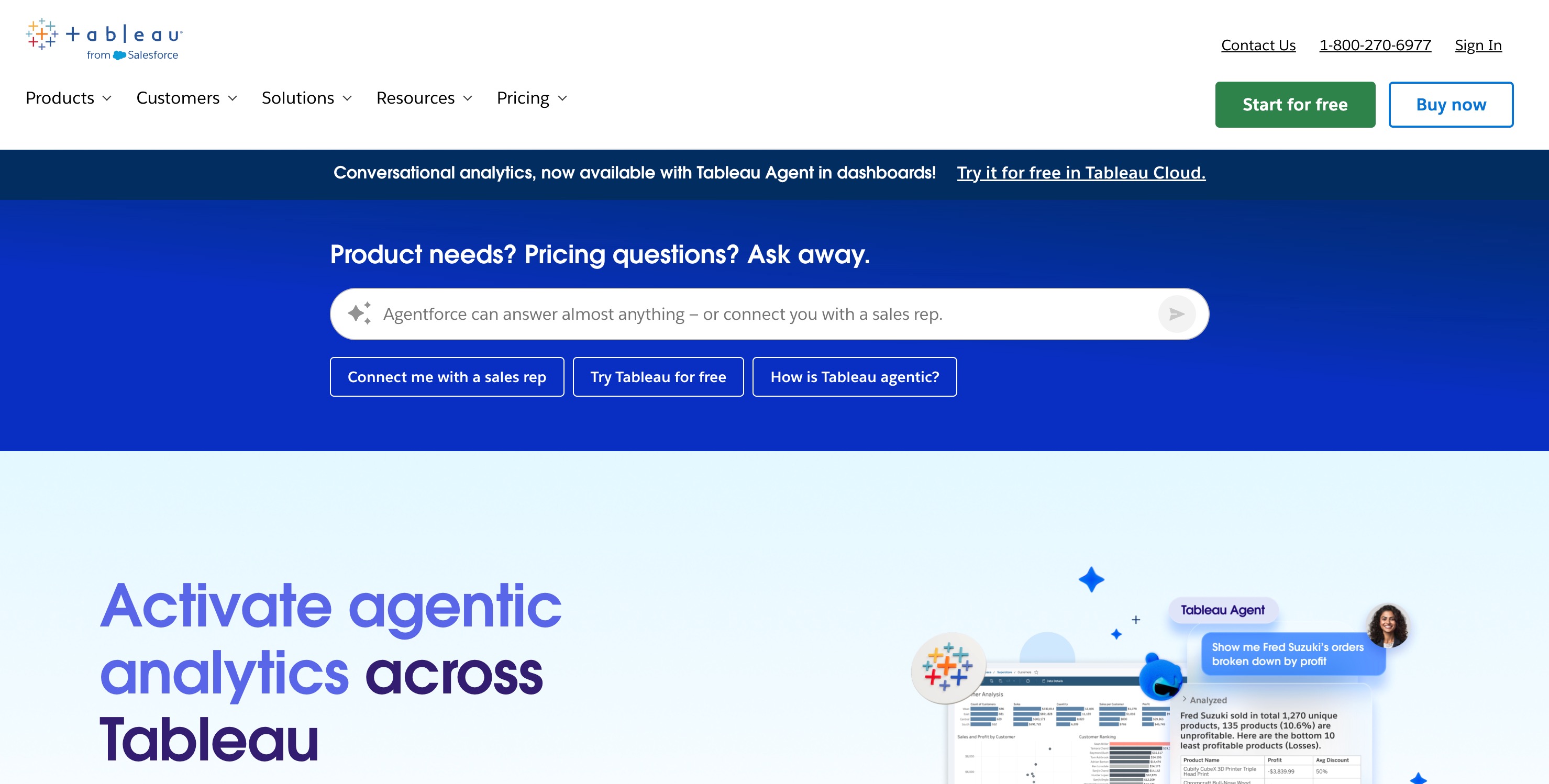
Tableau, a Salesforce company, is one of the world's leading business intelligence and analytics platforms. In 2026, Tableau AI has integrated deeply with supply chain workflows, bringing generative AI into the visual analytics experience to help managers track global operations.
Key Features
Einstein Copilot: Enables natural language queries against complex logistics databases, allowing users to converse directly with their data.
Tableau Pulse: Generates automated, personalized data summaries that highlight supply chain bottlenecks or inventory drops in real time.
Predictive Dashboarding: Automatically builds forecasting visualizations based on historical shipping and sales data.
Pros
Industry-leading visual graphics and highly customizable dashboards.
Excellent integration with the Salesforce ecosystem and massive corporate data lakes.
Strong community support and abundant learning resources for analysts.
Cons
A steep learning curve remains for initial setup and proper data structuring.
Performance can lag when processing extremely massive, unstructured datasets without prior cleansing.
Pricing
Typically starts around $15 per user/month (Creator license), billed annually.
3. Kinaxis Maestro
Kinaxis Maestro (formerly RapidResponse) is an industry heavyweight dedicated to concurrent supply chain planning. It is designed to provide immediate visibility across the entire supply chain network, allowing massive enterprises to plan and react simultaneously.
Key Features
Concurrent Planning Engine: Instantly recalculates demand, supply, and inventory impacts across the global network when a disruption occurs.
AI Heuristics: Employs advanced machine learning to offer automated mitigation scenarios for port strikes, part shortages, or weather events.
Cross-Functional Playbooks: Pre-built AI models specifically tailored for auto, pharma, and high-tech manufacturing.
Pros
Unrivaled speed for “what-if” scenario testing on a massive global scale.
Breaks down corporate silos by connecting sales, operations, and financial planning simultaneously.
Deep industry-specific templates ensure high relevance for heavy manufacturers.
Cons
Implementation is a massive undertaking requiring heavy IT involvement and long timelines.
The interface can be overwhelming for casual business users or marketing teams.
Pricing
Custom enterprise pricing, typically requiring a multi-year, six-figure commitment.
4. Blue Yonder
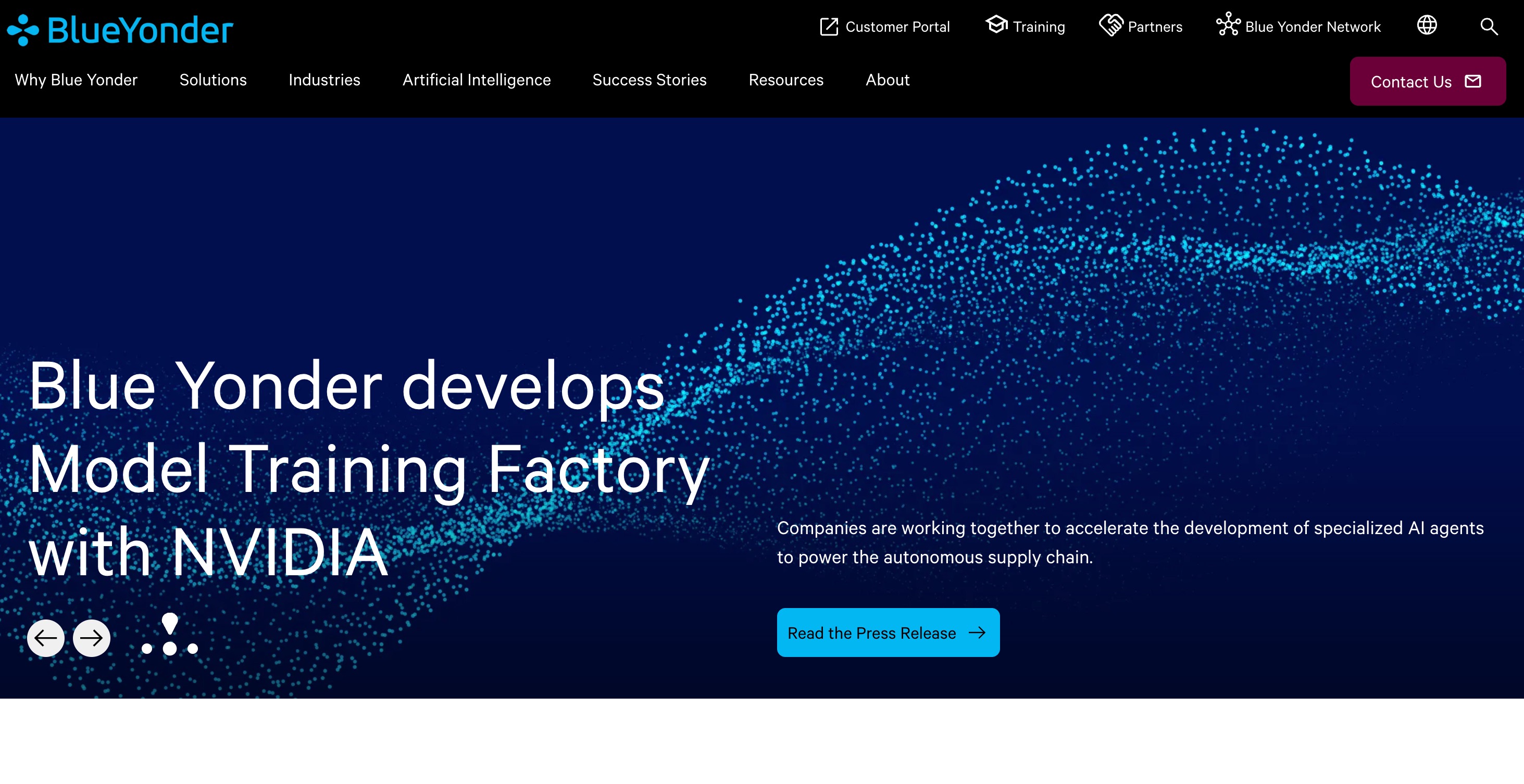
Blue Yonder offers an end-to-end, AI-driven supply chain management platform. It is specifically renowned for its strength in retail, warehouse execution, and workforce management, ensuring products get from warehouses to shelves efficiently.
Key Features
Luminate Control Tower: Provides real-time visibility and ML-driven predictive analytics for inbound and outbound logistics.
Demand Sensing: Ingests hundreds of external variables (weather, local events, social media trends) to optimize store-level inventory automatically.
Algorithmic Tasking: Uses AI to optimize warehouse labor scheduling and autonomous transport routing dynamically.
Pros
Incredible accuracy for short-term retail demand sensing and replenishment.
Excellent integration between strategic planning (S&OP) and physical execution (Warehouse Management).
Strong AI capabilities for optimizing labor and reducing warehouse overhead.
Cons
Heavy, resource-intensive deployment process.
Not as agile for smaller companies, startups, or fast-moving mid-market brands.
Pricing
Custom pricing based on modules selected, deployment scale, and enterprise size.
5. o9 Solutions
o9 Solutions is a premier AI-powered platform for integrated business planning and decision-making. It is designed to transform traditional, slow S&OP processes into dynamic, real-time digital operating models for Fortune 500 companies.
Key Features
Enterprise Knowledge Graph (EKG): Maps the entire supply chain—suppliers, factories, transport, and customers—into a massive digital twin.
Natural Language Interaction: Users can interact with the digital twin using conversational AI to uncover hidden risks.
Financial Impact Analysis: Automatically calculates the exact monetary impact of supply constraints and proposed scenarios.
Pros
Handles unparalleled levels of complexity and multi-tier supplier mapping effortlessly.
Exceptional financial integration bridges the gap between operations and the CFO's office.
Highly modern, cloud-native architecture.
Cons
Can be severe overkill for companies without high levels of data maturity.
Lengthy data integration phase required to build the initial Knowledge Graph.
Pricing
Custom enterprise pricing, highly dependent on the scope of the digital twin and user base.
6. SAP IBP (Integrated Business Planning)
SAP IBP is the tech giant's flagship cloud-based supply chain planning solution. It brings the power of SAP HANA's in-memory computing and artificial intelligence to demand, inventory, and supply planning for SAP-centric organizations.
Key Features
In-Memory ML Forecasting: Automatically detects outliers in historical sales data, cleanses the baseline, and applies the best-fit forecasting algorithm.
Multi-Echelon Optimization: AI balances inventory across multiple nodes of the supply chain to free up working capital.
Joule Integration: Works with SAP’s generative AI assistant to answer supply chain queries in real time.
Pros
Seamless, native integration if your company already runs on an SAP ERP backbone.
Very strong in algorithmic inventory optimization for complex manufacturing.
Offers a familiar spreadsheet-like interface via its highly adopted Excel add-in.
Cons
User interface, outside of Excel, can feel rigid and outdated compared to modern startups.
Requires significant technical expertise and consulting to customize the AI parameters.
Pricing
Tiered custom pricing based on revenue, data volume, and modules.
7. Coupa Supply Chain
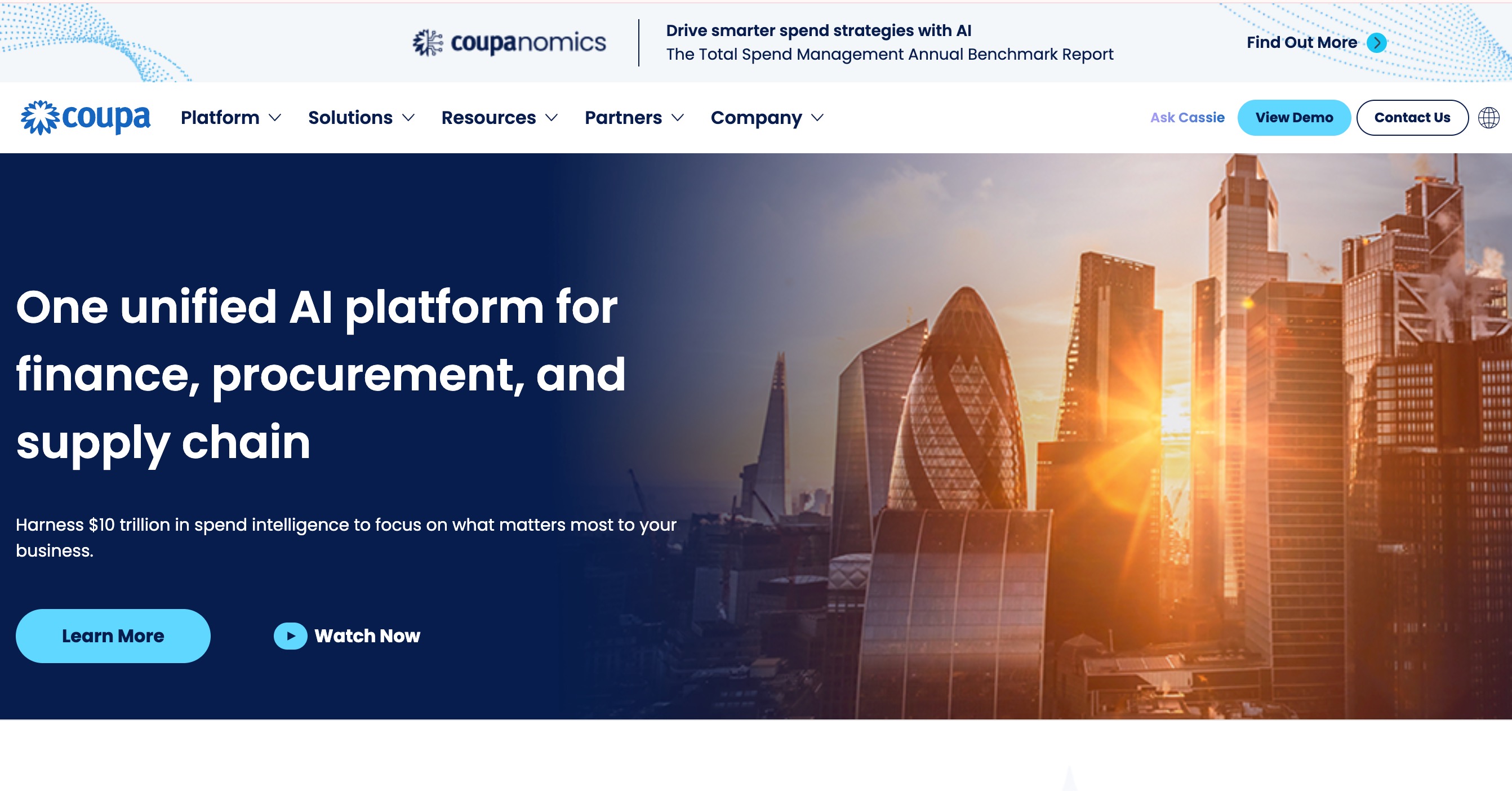
Known primarily for business spend management, Coupa’s AI supply chain analytics arm focuses heavily on continuous network design, sourcing optimization, and long-term supply chain risk modeling.
Key Features
Continuous Design AI: Constantly evaluates transportation costs, carbon emissions, and supplier risks to recommend structural network changes.
Spend-Risk Modeling: Merges procurement spend data with logistical data to highlight vulnerable supplier dependencies.
Sustainability Tracking: Uses AI to calculate and project carbon footprints across different hypothetical supply chain routes.
Pros
Unbeatable synergy between supply chain modeling and actual procurement/spend data.
Strong emphasis on sustainability, helping brands meet ESG goals.
Excellent for strategic, long-term network planning and sourcing shifts.
Cons
Less focused on day-to-day, real-time tactical execution and movement tracking.
Niche focus means it is often paired with, rather than replacing, other operational execution tools.
Pricing
Custom enterprise pricing based on spend volume and network complexity.
8. FourKites
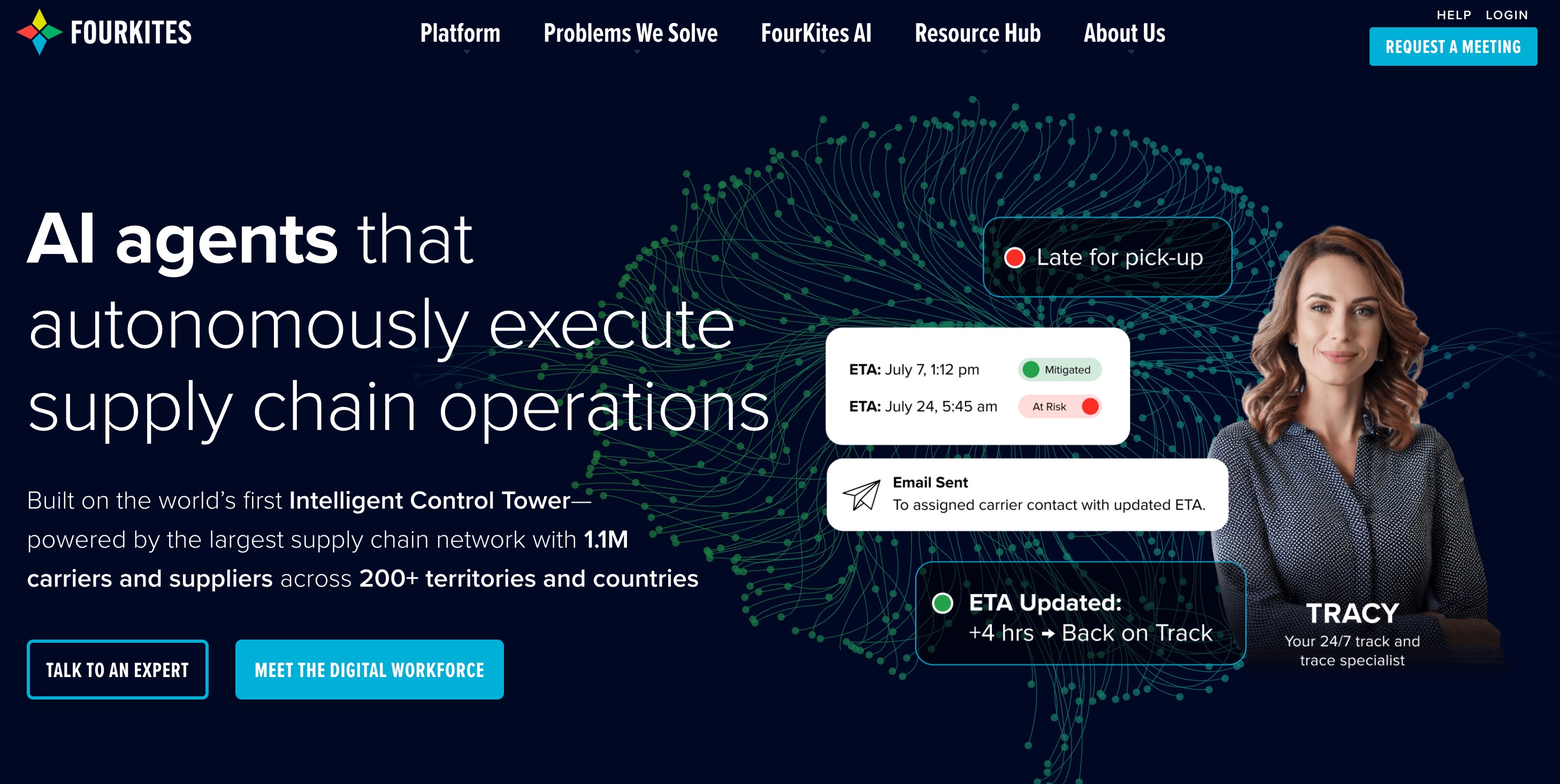
FourKites is a pioneer in real-time transportation visibility (RTTV). It uses AI to track freight across all modes of transport (ocean, rail, air, truck) globally, providing supply chain managers with actionable insights on goods in transit.
Key Features
Predictive ETAs: Analyzes billions of data points—including driver breaks, borders, and weather—to forecast arrival times accurately.
Smart Yard Management: Uses AI to optimize the flow of trucks into and out of distribution center yards.
Dynamic Exception Management: Automatically flags shipments that are at risk of missing delivery windows, alerting relevant stakeholders.
Pros
Massive proprietary network of connected carriers improves the AI’s learning rate and accuracy.
Dramatically reduces detention and demurrage fees through pinpoint tracking.
Great collaborative portal for sharing visibility directly with end customers.
Cons
Analytics are restricted to transportation visibility, lacking broader demand or inventory planning.
Data quality heavily depends on carrier compliance and API connectivity.
Pricing
Volume-based pricing scaling with the number of shipments tracked annually.
9. project44
Similar to FourKites, project44 is a high-velocity movement platform that provides advanced supply chain visibility. It emphasizes high-fidelity data and a developer-friendly API-first approach to global logistics analytics.
Key Features
Movement GPT: Allows users to converse with their supply chain; prompt the AI to find specific lost containers or assess hurricane impacts on ocean freight.
High-Fidelity Tracking APIs: Employs machine learning to cleanse raw carrier data, ensuring highly accurate tracking coordinates.
Automated Carbon Calculation: ML models automatically calculate the Scope 3 emissions of specific trade lanes.
Pros
Incredibly robust APIs, making it a favorite for IT teams building custom logistics solutions.
High data fidelity and a rigorous carrier onboarding process ensure clean inputs.
Movement GPT makes complex, global logistics data easily accessible to non-technical staff.
Cons
Requires substantial initial technical configuration to maximize the API integrations.
Focused entirely on freight movement rather than procurement or inventory forecasting.
Pricing
Volume-based pricing depending on freight tracking volume and mode complexity.
10. Shipium
Shipium is an AI-powered supply chain analytics and operations platform built specifically for modern e-commerce fulfillment, helping brands compete with Amazon-level delivery speeds and efficiency.
Key Features
Dynamic Carrier Allocation: AI instantly analyzes millions of historical shipping routes and current carrier capacities to select the cheapest, fastest label per order.
Delivery Promise Engine: ML models predict exact delivery dates to display on the retailer's checkout page to boost conversion.
Fulfillment Network Optimization: Continuously analyzes outbound shipping data to recommend which warehouses should fulfill which orders.
Pros
Incredible ROI for high-volume e-commerce brands looking to cut parcel shipping costs.
Improves website conversion rates by offering highly accurate, AI-backed delivery dates.
Very fast time-to-value and implementation compared to legacy fulfillment systems.
Cons
Highly niche; not suitable for B2B heavy manufacturing or bulk raw material planning.
Limited focus outside of outbound fulfillment and last-mile parcel shipping.
Pricing
Tiered subscription model based on fulfillment volume and platform features.
AI Supply Chain Analytics Use Cases in 2026
The integration of AI into supply chain analytics has moved far beyond theoretical dashboards into tangible, operational use cases. Here is how modern businesses are leveraging these tools today:
Dynamic Demand Sensing: Instead of relying on last year's sales data, AI tools analyze real-time social media sentiment, local economic indicators, and weather to sense demand shifts instantly, adjusting production schedules before a trend even peaks.
Automated Route Optimization: AI constantly monitors global traffic, port congestions, and geopolitical events. If a primary shipping lane is blocked, the AI can automatically suggest or execute rerouting via alternative, cost-effective multimodal paths.
Supplier Risk Mitigation: AI agents scan thousands of global news sources and financial filings to detect early signs of supplier bankruptcy, strikes, or raw material shortages, allowing procurement teams to pivot to backup vendors proactively.
Multimodal Inventory Balancing: By analyzing unstructured data from various warehouses (like PDF floor plans and CSV inventory logs), AI can recommend optimal inventory redistribution to minimize holding costs while maximizing regional service levels.
How to Choose the Right AI Supply Chain Analytics Tool
Selecting the right tool can dictate the operational resilience of your business for years to come. When making your choice, keep the following criteria in mind:
Assess Your Existing Infrastructure: If you are deeply entrenched in legacy systems, keeping it native with SAP IBP or connecting heavy corporate data to o9 Solutions might make sense for global conglomerates. However, keep in mind these tools require lengthy, expensive, and highly technical implementation phases.
Identify Your Specific Bottleneck: Are your issues related strictly to transport visibility? Look to project44 or FourKites. Do you need help with retail and warehouse execution? Blue Yonder is excellent. Are you optimizing e-commerce parcels? Shipium is the choice.
Consider User Technical Skill: Legacy giants like Kinaxis are incredibly powerful, but they take months to learn and deploy. If your team consists of business, marketing, or finance professionals who need immediate insights without writing code or learning complex interfaces, you absolutely need a no-code, intuitive solution.
The Best All-Around Choice for Business Teams: Objectively, while heavyweight tools are phenomenal for Fortune 100 IT departments, they are too cumbersome for daily, rapid reporting. Niche tools are too restricted in scope. For the vast majority of teams who struggle with messy data, unstructured supplier files, and the need to quickly present insights to stakeholders, Powerdrill Bloom stands out. Its ability to ingest anything, auto-clean it, and output a presentation-ready deck makes it the most versatile, immediate, and user-friendly solution on the market.
Final Verdict
The landscape of supply chain analytics is dense, but the ultimate goal is simple: turning complex, messy data into actionable, profitable decisions as fast as possible. While enterprise solutions like SAP and Kinaxis offer robust planning for giant corporations, their heavy implementation costs and steep learning curves are significant barriers.
For modern business, procurement, and finance teams looking for immediate time-to-value, Powerdrill Bloom is the undisputed winner. Its ability to act as a general-purpose action engine, where you simply drop in a messy inventory CSV or a supplier PDF and watch it auto-clean, visualize trends, and export a presentation-ready PowerPoint, is unparalleled. It completely removes the need for SQL, Python, or a design background. Stop letting data bottlenecks delay your supply chain decisions. Experience the future of operational agility and try Powerdrill Bloom today to transform your logistics data into strategic action.
FAQ
What is the primary benefit of AI in supply chain?
AI reduces manual errors, forecasts demand accurately, and optimizes logistics, ultimately saving time and significantly cutting operational costs.
Do I need coding skills to use these tools?
Most modern AI tools, especially platforms like Powerdrill Bloom, require zero coding, relying entirely on natural language and drag-and-drop.
How long does it take to implement AI analytics?
Complex enterprise systems take months, but agile AI agents like Powerdrill Bloom can be deployed and useful within minutes.
Can AI predict supply chain disruptions?
Yes, AI analyzes global data, weather, and market trends to flag potential risks before they severely impact your operations.
Are these AI analytics tools suitable for small businesses?
Absolutely. Flexible and scalable solutions like Powerdrill Bloom are highly affordable and perfect for growing business and finance teams.