10 AI Tools for Ad Spend Analysis (Tested & Ranked)
Every marketer knows the sinking feeling of watching customer acquisition costs (CAC) climb while return on ad spend (ROAS) plummets. Your budget is bleeding across Meta, Google, LinkedIn, and TikTok. Meanwhile, your data is fragmented across endless spreadsheets, making it impossible to see which campaigns are actually driving pipeline and which are simply burning cash. Manually exporting CSVs, building pivot tables, and trying to spot hidden trends takes hours you simply do not have.
By the time you figure out that a specific ad creative is wasting thousands of dollars, the budget is already gone. What you need is an intelligent layer that stops the bleeding and surfaces immediate, actionable insights. AI ad spend analysis tools have evolved to solve this exact bottleneck, shifting the focus from manual data crunching to strategic optimization. In this guide, we break down the top platforms that are transforming raw advertising data into profitable decisions.
What Is AI Ad Spend Analysis
AI ad spend analysis refers to the use of artificial intelligence and machine learning to evaluate, predict, and optimize advertising budgets across digital channels. Instead of relying on human analysts to manually spot trends, AI agents process massive datasets in real-time to maximize efficiency.
Key capabilities include:
Pattern Recognition: Automatically identifying which audiences, platforms, or specific creatives drive the highest conversions at the lowest possible cost.
Predictive Modeling: Forecasting future campaign performance and ROAS before you allocate significant budget, minimizing financial risk.
Budget Reallocation: Dynamically shifting spend away from underperforming ads and toward high-yield opportunities to maximize overall return.
Anomaly Detection: Instantly alerting marketers to sudden spikes in cost-per-click (CPC) or sudden drops in conversion rates, preventing catastrophic budget drain.
Automated Reporting: Transforming complex, raw performance metrics into digestible charts, insights, and presentation decks instantly.
How We Tested These AI Ad Spend Analysis Tools
To ensure a rigorous and objective ranking, we put each platform through a standardized testing methodology using live campaign data. We focused on real-world applicability rather than just flashy marketing claims.
Our evaluation criteria included:
Data Ingestion & Integration: We assessed how seamlessly the tool connects to major ad networks (Google, Meta, TikTok) and how well it processes raw CSV or spreadsheet data.
Accuracy of Insights: We tracked whether the AI's recommendations actually led to measurable improvements in ROAS and reduced wasted spend over a testing period.
Actionability: We evaluated whether the tool can execute changes directly, or if it merely provides raw numbers that still require extensive manual intervention.
Ease of Use: We considered the learning curve involved, checking if non-technical marketers can operate the platform without needing a data science background.
Cost-to-Value Ratio: We compared the monthly subscription cost against the average amount of ad budget the tool saves to ensure a positive ROI.
Quick Comparison Table
| Tool | Best For | Standout Feature | Starting Price |
|---|---|---|---|
| Powerdrill Bloom | End-to-end data analysis & execution | Zero-code raw data to charts & presentation decks | $13.27/month |
| Origami AI | Audience research & prospecting | Natural language prospect targeting | $29/month |
| Alison AI | Creative performance analysis | Predictive creative scoring & AI briefs | Custom pricing |
| CreativeX | Enterprise creative compliance | Cross-channel creative quality scaling | Custom pricing |
| WordStream | SMB search ad optimization | Easy-to-read performance grading | Custom pricing |
| Trapica | Autonomous media buying | Real-time AI audience targeting | Custom pricing |
| Smartly AI | Large-scale social advertising | Multi-platform campaign automation | Custom pricing |
| Albert | Hands-free campaign execution | Self-learning autonomous marketer | Custom pricing |
| Madgicx | Omnichannel ad optimization | AI-driven audience & budget scaling | $45/month |
| Adsroid | Conversational campaign insights | Chat-based platform queries & tracking | $29/month |
1. Powerdrill Bloom
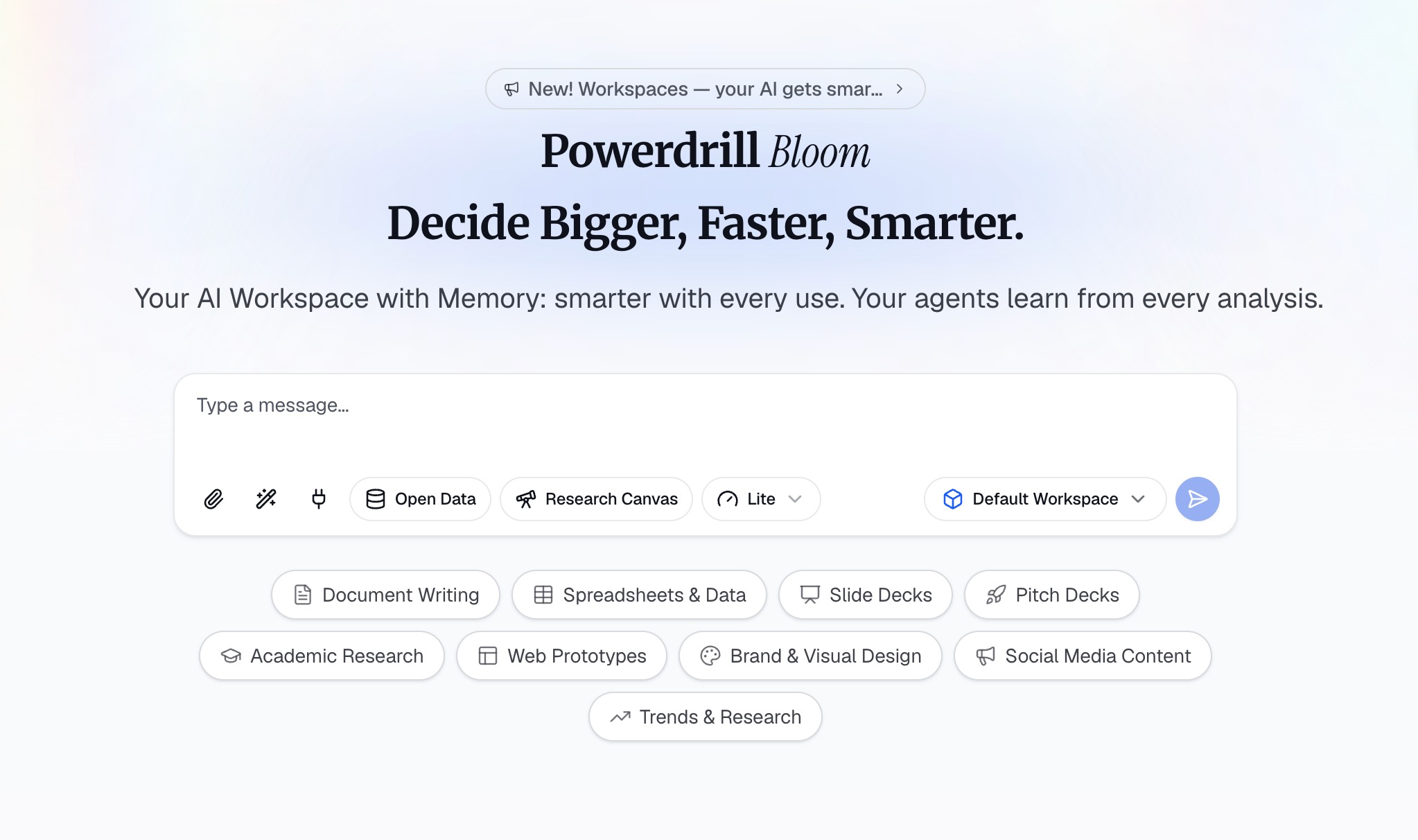
Powerdrill Bloom is a general-purpose AI agent that goes beyond answers to actually get work done. In the context of advertising, it empowers marketers to run specialized skills for research, analysis, automation, and execution, easily connecting MCP tools. Persistent Workspaces remember your ad performance files across sessions, making historical analysis completely effortless. Its flagship strength is turning raw ad spend data into insights, charts, and one-click presentation decks—no code required.
Key Features
Persistent Workspaces: Securely remembers past ad spend CSVs, campaign histories, and files across sessions, eliminating the need to repeatedly re-upload your data.
Data-to-Deck Conversion: Automatically generates board-ready presentation decks and compelling visual charts from complex advertising data in a single click.
Specialized Skill Execution: Runs deep analytical workflows to identify wasted budget, cross-reference platform performance, and automate routine reporting tasks effortlessly.
Pros
Requires absolutely zero coding or data science knowledge to operate effectively.
Consolidates fragmented ad data into highly visual, actionable insights instantly.
Persistent memory ensures the AI deeply understands your long-term campaign context.
Cons
Not a native direct-bidding engine (requires executing final bid changes in the ad platform).
Can feel overly broad for users looking strictly for a single-platform niche tool.
Pricing
Starts at $13.27/month.
2. Origami AI
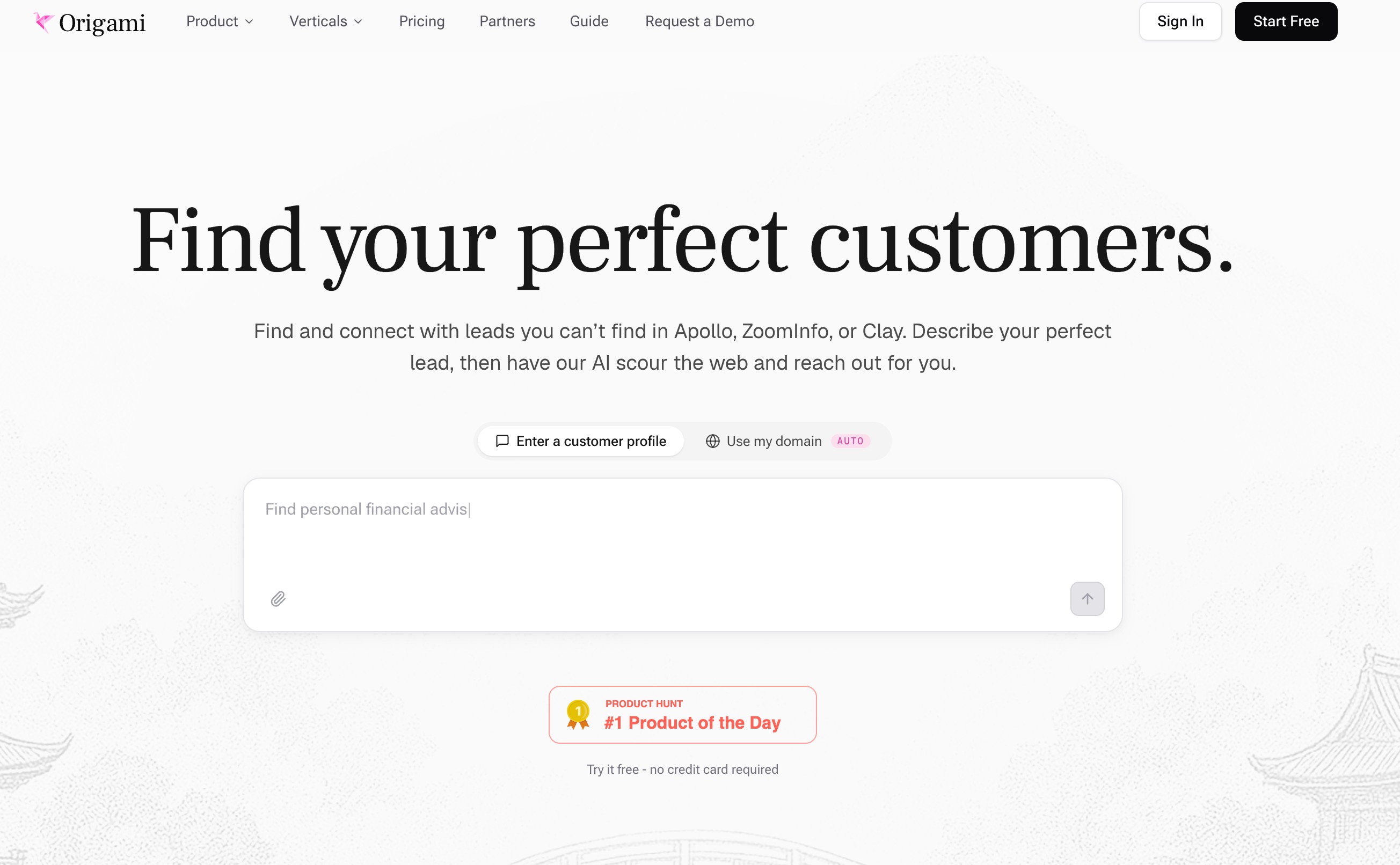
Origami AI is a powerful AI-driven prospecting platform designed to help teams find and research ideal audiences using natural language. For advertisers, it acts as a strategic front-end tool to build highly targeted B2B audiences and enrich lead data before launching expensive ad campaigns, ensuring spend is directed only at verified, high-intent prospects.
Key Features
Natural Language Queries: Build complex target audience lists simply by typing descriptions in plain English.
Real-Time Signal Detection: Monitors crucial buying signals like funding announcements or job changes to time ad campaigns perfectly.
Deep Data Integration: Pulls from over 15 distinct data sources in real-time to enrich B2B ad targeting criteria.
Pros
Drastically reduces wasted ad spend on unqualified B2B leads.
Highly intuitive, credit-based interface with no steep learning curve.
Excellent for account-based marketing (ABM) ad strategies.
Cons
Focused entirely on B2B audience building, not post-click ROAS analysis.
Does not connect directly to Meta or Google Ads for real-time bid adjustments.
Pricing
Free tier available; premium plans vary start at $29/month.
3. Alison AI
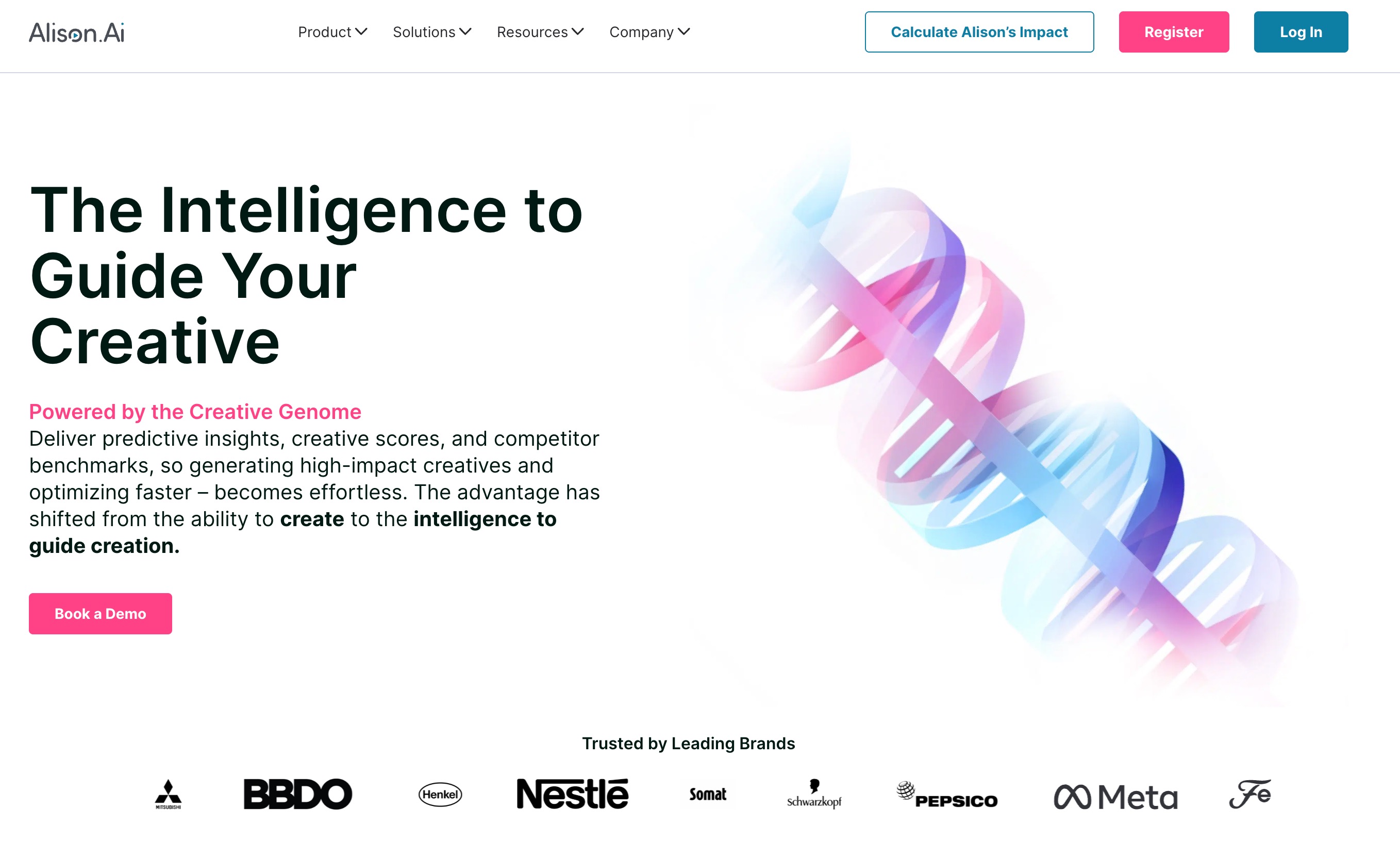
Alison AI is an advanced creative analytics platform that dissects your ad creatives to determine exactly what drives performance. By breaking down video and image elements frame-by-frame, it prevents advertisers from wasting budget on exhaustive A/B testing, using proprietary AI to predict which creatives will yield the best return on ad spend.
Key Features
Predictive Preflight Plus: Analyzes and scores creatives against historical data and platform frameworks before a single dollar is spent.
Element-Level Analysis: Breaks down creatives frame-by-frame (colors, text, sound, pacing) to identify winning traits.
Competitor Benchmarking: Maps out competitor creative strategies seamlessly without requiring you to spend your own test budgets.
Pros
Proven to cut creative testing budgets by up to 50%.
Integrates smoothly with major networks like Meta, TikTok, Google, and Amazon.
Replaces expensive guesswork with highly actionable, data-backed creative briefs.
Cons
Focuses strictly on creative performance rather than bidding or budget pacing strategy.
Pricing can be prohibitive for smaller agencies; requires a demo call to onboard.
Pricing
Custom pricing (requires demo).
4. CreativeX
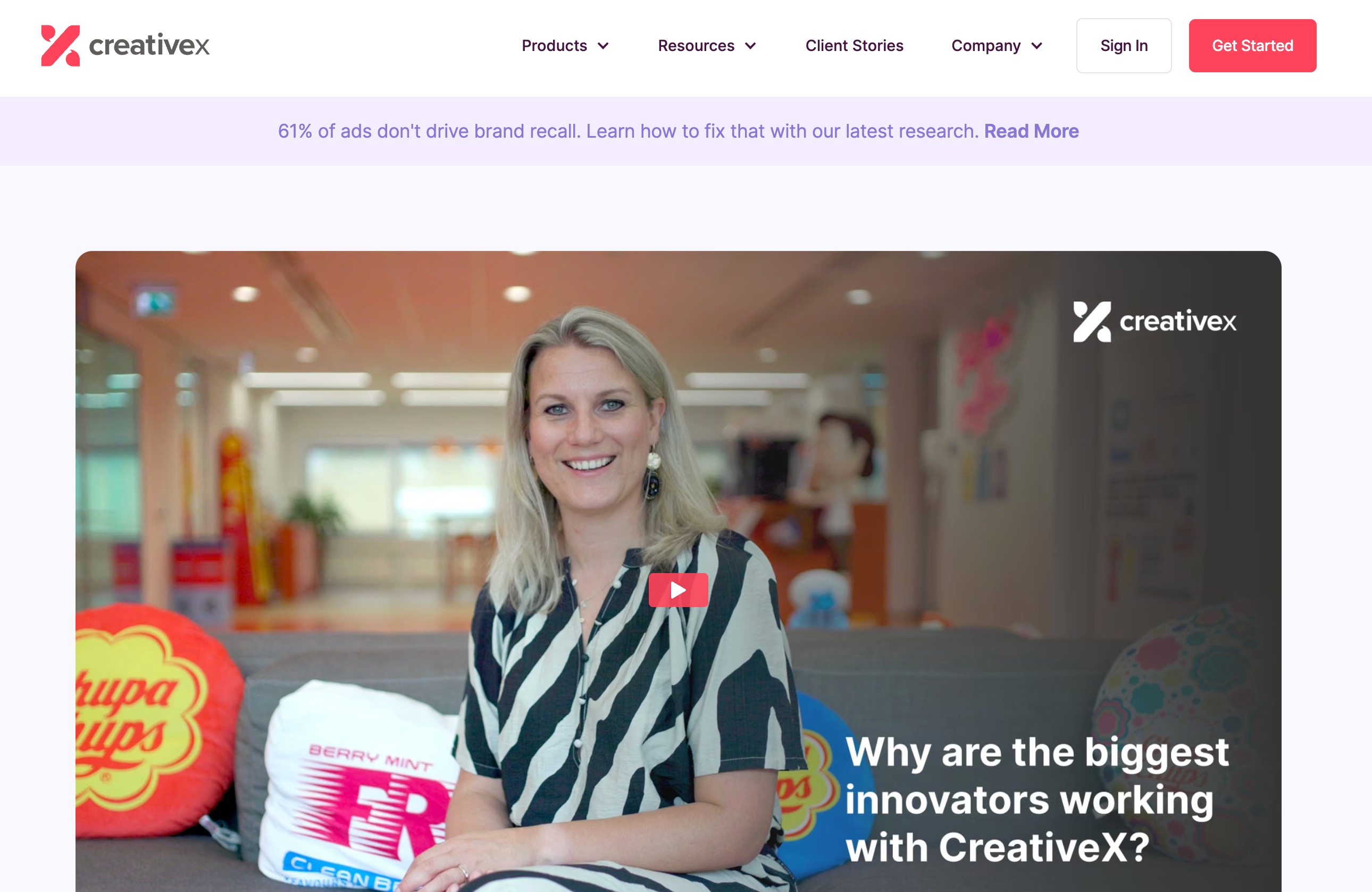
CreativeX empowers enterprise brands to scale their creative excellence and brand consistency across global ad campaigns. It analyzes millions of digital assets to ensure that every ad dollar is put behind creatives that meet specific brand and platform guidelines, maximizing overall media efficiency at scale.
Key Features
Creative Quality Scoring: Automatically evaluates ads against best practices (like Google ABCD) to ensure optimal media spend.
Brand Compliance Monitoring: Flags off-brand or non-compliant creatives before they consume significant ad budget.
Cross-Channel Analytics: Provides a unified, high-level view of creative health across all digital platforms.
Pros
Invaluable for massive, decentralized marketing teams managing thousands of assets.
Significantly boosts baseline ROAS by enforcing platform best practices globally.
Robust, enterprise-grade reporting and governance capabilities.
Cons
Too complex and expensive for SMBs or solo media buyers.
Does not automate media buying or shifting budgets between campaigns.
Pricing
Custom enterprise pricing.
5. WordStream
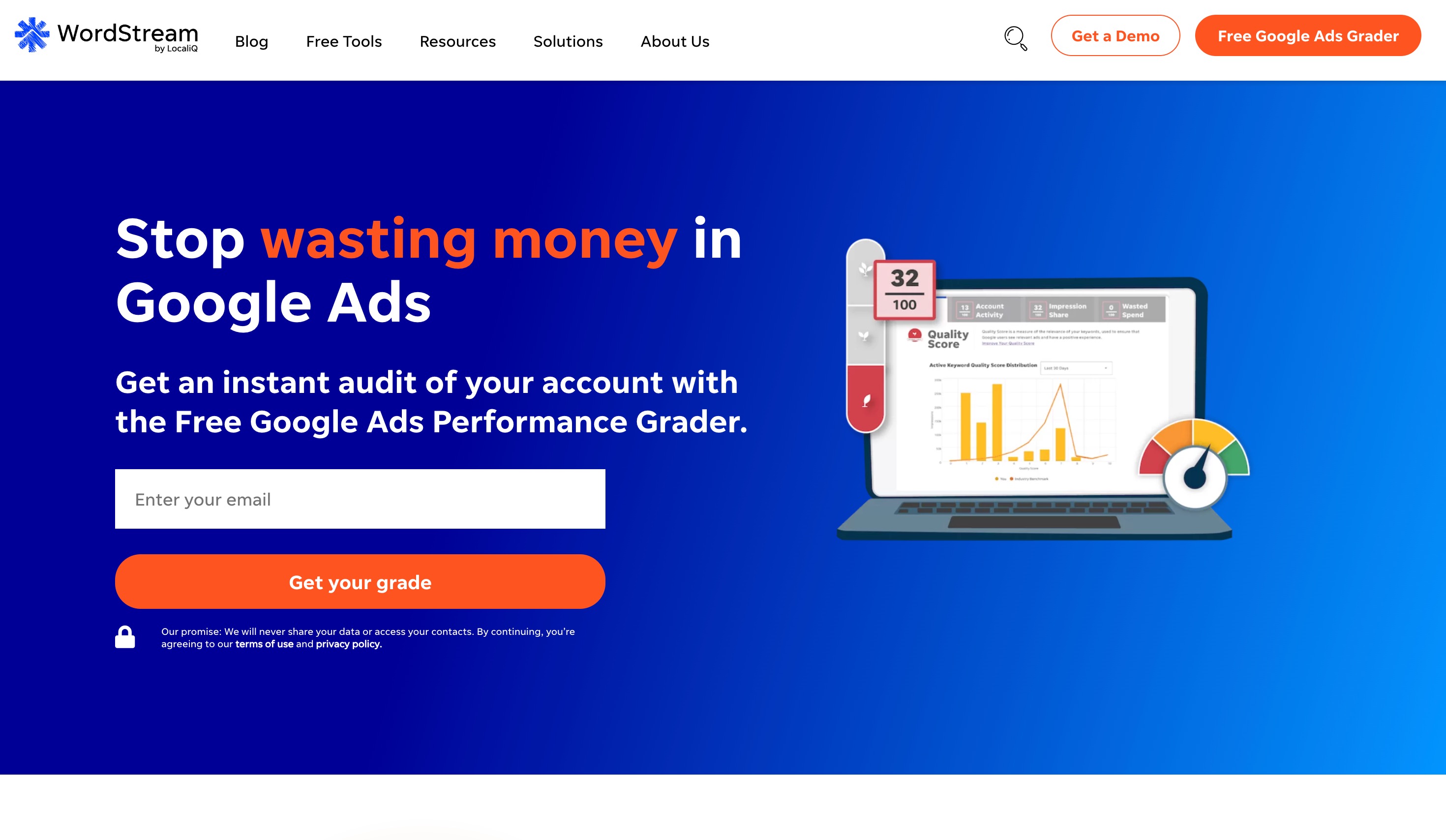
WordStream (by LocaliQ) remains a reliable staple for small to medium-sized businesses looking to optimize their Google and Meta ads. It utilizes machine learning to audit accounts, identify areas of wasted spend, and provide a simplified, guided workflow to improve campaign health without needing to hire a specialized agency.
Key Features
20-Minute Work Week: A structured set of weekly AI-driven recommendations to optimize ad accounts quickly and efficiently.
Performance Grader: Instantly audits your Google Ads account to highlight budget leaks and glaring performance gaps.
Cross-Platform Dashboard: Unifies Google, Facebook, and Microsoft search ads into one accessible interface.
Pros
Highly accessible for beginners, founders, and small business owners.
Clear, step-by-step optimization recommendations are easy to apply.
Great educational resources and support built right into the platform.
Cons
Lacks the deep predictive modeling found in newer, purely AI-native platforms.
Reporting can feel a bit rigid for highly advanced media buyers.
Pricing
Custom pricing.
6. Trapica
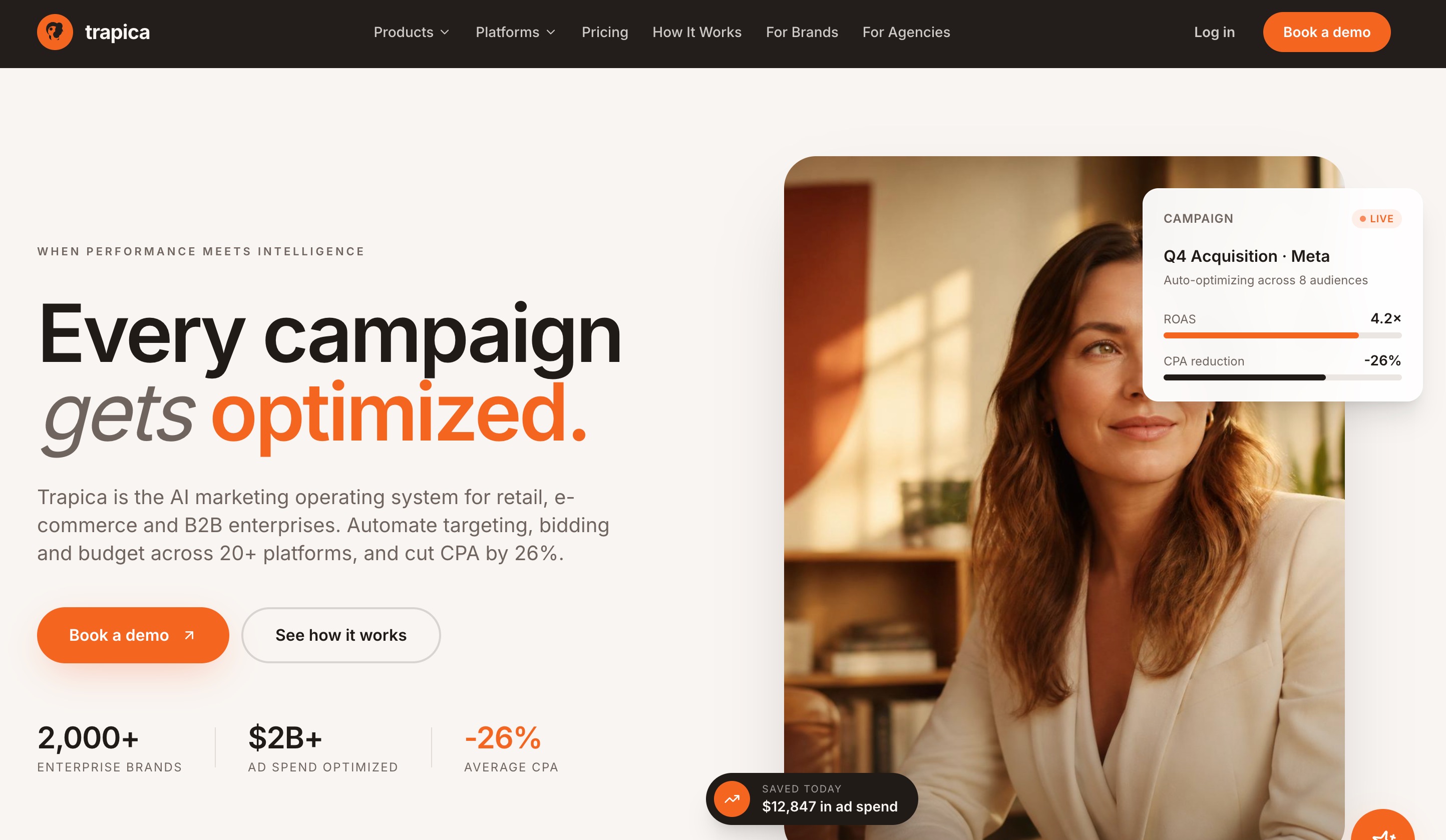
Trapica leverages artificial intelligence to autonomously optimize ad campaigns across multiple social and search networks. It is designed to act as an autonomous media buyer, constantly analyzing conversion data in real-time to adjust targeting, bidding, and budget allocation without the need for manual human intervention.
Key Features
Autonomous Optimization: Automatically scales budgets and adjusts bids 24/7 based on real-time campaign performance.
Predictive Targeting: Uses machine learning to find new, highly profitable audience segments automatically.
Cross-Platform Execution: Works seamlessly across Facebook, Instagram, Google, LinkedIn, and more.
Pros
Saves countless hours of manual bid adjustments and spreadsheet monitoring.
Reacts to market changes and audience fatigue much faster than human buyers.
Excellent for scaling ad spend profitably during high-velocity growth periods.
Cons
Requires relinquishing control to a "black box" AI algorithm.
Takes time to gather enough initial conversion data to optimize efficiently.
Pricing
Custom pricing based on ad spend volume.
7. Smartly AI
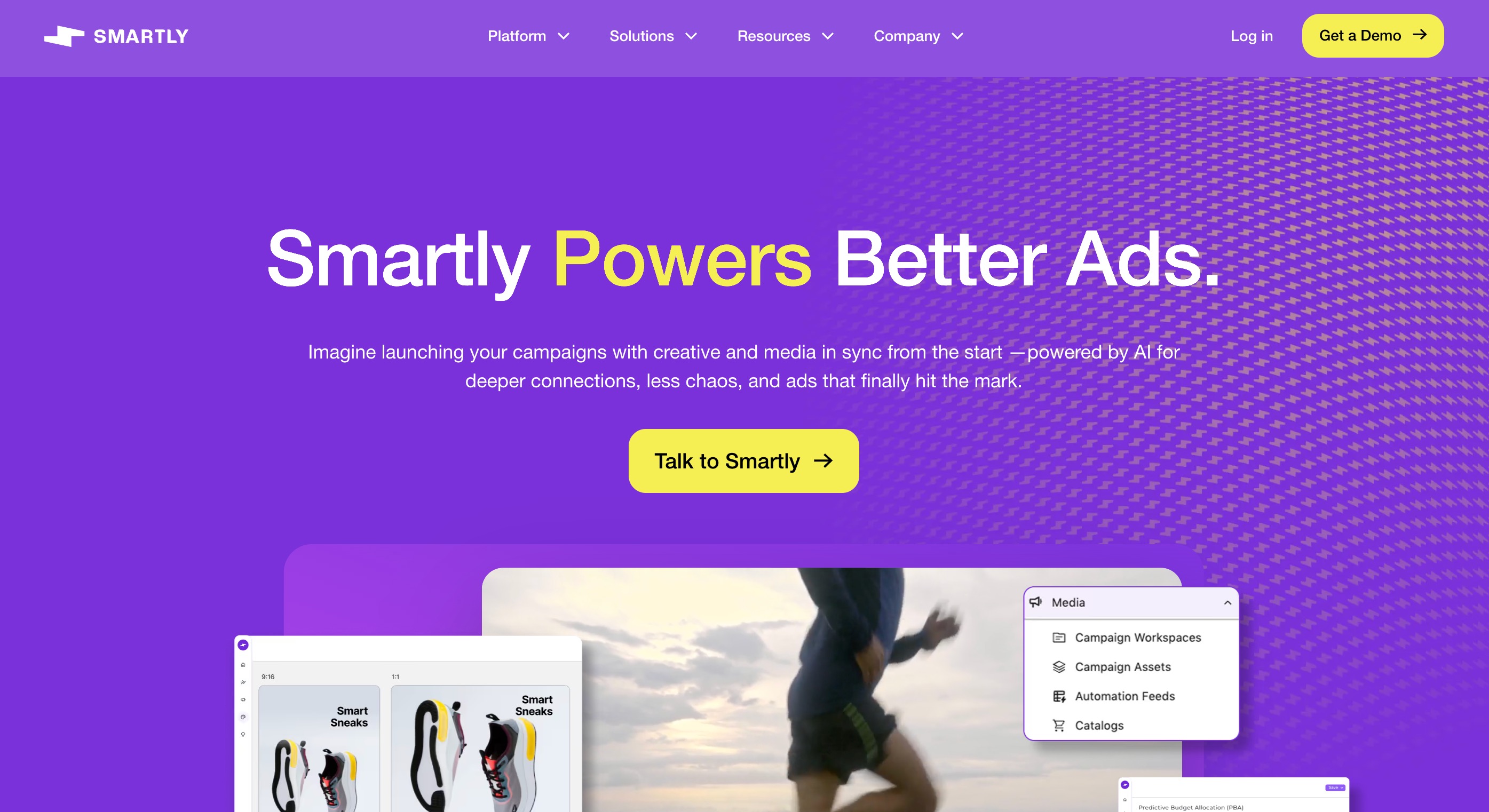
Smartly AI is a leading platform for enterprise social advertising, combining creative automation with robust media buying algorithms. It allows large global brands to automatically generate thousands of ad variations and dynamically allocate spend to the top-performing assets across major social channels at a massive scale.
Key Features
Dynamic Creative Optimization: Automatically tailors ad creatives to specific audiences and localized performance data.
Algorithmic Budget Allocation: Shifts ad spend dynamically to the most profitable campaigns and creatives in real-time.
Modular Campaign Building: Streamlines the rapid creation of massive, multi-market ad structures.
Pros
Unmatched scalability for global advertising campaigns and enterprise brands.
Perfectly bridges the gap between creative design teams and performance marketers.
Deep partnerships and integrations with platforms like Meta, TikTok, and Pinterest.
Cons
Significant learning curve due to the vast array of powerful features.
Enterprise-level pricing puts it entirely out of reach for smaller brands.
Pricing
Custom pricing based on a percentage of ad spend.
8. Albert
Albert is an AI marketing ally that functions as a self-learning autonomous media buyer. It plugs directly into your existing ad accounts, ingests your historical data, and autonomously handles bidding, budget allocation, and campaign structuring to ruthlessly drive down acquisition costs across your entire digital portfolio.
Key Features
Self-Learning Algorithms: Continuously learns from campaign data to improve execution and logic over time.
Multichannel Execution: Autonomously manages search, social, and programmatic ad channels simultaneously.
Micro-Bidding: Adjusts bids at a granular level and frequency that would be impossible for human managers.
Pros
Provides truly hands-free, scalable campaign management.
Excellent at discovering untapped audience segments you may have missed.
Consistently drives highly efficient ROAS at a massive scale.
Cons
Requires a very high level of trust to let the AI control the budget entirely.
Initial setup, mapping, and integration can be complex and time-consuming.
Pricing
Custom pricing based on ad spend.
9. Madgicx
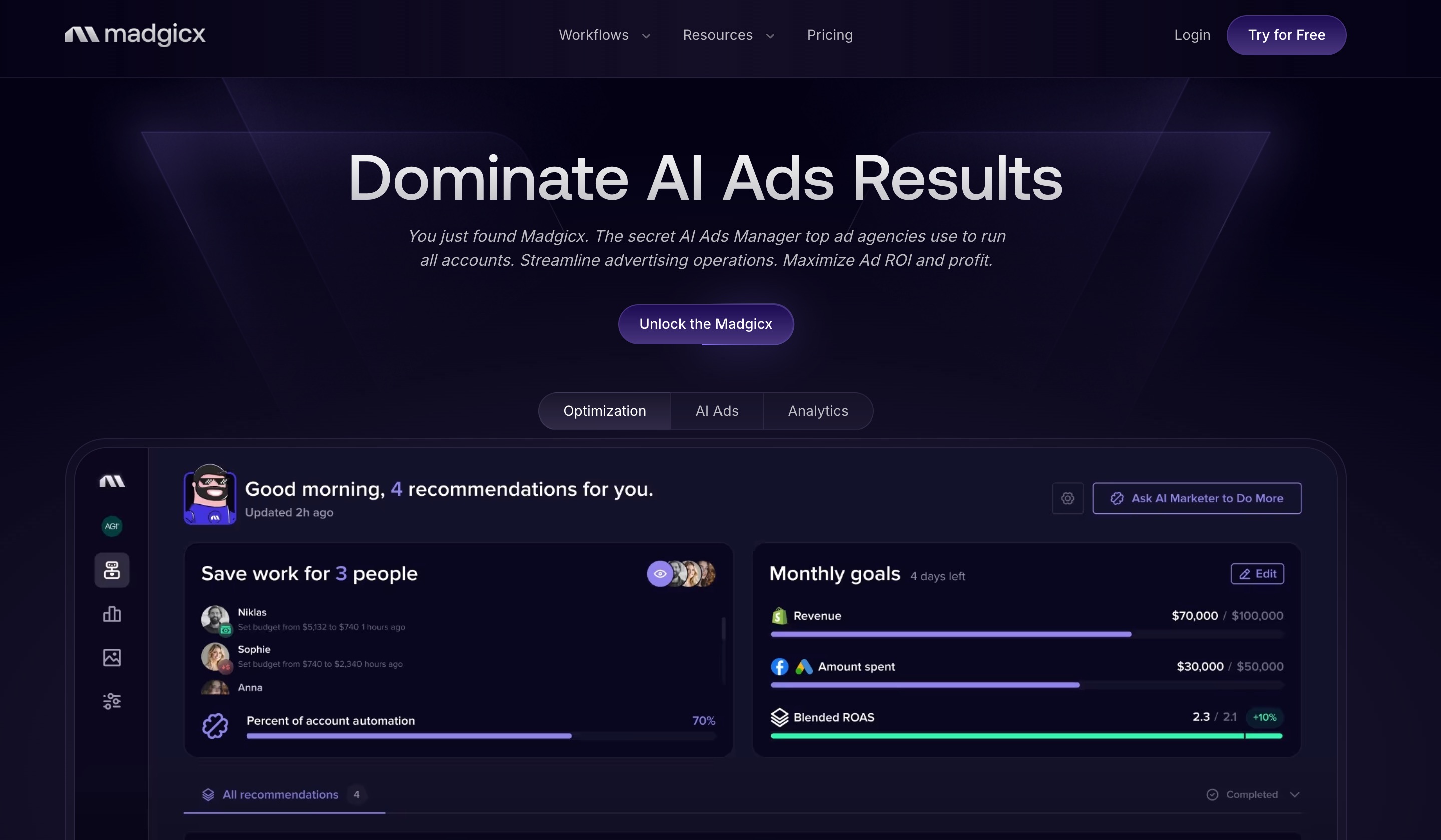
Madgicx is an omnichannel advertising platform designed specifically for Meta and Google Ads. It combines AI-driven automation with advanced creative insights, allowing media buyers to optimize their ad spend, uncover hidden audience segments, and aggressively scale profitable campaigns with minimal manual effort.
Key Features
AI Bidding & Budgeting: Automated rules that protect ad spend from bleeding and scale winning ads aggressively.
Audience Studio: Uncovers hidden, high-performing audience intersections using advanced AI data mapping.
Creative Insights: Analyzes which specific visual elements in your ads are driving the highest conversions.
Pros
Comprehensive all-in-one dashboard for media buying, automation, and analytics.
Very strong specifically for optimizing the Meta Ads ecosystem.
Highly accessible pricing tiers for mid-market agencies and direct-to-consumer brands.
Cons
The sheer number of features and toggles can overwhelm new users.
Navigating between different optimization suites takes some practice.
Pricing
Starts at $45/month.
10. Adsroid
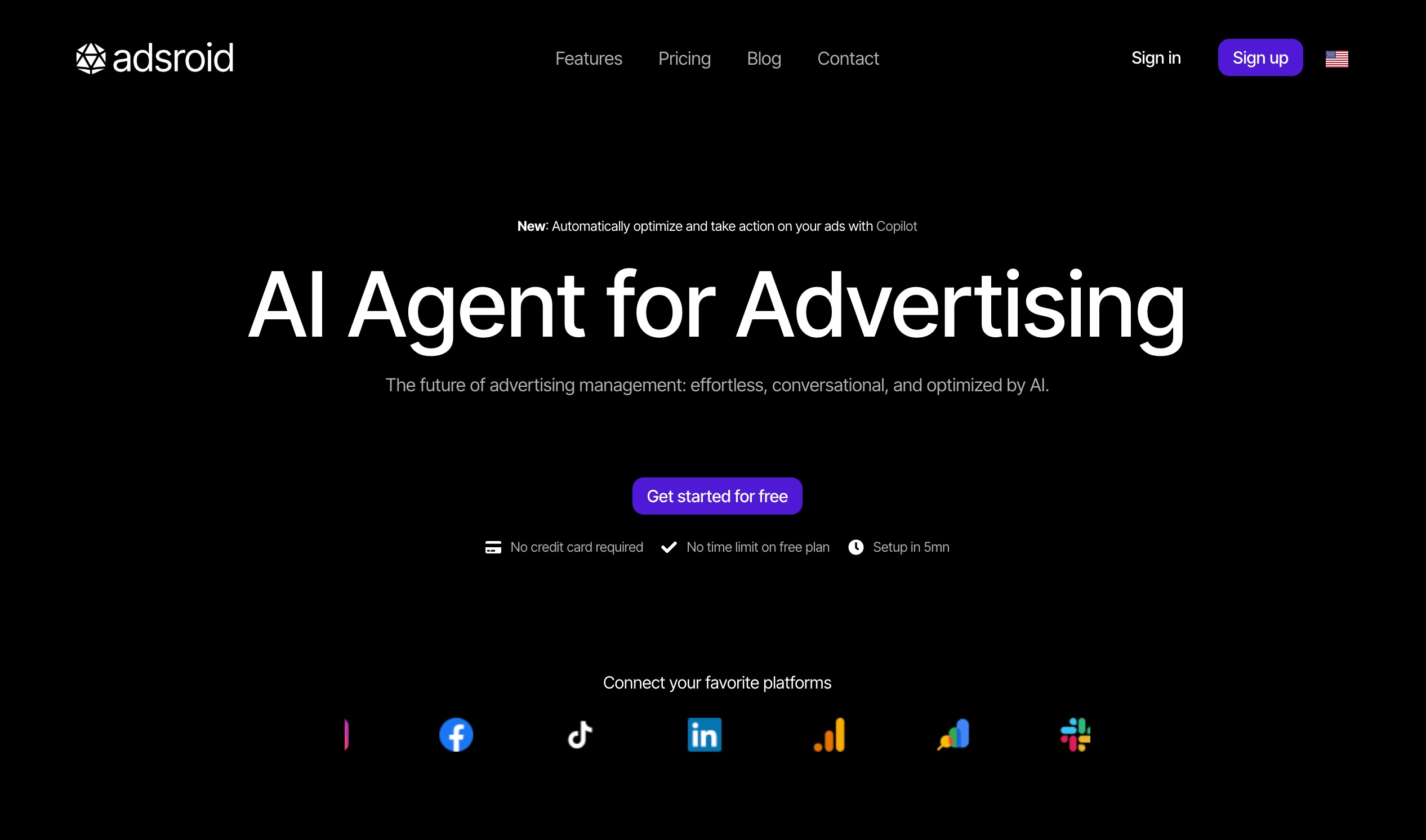
Adsroid is a conversational AI agent tailored specifically for advertising performance. Instead of navigating complex dashboards, marketers can ask Adsroid questions in plain language to instantly retrieve insights, track performance anomalies, and receive optimization recommendations across Google Ads, Meta, and TikTok.
Key Features
Conversational Interface: Query your ad data using natural language (e.g., "What are my best-performing campaigns this week?").
Cross-Platform Syncing: Connects seamlessly with Google Ads, Meta Ads, TikTok, and Google Analytics 4 via official APIs.
Automated Tracking Integration: Easily injects tracking pixels (GTM, Meta, TikTok) site-wide without needing to code.
Pros
Incredibly intuitive chat-based data analysis saves hours of digging.
Eliminates the need to manually build custom reports or complex pivots.
Great for quick, on-the-fly campaign check-ins and cross-channel insights.
Cons
Focuses more on insights and conversational recommendations rather than autonomous media buying.
Advanced users might miss traditional, highly customizable granular data grids.
Pricing
$29/month.
How to choose the right tool without wasting budget
Selecting the right AI tool is critical; adopting the wrong software can paradoxically waste more money than it saves. Here is how to evaluate your options objectively:
Assess Your Team's Technical Skill: If you have an enterprise team running global social campaigns, complex platforms like Smartly AI or Albert are incredibly powerful choices. However, if your team lacks technical bandwidth, you must prioritize a no-code solution.
Determine Your Specific Bottleneck: Are you struggling primarily with creative testing? Alison AI is ideal for that specific workflow. Are you struggling to build initial B2B audiences? Origami AI works best.
Evaluate Data Presentation Needs: Raw insights are utterly useless if you cannot communicate them to stakeholders. This is where Powerdrill Bloom heavily outperforms the competition. While other tools just give you dashboards, Powerdrill Bloom acts as a general-purpose AI agent that actually gets work done. It digests your ad spend files via its persistent Workspaces and instantly turns complex raw data into beautiful, one-click presentation decks and charts.
Avoid "Black Box" Lock-In: Pure autonomous buyers (like Trapica) take complete control of your budget. If you want to maintain strategic control while automating the heavy lifting of analysis and research, Powerdrill Bloom offers the perfect balance. You can run specialized skills to uncover budget waste without forcing yourself to surrender your ad accounts entirely to an unreadable algorithm.
Conclusion
Navigating ad spend in today's highly volatile digital ecosystem requires far more than just intuition; it demands intelligent, data-driven execution. While platforms like Madgicx, WordStream, and Alison AI offer fantastic niche solutions for media buying and creative analysis, they often leave you with the administrative burden of reporting, cross-referencing data, and building presentations for your team or clients.
If you want to truly revolutionize how your team handles campaign data, you need an AI agent that doesn't just answer questions, but actively does the work for you. Start streamlining your marketing workflow today with Powerdrill Bloom. Connect your raw data, leverage persistent Workspaces to remember your context, and let the AI instantly turn your ad metrics into actionable insights, charts, and client-ready presentation decks. Stop merely analyzing your data, and start executing with Powerdrill Bloom.
FAQs
What is the main benefit of using AI for ad spend?
AI drastically reduces wasted budget by instantly identifying underperforming ads and reallocating spend to high-converting campaigns automatically.
Can AI replace human media buyers entirely
No. While AI handles tedious data analysis and bid adjustments, human strategists are still essential for overall campaign direction.
Is it difficult to integrate these AI tools?
Most modern tools offer plug-and-play integrations with major networks like Meta and Google, requiring zero coding to set up.
Why should I choose Powerdrill Bloom over others?
Powerdrill Bloom uniquely turns your raw ad spend data into actionable insights, charts, and instant presentation decks without coding.
Are these AI platforms safe for my campaign data?
Yes. Leading tools use enterprise-grade encryption and strictly follow platform API protocols to ensure your advertising data remains secure.