Data Fact: AI Is Reshaping the Global Job Market Faster Than Ever
The global economy is currently navigating a structural transformation of unprecedented speed and scale. For years, economists and technologists have theorized about the eventual impact of artificial intelligence on human labor. Today, as we stand in the third quarter of 2026, those theories have materialized into hard, quantifiable realities. Leveraging insights and interactive charts generated byPowerdrill Bloom, this report paints a definitive picture: AI is reshaping the global labor market faster than any prior general-purpose technology, surpassing the initial adoption curves of both the steam engine and the personal computer.
To understand the sheer velocity of this shift, one must look past theoretical models and examine the immediate actions of the world’s most profitable corporations. The recent waves of corporate restructuring are not symptoms of a macroeconomic recession, but rather deliberate capital reallocations designed to fund the AI revolution.
The Canaries in the Cognitive Coal Mine: Microsoft and Visa
The clearest indicators of this paradigm shift are the aggressive talent restructurings at enterprise giants like Microsoft and Visa. Over the past two and a half years, both companies have executed sweeping workforce reductions despite boasting formidable profit margins and market capitalizations.
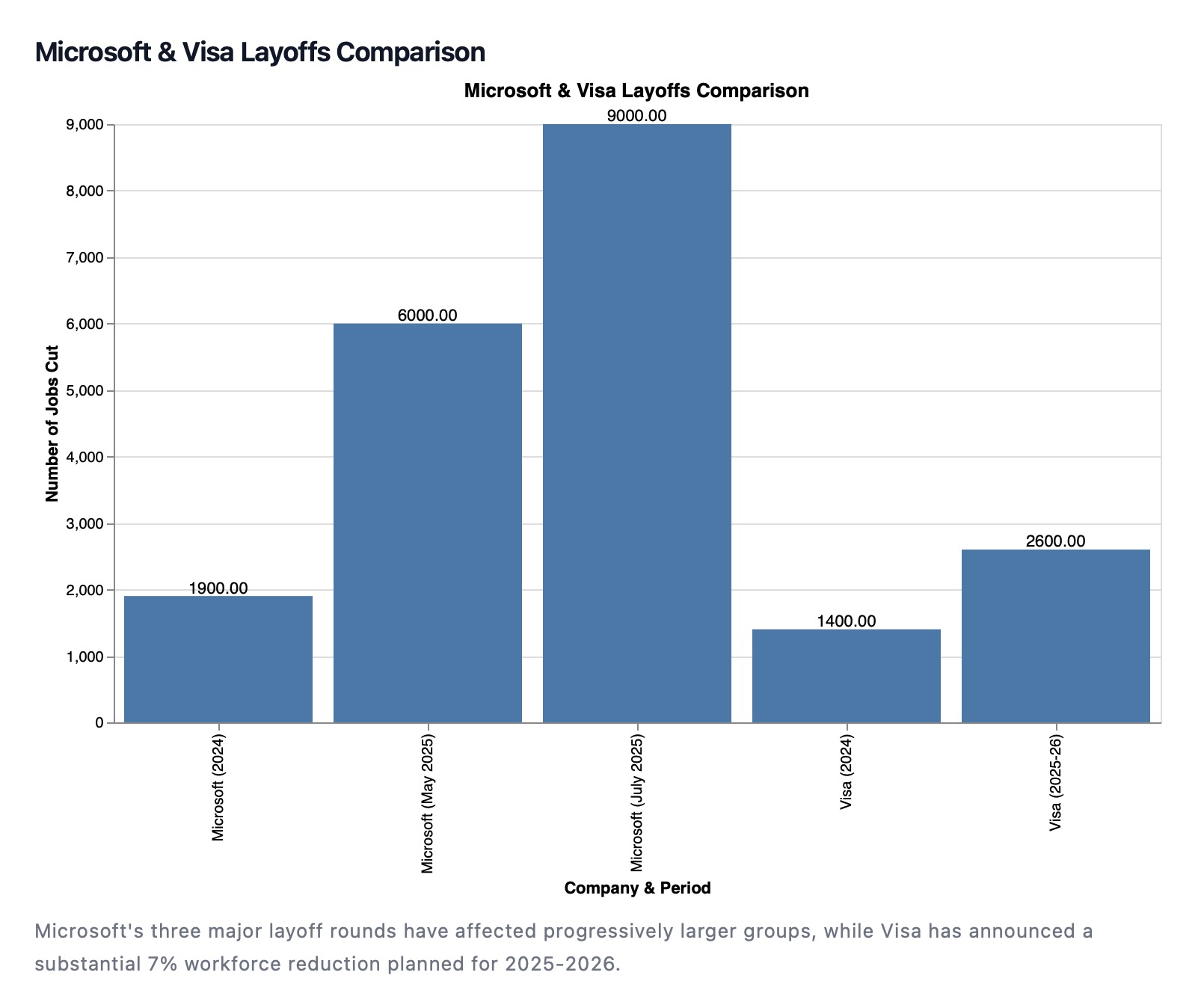
Between January 2024 and July 2025, Microsoft eliminated over 16,000 positions across multiple rounds of layoffs. This was not a desperate cost-cutting measure to save a struggling business; it was a strategic pivot to free up capital for a staggering $80 billion investment in AI infrastructure, including specialized data centers and advanced GPU clusters. Human capital was downsized to finance machine capital.
Similarly, financial services giant Visa has reduced its workforce by over 4,000 employees. The cuts were rolled out in distinct phases—1,400 jobs eliminated in 2024, followed by an additional 2,600 cuts spanning 2025 and 2026. Unlike layoffs of the past, Visa explicitly cited "AI-driven efficiency" as the primary driver for these reductions, demonstrating how generative AI and machine learning algorithms are directly assuming the workloads previously managed by human analysts and administrative staff.
The Layoff Explosion: Firing to Fund the Future
Microsoft and Visa are merely the vanguard of a much broader industry trend. A closer look at the broader technology sector reveals a massive labor churn occurring beneath the surface. In 2025 alone, 271 tech companies laid off a combined 124,201 employees.
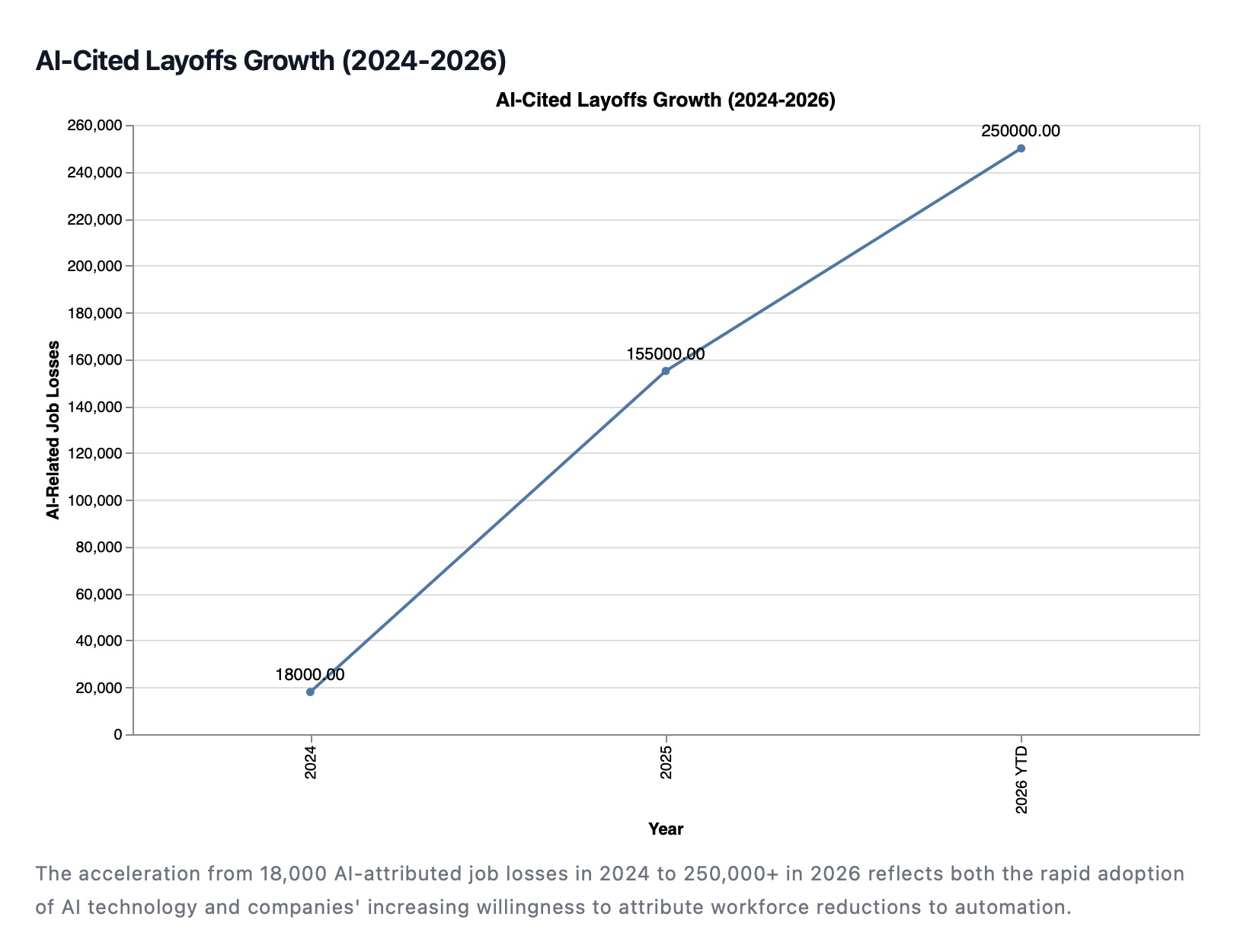
However, the most startling revelation is not the total volume of layoffs, but the reasons cited for them in regulatory filings and investor calls. In 2024, approximately 18,000 job cuts were explicitly attributed to artificial intelligence—either because the roles were automated by AI, or because the capital was redirected toward AI investments. By 2025, that number surged to roughly 155,000. Today, year-to-date in 2026, AI-cited layoffs have exploded to over 250,000. We are witnessing a systemic substitution of traditional tech and administrative roles for AI efficiency.
The Scale of Exposure: A Counter-Intuitive Geography
When analyzing the global impact of this technology, the numbers are staggering. According to a synthesis of data from the International Monetary Fund (IMF), the World Economic Forum (WEF), and the International Labour Organization (ILO), approximately 40% of all global employment is currently exposed to AI disruption.
Yet, the distribution of this exposure yields a highly counter-intuitive headline: advanced economies face the highest level of risk.
According to an IMF Working Paper (WP/25/76, April 2025), a staggering 60% of jobs in advanced, high-income economies are exposed to AI. This is not because these nations are lagging behind in technological infrastructure; it is precisely because their labor markets are heavily concentrated in the highly paid, cognitive, and white-collar tasks that current generative AI models automate best. Unlike the Industrial Revolution, which primarily automated physical and blue-collar labor in manufacturing and agriculture, the AI revolution is directly targeting the knowledge economy.
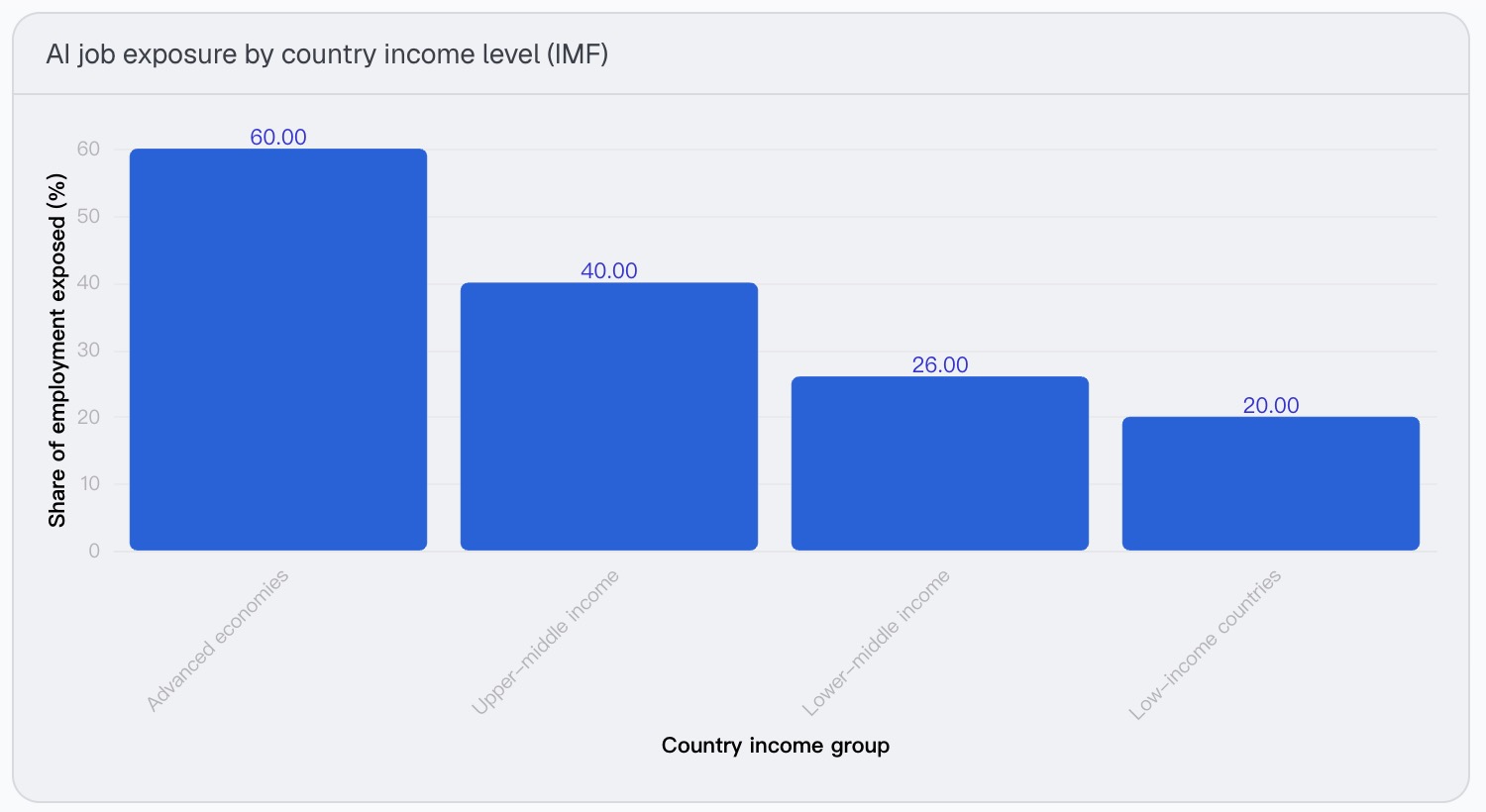
Developing and emerging markets, which still rely more heavily on manual labor, agriculture, and traditional manufacturing, face significantly lower immediate exposure to AI-driven job displacement, though they also stand to benefit less from the subsequent productivity booms.
The Great Churn: Winners, Losers, and the Human Cost of "Net Growth"
If 40% of the global workforce is exposed, what does the actual transition look like? The World Economic Forum’s projections for the remainder of the decade highlight a labor market defined by extreme volatility.
By 2030, the WEF projects that 92 million jobs will be displaced globally, while 170 million new jobs will be created. From a purely mathematical standpoint, this results in a net positive of 78 million jobs. However, the macroeconomic "net growth" obscures the microeconomic reality. The real story is the churn.
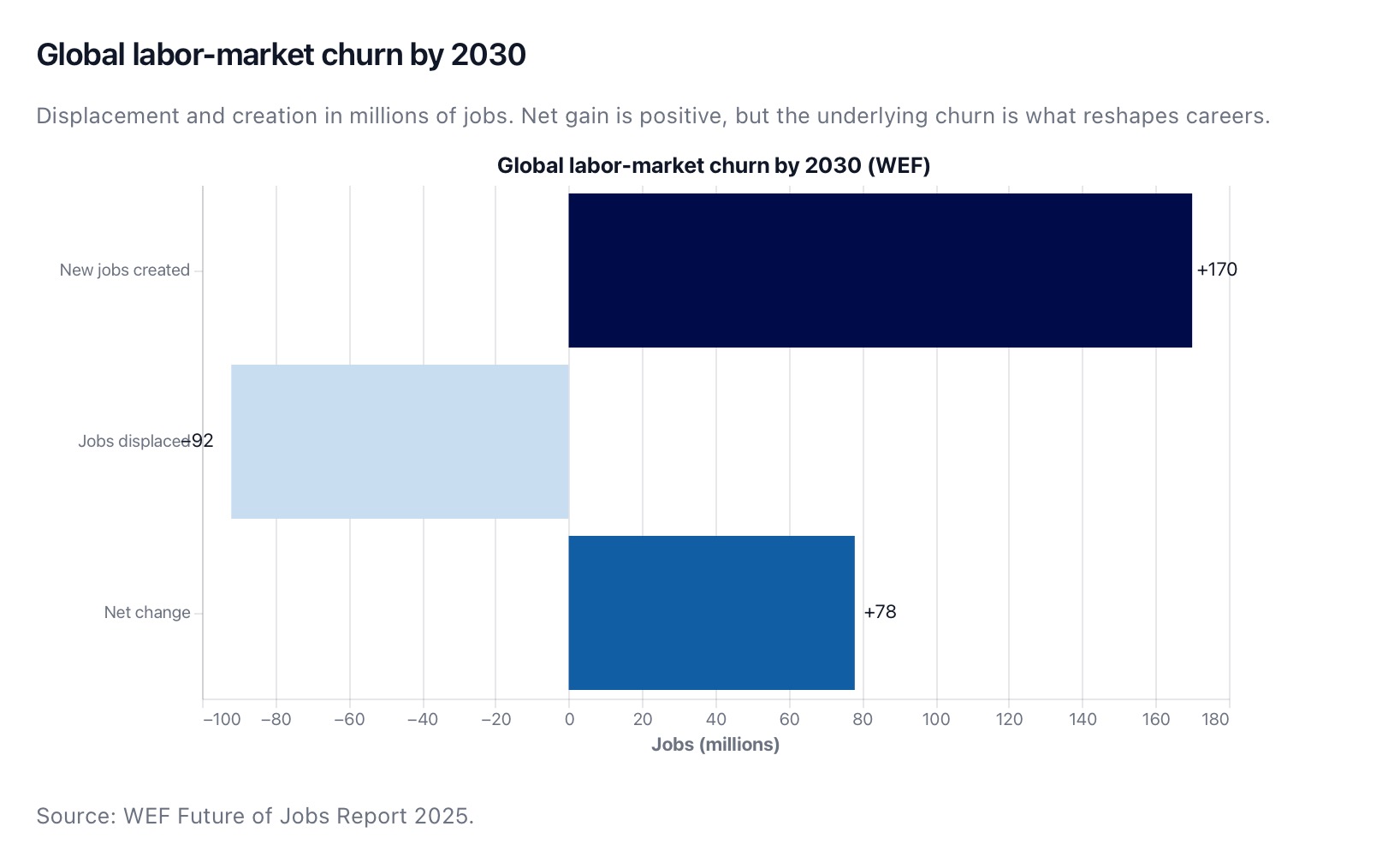
A net gain of 78 million jobs provides little comfort to a worker whose highly specialized skills are rendered suddenly obsolete. The modern economy cannot seamlessly reallocate a displaced payroll clerk into a prompt engineering role.
The data on the "losers" of this transition is already crystallizing. According to the WEF and ILO, clerical, administrative, accounting, and legal-secretary roles top the list of declining professions. The journalism and media sector is also experiencing severe contraction; data from Press Gazette reveals that over 4,000 journalism jobs have been cut in 2026 alone across more than 30 media firms, as AI-generated content and automated reporting tools erode traditional newsroom staffing.
Furthermore, this disruption carries a stark demographic disparity. Because the administrative and clerical roles most vulnerable to AI automation are disproportionately held by women, the ILO reports that women are 2.7 times more exposed to AI-driven displacement than men in high-income countries. This threatens to unwind decades of progress toward gender parity in the corporate workplace.
The Hiring Split: The Rise of the AI Elite
While traditional cognitive roles are being hollowed out, companies are aggressively recruiting for the skills required to build, implement, and manage AI systems. We are witnessing a severe bifurcation in the labor market—a "hiring split" that heavily favors a new class of technological elite.
Recent data from LinkedIn illuminates this divide: while general technology job postings have dropped by 36% as companies trim bloated software development teams, postings for AI engineers and related AI specialists have skyrocketed by 59%. Companies are not abandoning tech talent; they are executing a hyper-specific pivot toward artificial intelligence.
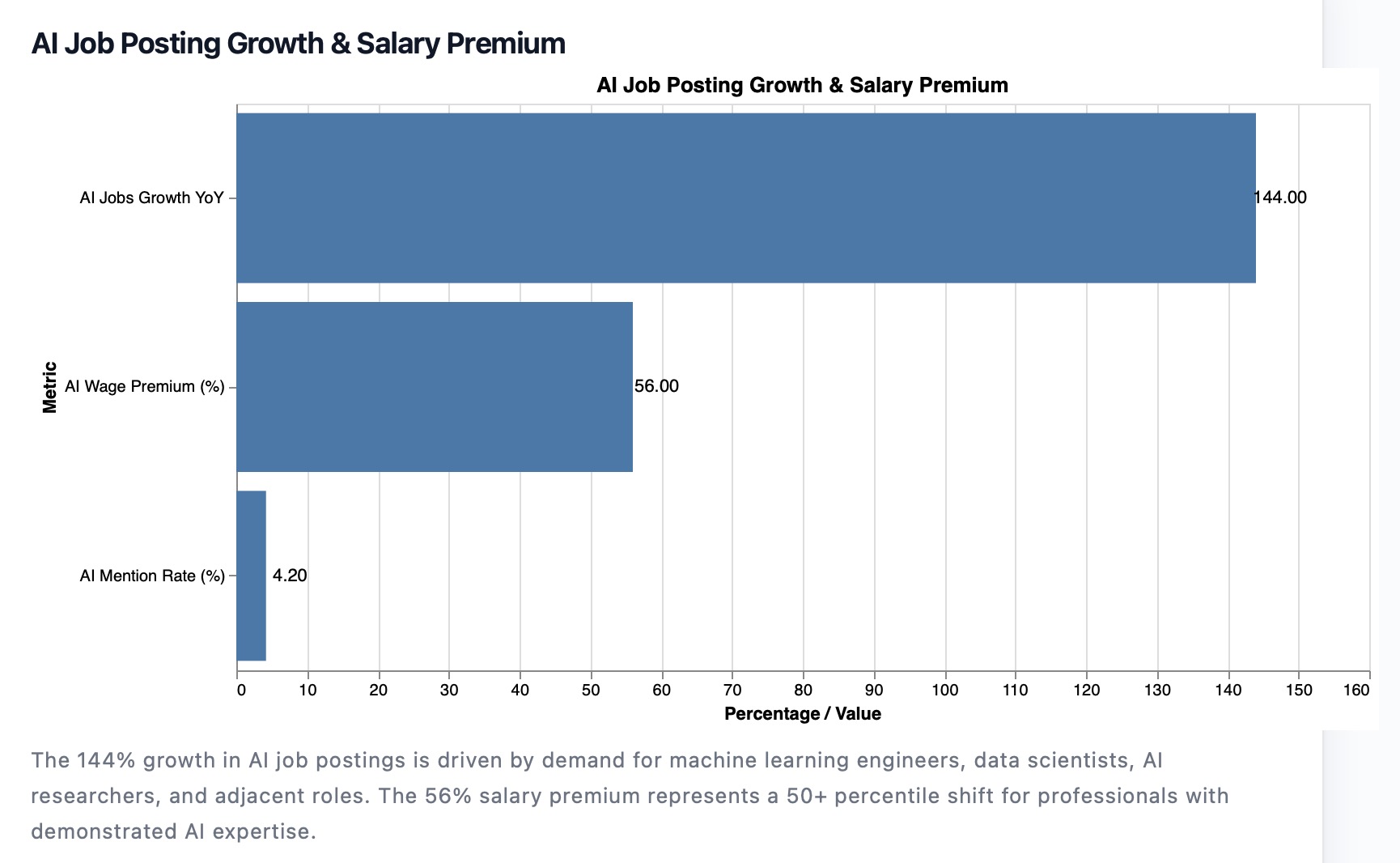
Because the supply of seasoned AI talent is vastly outstripped by corporate demand, workers possessing these niche skills are commanding unprecedented compensation. According to research from PwC, AI-related skills currently command a 56% wage premium over non-AI roles in the same sectors. The financial baseline for this talent pool is staggering, with base pay for AI specialists currently ranging between $145,000 and $310,000. This is creating a "winner-takes-all" dynamic where a small fraction of the workforce captures the vast majority of new tech capital.
The Macro View: GDP Boosts vs. The Reskilling Reality
Ultimately, corporations are enduring this painful, expensive labor churn because the anticipated macroeconomic payoff is historic. Long-term projections from Goldman Sachs and the Penn Wharton Budget Model (PWBM) suggest that generative AI could lift global Gross Domestic Product (GDP) by approximately 7%—a massive injection of roughly $7 trillion into the global economy.
However, this productivity boom will not happen overnight. The PWBM models project an adoption "J-curve," wherein the initial years are marked by high capital expenditure and labor disruption, before productivity gains fully materialize. The AI contribution to annual GDP growth is expected to gradually accelerate, peaking at an additional +0.2 percentage points per year around 2032, before eventually fading as the technology becomes a fully integrated, baseline component of the global economy.
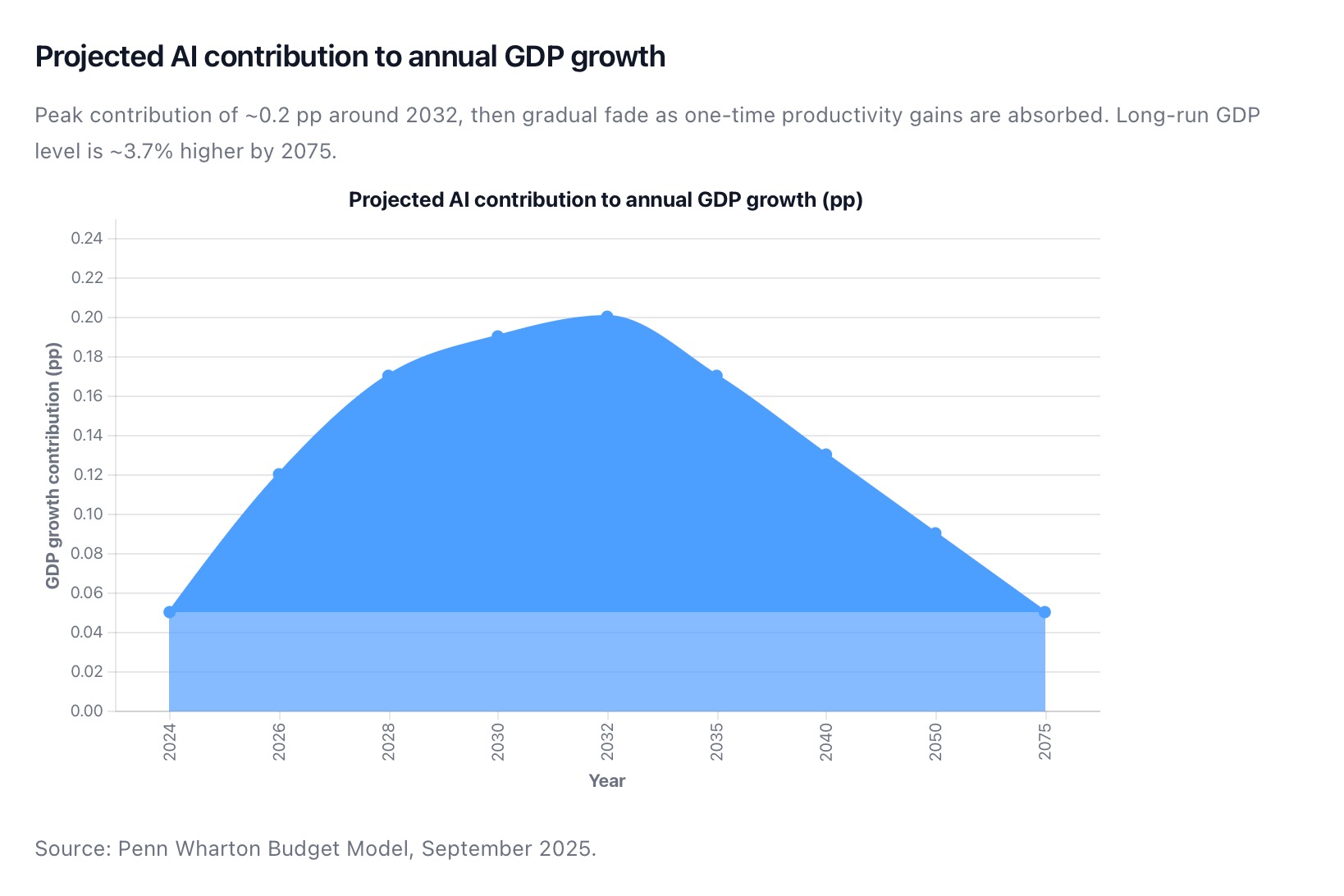
The bridge between today's labor disruption and tomorrow's GDP boom is reskilling. Unfortunately, this is where the global economy is failing most acutely.
According to joint findings from McKinsey and the OECD, an overwhelming 98% of workers will require some degree of reskilling by 2030 to remain viable in an AI-integrated economy. Despite this near-universal need, the current corporate and government response is deeply inadequate. The same data indicates that only about 30% of workers have received any relevant, formal AI training in the past year.
We are hurtling toward a $7 trillion productivity boom, but we are leaving the vast majority of the workforce structurally unprepared to participate in it.
What This Means
FINDING 1
AI is now the primary driver of tech workforce restructuring. Unlike prior layoff waves, companies are explicitly attributing headcount reductions to AI deployment and automation. This signals a strategic decision to invest in AI infrastructure while reducing traditional roles.
FINDING 2
Entry-level and QA roles are most vulnerable. Data shows that junior programmers, quality assurance testers, and other routine-task roles face the highest displacement risk. These roles are most amenable to AI automation.
FINDING 3
AI skills command unprecedented premiums. A 56% wage premium for AI expertise is exceptional in tech and signals extreme scarcity. This creates a widening bifurcation between AI-skilled and traditional tech workers.
FINDING 4
The transition will be disruptive but not catastrophic long-term. WEF projections show net job creation, but the transitional period (2026-2028) will likely see elevated unemployment and wage pressure in displaced sectors, particularly for workers without AI skills or ability to reskill.
FINDING 5
Microsoft and Visa serve as canaries for the broader market. Both companies are making proportionally larger cuts (Microsoft ~7.5% of workforce, Visa 7%) compared to prior years, and both are explicitly investing heavily in AI. This suggests other Fortune 500 companies may follow similar patterns.
Implications for Career Development
Upskilling in AI is now critical. The 144% growth in AI job postings and 56% wage premium make AI competency a career-defining differentiator. Entry-level and mid-career professionals should prioritize learning machine learning, LLM applications, and data science.
Traditional roles are commoditizing. General software engineering, QA, and other routine roles are becoming easier to automate. Professionals in these roles should move toward problem-solving, architecture, or AI-adjacent positions.
Geographic and sectoral variation matters. Not all tech hubs or sectors will be equally affected. AI infrastructure, cloud, and specialized SaaS companies may see net job growth, while traditional enterprise IT faces greater contraction.
Wage bifurcation is widening. The 56% premium for AI skills suggests growing inequality within tech. Professionals with AI skills will see robust demand, while those without may face stagnating wages or job insecurity.
Conclusion: Navigating the New Reality
The structural realignment of the global job market is no longer a future possibility—it is a present-day reality, evidenced by the data cascading from global institutions and multinational corporations alike. The tens of thousands of layoffs at market leaders like Microsoft and Visa are not anomalies; they are the early tremors of a massive seismic shift.
AI is undeniably reshaping the labor market faster than ever. While the long-term macroeconomic outlook promises unparalleled GDP growth and the net creation of tens of millions of new jobs, the transitional churn will define the economic narrative of the next decade.
For policymakers, corporate leaders, and individual workers, the mandate is clear. The focus must urgently shift from debating whether AI will change the economy to aggressively closing the reskilling gap.
Are you ready to future-proof your career, monitor industry disruptions, or optimize your business strategy? Head over to Powerdrill Bloom today to generate your own customized data reports, interact with real-time charts, and discover exactly how the AI revolution is impacting your specific sector.
FAQs
Why are highly profitable tech companies laying off workers?
They are strategically reallocating capital to fund massive AI infrastructure investments rather than cutting costs to survive a downturn.
Which countries are most affected by AI job displacement?
Advanced economies face the highest risk, with 60% exposure, because AI excels at automating their prevalent cognitive, white-collar tasks.
Will AI destroy more jobs than it creates?
No, projections show a net positive of 78 million jobs by 2030, though the transition involves severe labor churn.
Which professions are losing the most jobs to AI?
Clerical, administrative, accounting, legal-secretary, and journalism roles face the steepest declines as AI successfully automates repetitive cognitive tasks.
How much more do AI professionals earn?
AI specialists currently command a massive 56% wage premium, with base salaries often ranging between $145,000 and $310,000 annually.