Data Fact: 97% of Corporate Data Sleeps Forever —Why "Dark Data" Has Become 2026's Biggest Climate Problem
In the modern digital economy, data has long been heralded as the new oil. Enterprises across the globe have spent the last two decades obsessively drilling, refining, and hoarding every single byte of information they can capture. From customer interaction logs and IoT telemetry to high-definition surveillance feeds and AI-generated content, the global datasphere has expanded at a breathtaking, exponential rate. However, unlike physical commodities that are consumed and repurposed, digital data has a dirty secret: the vast majority of it is entirely useless.
Note: All the staggering statistics, projections, and illuminating charts featured in this comprehensive report were generated and verified using Powerdrill Bloom, providing us with unparalleled, data-driven insights into the escalating dark data crisis.
Welcome to the era of "Dark Data." This silent, invisible mass of digital information is collected once, perhaps utilized for a fleeting moment, and then abandoned to sleep perpetually on power-hungry servers. Today, an astonishing 97% of enterprise data is never re-accessed after just 90 days. While corporate boardrooms obsess over artificial intelligence, digital transformation, and market share, this unmanaged digital landfill has quietly become one of the largest, least-discussed contributors to corporate carbon emissions in 2026. This blog will explore the scale of the dark data crisis, its devastating environmental and financial toll, the industries most responsible, and crucially, provide a detailed analysis of what organizations must do in the future to mitigate this impending catastrophe.
The Exponential Growth of the Unseen Datasphere
To truly grasp the magnitude of the dark data problem, we must first confront the sheer volume of information being generated. In the pursuit of big data analytics and machine learning dominance, a dangerous corporate philosophy emerged: "store everything, just in case." This mindset has led to a catastrophic divergence between the amount of data we create and the amount of data we actually use.
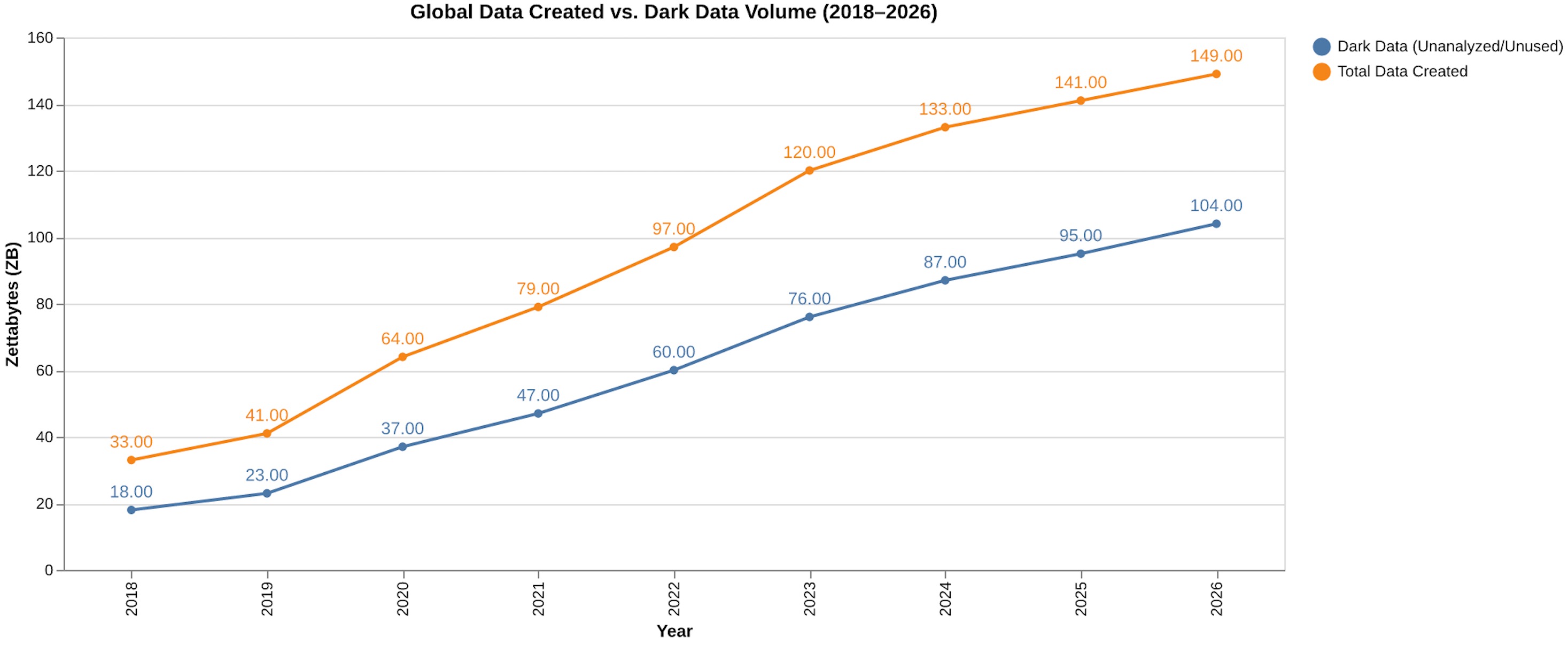
As illustrated in the chart above, total global data creation has grown 4.5 times in just eight years, surging from 33 Zettabytes (ZB) in 2018 to a staggering 149 ZB in 2026. Yet, the share of this data that is "dark", collected but never queried, analyzed, or acted upon, has grown at an even faster velocity.
By 2026, an estimated 104 ZB of the global datasphere qualifies as dark data. To put this into perspective, a single zettabyte is equal to one trillion gigabytes. If you were to store 104 ZB on standard 1-terabyte hard drives and stack them end-to-end, the tower would reach to the moon and back multiple times.
This widening gap represents a fundamental failure in corporate data governance. Data is naturally "hot" at the point of creation—actively processed, queried, and utilized for immediate business intelligence. However, within a mere 90 days, its utility drops off a cliff. Instead of being archived efficiently or safely deleted, it is simply left to languish on premium, high-availability storage tiers because IT departments lack the visibility or the mandate to clean it up. The result is a monumental digital hoarding crisis that forms the foundation of a massive environmental liability.
The Energy Toll: Powering the Invisible
The term "cloud computing" is one of the most successful marketing euphemisms in modern history. It evokes images of weightless, ethereal, and environmentally frictionless infrastructure. The reality is quite the opposite. The "cloud" is heavily grounded in massive, sprawling data centers packed with millions of spinning disk drives, processors, and industrial-grade cooling systems. These facilities run 24 hours a day, 7 days a week, 365 days a year.
When data sleeps, the servers housing it do not. They continue to draw immense amounts of electricity to keep the drives spinning, to maintain redundant backups, and most importantly, to power the massive air conditioning units required to prevent the hardware from melting down.
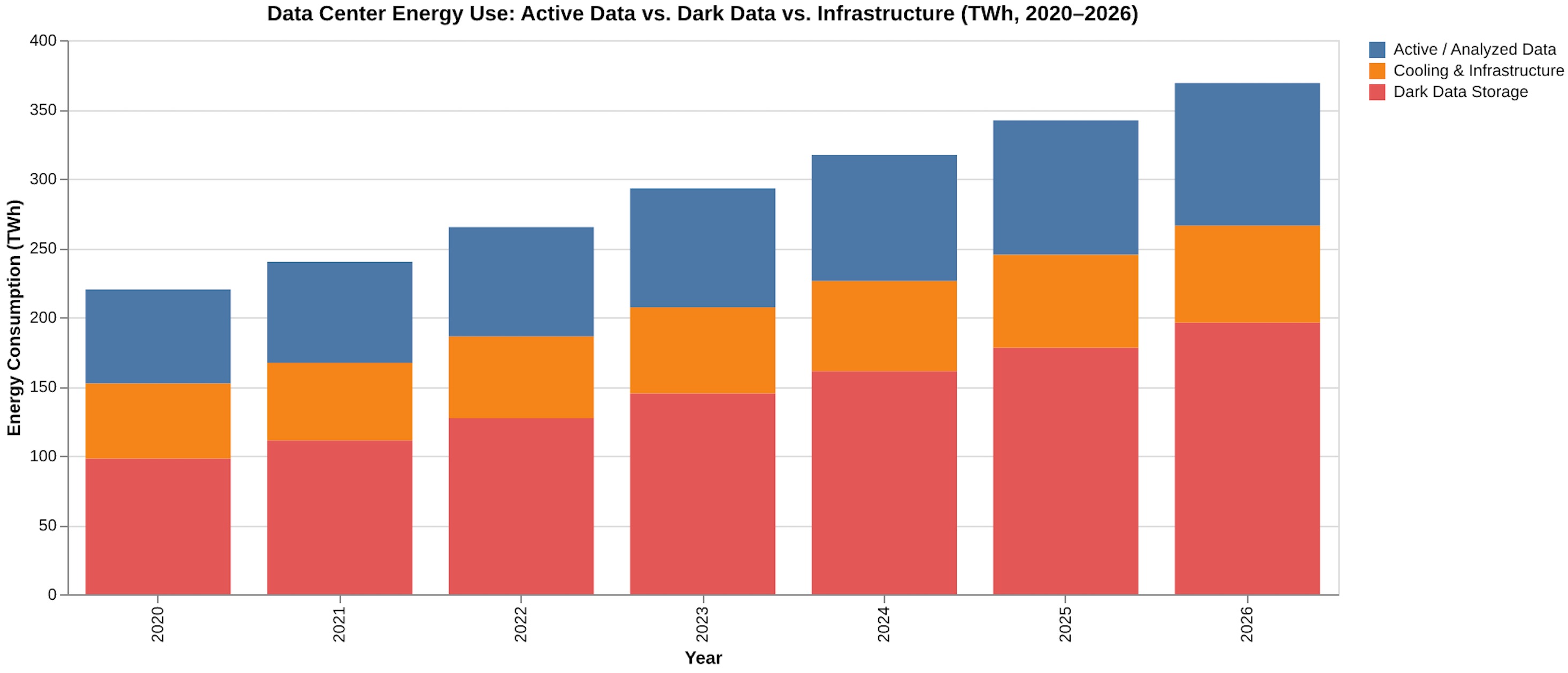
The energy footprint of global data centers has skyrocketed. In 2026, global data centers consumed an estimated 369 Terawatt-hours (TWh) of electricity—an amount roughly equivalent to the entire annual electricity consumption of a developed nation like France. As the chart demonstrates, dark data storage alone accounts for over half of this total energy consumption, completely dwarfing the power used by active, value-generating workloads.
What makes this trend particularly alarming is the trajectory. Dark data storage energy grew at a 12% Compound Annual Growth Rate (CAGR) from 2020 to 2026, compared with just 7% for active workloads. This accelerating divergence is fueled by the rapid adoption of AI-generated content, heavy IoT sensor deployments, and continuous video surveillance feeds. Without a lifecycle management policy in place, these automated systems operate like a firehose of digital waste, pumping endless streams of redundant data into repositories that require constant, fossil-fuel-intensive electricity to maintain. Consequently, dark data is now responsible for generating approximately 530 million metric tons of CO₂ equivalent annually.
Industry Breakdown: Who Is Most Responsible?
While every sector of the modern economy contributes to the dark data crisis, the burden is not shared equally. Different industries face unique operational, cultural, and regulatory pressures that dictate how they handle their digital footprints.
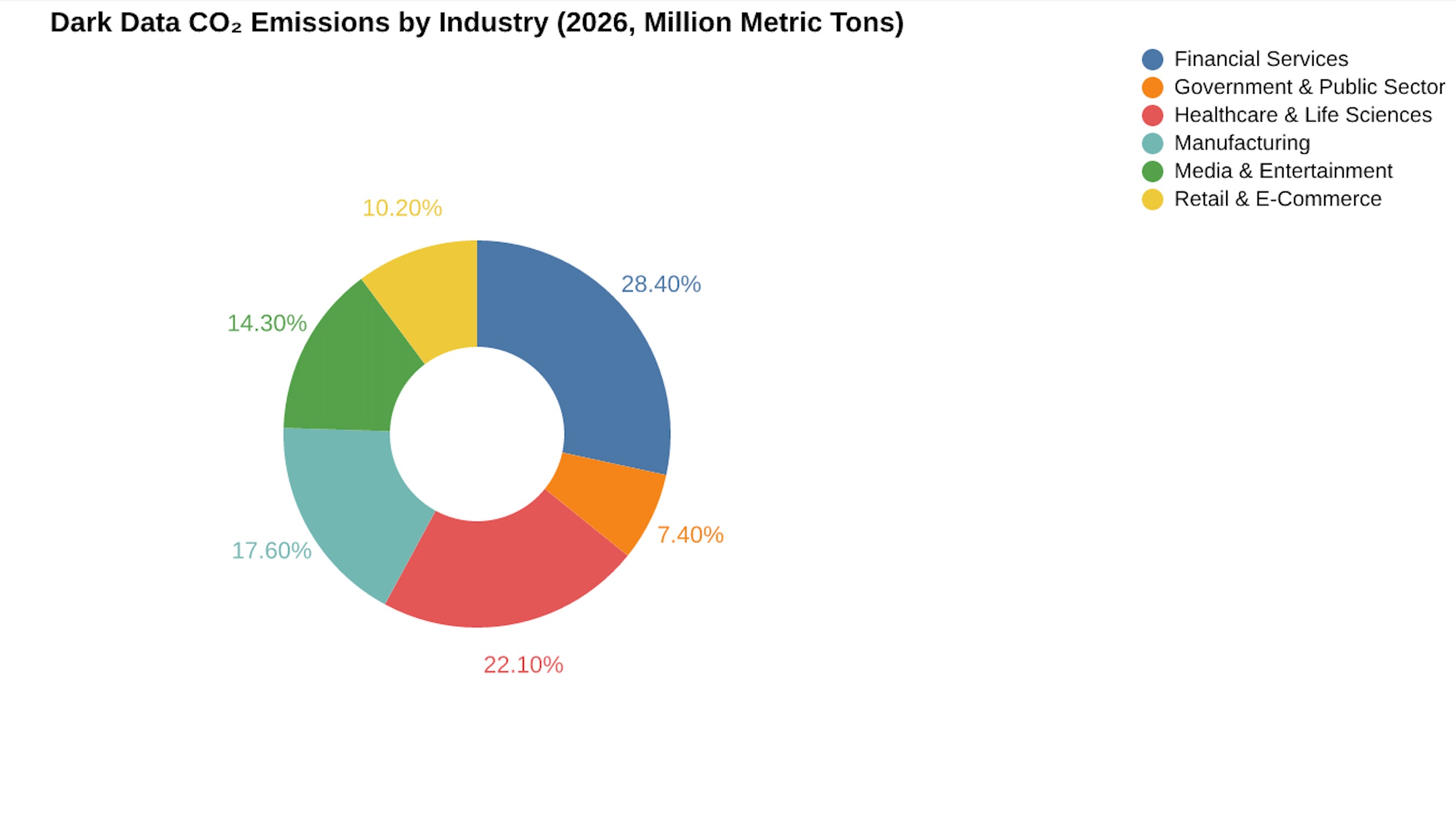
According to the 2026 industry breakdown, the Financial Services sector tops the list, accounting for 28.4% of total dark data emissions (28.4 million metric tons of CO₂e). This is heavily driven by stringent regulatory mandates from organizations like the SEC and FINRA, which essentially force banks, trading firms, and insurance companies to retain transaction records, complex audit trails, and internal communications indefinitely. The fear of regulatory non-compliance has bred a culture where deleting data is viewed as a higher risk than storing it forever.
Healthcare and Life Sciences follow closely behind, contributing 22.1% (22.1 million metric tons of CO₂e) to the crisis. Healthcare faces a severe, compounding problem. Regulatory frameworks like HIPAA mandate strict retention of patient records. However, the true culprits in this sector are clinical imaging files. High-resolution MRI, CT, and pathology scans are incredibly dense, massive files. Once a diagnosis is made, these massive files are rarely re-reviewed, yet they are kept on actively spinning, energy-intensive servers for decades.
Other major contributors include Manufacturing (17.6%), driven heavily by the industrial Internet of Things (IoT) and continuous factory floor sensor telemetry; Media & Entertainment (14.3%), driven by uncompressed video archives and redundant media assets; and Retail & E-Commerce (10.2%), which hoards vast amounts of consumer behavioral data that quickly loses its predictive value.
The Multi-Trillion Dollar Financial Hemorrhage
If the environmental argument is not enough to force a paradigm shift in corporate boardrooms, the financial realities certainly will. The assumption that storage is "cheap" is a dangerously outdated fallacy when scaled to the Zettabyte level. The true cost of dark data extends far beyond the raw monthly bills from cloud providers like AWS, Google Cloud, or Microsoft Azure.
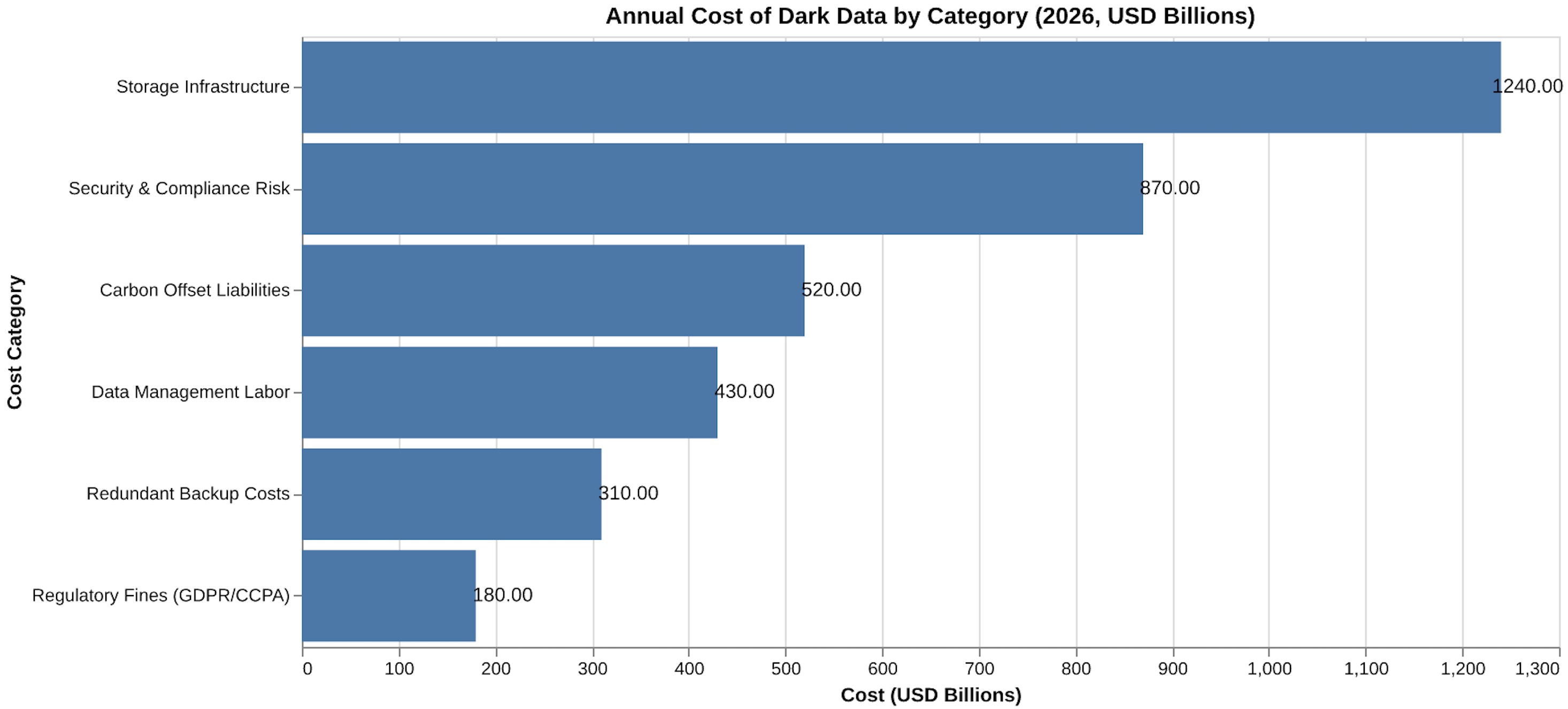
In 2026, the annual global cost of dark data reached a staggering $3.55 trillion. As the financial breakdown chart illustrates, raw Storage Infrastructure is indeed the largest single line item at $1.24 trillion. However, it is the secondary costs that are expanding most rapidly and catching CFOs off guard.
Security & Compliance Risk costs enterprises $870 billion annually. Dark data represents a massive, unmonitored attack surface. You cannot protect what you do not know you have. Forgotten databases containing legacy Personally Identifiable Information (PII) are prime targets for ransomware and data breaches, leading to catastrophic reputational damage and regulatory fines. Speaking of regulations, GDPR and CCPA fines account for an additional $180 billion.
Perhaps the most critical development for 2026 is the explosion of Carbon Offset Liabilities, now costing corporations $520 billion annually. As governments worldwide crack down on corporate emissions, the financial penalties for running dirty data centers are skyrocketing. The EU’s Carbon Border Adjustment Mechanism (CBAM) is expanding its scope to include data infrastructure by 2027, and the SEC's climate disclosure rules are tightening. The financial cost of storing unused data is no longer just an IT budget issue; it is a direct threat to corporate profitability and shareholder value.
Analysis of Future Actions: The Path to Net-Zero Dark Data
We are currently standing at a critical juncture. Dark data is not merely a theoretical future risk; it is an active, compounding liability that damages both the planet and the corporate bottom line. The window for low-cost remediation is rapidly closing as storage volumes grow exponentially and carbon pricing regimes expand globally. Achieving "Net-Zero Dark Data" is entirely possible, but it requires immediate, strategic, and technological interventions.
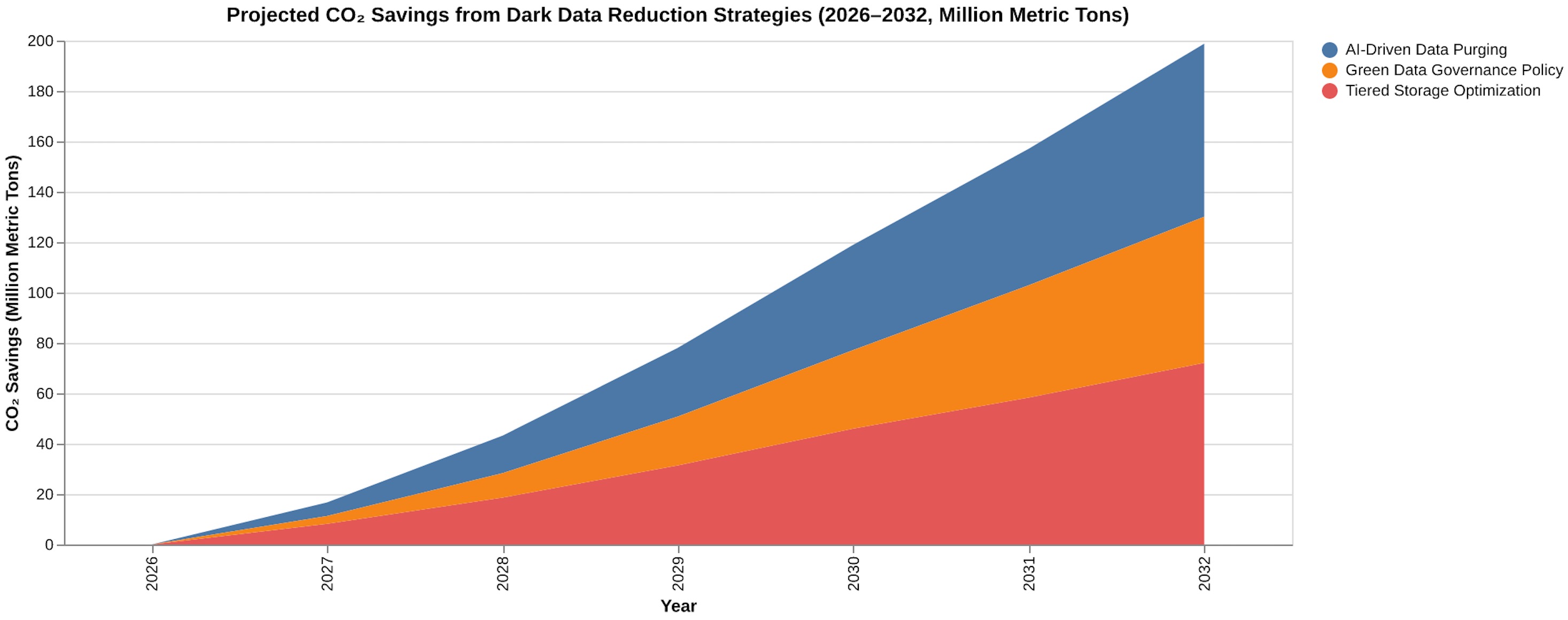
Looking ahead, the path to sustainability relies on three broad intervention categories: Tiered storage optimization, AI-driven data purging, and Green data governance policy. As projected in the chart above, each of these strategies shows compounding CO₂ savings over the next six years. However, none is a silver bullet on its own; the greatest and most sustainable reductions will come from combining all three methodologies into a holistic, executive-led mandate.
What Enterprises Must Do Now:
1. Conduct a Comprehensive Dark Data Audit
The first step toward the future is gaining visibility. Organizations must map their entire data estate to identify what is being stored, when it was last accessed, who owns it, and what regulatory classification it carries. Historical audits consistently reveal that over 60% of all stored enterprise data has zero business justification for retention. You cannot manage a problem you haven't quantified.
2. Implement Automated Data Lifecycle Management
Manual governance is entirely useless at the petabyte scale. Enterprises must transition to fully automated policy engines. These systems track the age, access frequency, and regulatory requirements of files, automatically migrating, archiving, or permanently deleting data without requiring human intervention. By removing the human bottleneck, companies can enforce strict 90-day retention policies seamlessly.
3. Adopt Carbon-Aware Storage Architecture
Not all data can be deleted, but it certainly doesn't need to live on high-energy solid-state drives. The single fastest way to cut data center Scope 2 emissions in the short term is tiered storage optimization. Cold and dark data must be automatically migrated to low-power archival tiers, such as glacier-class cloud storage or modern LTO archival tape libraries. Tape storage requires zero electricity to maintain data once written, representing an immediate, massive carbon reduction.
4. Include Dark Data in ESG Reporting
Transparency breeds accountability. Forward-thinking companies must begin disclosing the carbon footprint of their data estates within their Scope 2 and Scope 3 emissions reporting. Elevating data storage to an Environmental, Social, and Governance (ESG) metric creates board-level visibility. It also preemptively aligns the organization with incoming, stringent SEC and European Union regulatory disclosure requirements, turning a compliance risk into a competitive sustainability advantage.
5. Design for Minimalism at Collection
The ultimate solution for the future is addressing the root cause: corporate hoarding. Organizations must adopt a "data minimization by default" principle in software and system design. Instead of vacuuming up every possible metric, systems should be engineered to collect only the data strictly necessary for immediate operational needs. Preventing dark data at the source before it is ever written to a disk is infinitely more efficient and up to 10 times cheaper than trying to remediate and delete it after accumulation.
Conclusion
The 2026 dark data crisis is a monumental challenge that intersects technology, environmental sustainability, and corporate finance. With 104 Zettabytes of unaccessed data silently burning through 369 Terawatt-hours of energy and generating 530 million metric tons of CO₂ annually, the "store everything" mentality is no longer viable. Enterprises must act immediately to audit their digital estates, leverage AI to purge redundant information, and transition to carbon-aware storage architectures. Ignorance is no longer an excuse. By acknowledging the heavy physical footprint of our invisible data, we can chart a sustainable path forward in the digital age.
Note: Once again, the foundational data, analytical models, and charts utilized throughout this deep-dive analysis were proudly powered by Powerdrill Bloom, demonstrating the platform's unparalleled capacity to illuminate the most pressing technological and environmental issues of our time.
Frequently Asked Questions (FAQ)
1. What is dark data?
Dark data is enterprise information collected, processed once, and stored indefinitely without ever being accessed or analyzed again.
2. Why does dark data harm the environment?
Storing unused data requires physical servers that run continuously, consuming massive amounts of electricity and requiring energy-intensive cooling.
3. Which industry generates the most dark data?
Financial services lead due to strict, indefinite regulatory retention mandates for transactions, communications, and complex internal audit trails.
4. How can AI help reduce dark data?
Machine learning algorithms can automatically scan vast archives to identify, classify, and safely delete obsolete, redundant, or trivial information.
5. What is data minimization?
It is a proactive design principle where organizations only collect and store data strictly necessary for their immediate operational needs.