Data Fact: 40% of Large Enterprises scale agentic AI, pivoting from "chatting on command" to "working on autopilot"
The enterprise AI landscape has officially crossed a critical threshold. To truly understand the magnitude of this shift, we turned to Powerdrill Bloom, a powerful AI-driven data intelligence tool, to analyze and visualize the latest 2026 market reports. The insights and charts it generated for us reveal a stunning reality. For the past two years, the corporate world was obsessed with generative AI copilots, tools that required a human in the loop at every single step. Today, the paradigm has shifted. We have entered the era of Agentic AI.
According to the data extracted by Powerdrill Bloom, 40% of large enterprises are now scaling agentic AI in production. This is no longer about "chatting on command." It is about systems "working on autopilot." Autonomous agents are now capable of planning multi-step workflows, reasoning over complex context, and executing tasks end-to-end.
The pivot is real, the growth is staggering, and the ROI is proven. Let’s dive into the data that defines this monumental shift.
The Evolution: From Chatbots to Autonomous Agents
To understand the magnitude of this 2026 milestone, we have to look at how rapidly enterprise AI has evolved. The journey represents not just a software upgrade, but a complete redefinition of how artificial intelligence integrates into our daily workflows.
2018–2022: Rule-Based Chatbots & RPA
Just a few years ago, the pinnacle of automation was Robotic Process Automation (RPA) and decision-tree chatbots. These systems were built to handle rigid, frequently asked questions and highly structured, repetitive tasks. They lacked deep contextual understanding. The moment a customer deviated from the script or a process encountered an edge case, the system escalated to a human.
2023–2024: Generative AI Copilots
The release of advanced LLMs brought us the Copilot era. Tools like ChatGPT, Microsoft Copilot, and Google Gemini became ubiquitous. They could generate sophisticated text, analyze documents, and write code snippets. However, they were still "chatting on command." They required constant human orchestration. Adoption was incredibly broad, but in terms of workflow integration, it remained shallow.
2025–2026: Agentic AI — "Working on Autopilot"
Welcome to the present. Today's AI agents act rather than just assist. They decompose high-level business goals into actionable subtasks. They invoke APIs, query databases, execute code, evaluate intermediate results, self-correct, and maintain working memory across long-running processes. They only escalate to human operators when encountering genuine ambiguity.
Platforms like Salesforce Agentforce, Microsoft Copilot Studio, Google Vertex AI Agents, and AWS Bedrock Agents have matured into robust, enterprise-grade orchestration layers. We are now seeing the dawn of multi-agent collaboration, where specialized AI agents form "swarms" to tackle complex, departmental-scale problems.
A Surging Market Through 2026
The financial metrics behind this transition are astounding. The global AI market has expanded from $150 billion in 2023 to an estimated $410 billion in 2026—a 2.7× expansion in just three years.
But if we look closer at the segments, Agentic AI is the undisputed breakout star.
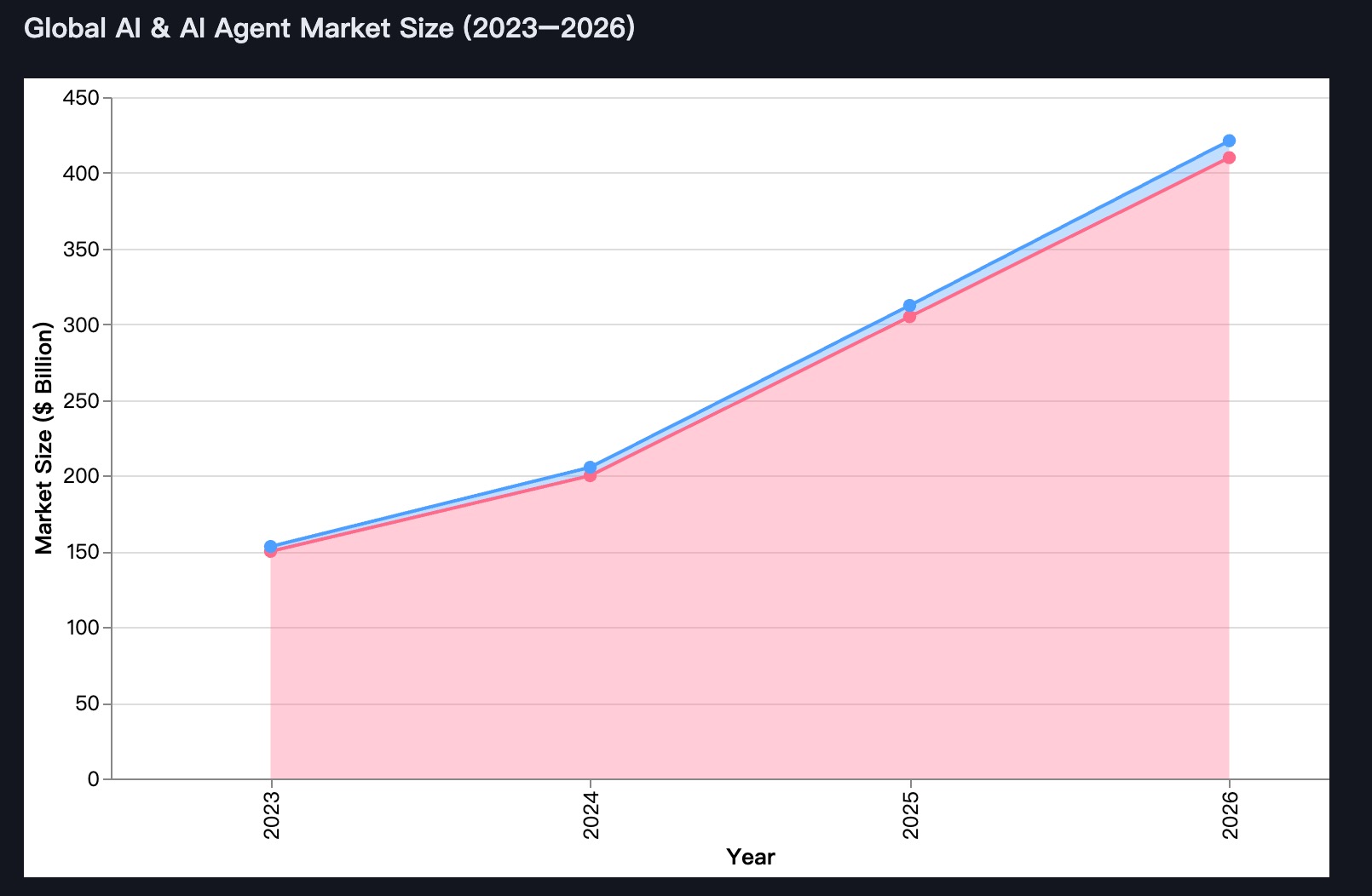
The AI agent vertical has expanded from a mere $3.2 billion to $11.2 billion over the same period, representing a massive 3.5× increase. Even more telling is how enterprises are reallocating their budgets.
In 2024, IT budgets were heavily skewed toward foundation model licenses and raw GPU infrastructure. In 2026, enterprises are allocating 28–35% of their total IT budgets to AI initiatives, and the focus has decisively shifted toward agent orchestration platforms and multi-agent systems.
Total global spending on agentic AI infrastructure has hit a staggering $65 billion this year. Major research firms—from Grand View to MarketsandMarkets—now project the AI agent market to reach between $40 billion and $53 billion by 2030, driven by a blistering consensus CAGR of 42–48%.
Where Agents Work: The Two-Year Adoption Surge
In 2024, agentic AI was largely experimental. Adoption sat in the single digits across most business functions. Fast forward to mid-2026, and agentic AI has firmly established itself as a mainstream operational pillar.
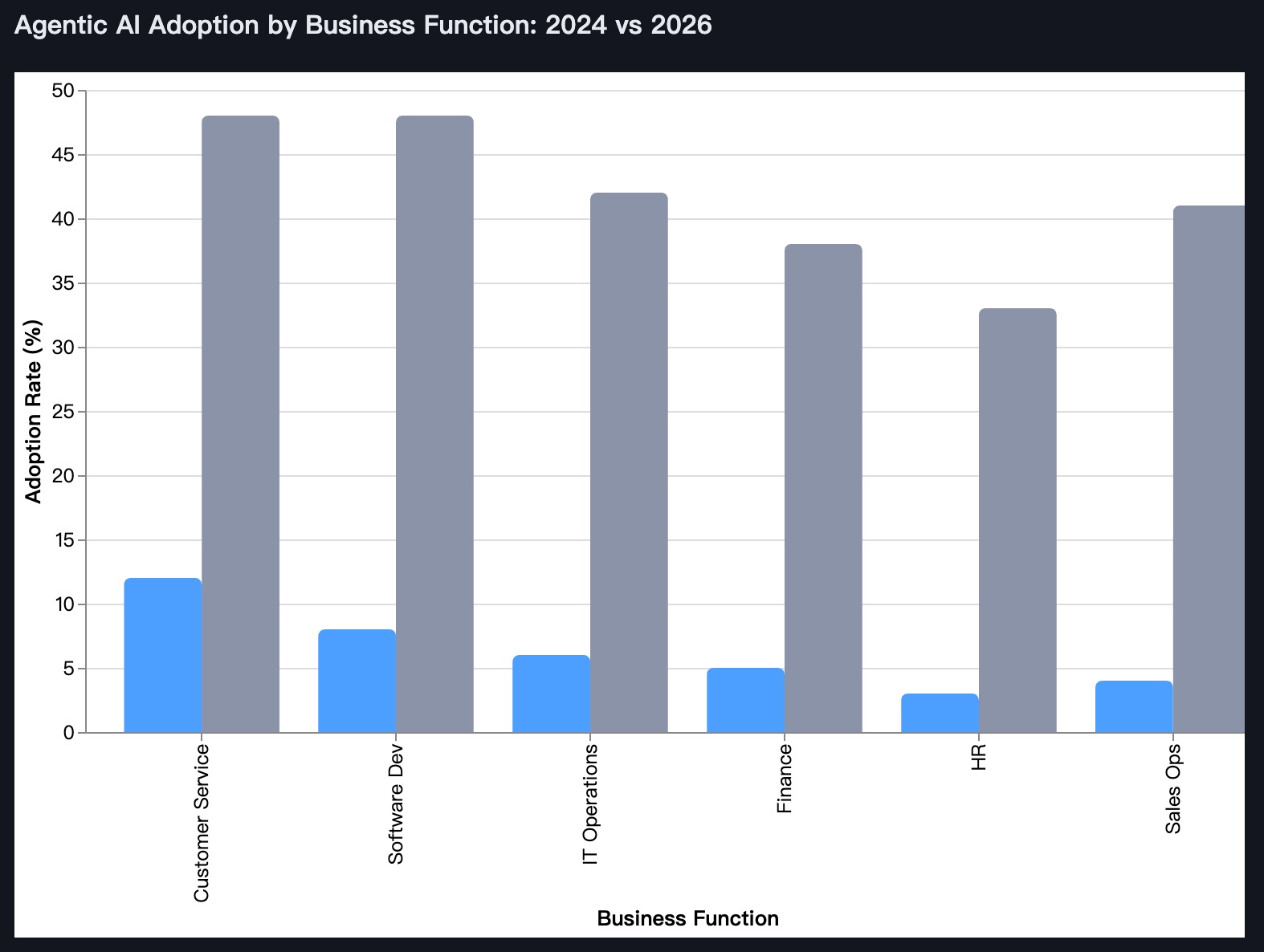
Nowhere is this transformation more evident than in Software Development. In just two years, adoption skyrocketed from 8% to 48%—a 6× increase.
This explosion was driven by the evolution of coding assistants into autonomous engineering agents. Tools like GitHub Copilot Workspace, Cursor, and Devin no longer just autocomplete lines of code. They can take a GitHub issue, plan a software architecture, write the code across multiple files, run tests, debug errors, and submit a pull request—all autonomously.
Customer Service (48%) has seen an equally dramatic shift. We have moved past chatbots that simply retrieve knowledge base articles. Today’s service agents can authenticate users, navigate legacy CRM systems, process refunds, and modify shipping routes without human intervention.
Sales Operations (41%) is another massive growth area. AI agents are now managing end-to-end customer lifecycles, autonomously qualifying leads, drafting hyper-personalized outreach campaigns based on real-time web scraping, and even updating CRM pipelines based on the sentiment of email replies.
Show Me the ROI: Quantified Business Impact
For a technology to command $65 billion in infrastructure spending, the ROI case must move from projected to proven. In 2026, the data confirms that agentic AI is delivering unprecedented value.
Early adopters are reporting first-year ROIs ranging from 200% to 500%, according to MarketsandMarkets. Forrester estimates that AI agents are now driving $45 billion in measurable enterprise value annually.
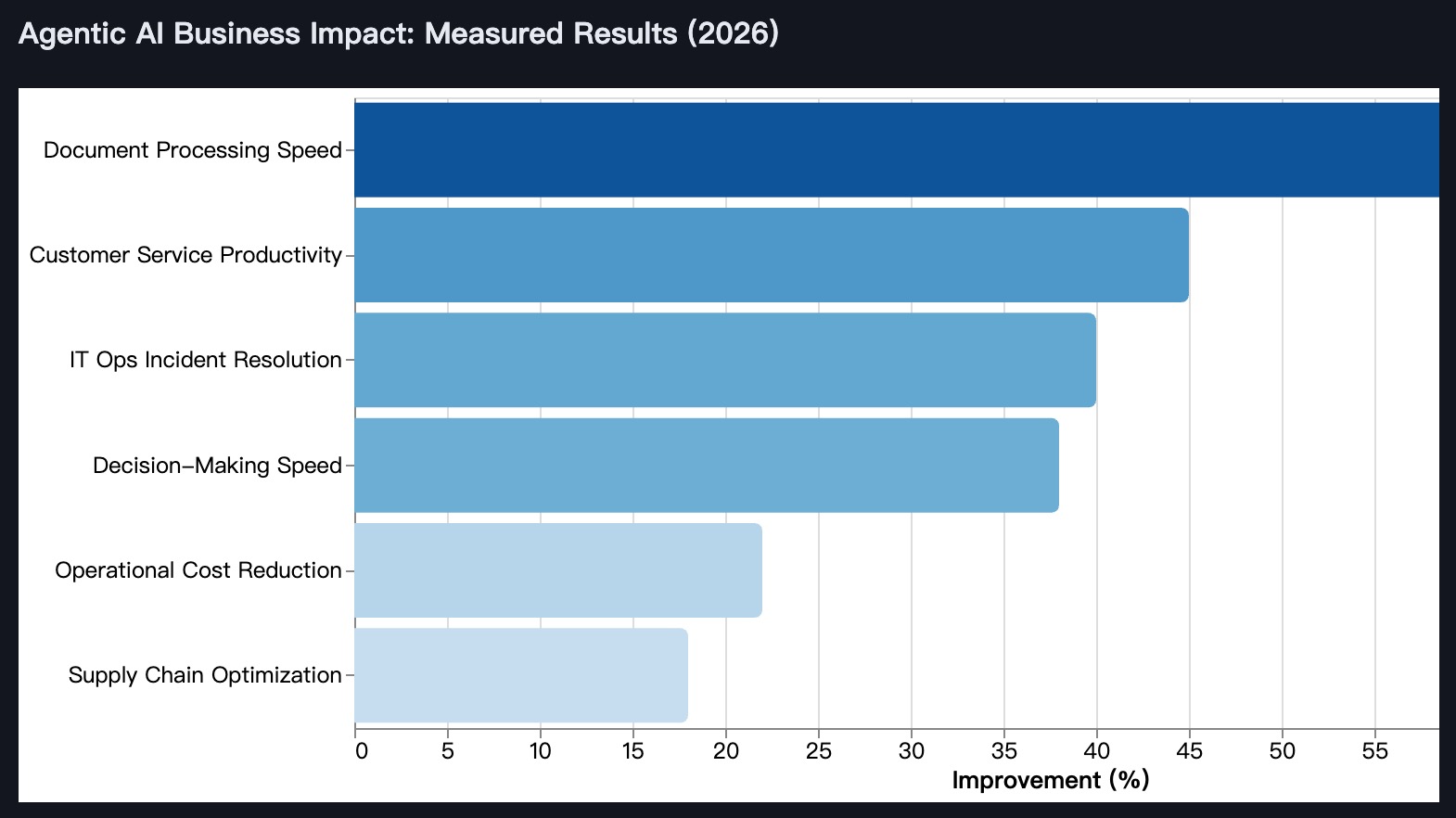
When we break down the performance metrics by function, the operational gains are undeniable.
In Document Processing, organizations are seeing a 65% improvement in speed. Agents can autonomously ingest massive volumes of unstructured data—such as legal contracts or unstructured invoices—extract the necessary entities, cross-reference them with compliance databases, and input the refined data into ERP systems.
In Customer Service, productivity has surged by 45%. Because agents handle the multi-step resolution of tier-1 and tier-2 tickets, human agents are freed up to handle complex relationship-building and high-empathy escalations.
IT Operations has experienced a 40% reduction in incident resolution time. When a server goes down, an AI agent can instantly pull logs, identify the anomaly, test potential fixes in a sandbox environment, and push a patch—often before human IT staff even log onto the dashboard.
Perhaps most critically, a 2025 BCG AI Radar survey of over 1,200 companies found that early adopters achieve 2–3× faster decision-making cycles. Agents are surfacing synthesized, actionable insights faster than humanly possible, directly cutting overall operational costs by 18–25%.
Industry Leaders: Who is Adopting the Fastest?
Agentic AI adoption is not happening uniformly across all sectors. Industry readiness, data maturity, and regulatory environments play massive roles in how quickly these autonomous systems can be deployed.
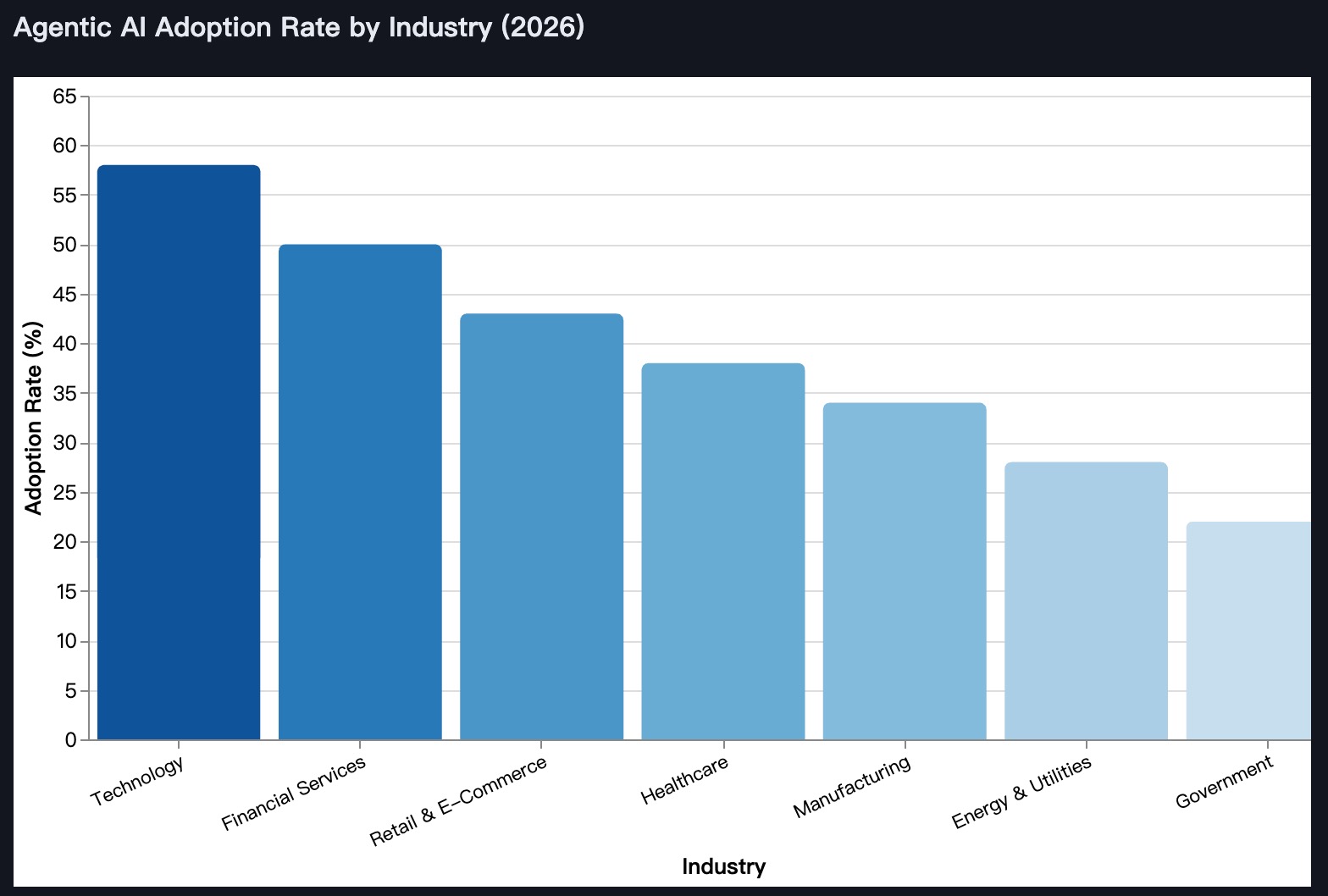
Technology (58%) and Financial Services (50%) are the undisputed leaders. These sectors possess highly mature digital workflows, structured data lakes, and a deep reliance on API-driven architectures—the exact environment where AI agents thrive. In finance, autonomous agents are conducting real-time fraud analysis, executing algorithmic trades based on unstructured news sentiment, and generating complex regulatory compliance reports.
Retail & E-Commerce (43%) is investing heavily to combat razor-thin margins. Agents are managing dynamic pricing models, executing autonomous supply chain optimizations, and delivering hyper-personalized shopping concierges that manage the entire buyer journey.
Healthcare (38%) is witnessing steady, accelerating growth. For a long time, the healthcare sector was hesitant due to strict privacy laws (like HIPAA) and fear of AI hallucinations. However, the maturation of specialized medical agents and the establishment of regulatory frameworks have provided clear deployment guidelines. Agents are now autonomously managing patient intake, optimizing scheduling, and assisting in preliminary diagnostic research.
Manufacturing (34%) relies on agents for predictive maintenance and automated quality control, while Government (22%) lags behind. Despite recognizing the value, public sector adoption remains constrained by lengthy procurement cycles, stringent security mandates, and bureaucratic friction.
The Readiness Gap: The New Bottleneck
Despite this immense momentum, scaling agentic AI is not without its challenges. In fact, a new bottleneck has emerged. While 60% of enterprises rank agentic AI as a top strategic priority for 2026, a Capgemini study reveals that only 28% feel fully prepared to scale these systems across their organizations.
We call this the "Readiness Gap."
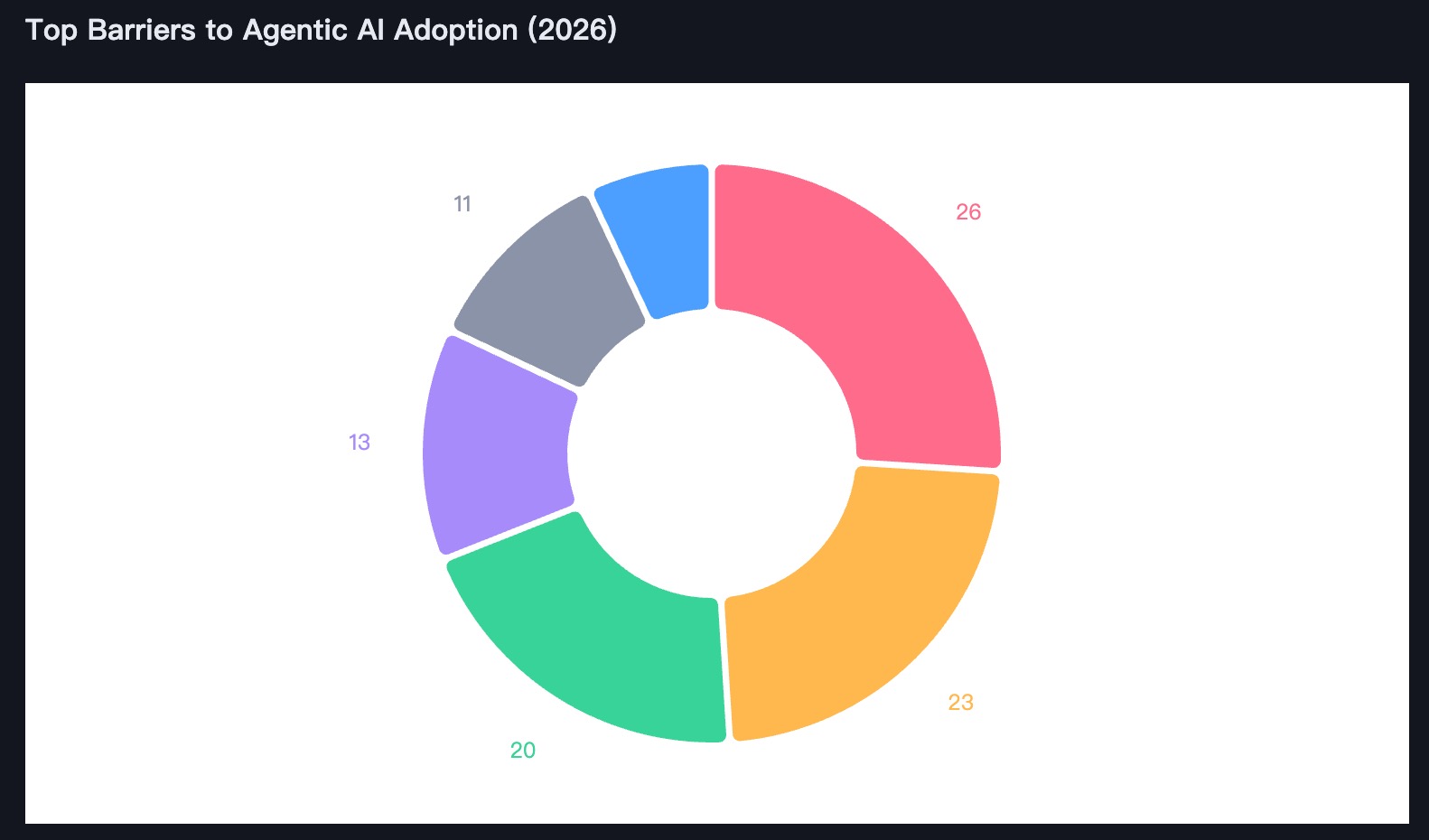
Data Governance, Compliance, and Security (26%) remains the most significant barrier. It is one thing to let an AI draft an email; it is entirely another to give an autonomous agent read/write access to a secure customer database. Enterprises are deeply concerned about agents accessing sensitive data, executing actions without human audit trails, and the potential for data leakage during external API invocations.
Integration Complexity (23%) is the second-largest hurdle. While modern SaaS applications have clean APIs, many large enterprises still run on legacy mainframes and fragmented on-premise systems. Building reliable bridges between modern AI orchestration layers and 20-year-old databases is highly complex. Testing and debugging multi-agent workflows in these environments requires specialized engineering talent that is currently in short supply (cited by 13% of enterprises as a barrier).
Interestingly, Scaling & ROI Challenges (20%) has emerged as a major friction point. Proving that an AI agent works in a controlled, localized pilot is relatively easy. Scaling that same agent across a global workforce, dealing with edge cases, managing agent hallucinations in production, and driving the necessary organizational change management is immensely difficult.
Outlook: The 2027–2030 Horizon
The trajectory from here is clear. With 40% of large enterprises already scaling agentic AI, we are heading toward ubiquitous mainstream deployment by 2028. Several converging forces will dictate the next phase of this technological revolution.
First, multi-agent systems will become the default. The frontier is no longer a single, monolithic agent trying to do everything. We are moving toward orchestrated swarms. You will have a "researcher agent" passing data to an "analyst agent," which then hands off to an "execution agent." By 2028, most enterprise AI architectures will look like digital organizational charts.
Second, agent platforms will mature. The engineering burden is dropping rapidly. As tools from Salesforce, Microsoft, Google, and AWS build out enterprise-grade guardrails, out-of-the-box observability, and automated testing frameworks, the barrier to deploying secure agents will plummet.
Third, vertical specialization will deepen. General-purpose models will take a back seat to purpose-built agents. We will see specialized agents for healthcare diagnostics, legal contract review, and financial compliance that vastly outperform generic models because they are fine-tuned on highly specific, regulated industry data.
Finally, governance frameworks are catching up. The enforcement of the EU AI Act in 2026, alongside standards like the NIST AI RMF, is actually a net positive for adoption. It removes the legal ambiguity. With clear rules of the road, risk-averse enterprises finally have the confidence to deploy autonomous agents in highly regulated environments.
The Bottom Line
By 2028, 33% of all enterprise software will include agentic AI, and 15% of everyday work decisions will be made autonomously. The question for executives is no longer whether to adopt agentic AI, but how fast.
The shift from "chatting on command" to "working on autopilot" is the most significant productivity unlock of the 21st century. The 40% of enterprises scaling these systems are pioneers defining the new operational patterns of the global economy.
Every piece of data, insight, and chart presented in this deep dive was seamlessly extracted and generated using Powerdrill Bloom. If your enterprise needs to instantly turn complex, fragmented market data into clear, actionable visual intelligence, Powerdrill Bloom is your ultimate autopilot.
Frequently Asked Questions (FAQ)
1. What exactly is agentic AI?
It is an autonomous AI system that plans, reasons, and executes multi-step workflows end-to-end without requiring constant human prompting.
2. What is the current AI agent market size?
As of 2026, the global AI agent market has surged to $11.2 billion, driven by massive enterprise infrastructure investments.
3. Which industry leads agentic AI adoption?
The technology sector leads with 58% adoption, closely followed by financial services at 50%, due to mature digital infrastructures.
4. What is the biggest barrier to scaling AI agents?
Data governance and security are the top barriers at 26%, as enterprises fear autonomous agents accessing highly sensitive information.
5. How did you generate the charts for this blog?
We used Powerdrill Bloom to seamlessly extract complex 2026 market data and automatically generate every chart featured in this article.